Strategy докупила 487 BTC «на дне» без продажи акций MSTR

cryptonews.ruPublished on 2025-11-23Last updated on 2025-11-23

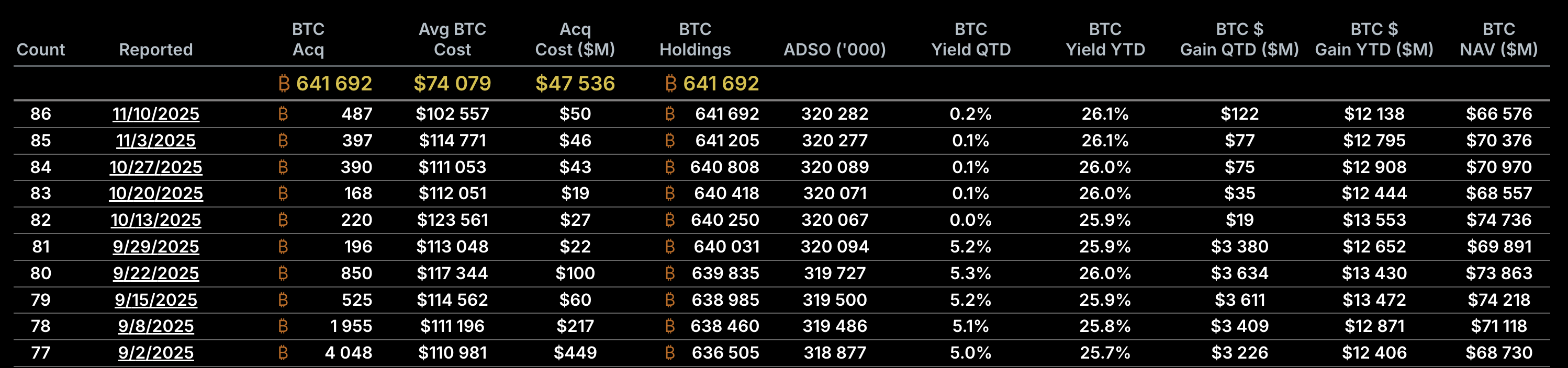
Криптоказначейская (DAT) компания Strategy объявила о покупке еще 487 BTC на сумму около $49,9 млн по средней цене $102 557 за монету. Об этом стало известно из соцсетей корпорации.

Это первая покупка в ноябре и продолжение серии закупок, начатой в 2020 году. С тех пор совокупный объем биткоинов (BTC) на балансе Strategy достиг 641 692 BTC, приобретенных в общей сложности за $47,54 млрд по средней цене $74 079.
Криптовалюты
График закупок биткоина. Источник: Strategy.

Закупка прошла на падении рынка. Кроме того, как отмечают пользователи и говорится в отчете компании, при финансировании сделки впервые не было продано ни одной акции MSTR.

За октябрь компания приобрела 1175 BTC, включая две одни из самых мелких закупок за год по 168 BTC и 196 BTC. При этом в первую неделю месяца Strategy делала перерыв и не отчитывалась о новых закупках.

Годовая доходность по биткоину (BTC Yield) компании на 2025 год достигла 26,1%.

Новые акции для финансирования покупок

7 ноября Strategy объявила о размещении бессрочных привилегированных акций серии A под тикером STRE. Ценные бумаги номинированы в евро и размещаются по цене €80 ($92,50) за акцию.

Компания рассчитывает получить чистую выручку около €608,8 млн ($704,5 млн). Первоначальный объем выпуска был увеличен с €350 млн до €620 млн, что отражено в обновленном проспекте.

В компании заявили, что привлеченные средства направят на финансирование новых закупок цифрового золота.

По теме: Роберт Кийосаки заявил, что ожидает биткоин по $250 000 и золото по $27 000

На пути к цифровому кредитованию

На прошлой неделе Глава Strategy Майкл Сэйлор также подтвердил намерение развивать компанию на основе цифрового кредита, используя накопленные активы как обеспечение.

«Каждый день мы спрашиваем себя, как создать лучшие кредитные инструменты, которые обеспечат наивысшие отложенные налоговые потоки и принесут максимальную выгоду инвесторам», — написал Сэйлор.

В рамках реализации плана компания планирует довести объем биткоин-резервов до $1 трлн.

Модель Strategy предполагает использование первой криптовалюты не только как резерва, но и как залога для выпуска новых долговых инструментов.

По теме: эксперт предсказал рост популярности стратегии «лонг по DAT, шорт по фьючерсу»

Эта статья не содержит инвестиционных советов или рекомендаций. Каждое инвестиционное и торговое решение связано с риском, читатели должны самостоятельно проводить исследование перед принятием решений.


Trending Cryptos

Related Reads

Conversation with Investor Zheng Di: MicroStrategy's Coin Sale Experiment, AI Economy, and Opportunities in US Stocks

Frontier tech investor Zheng "Didier" Di discusses the recent Bitcoin price drop, the financial strategy shift at MicroStrategy, the AI-driven surge in U.S. stocks, and the evolving role of crypto exchanges. Didier posits that the recent BTC decline stems less from macro factors or ETF outflows, and more from market repricing due to MicroStrategy's new financial structure. Following a wave of preferred stock and debt issuance (STRC, STRZ, etc.), MicroStrategy must now manage cash flow to pay dividends, potentially leading to a market expectation of sustained, small-scale BTC sales to maintain its "per-share bitcoin neutral" principle. Didier views this as a financial "experiment" testing market capacity for such recurring sell pressure, which, while creating near-term structural headwinds, likely avoids a true "death spiral" absent major new external shocks. Shifting to AI, Didier argues that tokens are becoming the new form of labor, with AI models and compute (tokenized inputs) increasingly replacing human roles in execution and middle-management. This drives enterprise efficiency and higher margins, fueling the sustained rally in U.S. semiconductor, data center, and infrastructure stocks. He foresees an emerging "machine economy" where automated agents transact and collaborate on-chain. Regarding crypto exchanges offering U.S. equities, Didier sees this as a natural evolution. With few crypto-native assets generating lasting value, exchanges are pivoting towards real-world assets (RWAs) like stocks and bonds. This doesn't necessarily cannibalize crypto but reflects a maturing industry focusing on blockchain's core utilities: decentralized choice and efficient settlement. He notes that trading logic for crypto natives doesn't need to drastically change, as meme-driven and fundamentalist strategies find analogs in U.S. markets. The "1011 event" (likely referring to a major market crash) severely damaged crypto market liquidity, marking a probable end to the altcoin speculative cycle, with capital flowing towards the deeper liquidity of U.S. markets. For the macro outlook, Didier is cautious about near-term market pressure from potential mega-IPOs (e.g., SpaceX) and the U.S. midterm elections, which could bring more regulatory scrutiny. Long-term, he remains bullish on AI's productivity gains and its convergence with blockchain/Web3, predicting a shift from speculative frenzy to a more institutionalized, industrial phase for the crypto sector.

marsbit10m ago

Conversation with Investor Zheng Di: MicroStrategy's Coin Sale Experiment, AI Economy, and Opportunities in US Stocks

marsbit10m ago

Playnance’s $GCOIN Lists on KoinBX Amid Rapid Growth in India

Playnance's native token, $GCOIN, has been listed on the cryptocurrency exchange KoinBX as of June 18. This move aims to enhance accessibility for its rapidly growing community, particularly in India, where the blockchain-powered Web3 iGaming ecosystem has gained significant traction. Over 130 partners in Playnance's "Be the Boss" program have built communities engaging thousands of active players in the region. The "Be the Boss" model allows participants to create and manage their own gaming communities, earning rewards tied to community activity. CEO Pini Peter noted India's high engagement, with community leaders successfully building player networks. One partner, Dr. Nicolas, reported earning over $57,000 through the program in recent months, highlighting both the financial rewards and the opportunity to grow an engaged community. $GCOIN serves as the ecosystem's core utility token, incentivizing participation and aligning the interests of players and community leaders ("Bosses"). The listing on KoinBX is part of Playnance's strategy to expand globally, increasing the token's utility and accessibility by combining community ownership, gamified engagement, and blockchain-based incentives. Founded in 2020, Playnance is a Web3 iGaming infrastructure company focused on creating live, non-custodial, on-chain products to onboard mainstream users. It currently processes approximately one million transactions daily, aiming to simplify the user experience while maintaining full on-chain transparency.

TheNewsCrypto50m ago

Playnance’s $GCOIN Lists on KoinBX Amid Rapid Growth in India

TheNewsCrypto50m ago

STRC Hits Historic Low, Saylor's Perpetual Motion Machine Grinds to a Halt

STRC, the perpetual preferred stock issued by MicroStrategy to fund its Bitcoin purchases, hit a historic low of $85.32, a 17% discount to its $100 par value. Designed as a "digital credit engine" to trade stably near par and enable continuous share issuance for buying Bitcoin, its plunge signals a breakdown in this model. Three key factors drove the decline: 1. Bitcoin's price fell over 50% from its peak, trading around $63,000 amid hawkish Fed signals. 2. MicroStrategy's cash reserves were depleted after a $1.5 billion convertible note repayment, slashing the dividend coverage for STRC's 11.5% yield to ~7 months. The company then sold 32 BTC to cover dividends—Michael Saylor's first Bitcoin sale since 2022—damaging the "never sell" narrative. 3. A competing Bitcoin-backed preferred stock, Strive's SATA, offers a higher yield (~13%) and daily dividends, drawing investors away from STRC. The drop triggers a negative cycle: STRC below par halts ATM share issuances, cutting off a key funding source for Bitcoin buys and potentially forcing more BTC sales for dividends, further eroding confidence. While Saylor argues the model is mathematically sound—needing only 2.3% annual Bitcoin growth to sustain itself—the market is testing the resilience of the leveraged Bitcoin treasury strategy in a bear market. The STRC price now reflects rising skepticism about this financial machinery's durability during downturns.

marsbit1h ago

STRC Hits Historic Low, Saylor's Perpetual Motion Machine Grinds to a Halt

marsbit1h ago

A Guide to Grayscale’s ‘Bottom Fishing’: Using Cash Flow to Assess Cryptocurrency Value

**Title:** Grayscale's Guide to Bottom-Fishing: Valuing Cryptoassets Using Cash Flows **Summary:** This report by Grayscale Research presents a fundamental valuation framework for cryptocurrency assets, moving beyond pure speculation to analyze those with underlying cash flows. It distinguishes between "commodity-like" assets (e.g., Bitcoin) and "cash-flow" assets, primarily within DeFi. Using the leading decentralized lending protocol Aave as a case study, the analysis applies traditional financial methodologies like Discounted Cash Flow (DCF) and Price-to-Earnings (P/E) multiples. Key findings indicate that AAVE tokens are currently undervalued. Despite recent challenges, the protocol's strong revenue growth, ~50% net profit margin, and diversified treasury support a fundamental valuation range of $80-$100 per token (compared to a ~$75 market price at the time of writing). In a base-case scenario driven by stablecoin adoption and regulatory clarity, the fair value could rise to around $175 within a year. The report emphasizes that protocol success does not automatically translate to token value. It critically examines the "value capture" mechanisms—such as buybacks, burns, and staking rewards—that channel protocol profits to token holders. Furthermore, it addresses the legal and governance complexities of Decentralized Autonomous Organizations (DAOs), noting their difference from traditional corporate equity but highlighting how robust, transparent governance can align protocol economics with holder interests. The conclusion is that the crypto market is maturing, with capital increasingly flowing towards projects with demonstrable fundamentals, real adoption, and disciplined capital allocation, creating opportunities for value-based investors.

marsbit2h ago

A Guide to Grayscale’s ‘Bottom Fishing’: Using Cash Flow to Assess Cryptocurrency Value

marsbit2h ago

Trading

Spot
Futures

Hot Articles

What is $BITCOIN

DIGITAL GOLD ($BITCOIN): A Comprehensive Analysis Introduction to DIGITAL GOLD ($BITCOIN) DIGITAL GOLD ($BITCOIN) is a blockchain-based project operating on the Solana network, which aims to combine the characteristics of traditional precious metals with the innovation of decentralized technologies. While it shares a name with Bitcoin, often referred to as “digital gold” due to its perception as a store of value, DIGITAL GOLD is a separate token designed to create a unique ecosystem within the Web3 landscape. Its goal is to position itself as a viable alternative digital asset, although specifics regarding its applications and functionalities are still developing. What is DIGITAL GOLD ($BITCOIN)? DIGITAL GOLD ($BITCOIN) is a cryptocurrency token explicitly designed for use on the Solana blockchain. In contrast to Bitcoin, which provides a widely recognized value storage role, this token appears to focus on broader applications and characteristics. Notable aspects include: Blockchain Infrastructure: The token is built on the Solana blockchain, known for its capacity to handle high-speed and low-cost transactions. Supply Dynamics: DIGITAL GOLD has a maximum supply capped at 100 quadrillion tokens (100P $BITCOIN), although details regarding its circulating supply are currently undisclosed. Utility: While precise functionalities are not explicitly outlined, there are indications that the token could be utilized for various applications, potentially involving decentralized applications (dApps) or asset tokenization strategies. Who is the Creator of DIGITAL GOLD ($BITCOIN)? At present, the identity of the creators and development team behind DIGITAL GOLD ($BITCOIN) remains unknown. This situation is typical among many innovative projects within the blockchain space, particularly those aligning with decentralized finance and meme coin phenomena. While such anonymity may foster a community-driven culture, it intensifies concerns about governance and accountability. Who are the Investors of DIGITAL GOLD ($BITCOIN)? The available information indicates that DIGITAL GOLD ($BITCOIN) does not have any known institutional backers or prominent venture capital investments. The project seems to operate on a peer-to-peer model focused on community support and adoption rather than traditional funding routes. Its activity and liquidity are primarily situated on decentralized exchanges (DEXs), such as PumpSwap, rather than established centralized trading platforms, further highlighting its grassroots approach. How DIGITAL GOLD ($BITCOIN) Works The operational mechanics of DIGITAL GOLD ($BITCOIN) can be elaborated on based on its blockchain design and network attributes: Consensus Mechanism: By leveraging Solana’s unique proof-of-history (PoH) combined with a proof-of-stake (PoS) model, the project ensures efficient transaction validation contributing to the network's high performance. Tokenomics: While specific deflationary mechanisms have not been extensively detailed, the vast maximum token supply implies that it may cater to microtransactions or niche use cases that are still to be defined. Interoperability: There exists the potential for integration with Solana’s broader ecosystem, including various decentralized finance (DeFi) platforms. However, the details regarding specific integrations remain unspecified. Timeline of Key Events Here is a timeline that highlights significant milestones concerning DIGITAL GOLD ($BITCOIN): 2023: The initial deployment of the token occurs on the Solana blockchain, marked by its contract address. 2024: DIGITAL GOLD gains visibility as it becomes available for trading on decentralized exchanges like PumpSwap, allowing users to trade it against SOL. 2025: The project witnesses sporadic trading activity and potential interest in community-led engagements, although no noteworthy partnerships or technical advancements have been documented as of yet. Critical Analysis Strengths Scalability: The underlying Solana infrastructure supports high transaction volumes, which could enhance the utility of $BITCOIN in various transaction scenarios. Accessibility: The potential low trading price per token could attract retail investors, facilitating wider participation due to fractional ownership opportunities. Risks Lack of Transparency: The absence of publicly known backers, developers, or an audit process may yield skepticism regarding the project's sustainability and trustworthiness. Market Volatility: The trading activity is heavily reliant on speculative behavior, which can result in significant price volatility and uncertainty for investors. Conclusion DIGITAL GOLD ($BITCOIN) emerges as an intriguing yet ambiguous project within the rapidly evolving Solana ecosystem. While it attempts to leverage the “digital gold” narrative, its departure from Bitcoin's established role as a store of value underscores the need for a clearer differentiation of its intended utility and governance structure. Future acceptance and adoption will likely depend on addressing the current opacity and defining its operational and economic strategies more explicitly. Note: This report encompasses synthesised information available as of October 2023, and developments may have transpired beyond the research period.

396 Total ViewsPublished 2025.05.13Updated 2025.05.13

What is $BITCOIN

Discussions

Welcome to the HTX Community. Here, you can stay informed about the latest platform developments and gain access to professional market insights. Users' opinions on the price of BTC (BTC) are presented below.

活动图片