Ancient Bitcoin Holders Stir: $52 Billion In Old Coins Revived This Year

bitcoinistPublished on 2025-11-08Last updated on 2025-11-08

Abstract

On-chain data shows a humongous amount of old Bitcoin saw revival in 2025. Here's how the year stacks up against...

Trusted Editorial content, reviewed by leading industry experts and seasoned editors. Ad Disclosure

On-chain data shows a humongous amount of old Bitcoin saw revival in 2025. Here’s how the year stacks up against previous ones.

5+ Year Old Bitcoin Revived Supply Broke $52 Billion This Year

As explained by on-chain analyst Checkmate in a new post on X, 2025 has seen a large amount of old tokens come back to life. Coins are considered to be “old” when they are dormant (that is, not involved in any transaction on the blockchain) for at least 5 years.

There are different bands these old tokens can be further divided into. The youngest band is the 5 to 7 years range, containing buyers from the last two BTC cycles who are resolute enough to still not have sold their coins.

The middle band corresponds to an age of 7 to 10 years old. At this range, there is a real chance that coins entering the cohort are doing so by becoming lost, rather than through “HODLing.” Finally, there is the 10+ years band, reflecting the truly ancient BTC supply.

In 2025 so far, the three cohorts have made movements worth (from youngest to oldest): $22.7 billion, $16.2 billion, and $13.3 billion. In total, over $52 billion in old supply broke dormancy this year. Below is the chart shared by Checkmate that shows how previous years compared.

Bitcoin Revived Supply

The data for the revived old BTC supply by year | Source: @_Checkmatey_ on X

As is visible in the graph, 2024 was the only year that surpassed this year in terms of total 5+ years old revived supply, although 2025 isn’t over yet so it may well surpass it by the end of December.

Interestingly, an old supply band that 2025 has already overtaken 2024 in this metric is the 10 years+ cohort. This means that this year Bitcoin saw the most amount of ancient supply come alive. The analyst has noted that $9.5 billion of these tokens have come from a single holder with 80,000 BTC.

In some other news, a large amount of liquidations have hit the cryptocurrency derivatives market as a result of the volatility that Bitcoin and others have gone through.

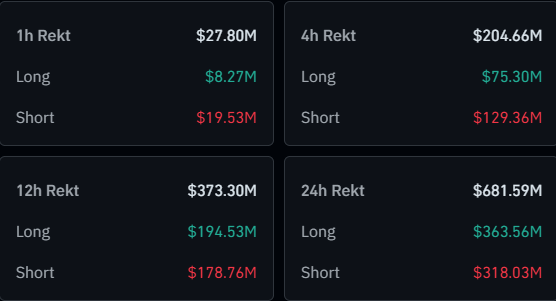
As data from CoinGlass shows, $686 million in liquidations have taken place over the last 24 hours.
Bitcoin Liquidations

Looks like liquidations have tended toward long contracts | Source: CoinGlass

Long contracts have outweighed short ones in liquidations in this period, as a result of volatility being to a net downside. More specifically, the bullish flush has amounted to $363 million, while the bearish one to $318 million.

Short liquidations have still been of a significant amount since down isn’t the only way the market has gone. Bitcoin initially fell below $100,000, before recovering back to the current level.
Bitcoin & Others

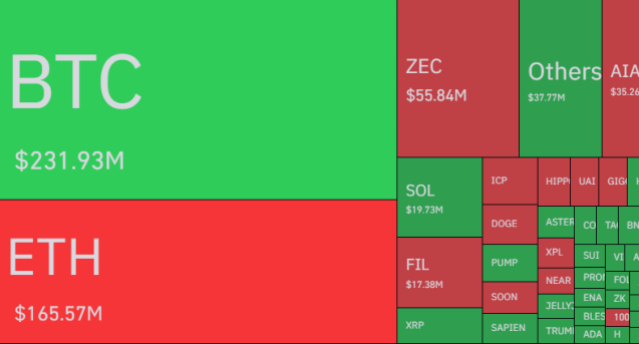
The breakdown of the liquidations by symbol | Source: CoinGlass

In terms of the individual assets, BTC-related contracts contributed the most toward the squeeze with $231 million in liquidations, while Ethereum came second at $165 million.

BTC Price

At the time of writing, Bitcoin is floating around $101,500, down nearly 8% in the last seven days.

Bitcoin Price Chart

The trend in the price of the coin over the last five days | Source: BTCUSDT on TradingView
Featured image from Dall-E, CoinGlass.com, checkonchain.com, chart from TradingView.com
Editorial Process for bitcoinist is centered on delivering thoroughly researched, accurate, and unbiased content. We uphold strict sourcing standards, and each page undergoes diligent review by our team of top technology experts and seasoned editors. This process ensures the integrity, relevance, and value of our content for our readers.

Keshav is a Physics graduate who has been employed as a writer with Bitcoinist since June 2021. He is passionate about writing and through the years, he has gained experience working in a variety of niches. Keshav holds an active interest in the cryptocurrency market, with on-chain analysis being an area he particularly likes to research and write about.

Trending Cryptos

Related Reads

HIVE Invests $185 Million in 2016 Blackwell Ultra GPUs to Achieve $200 Million Annual Revenue Target

HIVE Digital Technologies announced that its subsidiary BUZZ HPC has signed a five-year contract worth approximately $350 million with a high investment-grade company to provide cloud computing services using GPUs. The deal is expected to generate around $500,000 in daily revenue from high-performance computing once operational in Q4. This marks the second major GPU supply agreement since June. The contract will increase BUZZ HPC's annual revenue by about $70 million, bringing HIVE's total projected annual revenue to approximately $180 million. About $35 million is recognized immediately, with the remaining $145 million under contract to be deployed by the end of 2026. Under the agreement, BUZZ HPC will deploy a dedicated cluster of 2,016 NVIDIA Blackwell Ultra GPUs hosted in GB300 NVL72 racks, using Quantum-X800 InfiniBand networking and VAST Data storage. The cluster, based on an NVIDIA reference architecture, will be located at Bell AI Fabric's site in Merritt, British Columbia, powered by renewable hydroelectricity. HIVE estimates the capital expenditure for the cluster and related equipment at around $185 million. Funding will come from an upfront client payment, proceeds from a future convertible note issuance, and equipment financing. After the contract term, HIVE will retain ownership of the infrastructure. This move is part of HIVE's strategy to reach a $200 million annual revenue target from its GPU cloud business. Other mining companies like IREN, Hut 8, and TeraWulf have also recently announced major AI/cloud deals.

cryptonews.ru6m ago

HIVE Invests $185 Million in 2016 Blackwell Ultra GPUs to Achieve $200 Million Annual Revenue Target

cryptonews.ru6m ago

The AI Boom Faces a Leverage Problem After a Fund with 67% AI Investments Crashes

Situational Awareness AI, a hedge fund founded by a former OpenAI researcher and led by Leopold Aschenbrenner, lost approximately 67% of its value in July 2026. The fund, which had generated a 439% return using roughly 4x leverage on concentrated bets in AI infrastructure and chip stocks, faced margin calls from major brokers as its positions fell 35-47%. Unable to meet the calls, the fund was forced to liquidate its entire public stock portfolio. The collapse highlights the risks of excessive leverage in volatile tech sectors, even when underlying investment theses—like strong demand for AI memory chips from companies like Micron—prove correct. Notably, the fund continues operating, having recently invested $400 million in a chip manufacturing startup. Global regulators, including the Bank of England, had warned of rising leverage in stock markets, particularly around highly valued AI companies, drawing parallels to past blow-ups like Archegos. While AI investment momentum remains strong, with trillions projected for infrastructure, the incident raises questions about how markets will manage risk. Institutional investors may shift toward longer-term, less leveraged structures, as seen in record fundraising for real assets like data centers in 2025. The key uncertainty is whether patient capital or highly leveraged holders will dominate during the next market downturn.

cryptonews.ru6m ago

The AI Boom Faces a Leverage Problem After a Fund with 67% AI Investments Crashes

cryptonews.ru6m ago

Trading

Spot

Hot Articles

What is $BITCOIN

DIGITAL GOLD ($BITCOIN): A Comprehensive Analysis Introduction to DIGITAL GOLD ($BITCOIN) DIGITAL GOLD ($BITCOIN) is a blockchain-based project operating on the Solana network, which aims to combine the characteristics of traditional precious metals with the innovation of decentralized technologies. While it shares a name with Bitcoin, often referred to as “digital gold” due to its perception as a store of value, DIGITAL GOLD is a separate token designed to create a unique ecosystem within the Web3 landscape. Its goal is to position itself as a viable alternative digital asset, although specifics regarding its applications and functionalities are still developing. What is DIGITAL GOLD ($BITCOIN)? DIGITAL GOLD ($BITCOIN) is a cryptocurrency token explicitly designed for use on the Solana blockchain. In contrast to Bitcoin, which provides a widely recognized value storage role, this token appears to focus on broader applications and characteristics. Notable aspects include: Blockchain Infrastructure: The token is built on the Solana blockchain, known for its capacity to handle high-speed and low-cost transactions. Supply Dynamics: DIGITAL GOLD has a maximum supply capped at 100 quadrillion tokens (100P $BITCOIN), although details regarding its circulating supply are currently undisclosed. Utility: While precise functionalities are not explicitly outlined, there are indications that the token could be utilized for various applications, potentially involving decentralized applications (dApps) or asset tokenization strategies. Who is the Creator of DIGITAL GOLD ($BITCOIN)? At present, the identity of the creators and development team behind DIGITAL GOLD ($BITCOIN) remains unknown. This situation is typical among many innovative projects within the blockchain space, particularly those aligning with decentralized finance and meme coin phenomena. While such anonymity may foster a community-driven culture, it intensifies concerns about governance and accountability. Who are the Investors of DIGITAL GOLD ($BITCOIN)? The available information indicates that DIGITAL GOLD ($BITCOIN) does not have any known institutional backers or prominent venture capital investments. The project seems to operate on a peer-to-peer model focused on community support and adoption rather than traditional funding routes. Its activity and liquidity are primarily situated on decentralized exchanges (DEXs), such as PumpSwap, rather than established centralized trading platforms, further highlighting its grassroots approach. How DIGITAL GOLD ($BITCOIN) Works The operational mechanics of DIGITAL GOLD ($BITCOIN) can be elaborated on based on its blockchain design and network attributes: Consensus Mechanism: By leveraging Solana’s unique proof-of-history (PoH) combined with a proof-of-stake (PoS) model, the project ensures efficient transaction validation contributing to the network's high performance. Tokenomics: While specific deflationary mechanisms have not been extensively detailed, the vast maximum token supply implies that it may cater to microtransactions or niche use cases that are still to be defined. Interoperability: There exists the potential for integration with Solana’s broader ecosystem, including various decentralized finance (DeFi) platforms. However, the details regarding specific integrations remain unspecified. Timeline of Key Events Here is a timeline that highlights significant milestones concerning DIGITAL GOLD ($BITCOIN): 2023: The initial deployment of the token occurs on the Solana blockchain, marked by its contract address. 2024: DIGITAL GOLD gains visibility as it becomes available for trading on decentralized exchanges like PumpSwap, allowing users to trade it against SOL. 2025: The project witnesses sporadic trading activity and potential interest in community-led engagements, although no noteworthy partnerships or technical advancements have been documented as of yet. Critical Analysis Strengths Scalability: The underlying Solana infrastructure supports high transaction volumes, which could enhance the utility of $BITCOIN in various transaction scenarios. Accessibility: The potential low trading price per token could attract retail investors, facilitating wider participation due to fractional ownership opportunities. Risks Lack of Transparency: The absence of publicly known backers, developers, or an audit process may yield skepticism regarding the project's sustainability and trustworthiness. Market Volatility: The trading activity is heavily reliant on speculative behavior, which can result in significant price volatility and uncertainty for investors. Conclusion DIGITAL GOLD ($BITCOIN) emerges as an intriguing yet ambiguous project within the rapidly evolving Solana ecosystem. While it attempts to leverage the “digital gold” narrative, its departure from Bitcoin's established role as a store of value underscores the need for a clearer differentiation of its intended utility and governance structure. Future acceptance and adoption will likely depend on addressing the current opacity and defining its operational and economic strategies more explicitly. Note: This report encompasses synthesised information available as of October 2023, and developments may have transpired beyond the research period.

1.9k Total ViewsPublished 2025.05.13Updated 2025.05.13

What is $BITCOIN

Discussions

Welcome to the HTX Community. Here, you can stay informed about the latest platform developments and gain access to professional market insights. Users' opinions on the price of BTC (BTC) are presented below.

活动图片