$BTC Price Prediction After Crash to $105K: $HYPER Hits $25.7M

bitcoinistPublished on 2025-11-04Last updated on 2025-11-04

Abstract

Quick Facts: 1️⃣ Analysts see Bitcoin's 'Red October' as a healthy mid-cycle reset, not a bear market, setting the stage...

Trusted Editorial content, reviewed by leading industry experts and seasoned editors. Ad Disclosure

Quick Facts:

1️⃣ Analysts see Bitcoin’s ‘Red October’ as a healthy mid-cycle reset, not a bear market, setting the stage for a strong bullish rebound in November.

2️⃣ With historical data showing a 47% average November return, experts maintain a $120,000 to $150,000 Bitcoin price target by the end of 2025.

3️⃣ Achieving high price targets and mass adoption requires scalable infrastructure, which Bitcoin Hyper ($HYPER) aims to deliver through its high-speed, utility-focused Bitcoin Layer 2 network.

After suffering its first negative October in six years, a period now dubbed ‘Red October,’ Bitcoin investors are naturally a little anxious. Is this the start of a deep bear market, or just a bump in the road?

According to market analysts, it’s firmly the latter. They view the recent downturn as a healthy mid-cycle reset that’s actually setting the stage for a major bullish run heading into November.

Right now, Bitcoin is trading around $104K after the wider crypto market dip. The sell-off was intense, triggering over $1.18B in leveraged long liquidations.
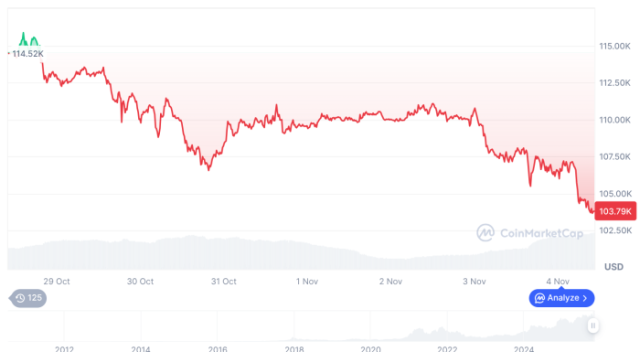
$BTC price chart showing the recent decline.

This volatility comes against a complex global backdrop: the Federal Reserve’s mixed signals on rate cuts are keeping risk assets like crypto under pressure. Even institutional players felt the chill, with US spot Bitcoin ETFs, like BlackRock’s IBIT, seeing significant daily outflows.

Despite the recent pain, experts are remarkably optimistic. Rachel Lin, CEO of SynFutures, in a conversation with Decrypt, suggests corrections like this are usually the ‘midpoint of a broader cycle rather than the end.’

History is on the bulls’ side, too. November has traditionally been a powerhouse month for Bitcoin, averaging a 47% return over the last twelve years, according to our calculations.

Year November Return (Approx.)
2013 +451.2%
2014 -12.7%
2015 +30.6%
2016 +28.5%
2017 +53.6%
2018 -37.2%
2019 -17.6%
2020 +43%
2021 -7%
2022 -16.2%
2023 +8.8%
2024 +41.6%
Average Return +47%

Lin expects things to stabilize early this month as the market digests the Fed’s commentary. But if Bitcoin keeps following its typical post-halving script, she maintains that a surge toward $150K by the end of 2025 is still very much in play.

Strong underlying demand from ETF flows and institutional interest suggests that, fundamentally, the bull market remains intact. So, while October was red, the feeling is that it was just a shakeout, paving the way for a much greener November and a powerful close to the year.

For a strong November to be a certainty, however, the entire ecosystem needs to evolve, demanding more powerful infrastructure to handle mass adoption and utility.

That essential upgrade is exactly what Bitcoin Hyper ($HYPER) aims to deliver: a game-changing Layer-2 network designed to unleash Bitcoin’s full potential in the modern crypto landscape.

Introducing Bitcoin Hyper ($HYPER): The Bitcoin Upgrade You’ve Been Waiting For

Let’s be honest: we all love Bitcoin for its security and trust, but using it can feel like driving a tank, slow, clunky, and way too expensive for a simple transaction. Bitcoin Hyper ($HYPER) is here to change that, acting as the ultimate accelerator for the world’s favorite crypto.

It’s the first true Bitcoin Layer 2 (L2) network built specifically to address those headaches. Its secret weapon is the Solana Virtual Machine (SVM). Think of it: the rock-solid security of Bitcoin combined with the lightning-fast performance of Solana!
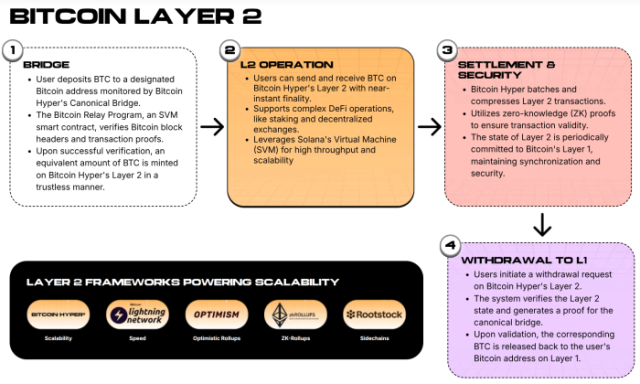
Layer 2 process explained in detail.

It’s about more than faster payments; it’s about unlocking the true potential of your $BTC. Suddenly, you can tap into staking rewards, DeFi apps, and the complex world of NFTs, all anchored to Bitcoin’s foundation.

Instead of just sitting in your wallet as a store of value, your Bitcoin can now become a vital part of the modern Web3 economy.

For a full breakdown of Bitcoin Hyper, we’ve got you covered in our ‘What is Bitcoin Hyper’ guide.

Turn Your Bitcoin Ambition into $HYPER Potential

If you believe $BTC is heading for the $150K mark, imagine the potential of a project that’s literally powering its next phase of utility. That’s the investment case for Bitcoin Hyper’s native $HYPER token.

It’s not a speculative coin; it’s the fuel for the whole Bitcoin Hyper L2 network. You use it to pay the lightning-cheap transaction fees and, crucially, to earn passive income.

The $HYPER presale has seen phenomenal momentum, raising over $25M, and proving the market is ready to turbocharge $BTC’s future. It’s captured the attention of retail investors and major crypto whales alike, with buys as large as $379.9K.
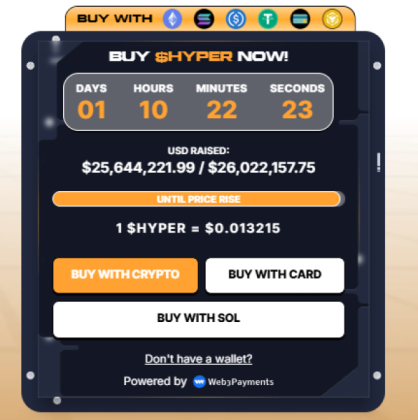
$HYPER presale widget showing the total amount raised.

Early buyers have the opportunity to participate in staking, which currently offers a dynamic APY of 46%, a serious way to make your investment work for you before the token even hits major exchanges.

This presale momentum, combined with the project’s foundational role in bringing modern utility to Bitcoin, has our analysts bullish, forecasting a $HYPER price of $0.32 by the end of 2025.

Remember, this is not intended as financial advice, and you should always do your own research before making any investments.

Authored by Ben Wallis, Bitcoinist – https://bitcoinist.com/feds-demand-5-years-for-samourai-wallet-founders-best-wallet-remains-private/

Editorial Process for bitcoinist is centered on delivering thoroughly researched, accurate, and unbiased content. We uphold strict sourcing standards, and each page undergoes diligent review by our team of top technology experts and seasoned editors. This process ensures the integrity, relevance, and value of our content for our readers.

Ben is a freelance writer specializing in crypto developments (mainly altcoins) and the intricate ways global economics shape the digital asset space. His B.Ed. in Education provides a unique foundation for his writing, enabling him to distill complex crypto concepts and market shifts into clear, digestible insights. This skill is key to helping readers adapt and apply their understanding to the ever-evolving world of crypto investment. Passionate about making crypto accessible, Ben crafts content designed to educate a broad audience, from current market events to the essential foundational knowledge that underpins them. His goal is to empower readers through understanding. When he’s not immersed in crypto analysis and breaking down complex topics, Ben is an avid Pokémon fan and enjoys all things Disney.

Trending Cryptos

Related Reads

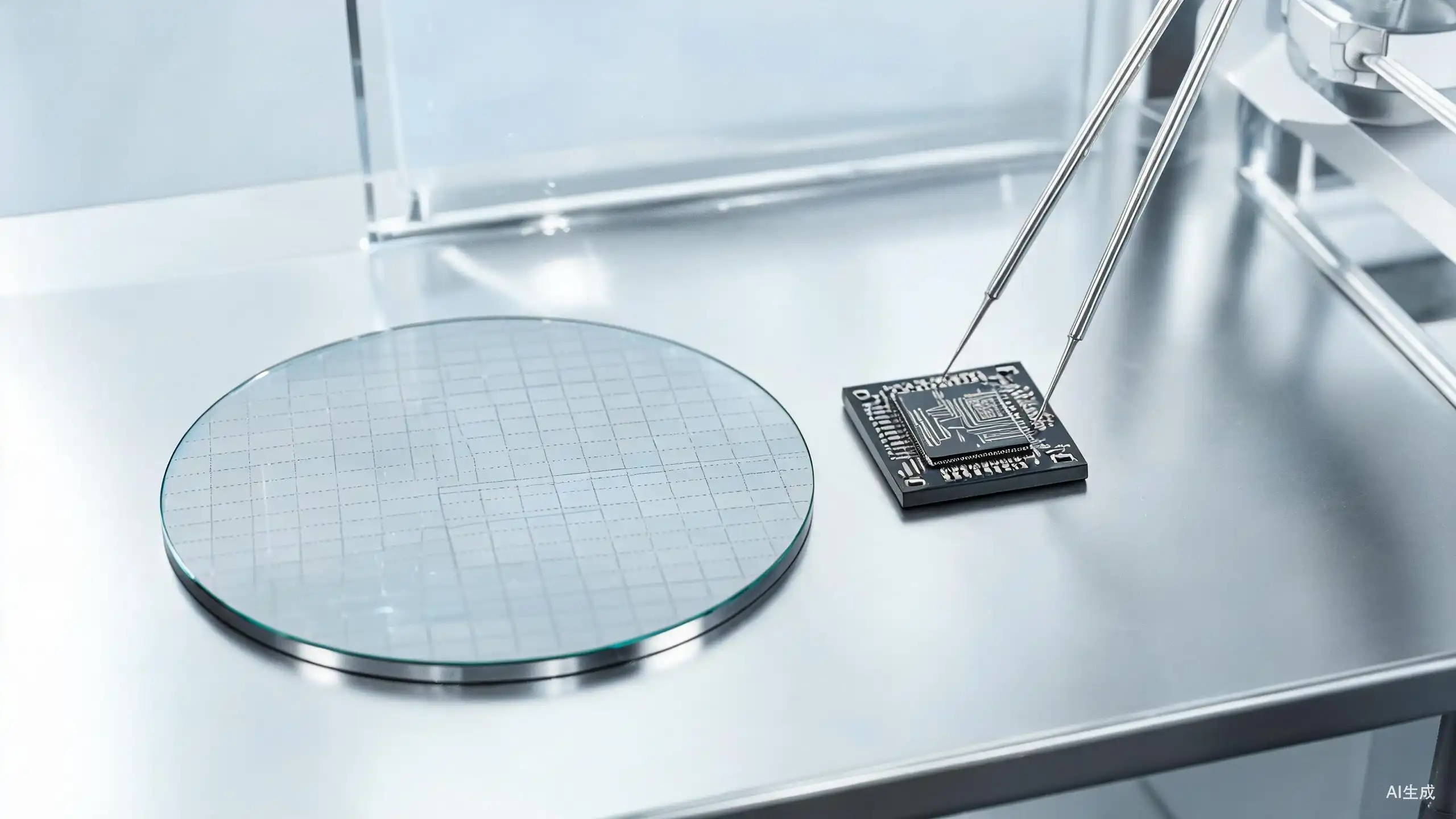
Domestic RF Filters, Finally Starting to Compete?

China's domestic filter industry, particularly in the challenging BAW (Bulk Acoustic Wave) segment, has reached a significant inflection point, moving from solving the "availability" problem to entering a phase of commercial competition and scale. The market is attractive, with the global mobile terminal RF filter market projected to reach $9.2 billion in 2025, and BAW filters showing strong growth. However, the sector is historically dominated by giants like Broadcom and Qorvo, protected by deep patent walls, as evidenced by lawsuits that have bankrupted competitors like Akoustis. Previously, high-frequency BAW filter production in China was nearly zero. Now, domestic players like Nous Micro, Wuhan Memsensing, Hansky, and others are forming a genuine industrial cluster, achieving mass production and shipping hundreds of millions of chips to clients. Different business models are emerging, including IDM and fab-lite approaches through partnerships with foundries like Sai Microelectronics and Runxin Sensing. A key signal of this new competitive phase is a patent lawsuit filed by Nous Micro against Wuhan Memsensing in June 2025, alleging infringement of a core BAW resonator patent. This conflict, rather than mere internal friction, underscores that the industry now has substantial products and market stakes to contest. The challenge is no longer just technical breakthrough but transforming technological leads into sustainable commercial success through superior patents, product performance, cost control, and customer acquisition. Chinese companies are finally positioned to compete for a share of this lucrative market long held by foreign leaders.

marsbit27m ago

Domestic RF Filters, Finally Starting to Compete?

marsbit27m ago

Zhang Lei: How He Became the Biggest Money-Maker This Year

Zhang Lei's company Pinzhun Laser (频准激光) became the biggest "meat sign" (highly profitable new share) of the year on its A-share market debut. Its stock price skyrocketed nearly 600% from its IPO price, generating potential single-lot profits of over 550,000 RMB for lucky subscribers. Founded by Zhang Lei, a 2014 Ph.D. graduate from the Shanghai Institute of Optics and Fine Mechanics, Pinzhun Laser specializes in ultra-stable, narrow-linewidth lasers critical for quantum computing. Its lasers are used by leading global research teams at Harvard, Caltech, and France's PASQAL. The company later successfully applied its core frequency conversion technology to the semiconductor sector, developing deep-ultraviolet lasers for advanced chip manufacturing and inspection. This move diversified its revenue, with semiconductor sales growing rapidly to account for over 25% of its business by 2025. The company boasts gross margins consistently above 69%. Remarkably, Pinzhun Laser required only two major external funding rounds before its IPO, a testament to its early profitability. Key strategic investors in its IPO included major downstream players like BOE,佰维存储 (BIWIN), and中微半导体 (AMEC), signaling strong industry validation. The article highlights the crucial early-stage support from Hangzhou-based capital, particularly funds associated with the Hangzhou Institute of Optics and Fine Mechanics. This "patient capital" model, part of Hangzhou's broader 300-billion-yuan industrial fund strategy, focuses on partnering with scientist-entrepreneurs through the risky valley of death from lab to market. The success of Pinzhun Laser and another Hangzhou-backed firm,宇树科技 (Unitree Robotics), showcases how this supportive ecosystem helps build leading hard-tech companies.

marsbit32m ago

Zhang Lei: How He Became the Biggest Money-Maker This Year

marsbit32m ago

3-Month Loss of $10 Billion, DAT Companies Begin to Return to Rationality

During the recent earnings season, major Digital Asset Treasury (DAT) companies reported staggering combined losses of approximately $10 billion for Q2 and over $30 billion for the first half, primarily due to markdowns on their bitcoin holdings. However, contrary to expectations, their stock prices have rebounded from June lows, indicating the market had already priced in these losses. The key shift is a collective return to rationality. Companies like Strategy, Sharplink, and Metaplanet are now prioritizing a new core metric: increasing the amount of crypto assets per share. This marks a departure from last year's aggressive growth-at-all-costs narrative. To achieve this, they are adopting disciplined capital allocation—issuing stock to buy crypto when trading at a premium, and halting dilution or initiating buybacks when at a discount. Some, like Strategy, have even broken "never sell" pledges to uphold this discipline. A major tool enabling this strategy is the STRC model—perpetual preferred shares offering high dividends (e.g., 12-13%) to raise fixed-income capital for purchasing bitcoin. Strive, Bitmine, and Metaplanet have launched their own variants. Sharplink pursues a different path, staking its vast Ethereum holdings to generate native yield. While the premium of DAT stocks over their underlying crypto asset value has declined and may not fully return, the model is evolving rather than ending. Stripped of hype, DAT firms are becoming actively managed, leveraged thematic funds. Their survival through massive losses and continued institutional investment (with major funds adding billions to positions during downturns) suggests the industry is maturing into a more calculated, long-term business focused on compounding crypto per share.

marsbit37m ago

3-Month Loss of $10 Billion, DAT Companies Begin to Return to Rationality

marsbit37m ago

PI Price Forecast Remains Stable at $0.086 as Pi Network Reforms App Economy

PI price forecast remains stable around $0.086 as it continues to trade below a key descending trendline from April. The token has been consolidating in a narrow range between $0.078 and $0.086 throughout August, with major EMAs positioned above the price indicating bearish pressure. Key resistance levels are identified at the 20-day EMA ($0.08772) and the SuperTrend indicators around $0.09-$0.10. Support sits at the current price and the August range low of $0.070. Fundamentally, Pi Network announced a major change to its App Studio pricing model, set for August 24, 2026. The fixed, subsidized rate of 0.25 Pi for app creation/editing will shift to a usage-based model reflecting actual AI service costs. Subsidized rates will remain for apps demonstrating genuine user adoption. Separately, the mandatory node protocol upgrade has reached version 26.1, with only version 27.1 remaining to complete the sequence. On-chain activity shows increased transaction volume, including patterns of repeated 0.03 Pi transfers, potentially related to testing following the protocol upgrade. The bullish scenario targets a break above the $0.08772-$0.09000 resistance cluster, opening a path toward the 50-day EMA at $0.09560. The bearish risk is a breakdown below the consolidation range, potentially testing the $0.070 support level. The conclusion notes that while fundamental developments are progressing, the price chart remains technically constrained until it can decisively break above the persistent downtrend line and key moving averages.

cryptonews.ru40m ago

PI Price Forecast Remains Stable at $0.086 as Pi Network Reforms App Economy

cryptonews.ru40m ago

Trading

Spot

Hot Articles

What is DOGE M

Doge Matrix ($doge m): The New Breed of Community-Driven Cryptocurrency Introduction In the ever-evolving landscape of cryptocurrency, new projects constantly emerge, each aiming to capture the interest of investors and enthusiasts alike. One of the latest entrants to this domain is Doge Matrix, represented by the ticker symbol $doge m. This project has attracted attention thanks to its roots in the popular meme culture surrounding Dogecoin, establishing its place within the web3 space. This article aims to provide a comprehensive analysis of Doge Matrix, covering its overview, creator, investors, functionality, timeline, and notable aspects. What is Doge Matrix ($doge m)? Doge Matrix is a community-driven cryptocurrency project that seemingly builds upon the widespread appeal of Dogecoin, a digital currency known for its Shiba Inu mascot and its meme origins. While the overarching objectives of Doge Matrix are not extensively defined, it is characterised by a commitment to harnessing community involvement and support. Unlike traditional cryptocurrencies that often emphasise utility or intrinsic value through underlying technologies, Doge Matrix positions itself within a space that embraces the cultural phenomenon of cryptocurrencies, particularly appealing to those who resonate with the ethos of meme-based assets. Drawing on the strengths of the Dogecoin community, Doge Matrix operates as part of a broader ecosystem, inviting participation and engagement from users who share an interest in cryptocurrency and the digital landscape. Who is the Creator of Doge Matrix ($doge m)? The identity of the creator of Doge Matrix remains unknown. This lack of transparency is not an uncommon occurrence in the cryptocurrency space, where some projects are launched without revealing the identities of their founders. The absence of information regarding the founding team can raise questions among potential investors about the project’s accountability and direction. Who are the Investors of Doge Matrix ($doge m)? As it stands, there is no publicly available information detailing the investors or investment foundations that back Doge Matrix. The project appears to rely primarily on community support rather than institutional investment. This model aligns with the community-driven nature of the initiative, fostering an environment where the direction of the project is shaped by its participants rather than being dictated by a select few financial backers. How Does Doge Matrix ($doge m) Work? The specifics regarding the operational mechanisms of Doge Matrix are somewhat vague, reflecting a broader trend of projects in the meme coin space where innovative functionalities are not always clearly articulated. Nonetheless, Doge Matrix seems designed to tap into the existing cryptocurrency ecosystem by encouraging user participation while tapping into the familiar cultural references associated with Dogecoin. Its potentially unique characteristics derive from community interactions rather than technological advancements, emphasising shared experiences and collaboration among token holders. While the exact innovations have not been explicitly outlined, the project appears to create a space where community members can engage, share ideas, and propel the project's potential forward. Timeline of Doge Matrix ($doge m) Reflecting on the project’s timeline reveals notable events that have defined its journey thus far: November 25, 2024: Doge Matrix reached its all-time high value, marking a significant milestone in its early history. January 1, 2025: Conversely, Doge Matrix hit its all-time low value, illustrating the volatility often associated with cryptocurrencies, especially in the early stages of a project's lifecycle. Ongoing: The project continues to be actively traded and supported by its community, although specific future milestones or objectives have yet to be disclosed. Key Points About Doge Matrix ($doge m) Community Focus At the heart of Doge Matrix is a commitment to community engagement. The project thrives on the premise of collaboration and shared objectives among its members, emphasising the importance of collective effort. Unlike centralised projects that often have a defined leadership structure, Doge Matrix at present showcases a more fluid approach to governance, where every community member's voice matters. Volatility The cryptocurrency market is notorious for its volatility, and Doge Matrix is no exception. Its price history reflects significant fluctuations between high and low values, which is typical of many new cryptocurrencies but underscores the risks associated with investment in emerging tokens. Lack of Detailed Information One of the most striking features about Doge Matrix is the scarcity of detailed information regarding its technological underpinnings and operational mechanisms. This ambiguity necessitates that potential investors conduct thorough due diligence before engaging with the project. Conclusion In summary, Doge Matrix ($doge m) illustrates a new wave of cryptocurrency projects that lean heavily on community engagement and cultural relevance. While lacking in certain specifics—such as clear leadership, defined objectives, and detailed functionality—the project has managed to generate interest within the crypto community, leveraging the established appeal of meme culture. As with any investment in the cryptocurrency space, understanding the inherent risks and conducting comprehensive research is essential for potential participants. Doge Matrix stands as a reminder of the dynamic, sometimes unpredictable nature of the crypto industry, marked by constant evolution and enthusiasm for community-driven initiatives.

666 Total ViewsPublished 2025.02.03Updated 2025.02.03

What is DOGE M

What is $M

Understanding Mantis ($M): A New Era in Cross-Chain Interoperability In the continually evolving landscape of Web3 and cryptocurrency, new projects strive to offer innovative solutions aimed at enhancing the user experience and expanding functional possibilities within the decentralised financial ecosystem. One such project garnering attention is Mantis ($M), a pioneering protocol founded on the principles of cross-chain interoperability and intent-based settlements. This article delves into the essential aspects of Mantis, including its core functionality, creators, investment backing, innovative features, and critical milestones. What is Mantis ($M)? Mantis is described as a multi-domain intent settlement protocol that simplifies cross-chain interactions, enabling users to execute complex financial transactions across various blockchain platforms seamlessly. The protocol operates through three primary layers: Intent Expression: Users can articulate their transaction goals using natural language facilitated by the DISE LLM, an advanced AI language model. For instance, a user might express a desire to swap Ethereum (ETH) for Solana (SOL) with a specific slippage tolerance of 1%. Execution: This layer employs a network of solvers that compete to fulfil user intents. Transactions are executed using mechanisms such as Coincidence of Wants (CoWs) and Order Flow Auctions (OFAs), which ensure that user demands are met optimally. Settlement: Leveraging the Inter-Blockchain Communication (IBC) protocol, Mantis enables atomic cross-chain transactions, allowing users to operate across various supported chains, including Ethereum, Solana, and Cosmos. Mantis is engineered to introduce native yield generation for idle assets, employing cryptographic proofs to maintain the integrity of transactions throughout the entire process. Creators & Development Team Mantis was conceived by the Composable Foundation, a research-driven organisation notable for its emphasis on blockchain interoperability solutions. This foundation collaborates with esteemed academic institutions, including Harvard University and the University of Lisbon, contributing to extensive research and development efforts that inform Mantis's architecture and functionality. The Composable Foundation’s commitment to fostering innovation in the blockchain space positions Mantis as a robust solution for the growing demand for interoperability among multiple blockchain networks. Investors & Backing While specific details about individual investors have not been publicly disclosed, Mantis enjoys substantial backing from various entities, including: Ecosystem grants from IBC-enabled chains, which support the protocol's growth and integration within decentralised finance ecosystems. Strategic partnerships with infrastructure providers that enhance Mantis's network capabilities and deployment strategies. Funding through the Composable Foundation's treasury, ensuring sustained financial support for ongoing development and operational costs. These collaborative efforts reflect a consensus among stakeholders about the importance of enhancing cross-chain functionality and the potential utility of Mantis's infrastructural innovations. Key Innovations Mantis sets itself apart through several pioneering innovations that enhance its functionality and utility: Chain-Agnostic Intents: Users can initiate transactions from any supported chain while settling on another. This flexibility empowers users, driving increased interaction among different platforms. AI-Powered Interface: The integration of DISE LLM allows users to conduct complex DeFi operations using natural language, thereby simplifying interactions and making blockchain technology accessible to a broader audience. Cross-Domain MEV Capture: Mantis creates an internal market for maximal extractable value (MEV) through competitions among solvers. This innovative approach allows for greater efficiency and value extraction in complex transactions. Modular Settlement Layer: The protocol supports various verification methods, including zero-knowledge proofs and optimistic rollups, providing a versatile framework that can adapt to emerging blockchain technologies. Historical Timeline Mantis's development is marked by several critical milestones that chart its trajectory and growth: | Year | Milestone | |————|————————————————————————-| | 2022 | Initial concept development within the Composable Foundation's research division. | | Q3 2024 | Launch of the testnet with bridging capabilities between Solana and Ethereum. | | Q1 2025 | Anticipated Token Generation Event (TGE) alongside the mainnet launch. | | Q2 2025 | Expected integration of DISE LLM and expansion of cross-chain capabilities. | | 2025 H2 | Planned support for over 15 chains through further IBC upgrades. | This timeline outlines Mantis's evolution, from conceptual discussions to active implementation and future growth phases. Ecosystem Growth Strategy Mantis's strategy for ecosystem growth includes several initiatives designed to encourage user participation and developer engagement: Credits System: Users can earn protocol credits by providing liquidity and engaging in referral programmes. These credits are redeemable for incentives in the future, fostering a robust user community. Modular Software Development Kit (SDK): This toolkit empowers developers to create applications based on intent-driven models utilising Mantis's infrastructure, thus promoting innovation within its ecosystem. Governance Model: As the protocol matures, $M token holders will have a voice in protocol governance, allowing them to vote on proposed upgrades and changes, thereby enhancing community engagement and decentralisation. Mantis represents a significant advancement in the realm of cross-chain architecture. By seamlessly integrating advanced AI algorithms with a robust settlement framework, Mantis seeks to tackle the problems of fragmentation within multi-chain ecosystems. Its innovative approach prioritises improved user experiences while adhering to the foundational principles of decentralisation and security, setting a new standard for the future interoperability of blockchain technologies. As Mantis continues its journey of growth and implementation, it promises to be a project to watch closely in the competitive landscape of Web3 and decentralised finance. With its focus on crossing boundaries and elevating user engagement, Mantis is poised to be an integral part of the future developments in the cryptocurrency space.

201 Total ViewsPublished 2025.03.18Updated 2025.03.18

What is $M

Discussions

Welcome to the HTX Community. Here, you can stay informed about the latest platform developments and gain access to professional market insights. Users' opinions on the price of M (M) are presented below.

活动图片