Ethereum Price Slips below $4,000 as Institutions Continue Accumulating Despite Market Pullback

bitcoinistPublished on 2025-10-31Last updated on 2025-10-31

Abstract

Ethereum (ETH) has fallen below the critical $4,000 level amid renewed market uncertainty following comments from Federal Reserve Chair Jerome...

Trusted Editorial content, reviewed by leading industry experts and seasoned editors. Ad Disclosure

Ethereum (ETH) has fallen below the critical $4,000 level amid renewed market uncertainty following comments from Federal Reserve Chair Jerome Powell.

Powell’s indication that the latest 25-basis-point rate cut may be the last of 2025 has fueled caution across both traditional and crypto markets. As a result, the Ethereum price is at slightly above $3,900, marking a 2.2% daily decline, with Bitcoin and other major altcoins also in the red.

The broader pullback saw Ethereum ETFs record $81.44 million in outflows, led by Fidelity’s FETH at $69.49 million. Only BlackRock’s ETHA fund showed resilience, posting $21.36 million in inflows. This shift follows two consecutive days of positive ETF activity, indicating profit-taking and reduced risk appetite among traders.
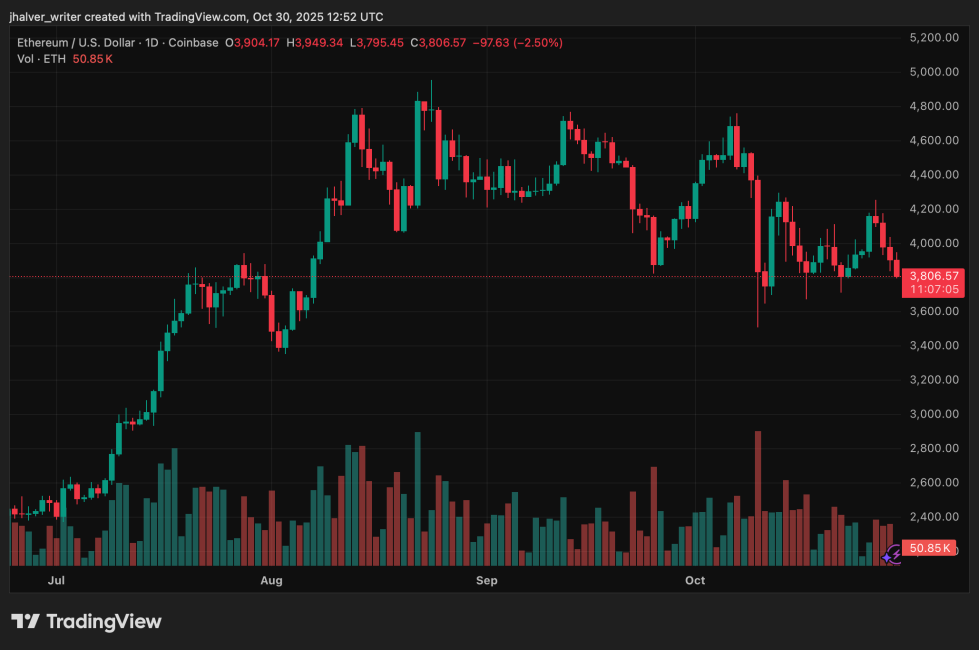
Ethereum price ETH ETHUSD

ETH's price trends to the downside on the daily chart. Source: ETHUSD on Tradingview

Institutional Demand Grows Even as the Ethereum Price Weakens

While the Ethereum price slipped, institutional accumulation has intensified. Data shows that institutions now hold 4.1% of Ethereum’s total supply, surpassing Bitcoin’s 3.6% for the first time. Analysts attribute this shift to the GENIUS Act, which provides a clear framework for stablecoin and on-chain finance regulation.

This policy clarity has boosted institutional trust in Ethereum as the backbone of DeFi and tokenized RWAs. Despite the current weakness, many funds continue to add exposure, anticipating Ethereum’s Web3 Dominance.

Technically, the Ethereum price shows mixed signals. RSI sits at 44, and the MACD line remains below the signal line, both pointing to fading bullish momentum.

Analysts caution that if ETH fails to reclaim $4,000, it could revisit support zones around $3,850–$3,750. A decisive close above $4,100, however, may renew bullish sentiment toward $4,400–$4,500.

On-Chain Activity Reaches Record Highs Amid Low Fees

Interestingly, Ethereum’s network fundamentals remain robust even as price momentum cools. On-chain activity has surged to record highs, with daily transactions and unique active addresses breaking all-time records.

Similarly, gas fees remain near historic lows, signaling improved scalability driven by Layer-2 networks such as Arbitrum, Optimism, and Base.

This efficiency milestone showcases Ethereum’s technological evolution, from its proof-of-stake transition to the upcoming EIP-4844 (proto-danksharding) upgrade.

Analysts believe this combination of strong institutional demand and record network usage, despite short-term price pressure, positions the Ethereum price for a sustained recovery once macroeconomic headwinds ease.

Cover image from ChatGPT, ETHUSD chart from Tradingview

Editorial Process for bitcoinist is centered on delivering thoroughly researched, accurate, and unbiased content. We uphold strict sourcing standards, and each page undergoes diligent review by our team of top technology experts and seasoned editors. This process ensures the integrity, relevance, and value of our content for our readers.

Trending Cryptos

Related Reads

SEC Suddenly Proposes "Regulation Crypto": U.S. Token Fundraising May Become Legal Again

On August 18, the U.S. Securities and Exchange Commission (SEC) proposed a landmark set of permanent rules, "Regulation Crypto Assets," specifically designed for crypto asset investment contracts. The 402-page proposal introduces two registration exemption paths and a groundbreaking safe harbor mechanism, representing the SEC's first dedicated crypto-specific regulatory framework. Two exemption tiers are proposed: a "Startup Exemption" allowing a one-time raise of up to $5 million within four years with basic disclosure requirements, and a "Financing Exemption" permitting raises of up to $75 million every 12 months with stricter obligations, including financial statements and ongoing reporting. Both paths require "principles-based narrative disclosure," a flexible approach distinct from traditional IPO forms. The most transformative element is the investment contract safe harbor. It provides a legal path for tokens to "graduate" from being classified as securities. If an issuer completes or permanently ceases its "essential managerial efforts" as promised in the investment contract and meets specific conditions, it can file with the SEC to have the token exit the securities framework. This creates a novel legal lifecycle where a token can begin as a regulated security for fundraising and later become a non-security asset as the network decentralizes. This move is seen as the SEC pragmatically filling a legislative vacuum, as the stalled CLARITY Act in Congress faces significant delays. The proposal aims to offer a compliant pathway for token offerings within the U.S., countering the trend of projects moving overseas. While currently a proposal open for a 60-day public comment period, it signals a major potential shift from an enforcement-heavy approach toward establishing clearer rules for the crypto industry.

marsbit7m ago

SEC Suddenly Proposes "Regulation Crypto": U.S. Token Fundraising May Become Legal Again

marsbit7m ago

Late Qing County Magistrates' 'Official Debt' and the Crypto World's 'Exchange Listings': The Cross-Temporal Truth of Financializing Power

This article draws parallels between financialization of power in late Qing Dynasty China and the modern cryptocurrency industry. It opens with a staggering contemporary corruption case involving billions, illustrating how official positions control massive cash flows, akin to toll booths. The core analysis focuses on Du Fengzhi, a late Qing county magistrate. His 22-year journey from passing the provincial exam to finally obtaining a post highlights how bureaucratic "qualification" (like a VC investment) doesn't guarantee immediate benefit. Crucially, upon receiving his appointment, Du had to borrow heavily—"official debt"—to cover travel and networking costs to actually assume his position. Lenders, seeing his future post as a revenue-generating asset, offered loans with exorbitant effective interest rates (e.g., borrowing 4000 taels but receiving only 2000), effectively discounting and financializing his future power. Once in office, Du faced immense pressure from both public tax quotas and his crippling private debt. His diaries reveal aggressive, sometimes extreme, tax collection methods (sealing ancestral temples, pressuring local gentry) to meet these demands. The article argues this created a system where public duty and private financial survival became indistinguishable, with corruption evolving from operational necessity to normalized practice. The piece consistently analogizes this to crypto: VC funding as mere "qualification," the costly "listing" process on exchanges, the role of market makers and KOLs as intermediaries akin to local gentry, and the relentless pressure on funded projects to deliver returns—often leading to perpetual pivots, artificial metrics, and ultimately, the extraction of value from retail liquidity. Both systems, it concludes, are driven by the financialization of future potential, trapping individuals in cycles of debt and obligation with limited alternatives for upward mobility.

marsbit14m ago

Late Qing County Magistrates' 'Official Debt' and the Crypto World's 'Exchange Listings': The Cross-Temporal Truth of Financializing Power

marsbit14m ago

U.S. Stock Market Trends (August 19th): AI Hardware Rally Loosens, Long-Term Bond Yields Challenge Tech Valuations

U.S. stocks weakened further on Tuesday, with major indices hitting two-week lows for a third consecutive session. Pressure centered on the AI hardware sector, as the previously rebounding Philadelphia Semiconductor Index fell sharply. Meanwhile, persistently high long-term Treasury yields and rising oil prices fueled by Middle East tensions prompted a cautious reassessment of high-valuation tech assets. Key closing data: The S&P 500 fell 0.69%, the Dow Jones dropped 0.22%, and the Nasdaq declined 1.33%. The 10-year Treasury yield hovered near 4.70%, while the 30-year yield briefly touched a new high since 2007 before settling around 5.28%. WTI crude rose to $84.94. The chip sector led the decline, with the Philadelphia Semiconductor Index dropping about 5%. Losses spread across memory, optical communication, and AI infrastructure stocks. This shift indicates investor focus is moving from chasing AI demand momentum to evaluating valuations and earnings timing. The "Magnificent Seven" stocks showed mixed performance, with pressure more concentrated on AI hardware than software giants. The market is observing whether capital will rotate back to large-cap tech, sustaining the internal AI sector rotation, or if the broader AI trade is entering a cooling phase. Chinese stocks were mostly weaker, with the Nasdaq Golden Dragon China Index down about 1%. Baidu's stock fell sharply post-earnings due to profit pressure from AI investments, while Alibaba gained. Persistently high long-term bond yields and rising oil prices are re-emerging as key anchors for U.S. stock pricing, constraining valuation multiples for AI-related companies. Corporate events, including earnings from Home Depot and AI financing news like Anthropic's reported credit line expansion, continue to highlight cost and capital expenditure pressures. Focus for the coming sessions: 1) Whether the 30-year Treasury yield stabilizes below 5.30%, and 2) The market's ability to absorb the chip sector sell-off, determining if it's a pre-earnings consolidation or the start of a broader AI hardware cool-down.

marsbit18m ago

U.S. Stock Market Trends (August 19th): AI Hardware Rally Loosens, Long-Term Bond Yields Challenge Tech Valuations

marsbit18m ago

Galaxy Research: Crypto Lending Contracts for Third Consecutive Quarter, Market Undergoing Orderly Deleveraging

**Galaxy Research Report: Crypto Lending Market Sees Orderly Deleveraging for Third Consecutive Quarter** The crypto asset-backed lending market contracted for a third consecutive quarter in Q2 2026, shrinking by $11.33B (-16.78%) to a total of $56.16B. This represents a 40.13% decline from the Q3 2025 peak. The process is marked by a controlled, "stair-step" decline rather than the sharp, cascading collapses seen in 2022, suggesting a healthier, more orderly deleveraging driven by market retrenchment rather than forced liquidations. Key findings include: * **CeFi vs. DeFi:** Centralized Finance (CeFi) lending ($22.98B) surpassed Decentralized Finance (DeFi) lending ($20.43B) for the first time since Q3 2023, as DeFi loan volumes fell 27.61% quarter-over-quarter. * **Market Leaders:** Tether remains the dominant CeFi lender, holding 58.54% market share. CeFi's top three players (Tether, Maple, Nexo) control nearly 75% of that segment. * **Corporate Debt:** Debt used by companies for digital asset treasury strategies declined by $1.5B to $16.1B, mainly due to a debt buyback by MicroStrategy. * **Rates & Leverage:** Stablecoin borrowing costs edged higher. Analysis of Aave V3 shows e-mode loans, primarily used for leveraged Ethereum staking strategies, carry significantly higher risk (debt-weighted avg. Health Factor ~1.06) compared to standard loans. * **Futures:** Aggregate futures open interest (OI) was relatively stable, down only 3.08% to $103.2B at quarter-end, though it has since rebounded. BTC and ETH futures OI together comprised 65% of the total. In conclusion, the crypto market continues to shed leverage in a measured manner. If this trend persists, the market may avoid the type of disorderly, cascading failures seen in the last cycle, even if lending activity continues to contract.

marsbit39m ago

Galaxy Research: Crypto Lending Contracts for Third Consecutive Quarter, Market Undergoing Orderly Deleveraging

marsbit39m ago

Trading

Spot

Hot Articles

Discussions

Welcome to the HTX Community. Here, you can stay informed about the latest platform developments and gain access to professional market insights. Users' opinions on the price of ETH (ETH) are presented below.

活动图片