Цена Solana не изменилась из-за притока инвестиций в ETF

cryptonews.ruPublished on 2025-01-28Last updated on 2025-10-29

За первый день торгов в ETF на основе криптовалюты Solana (SOL) вложили $69,5 млн, но курс монеты замер.

28 октября в США появился первый биржевой фонд на базе SOL под названием The Bitwise Solana Staking ETF (BSOL). Дериватив пользовался популярностью, о чём свидетельствует приток капитала, достигший $69,5 млн, благодаря которому уровень капитализации ETF повысился до $106,6 млн.
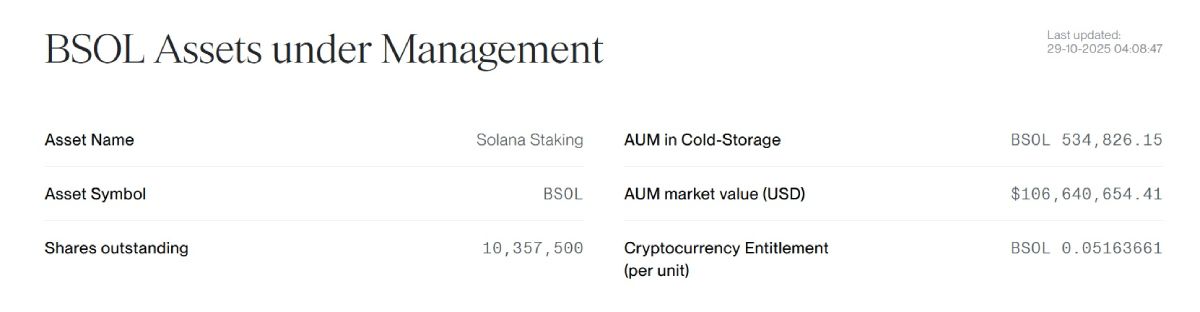
bsol-stats

Показатели BSOL

Как сообщил аналитик ETF Эрик Балчунас, Solana-ETF сильно опередил конкурентов в лице фонда на основе Hedera (HBAR) и Litecoin (LTC) по сумме привлечённых инвестиций. В понедельник в Canary HBAR ETF (HBR) вложили $8 млн, а в Canary Litecoin ETF – лишь $1 млн.

Это можно объяснить двумя причинами. Во-первых, Solana занимает более высокое место в рейтинге цифровых активов по уровню капитализации, а во-вторых, хранение паёв BSOL приносит пассивный доход в размере 4,72%, так как купленные взамен выпущенных акций монеты Solana отправляют на стейкинг.

Тем не менее проявленный к биржевому фонду интерес не повлиял на курс SOL, который за последние сутки снизился на 0,05%. Очевидно, это обусловлено небольшим по меркам Solana притоком капитала, составившим лишь 0,065% от стоимости выпущенных цифровых активов, достигающей $106,75 млрд. Тем не менее в долгосрочной перспективе востребованность BSOL будет стимулировать рост цены криптовалюты.


Trending Cryptos

Related Reads

In the AI Era, What's Left for Bitcoin?

As Bitcoin falls below $60,000, the author reflects on the relationship between AI and Bitcoin, seeing them as two sides of the same coin. In the AI era, the cost of generating content has plummeted, making fake text, images, and videos increasingly easy and cheap to produce. This has led to a fundamental shift: while AI dramatically lowers the cost of information production, it also undermines trust and authenticity online. What becomes truly valuable is not more content, but the ability to verify what is real—"verifiability." This perspective offers a new lens for Bitcoin. Its massive energy consumption, often criticized as wasteful, is reinterpreted. While AI burns energy to enhance "capability" and efficiency, Bitcoin burns energy to produce "verifiability." Its purpose is not to be trusted but to enable a system where no trust in intermediaries—banks, platforms, or developers—is needed. Every transaction and the entire ledger's history is secured by cryptography and a decentralized network of nodes, making it independently verifiable. AI cannot forge a transaction on the Bitcoin network because the system is designed for proof, not generation. The author draws a historical parallel to the Renaissance: the printing press drastically reduced the cost of copying knowledge, while double-entry bookkeeping reduced the cost of trust in commerce. Today, AI is the new printing press, reducing content creation costs to near zero. Blockchain, and Bitcoin as its pioneer, may be the modern equivalent of double-entry bookkeeping—a foundational technology for verifying digital asset ownership and historical records without centralized authorities. Thus, AI and blockchain are not competitors. AI lowers the cost of creation; blockchain lowers the cost of verification. In an age where AI can generate anything, true scarcity may lie not in more content, but in independently verifiable facts. Whether the market will reprice Bitcoin accordingly remains uncertain, but its core value proposition as a "machine for producing verifiability" becomes strikingly relevant.

marsbit1h ago

In the AI Era, What's Left for Bitcoin?

marsbit1h ago

In the Age of AI, What's Left for Bitcoin?

Author: Sevclub, Seven Research Amid Bitcoin's recent drop below $60k, the author reflects on a growing sense that AI and Bitcoin are two sides of the same coin. Today, encountering any content triggers a new default question: "Was this made by AI?" The cost of generating convincing text, images, and video is now negligible. While the internet lowered information *distribution* costs, AI is crashing information *production* costs to near zero. The consequence is a flood of content where truth and falsehood are increasingly indistinguishable. In this environment, what becomes truly valuable is not more information, but the ability to verify what is real—"verifiability." This reframes the common criticism that Bitcoin "wastes electricity." AI consumes power to produce "capability" (e.g., more powerful models). Bitcoin consumes power to produce something else: "verifiability." Bitcoin's core purpose isn't about belief or trust in any institution, developer, or even its creator. It's about enabling independent verification. Every bitcoin's origin, every transaction, and the integrity of the entire ledger are secured by mathematics, cryptography, and a global network of nodes. AI can fabricate convincing media, but it cannot falsify a transaction on the Bitcoin network. The expended energy makes篡改历史 (tampering with history) prohibitively expensive, purchasing a globally verifiable ledger. The author draws a historical parallel to the Renaissance. The printing press drastically reduced the cost of copying knowledge, while double-entry bookkeeping reduced the cost of trust in commerce—one enabled creation, the other verification. Today, AI is the new printing press, driving content production costs toward zero. The question becomes: what is this era's "double-entry bookkeeping"? Blockchain appears to be the leading candidate. It doesn't verify which news is true or which image is real, but it provides a foundational layer for independently verifying asset ownership and historical records in the digital realm without centralized authorities. Therefore, AI and blockchain are not in competition. AI lowers the cost of *generation*. Blockchain (and Bitcoin as a prime example) lowers the cost of *verification*. One creates, the other proves. Whether Bitcoin ultimately succeeds remains uncertain, facing potential challenges from quantum computing, regulation, and technical evolution. However, the author now sees it less as a "machine for making bitcoin" and more as a "machine for making verifiability." In an age where AI can generate anything, true scarcity may no longer be "more content," but "more independently verifiable facts." Whether the market will price this accordingly is a separate question.

链捕手1h ago

In the Age of AI, What's Left for Bitcoin?

链捕手1h ago

Trading

Spot

Hot Articles

Discussions

Welcome to the HTX Community. Here, you can stay informed about the latest platform developments and gain access to professional market insights. Users' opinions on the price of SOL (SOL) are presented below.

活动图片