Institutions Dump Massive Amounts Of Bitcoin And Ethereum As XRP And Solana Buying Ramps Up

bitcoinistPublished on 2025-10-01Last updated on 2025-10-01

Abstract

Institutional investors offloaded a significant amount of Bitcoin and Ethereum last week based on the outflows from crypto funds. Meanwhile,...

Trusted Editorial content, reviewed by leading industry experts and seasoned editors. Ad Disclosure

Institutional investors offloaded a significant amount of Bitcoin and Ethereum last week based on the outflows from crypto funds. Meanwhile, XRP and Solana stood out as they were among the few altcoins that recorded net inflows. 

Institutions Dump Bitcoin And Ethereum For XRP And Solana

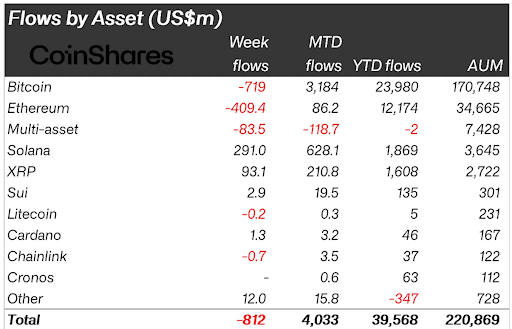
A CoinShares report revealed that Bitcoin and Ethereum funds experienced net outflows of $719 million and $409.4 million, respectively, last week. Meanwhile, XRP and Solana recorded net inflows of $93.1 million and $291 million during the same period, highlighting a notable trend among institutional investors

The inflows for XRP and Solana increased from last week, when these assets recorded inflows of $69.4 million and $127.3 million, respectively. Notably, the rotation from Bitcoin and Ethereum to XRP and Solana comes just ahead of the potential approval of spot ETFs for these in the U.S. 
Bitcoin
Source: Chart from CoinShares on X

The SEC is expected to approve the pending XRP and Solana ETF filings, as both altcoins meet the predetermined requirements under the recently approved generic listing standards. Bloomberg analyst Eric Balchunas stated that the approval odds for these funds are now 100% as the generic listing standards leave fund issuers waiting for a green light from the SEC’s Division of Corporation Finance. 

The potential approval of the XRP and Solana ETFs is expected to have a positive impact on the XRP and SOL prices, which explains why institutional investors may be looking to gain exposure to these assets ahead of the SEC’s approval. It is worth mentioning that Bitcoin and Ethereum have recorded significant gains since their respective spot ETFs launched in the U.S. last year, which provides a bullish outlook for both XRP and Solana ahead of their ETFs’ launch. 

Market experts, such as Nate Geraci, have already suggested that the XRP and Solana ETFs could experience significant demand. He also believes that people are severely underestimating the investor demand for XRP and SOL ETFs. 

SOL May Be The First To Gain Approval

Balahunas revealed that the final deadlines for the Solana ETFs come up on October 10, just before the deadline for the XRP ETFs on October 17. As such, the SOL ETFs could get approved before the XRP ETFs, although the SEC may also approve these funds simultaneously. 

Meanwhile, Geraci alluded to a report stating that next week could be a realistic timeframe for the approval of Solana ETFs. However, Geraci noted that the U.S. government shutdown could “throw [a] wrench in [the] process.” 

The U.S. government has already shut down, which affects the SEC’s operations and could delay a potential approval if the funding bill isn’t passed soon. Bloomberg analyst James Seyffart had also earlier warned about the shutdown and how it could complicate the approval process.

Bitcoin
BTC trading at $116,452 on the 1D chart | Source: BTCUSDT on Tradingview.com
Featured image from iStock, chart from Tradingview.com
Editorial Process for bitcoinist is centered on delivering thoroughly researched, accurate, and unbiased content. We uphold strict sourcing standards, and each page undergoes diligent review by our team of top technology experts and seasoned editors. This process ensures the integrity, relevance, and value of our content for our readers.

Scott Matherson is a leading crypto writer at Bitcoinist, who possesses a sharp analytical mind and a deep understanding of the digital currency landscape. Scott has earned a reputation for delivering thought-provoking and well-researched articles that resonate with both newcomers and seasoned crypto enthusiasts. Outside of his writing, Scott is passionate about promoting crypto literacy and often works to educate the public on the potential of blockchain.

Trending Cryptos

Related Reads

Vitalik Moves to Local Mixing as Obfuscation Series Reaches Third Stage

Ethereum co-founder Vitalik Buterin published the third part of his series on cryptographic obfuscation, focusing on a method called "local mixing." This method abandons lattices and elliptic curves in favor of ideas borrowed from hash function design. Buterin described local mixing as a "completely different way of cryptography," free from elliptic curves, prime factorization, and lattices, making it more akin to symmetric cryptography used in everyday encryption. The process begins with a circuit of logic gates like XOR, AND, and NOT. It undergoes a pipeline that ensures a correct output while obscuring any trace of the internal logic. Key steps include adding reversibility, strengthening, mechanization, mixing, and finally obfuscation. The mixing step scatters extra logic gates and shuffles their arrangement. Reversibility is foundational, allowing gates to be rewritten as other reversible gates with similar behavior. Buterin acknowledged local mixing is a "wild and risky undertaking," lying on the "graveyard of failed attempts at white-box cryptography." However, its proponents argue it needs more research effort and a willingness to accept higher overhead costs. Buterin suggested AI could accelerate its development. He called obfuscation the "final boss of cryptography," with the most complex constructions having runtimes exceeding the universe's age. The article concludes by explaining obfuscation's utility: it can encrypt a program so it still functions with normal inputs and outputs while hiding the code. Combined with blockchain, this moves toward a "trusted third party that requires no trust," enabling applications like private, collusion-resistant voting without relying on a trusted committee.

cryptonews.ru31m ago

Vitalik Moves to Local Mixing as Obfuscation Series Reaches Third Stage

cryptonews.ru31m ago

India Orders Closure of Hundreds of Google Firebase Accounts Used in Banking Frauds

India's cybercrime agency ordered Google to block hundreds of accounts on its Firebase app development platform. The move came after investigators traced numerous fake banking apps and phishing websites to the service. The Indian Cyber Crime Coordination Centre (I4C) sent multiple notices to Google, identifying at least 57 websites and databases on Firebase allegedly used to distribute malware and steal victims' financial data. Among these, seven were phishing pages mimicking login screens of major Indian banks like State Bank of India, ICICI Bank, and Axis Bank. The rest were reportedly data collection points for stolen information like credit card numbers and one-time passwords. The fraud scheme involved Android malware disguised as legitimate banking apps, luring victims with promises of new credit cards, rewards, or credit limit increases. Once installed, the app secretly forwarded device data to a Firebase database controlled by scammers, granting them access to other apps and the victim's funds. One scam specifically targeted beneficiaries of a government farmer aid program. This action marks a shift in India's approach. Previously focused on blocking individual fraudulent websites, authorities are now targeting the broader infrastructure enabling these scams. The move highlights how fraudsters exploit widely accessible platforms like Firebase, attracted by its free tier and database capabilities, to target India's vast digital payment user base.

cryptonews.ru33m ago

India Orders Closure of Hundreds of Google Firebase Accounts Used in Banking Frauds

cryptonews.ru33m ago

Trading

Spot

Hot Articles

What is $BITCOIN

DIGITAL GOLD ($BITCOIN): A Comprehensive Analysis Introduction to DIGITAL GOLD ($BITCOIN) DIGITAL GOLD ($BITCOIN) is a blockchain-based project operating on the Solana network, which aims to combine the characteristics of traditional precious metals with the innovation of decentralized technologies. While it shares a name with Bitcoin, often referred to as “digital gold” due to its perception as a store of value, DIGITAL GOLD is a separate token designed to create a unique ecosystem within the Web3 landscape. Its goal is to position itself as a viable alternative digital asset, although specifics regarding its applications and functionalities are still developing. What is DIGITAL GOLD ($BITCOIN)? DIGITAL GOLD ($BITCOIN) is a cryptocurrency token explicitly designed for use on the Solana blockchain. In contrast to Bitcoin, which provides a widely recognized value storage role, this token appears to focus on broader applications and characteristics. Notable aspects include: Blockchain Infrastructure: The token is built on the Solana blockchain, known for its capacity to handle high-speed and low-cost transactions. Supply Dynamics: DIGITAL GOLD has a maximum supply capped at 100 quadrillion tokens (100P $BITCOIN), although details regarding its circulating supply are currently undisclosed. Utility: While precise functionalities are not explicitly outlined, there are indications that the token could be utilized for various applications, potentially involving decentralized applications (dApps) or asset tokenization strategies. Who is the Creator of DIGITAL GOLD ($BITCOIN)? At present, the identity of the creators and development team behind DIGITAL GOLD ($BITCOIN) remains unknown. This situation is typical among many innovative projects within the blockchain space, particularly those aligning with decentralized finance and meme coin phenomena. While such anonymity may foster a community-driven culture, it intensifies concerns about governance and accountability. Who are the Investors of DIGITAL GOLD ($BITCOIN)? The available information indicates that DIGITAL GOLD ($BITCOIN) does not have any known institutional backers or prominent venture capital investments. The project seems to operate on a peer-to-peer model focused on community support and adoption rather than traditional funding routes. Its activity and liquidity are primarily situated on decentralized exchanges (DEXs), such as PumpSwap, rather than established centralized trading platforms, further highlighting its grassroots approach. How DIGITAL GOLD ($BITCOIN) Works The operational mechanics of DIGITAL GOLD ($BITCOIN) can be elaborated on based on its blockchain design and network attributes: Consensus Mechanism: By leveraging Solana’s unique proof-of-history (PoH) combined with a proof-of-stake (PoS) model, the project ensures efficient transaction validation contributing to the network's high performance. Tokenomics: While specific deflationary mechanisms have not been extensively detailed, the vast maximum token supply implies that it may cater to microtransactions or niche use cases that are still to be defined. Interoperability: There exists the potential for integration with Solana’s broader ecosystem, including various decentralized finance (DeFi) platforms. However, the details regarding specific integrations remain unspecified. Timeline of Key Events Here is a timeline that highlights significant milestones concerning DIGITAL GOLD ($BITCOIN): 2023: The initial deployment of the token occurs on the Solana blockchain, marked by its contract address. 2024: DIGITAL GOLD gains visibility as it becomes available for trading on decentralized exchanges like PumpSwap, allowing users to trade it against SOL. 2025: The project witnesses sporadic trading activity and potential interest in community-led engagements, although no noteworthy partnerships or technical advancements have been documented as of yet. Critical Analysis Strengths Scalability: The underlying Solana infrastructure supports high transaction volumes, which could enhance the utility of $BITCOIN in various transaction scenarios. Accessibility: The potential low trading price per token could attract retail investors, facilitating wider participation due to fractional ownership opportunities. Risks Lack of Transparency: The absence of publicly known backers, developers, or an audit process may yield skepticism regarding the project's sustainability and trustworthiness. Market Volatility: The trading activity is heavily reliant on speculative behavior, which can result in significant price volatility and uncertainty for investors. Conclusion DIGITAL GOLD ($BITCOIN) emerges as an intriguing yet ambiguous project within the rapidly evolving Solana ecosystem. While it attempts to leverage the “digital gold” narrative, its departure from Bitcoin's established role as a store of value underscores the need for a clearer differentiation of its intended utility and governance structure. Future acceptance and adoption will likely depend on addressing the current opacity and defining its operational and economic strategies more explicitly. Note: This report encompasses synthesised information available as of October 2023, and developments may have transpired beyond the research period.

2.0k Total ViewsPublished 2025.05.13Updated 2025.05.13

What is $BITCOIN

Discussions

Welcome to the HTX Community. Here, you can stay informed about the latest platform developments and gain access to professional market insights. Users' opinions on the price of BTC (BTC) are presented below.

活动图片