Ethereum ETFs See Record Inflows as ETH Breaks $4,000: Is a Bigger Rally Coming?

bitcoinistPublished on 2025-10-01Last updated on 2025-10-01

Abstract

Ethereum’s rebound accelerated after U.S. spot ETH ETFs recorded $547 million in net single-day inflows, ending a five-day outflow streak....

Trusted Editorial content, reviewed by leading industry experts and seasoned editors. Ad Disclosure

Ethereum’s rebound accelerated after U.S. spot ETH ETFs recorded $547 million in net single-day inflows, ending a five-day outflow streak. Fidelity’s FETH led with $202 million, while BlackRock’s ETHA contributed $154 million.

ETH ETFs now oversee about $27.5 billion, around 5.4% of the circulating market cap, indicating renewed institutional interest as the price regained the $4,000 psychological level.
Ethereum ETH ETHUSD

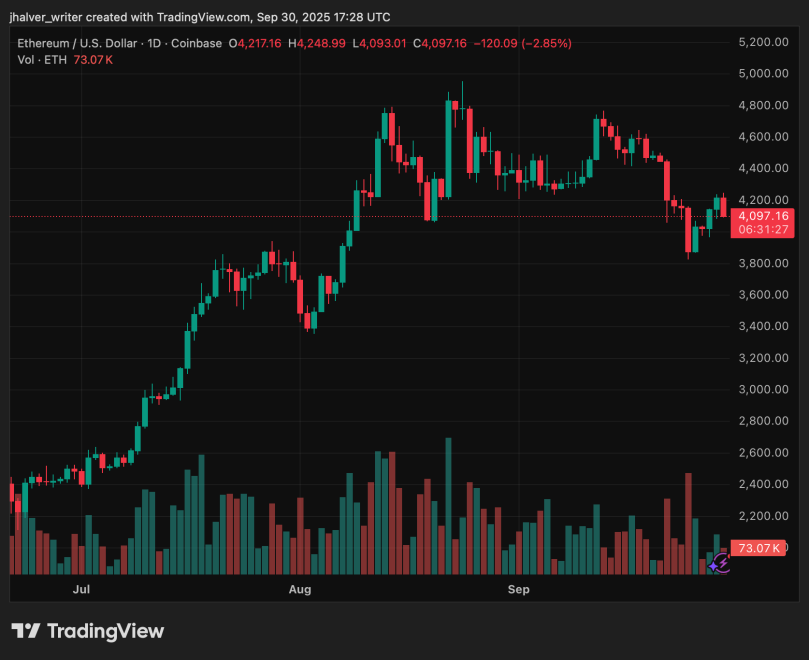
ETH's price trends sideways on low timeframes. Source: ETHUSD on Tradingview

The turnaround coincided with over $1 billion in combined inflows into U.S. Bitcoin and Ethereum ETFs, boosting risk appetite across major assets.

Smart Money Accumulates Ethereum (ETH) as Reserves Fall

On the balance-sheet front, institutions continue increasing their exposure. BitMine Immersion Technologies disclosed a 2.65 million ETH corporate treasury, the largest tracked among its peers, while Bit Digital plans a $100 million convertible note raise to acquire more ETH, potentially boosting its treasury rankings.

On-chain, CryptoQuant data indicate declining exchange reserves, consistent with coins being moved into custody and staking, conditions that historically tighten the circulating supply when demand rises.

Technically, analysts note ETH has rallied approximately 250% from cycle lows; some, like Ted Pillows, suggest a brief pullback could set the stage for a move towards $4,500–$5,000, with $10,000 possible later if liquidity and macro tailwinds align.

In the near term, sustaining closes above $4,200–$4,250 would keep bulls in control; failure to do so risks a decline towards the $3,800–$3,600 support level.

TradFi Integrations Strengthen the Fundamental Case

Beyond flows and treasuries, real-world rails are advancing. SWIFT has tested Ethereum’s Linea Layer-2 with BNP Paribas and BNY Mellon for on-chain settlement messaging, while a broader SWIFT–Consensys project explores a blockchain-based ledger for 24/7 cross-border payments.

If even a small part of SWIFT volume moves on-chain, it could become a steady demand driver for block space and ETH staking.

Alongside improving regulatory clarity and ETF adoption, these integrations strengthen Ethereum’s position as a neutral financial infrastructure for institutions, supporting the AI/data economy narrative highlighted by corporate buyers.

Bottom Line

Record ETF inflows, decreasing exchange supply, and rising TradFi pilots support a breakout above $ 4,000. Stay above $4,200, and the path opens towards $4,500–$5,000; lose that, and a healthy retest into the high $3,000s is likely to occur before the next move. For now, the evidence leans bullish.

Cover image from ChatGPT, ETHUSD chart from Tradingview

Editorial Process for bitcoinist is centered on delivering thoroughly researched, accurate, and unbiased content. We uphold strict sourcing standards, and each page undergoes diligent review by our team of top technology experts and seasoned editors. This process ensures the integrity, relevance, and value of our content for our readers.

Trending Cryptos

Related Reads

MiCA is coming for DeFi vaults, but regulation will be difficult

The European Commission is exploring whether to extend the Markets in Crypto-Assets (MiCA) regulation to cover decentralized finance (DeFi) lending and borrowing, including lending vaults. These vaults, which channel billions into on-chain credit markets, present significant regulatory challenges because their decentralized structure doesn't map neatly onto existing financial frameworks. Their legal status is currently based on non-binding interpretations that they fall outside MiCA and EU fund rules. The article uses Morpho's decentralized lending protocol as an example, illustrating how responsibilities are divided among various participants (owner, curator, allocator, sentinel), making it difficult to identify a single "provider" to regulate. Experts warn that broadly categorizing "DeFi lending" could inadvertently capture vastly different structures. They argue that any regulatory approach should focus on the specific structure and control mechanisms of a vault, rather than using decentralization as a simple dividing line, and that DeFi lending may require a dedicated, carefully crafted framework distinct from traditional finance. The Commission's consultation closes on September 30, 2026. The core challenge for regulators is not just whether to regulate DeFi lending, but how to design rules that distinguish between different forms of on-chain lending and the entities that control them.

cointelegraph15m ago

MiCA is coming for DeFi vaults, but regulation will be difficult

cointelegraph15m ago

Grayscale Report: Financial Privacy in the AI Era, Why Zcash Should Not Be Overlooked?

Title: Grayscale Report: Financial Privacy in the AI Era – Why Zcash Should Not Be Overlooked The article argues that privacy is a fundamental, not niche, attribute of functional money. It highlights that technological shifts, like the rise of AI and stablecoins, are driving a new wave of public focus on financial privacy. Zcash, a decentralized digital currency similar to Bitcoin but with built-in privacy via zero-knowledge proofs, is positioned to address this need. Unlike transparent blockchains, Zcash offers users the option to conduct "shielded" transactions that hide sender, receiver, and amount while remaining verifiable. The report details Zcash's evolution, noting key upgrades that improved usability and security. It points to rising on-chain usage of privacy features as evidence of real demand. Currently, ZEC holds a minimal share (~0.4%) of the total crypto market cap. Grayscale suggests this reflects a market assumption that privacy is a marginal concern. The investment thesis hinges on a potential market re-evaluation: if privacy is recognized as a core monetary feature in an era of enhanced surveillance, Zcash's current valuation represents significant upside potential. Key risks discussed include regulatory challenges, historical trusted setup concerns for older pools (mitigated by newer protocols), quantum computing threats, and execution risks associated with future technical upgrades. The conclusion is that while the future scale of private digital currency is uncertain, the market currently prices in little chance of its value increasing substantially, presenting a potential opportunity for investors.

marsbit2h ago

Grayscale Report: Financial Privacy in the AI Era, Why Zcash Should Not Be Overlooked?

marsbit2h ago

Trading

Spot

Hot Articles

Discussions

Welcome to the HTX Community. Here, you can stay informed about the latest platform developments and gain access to professional market insights. Users' opinions on the price of ETH (ETH) are presented below.

活动图片