Altcoin 24H Futures Volume Surpasses BTC and ETH: Warning Sign Or Market Shift?

bitcoinistPublished on 2025-09-29Last updated on 2025-09-29

Abstract

The altcoin market is navigating a period of volatility and uncertainty, with traders closely watching Bitcoin and Ethereum as they...

Trusted Editorial content, reviewed by leading industry experts and seasoned editors. Ad Disclosure

The altcoin market is navigating a period of volatility and uncertainty, with traders closely watching Bitcoin and Ethereum as they attempt to reclaim key levels. For many investors, the long-awaited altseason—a period where alternative cryptocurrencies outperform BTC—remains more of a hopeful narrative than a present reality. With BTC and ETH dominating market sentiment, smaller assets are caught in a tug-of-war between fading confidence and renewed optimism.

Despite the uncertainty, key data points suggest altcoins are heating up beneath the surface. Futures volumes have started to climb again, and liquidity is showing signs of shifting away from major coins into higher-risk plays. Historically, this kind of behavior often precedes strong rotations within the crypto market, where capital flows into mid- and low-cap tokens once confidence in BTC and ETH stabilizes.

For now, investors remain cautious, with many awaiting confirmation that bullish momentum will return before committing more aggressively. The coming weeks will be critical: if Bitcoin and Ethereum manage to hold above support and reestablish an upward trend, altcoins could be positioned for explosive growth. Until then, volatility will likely define trading conditions, leaving investors balancing both risk and opportunity.

Altcoin Futures Volume Signaling A Move

The altcoin market is drawing increased attention after 24H futures trading volume surpassed that of Bitcoin and Ethereum, according to the latest market data. This shift highlights a surge in speculative activity, with investors pouring liquidity into higher-risk assets. Analyst Ted Pillows explains that despite last week’s sharp flush-out, which cleared overleveraged positions across multiple altcoins, retail traders have quickly returned to the market, embracing what he calls a “full degen mode” approach.

Altcoin 24H volume surpasses BTC and ETH | Source: Ted Pillows

This dynamic raises both opportunities and risks. Elevated trading activity in altcoin derivatives reflects renewed appetite for risk-taking, signaling that investor sentiment has not been entirely derailed by recent volatility.

On the other hand, history shows that when altcoin futures volumes climb disproportionately compared to BTC and ETH, the market often faces heightened liquidation risk. Leveraged bets amplify price swings, and even small corrections can cascade into massive liquidations, dragging prices lower across the board.

Whether it materializes as a breakout to new highs or another round of forced liquidations depends largely on Bitcoin’s ability to stabilize and broader macroeconomic conditions. For now, the message is clear: retail enthusiasm has returned, volumes are rising, and altcoins are once again the focal point of speculative trading. While this sets the stage for explosive price action, it also reinforces the need for caution as the risk of another major liquidation event looms.

Altcoin Market Consolidates

The chart of the total crypto market cap excluding the top 10 coins shows that altcoins continue to trade in a decisive zone around $303B. After several months of consolidation, the market cap has formed a base above the $250B region, a level that acted as resistance in 2023 and now serves as support. This structural shift suggests that altcoins are maintaining strength despite recent volatility in Bitcoin and Ethereum.
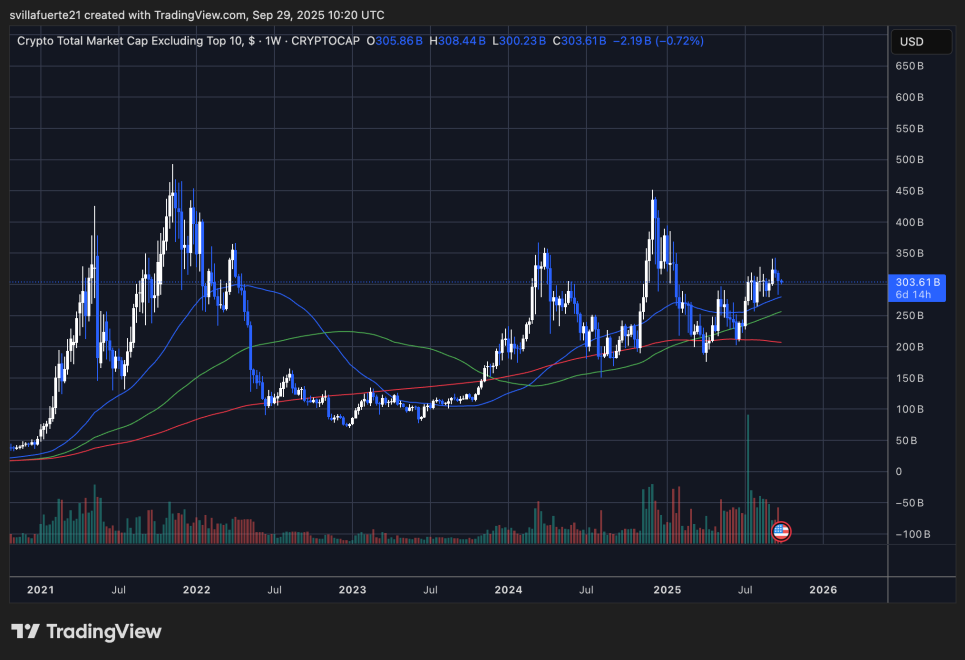
Crypto Total Market Cap excluding Top 10 | Source: OTHERS chart on TradingView

The moving averages highlight the trend more clearly: the 50-week SMA remains above the 200-week SMA, keeping a long-term bullish bias intact. However, the market has struggled to reclaim the $400B mark, a key resistance area tested multiple times since early 2024. Each rejection at this level has led to sharp retracements, signaling the importance of $400B as a breakout threshold for the next altseason.

Current price action shows tightening around the 50- and 100-week SMAs, reflecting indecision but also the potential for a strong move once momentum returns. A sustained close above $320B could signal renewed bullish momentum, while a breakdown below $280B may confirm deeper corrections.

Featured image from Dall-E, chart from TradingView

Editorial Process for bitcoinist is centered on delivering thoroughly researched, accurate, and unbiased content. We uphold strict sourcing standards, and each page undergoes diligent review by our team of top technology experts and seasoned editors. This process ensures the integrity, relevance, and value of our content for our readers.

Sebastian's journey into the world of crypto began four years ago, driven by a fascination with the potential of blockchain technology to revolutionize financial systems. His initial exploration focused on understanding the intricacies of various crypto projects, particularly those focused on building innovative financial solutions. Through countless hours of research and learning, Sebastian developed a deep understanding of the underlying technologies, market dynamics, and potential applications of cryptocurrencies. As his knowledge grew, Sebastian felt compelled to share his insights with others. He began actively contributing to online discussions on platforms like X and LinkedIn, focusing on fintech and crypto-related content. His goal was to expose valuable trends and insights to a wider audience, fostering a deeper understanding of the rapidly evolving crypto landscape. Sebastian's contributions quickly gained recognition, and he became a trusted voice in the online crypto community. To further enhance his expertise, Sebastian pursued a UC Berkeley Fintech: Frameworks, Applications, and Strategies certification. This rigorous program equipped him with valuable skills and knowledge regarding Financial Technology, bridging the gap between traditional finance (TradFi) and decentralized finance (DeFi). The certification deepened his understanding of the broader financial landscape and its intersection with blockchain technology. Sebastian's passion for finance and writing is evident in his work. He enjoys delving into financial research, analyzing market trends, and exploring the latest developments in the crypto space. In his spare time, Sebastian can often be found immersed in charts, studying 10-K forms, or engaging in thought-provoking discussions about the future of finance. Sebastian's journey as a crypto analyst and investor has been marked by a relentless pursuit of knowledge and a dedication to sharing his insights. His ability to navigate the complex world of crypto, combined with his passion for financial research and communication, makes him a valuable asset to the industry. As the crypto landscape continues to evolve, Sebastian remains at the forefront, providing valuable insights and contributing to the growth of this revolutionary technology.

Trending Cryptos

Related Reads

Beyond the 'Kimchi Premium': Institutional Transformation in Korea

South Korea's crypto landscape is moving beyond the volatile "Kimchi Premium" era driven by retail speculation, according to Andrew Park, CEO of Factblock. Park, who organizes Korea Blockchain Week, notes a significant shift in the nature of international inquiries. Global institutions are now focusing on market access, asset custody, tokenization, stablecoins, and regulatory compliance, rather than just token listings and prices. This institutionalization is being built through foundational, "unsexy" back-office work: developing corporate crypto accounts, legal finality for settlements, accounting standards, and custody solutions. Key regulatory steps include the Financial Services Commission's framework for corporate virtual asset accounts and National Assembly amendments to laws governing tokenized securities and real-world assets. Park, with a traditional finance background, bridges the perspectives of Wall Street and Web3. He explains that traditional banks prioritize managing edge-case failures and regulatory reporting, which crypto-native firms sometimes misunderstand. Conversely, traditional financiers often overlook blockchain's systemic utility for 24/7 global settlement and programmable money. Looking ahead, Park sees South Korea's next frontier at the intersection of AI and programmable blockchain infrastructure. He is particularly interested in the infrastructure needed for a "machine-to-machine" economy, where AI agents could autonomously conduct micropayments and transactions using on-chain settlement mechanisms—a concept already being explored in pilot projects by the Bank of Korea. With its advanced digital infrastructure and investments in both Web3 and AI, South Korea is uniquely positioned to develop this future.

cryptonews.ru3m ago

Beyond the 'Kimchi Premium': Institutional Transformation in Korea

cryptonews.ru3m ago

Telegram Introduces WEB-Proxy Technology: Traffic Camouflaged as Regular Website Visits

Telegram has introduced an experimental WEB-proxy technology, unveiled on August 21, 2026, designed to bypass blocking by disguising messenger traffic as regular, encrypted website visits. This new method in Telegram Desktop routes MTProxy data through a WebView transport using HTTPS or WebSocket, making the data stream indistinguishable from legitimate web browsing and offering a new avenue for accessing the service under restrictions. The core innovation is a multiplexed stream sent through the app's built-in browser engine. It maintains MTProxy's encryption but sends all data via a single WebView session. Special frame types (OPEN, DATA, WINDOW, CLOSE) package multiple Telegram connections into one secure channel that appears as a standard webpage load. A server-side relay receives this stream, separates it into individual connections for the MTProxy without decrypting content or knowing final destinations, preserving privacy. The WEB-proxy operates on a regular HTTPS domain that simultaneously hosts a public website. The proxy bridge page activates only with a specific parameter derived from the configuration; all other requests receive the standard homepage, providing reliable cover. Connection links use formats like https://t.me/webproxy?server=... or tg://webproxy, with port 443 and HTTPS being mandatory. Currently a proof-of-concept, the project includes a desktop implementation, an experimental Android client, and plans for iOS support. It represents a shift towards more sophisticated integration with legitimate web infrastructure, leveraging standard browser mechanisms to complicate traffic filtering. The practical value will depend on its resilience to adaptive traffic analysis and scalability. This approach structurally echoes earlier techniques like domain fronting, highlighting the cyclical nature of the struggle between censorship and circumvention technologies.

cryptonews.ru20m ago

Telegram Introduces WEB-Proxy Technology: Traffic Camouflaged as Regular Website Visits

cryptonews.ru20m ago

Trading

Spot

Hot Articles

What is $BITCOIN

DIGITAL GOLD ($BITCOIN): A Comprehensive Analysis Introduction to DIGITAL GOLD ($BITCOIN) DIGITAL GOLD ($BITCOIN) is a blockchain-based project operating on the Solana network, which aims to combine the characteristics of traditional precious metals with the innovation of decentralized technologies. While it shares a name with Bitcoin, often referred to as “digital gold” due to its perception as a store of value, DIGITAL GOLD is a separate token designed to create a unique ecosystem within the Web3 landscape. Its goal is to position itself as a viable alternative digital asset, although specifics regarding its applications and functionalities are still developing. What is DIGITAL GOLD ($BITCOIN)? DIGITAL GOLD ($BITCOIN) is a cryptocurrency token explicitly designed for use on the Solana blockchain. In contrast to Bitcoin, which provides a widely recognized value storage role, this token appears to focus on broader applications and characteristics. Notable aspects include: Blockchain Infrastructure: The token is built on the Solana blockchain, known for its capacity to handle high-speed and low-cost transactions. Supply Dynamics: DIGITAL GOLD has a maximum supply capped at 100 quadrillion tokens (100P $BITCOIN), although details regarding its circulating supply are currently undisclosed. Utility: While precise functionalities are not explicitly outlined, there are indications that the token could be utilized for various applications, potentially involving decentralized applications (dApps) or asset tokenization strategies. Who is the Creator of DIGITAL GOLD ($BITCOIN)? At present, the identity of the creators and development team behind DIGITAL GOLD ($BITCOIN) remains unknown. This situation is typical among many innovative projects within the blockchain space, particularly those aligning with decentralized finance and meme coin phenomena. While such anonymity may foster a community-driven culture, it intensifies concerns about governance and accountability. Who are the Investors of DIGITAL GOLD ($BITCOIN)? The available information indicates that DIGITAL GOLD ($BITCOIN) does not have any known institutional backers or prominent venture capital investments. The project seems to operate on a peer-to-peer model focused on community support and adoption rather than traditional funding routes. Its activity and liquidity are primarily situated on decentralized exchanges (DEXs), such as PumpSwap, rather than established centralized trading platforms, further highlighting its grassroots approach. How DIGITAL GOLD ($BITCOIN) Works The operational mechanics of DIGITAL GOLD ($BITCOIN) can be elaborated on based on its blockchain design and network attributes: Consensus Mechanism: By leveraging Solana’s unique proof-of-history (PoH) combined with a proof-of-stake (PoS) model, the project ensures efficient transaction validation contributing to the network's high performance. Tokenomics: While specific deflationary mechanisms have not been extensively detailed, the vast maximum token supply implies that it may cater to microtransactions or niche use cases that are still to be defined. Interoperability: There exists the potential for integration with Solana’s broader ecosystem, including various decentralized finance (DeFi) platforms. However, the details regarding specific integrations remain unspecified. Timeline of Key Events Here is a timeline that highlights significant milestones concerning DIGITAL GOLD ($BITCOIN): 2023: The initial deployment of the token occurs on the Solana blockchain, marked by its contract address. 2024: DIGITAL GOLD gains visibility as it becomes available for trading on decentralized exchanges like PumpSwap, allowing users to trade it against SOL. 2025: The project witnesses sporadic trading activity and potential interest in community-led engagements, although no noteworthy partnerships or technical advancements have been documented as of yet. Critical Analysis Strengths Scalability: The underlying Solana infrastructure supports high transaction volumes, which could enhance the utility of $BITCOIN in various transaction scenarios. Accessibility: The potential low trading price per token could attract retail investors, facilitating wider participation due to fractional ownership opportunities. Risks Lack of Transparency: The absence of publicly known backers, developers, or an audit process may yield skepticism regarding the project's sustainability and trustworthiness. Market Volatility: The trading activity is heavily reliant on speculative behavior, which can result in significant price volatility and uncertainty for investors. Conclusion DIGITAL GOLD ($BITCOIN) emerges as an intriguing yet ambiguous project within the rapidly evolving Solana ecosystem. While it attempts to leverage the “digital gold” narrative, its departure from Bitcoin's established role as a store of value underscores the need for a clearer differentiation of its intended utility and governance structure. Future acceptance and adoption will likely depend on addressing the current opacity and defining its operational and economic strategies more explicitly. Note: This report encompasses synthesised information available as of October 2023, and developments may have transpired beyond the research period.

2.0k Total ViewsPublished 2025.05.13Updated 2025.05.13

What is $BITCOIN

Discussions

Welcome to the HTX Community. Here, you can stay informed about the latest platform developments and gain access to professional market insights. Users' opinions on the price of BTC (BTC) are presented below.

活动图片