Bitcoin And Ethereum Prices Crash, But Technicals Show What’s Next

bitcoinistPublished on 2025-09-26Last updated on 2025-09-27

Abstract

Both Bitcoin and Ethereum have extended their retracements into the past 24 hours, puncturing price thresholds that many technical analysts...

Trusted Editorial content, reviewed by leading industry experts and seasoned editors. Ad Disclosure

Both Bitcoin and Ethereum have extended their retracements into the past 24 hours, puncturing price thresholds that many technical analysts had deemed as important support levels. Bitcoin has slipped below $110,000, while Ethereum has also broken beneath the $4,000 price level. 

The most recent correction questions the durability of the uptrend and whether this is a corrective pullback or the beginning of an extended downtrend. The charts of both assets, however, offer technical signals that point to the next direction for price action.

Bitcoin Is Testing Range Highs And Trend Anchors

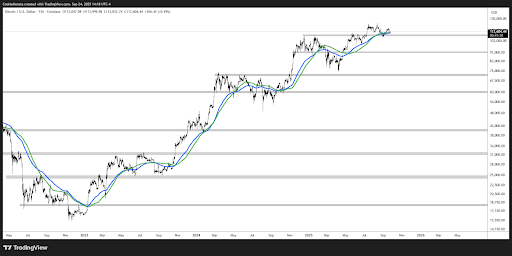
Technical analysis laid out by TraderMercury on the social media platform X noted that Bitcoin is currently bouncing from the previous range highs, along with the 12-hour 200MAs trend. In other words, Bitcoin’s price action has dipped down to a confluence zone where resistance and the 200-period moving averages on the 12-hour timeframe converge. That zone is acting as a pivot. If buyers defend it, the correction may be contained. However, if they don’t, the downside could open further.

There are still signs of life and buyer interest around that region, which is positive in the short term. But the higher-timeframe outlook, as TraderMercury stated, is “dauntingly boring and choppy.” This is pointing to the Bitcoin price’s oscillation without strong directional conviction on mid and high frames. That means any breakout (up or down) could be a clearer signal of where momentum wants to take things next.
Bitcoin
Source: Chart from TraderMercury on X

A notable red flag is if Bitcoin’s price begins to drift back inside the prior 8-month range below $108,000. That would indicate a failure of the breakout move that preceded it, and potentially signal a return to range dynamics or worse. The more bullish scenario is that Bitcoin carves out a move away from that range. Until then, the 12-hour and daily moving averages, plus the prior horizontal pivots around $108,000 to $111,000, will all act as tension zones to monitor.

Ethereum Maintains Favorable Context On Higher Timeframes

Despite breaking below $4,000, Ethereum has steadily maintained above a 4-year range. However, the most recent downtrend means that it has lost the 200MAs on the 4-hour candlestick timeframe chart. According to TraderMercury, this is an objective weakness that has been seen only one other time in the past five months.

However, this weakness doesn’t translate into a full-blown bearish narrative. Ethereum’s price action lost the same trend back in May, only for it to carve out a higher low on the weekly and resume upward movement into new highs.  Therefore, the market only becomes dangerous for ETH if its price breaks below $3,900. That’s a threshold TraderMercury flagged as a point of no return for the current setup. 

Until then, a reclaim of major higher averages on the daily to weekly timeframe, for instance, would act as a clean risk-on bullish signal if it happens soon.

$3,900 is the line in the sand for Ethereum. A bounce is always possible if it can hold above that and begin to re-engage with multi-month moving averages. If that fails, deeper support could come into play around $3,600.

At the time of writing, Bitcoin is trading at $109,600, and Ethereum is trading at $3,940.

Bitcoin
BTC trading at $109,646 on the 1D chart | Source: BTCUSDT on Tradingview.com
Featured image from Pixabay, chart from Tradingview.com
Editorial Process for bitcoinist is centered on delivering thoroughly researched, accurate, and unbiased content. We uphold strict sourcing standards, and each page undergoes diligent review by our team of top technology experts and seasoned editors. This process ensures the integrity, relevance, and value of our content for our readers.

Scott Matherson is a leading crypto writer at Bitcoinist, who possesses a sharp analytical mind and a deep understanding of the digital currency landscape. Scott has earned a reputation for delivering thought-provoking and well-researched articles that resonate with both newcomers and seasoned crypto enthusiasts. Outside of his writing, Scott is passionate about promoting crypto literacy and often works to educate the public on the potential of blockchain.

Trending Cryptos

Related Reads

Illinois' 0.2% Cryptocurrency Tax Sparks Major Legal Battle

Blockchain Association and Crypto Council for Innovation filed a lawsuit on August 21 in an Illinois district court against state officials, seeking to declare the state's Digital Asset Tax Act unlawful and block its implementation. The lawsuit centers on Illinois' plan to impose a 0.2% tax on the value of a digital asset for certain transactions through a digital asset broker, effective January 1. Plaintiffs argue the tax applies even to non-sales activities like transferring assets between wallets or paying for custody services, which is unlike the treatment of traditional assets like stocks or gold. They contend this discriminates against digital assets, taxing the mechanism of storage or transfer rather than an economic gain. The complaint highlights multiple ambiguities: a single crypto purchase involving exchange, deposit, and custody could trigger multiple taxable events; the law doesn't define how to value the asset or determine a customer's residency for tax purposes, leaving brokers guessing. Businesses face potential civil and criminal penalties for non-compliance, possibly leading them to avoid Illinois customers. The groups also challenge the legislative process, noting the tax was added as a small part of a massive 1,624-page bill passed hastily, violating constitutional requirements. They claim the tax violates federal laws like the Internet Tax Freedom Act and the dormant Commerce Clause. The immediate goal is to obtain an injunction before the January 1 enforcement date, testing whether a state can single out digital asset transactions for such a tax.

cryptonews.ru1h ago

Illinois' 0.2% Cryptocurrency Tax Sparks Major Legal Battle

cryptonews.ru1h ago

Trading

Spot

Hot Articles

What is $BITCOIN

DIGITAL GOLD ($BITCOIN): A Comprehensive Analysis Introduction to DIGITAL GOLD ($BITCOIN) DIGITAL GOLD ($BITCOIN) is a blockchain-based project operating on the Solana network, which aims to combine the characteristics of traditional precious metals with the innovation of decentralized technologies. While it shares a name with Bitcoin, often referred to as “digital gold” due to its perception as a store of value, DIGITAL GOLD is a separate token designed to create a unique ecosystem within the Web3 landscape. Its goal is to position itself as a viable alternative digital asset, although specifics regarding its applications and functionalities are still developing. What is DIGITAL GOLD ($BITCOIN)? DIGITAL GOLD ($BITCOIN) is a cryptocurrency token explicitly designed for use on the Solana blockchain. In contrast to Bitcoin, which provides a widely recognized value storage role, this token appears to focus on broader applications and characteristics. Notable aspects include: Blockchain Infrastructure: The token is built on the Solana blockchain, known for its capacity to handle high-speed and low-cost transactions. Supply Dynamics: DIGITAL GOLD has a maximum supply capped at 100 quadrillion tokens (100P $BITCOIN), although details regarding its circulating supply are currently undisclosed. Utility: While precise functionalities are not explicitly outlined, there are indications that the token could be utilized for various applications, potentially involving decentralized applications (dApps) or asset tokenization strategies. Who is the Creator of DIGITAL GOLD ($BITCOIN)? At present, the identity of the creators and development team behind DIGITAL GOLD ($BITCOIN) remains unknown. This situation is typical among many innovative projects within the blockchain space, particularly those aligning with decentralized finance and meme coin phenomena. While such anonymity may foster a community-driven culture, it intensifies concerns about governance and accountability. Who are the Investors of DIGITAL GOLD ($BITCOIN)? The available information indicates that DIGITAL GOLD ($BITCOIN) does not have any known institutional backers or prominent venture capital investments. The project seems to operate on a peer-to-peer model focused on community support and adoption rather than traditional funding routes. Its activity and liquidity are primarily situated on decentralized exchanges (DEXs), such as PumpSwap, rather than established centralized trading platforms, further highlighting its grassroots approach. How DIGITAL GOLD ($BITCOIN) Works The operational mechanics of DIGITAL GOLD ($BITCOIN) can be elaborated on based on its blockchain design and network attributes: Consensus Mechanism: By leveraging Solana’s unique proof-of-history (PoH) combined with a proof-of-stake (PoS) model, the project ensures efficient transaction validation contributing to the network's high performance. Tokenomics: While specific deflationary mechanisms have not been extensively detailed, the vast maximum token supply implies that it may cater to microtransactions or niche use cases that are still to be defined. Interoperability: There exists the potential for integration with Solana’s broader ecosystem, including various decentralized finance (DeFi) platforms. However, the details regarding specific integrations remain unspecified. Timeline of Key Events Here is a timeline that highlights significant milestones concerning DIGITAL GOLD ($BITCOIN): 2023: The initial deployment of the token occurs on the Solana blockchain, marked by its contract address. 2024: DIGITAL GOLD gains visibility as it becomes available for trading on decentralized exchanges like PumpSwap, allowing users to trade it against SOL. 2025: The project witnesses sporadic trading activity and potential interest in community-led engagements, although no noteworthy partnerships or technical advancements have been documented as of yet. Critical Analysis Strengths Scalability: The underlying Solana infrastructure supports high transaction volumes, which could enhance the utility of $BITCOIN in various transaction scenarios. Accessibility: The potential low trading price per token could attract retail investors, facilitating wider participation due to fractional ownership opportunities. Risks Lack of Transparency: The absence of publicly known backers, developers, or an audit process may yield skepticism regarding the project's sustainability and trustworthiness. Market Volatility: The trading activity is heavily reliant on speculative behavior, which can result in significant price volatility and uncertainty for investors. Conclusion DIGITAL GOLD ($BITCOIN) emerges as an intriguing yet ambiguous project within the rapidly evolving Solana ecosystem. While it attempts to leverage the “digital gold” narrative, its departure from Bitcoin's established role as a store of value underscores the need for a clearer differentiation of its intended utility and governance structure. Future acceptance and adoption will likely depend on addressing the current opacity and defining its operational and economic strategies more explicitly. Note: This report encompasses synthesised information available as of October 2023, and developments may have transpired beyond the research period.

2.0k Total ViewsPublished 2025.05.13Updated 2025.05.13

What is $BITCOIN

Discussions

Welcome to the HTX Community. Here, you can stay informed about the latest platform developments and gain access to professional market insights. Users' opinions on the price of BTC (BTC) are presented below.

活动图片