Ethereum Founder Buterin Defends Coinbase Amid Fierce Debate: Here’s Why

bitcoinistPublished on 2025-09-23Last updated on 2025-09-23

Abstract

Ethereum co-founder Vitalik Buterin has waded directly into a fast-escalating dispute over the role and risk profile of Coinbase’s Layer-2...

Trusted Editorial content, reviewed by leading industry experts and seasoned editors. Ad Disclosure

Ethereum co-founder Vitalik Buterin has waded directly into a fast-escalating dispute over the role and risk profile of Coinbase’s Layer-2 (L2) network, Base, arguing that critics are conflating core concepts and overlooking concrete guarantees that protect users on modern L2s. “Base is doing things the right way: an L2 on top of Ethereum, that uses its centralized features to provide stronger UX features, while still being tied into Ethereum’s decentralized base layer for security,” Buterin wrote, adding that L2s like Base “are non-custodial… not glorified servers that happen to submit hashes.”

Ethereum’s Buterin Clarifies L2 Security

Buterin’s post arrived after Coinbase’s chief legal officer Paul Grewal pushed back on commentary likening L2 sequencers to “exchanges,” and Base creator Jesse Pollak published a detailed thread explaining what a sequencer actually does. Pollak described Base’s sequencer as a system that “collects user transactions, orders them on a first-in/first-out basis, computes the resulting state changes, and batches them to Ethereum’s L1 for final settlement that’s faster and cheaper than transacting on L1.”

In his words, sequencers “do NOT act as ‘matching services’ or engines like those in traditional exchanges… the sequencer ensures these transactions are executed in a consistent, ordered manner, but it doesn’t decide matches or control trade logic. That’s up to the code.”

The crux of the controversy is custody and control: if an L2 can re-order, censor, or halt, does that make it functionally similar to a centralized intermediary? Buterin’s answer is that the Ethereum base layer ultimately governs user funds and provides the escape hatches that matter.

“Base does not have custody over your funds, they cannot steal funds or stop you from withdrawing funds (this is part of the L2beat stage 1 definition),” he wrote, pointing readers to L2BEAT’s taxonomy and to concrete examples of “force-exit” and anti-censorship pathways implemented at the L1 contract layer. He emphasized that these are not theoretical niceties: “There are concrete pathways implemented in smart contract logic on Ethereum L1… that ensure that the L2 users’ funds are ultimately controlled by L1, they cannot be stolen or blocked by the L2 operator.”

Buterin also addressed a recurring point of confusion: the notion that L2BEAT is some kind of ideological gatekeeper rather than a scorecard of objective assurances. “Many people have been confused by recent cynicism and think that things like L2beat are a weird sort of nerd-sharia compliance authority. This is NOT what is going on. The security that L2s provide, that L2beat measures, reflects concrete properties that protect you as a user from being rugged.”

To illustrate, he linked to a walkthrough of user withdrawals when an L2 shuts down, and to a censorship-resistance incident earlier this year where an L2’s design allowed transactions to bypass an uncooperative operator—examples meant to make the guarantees tangible.

The “stage-1” designation, often cited to critique Base’s current decentralization, was another flashpoint Buterin tackled head-on. “Yes stage 1 means that a security council with a 75% vote can override the onchain code,” he conceded. “However, stage 1 also requires that a quorum-blocking (>=26%) portion of the council sits outside the org that is managing the L1. Hence, the org cannot unilaterally censor or steal via a security council vote, so they are not a custodian.”

Base Is Eying ‘Stage 2’

The Ethereum co-founder again pointed readers to his framework for when and how projects should progress to “stage-2,” where even a unanimous council cannot override functioning on-chain logic. The policy implication is explicit: the presence of an emergency-brake governance layer does not, in itself, transform an L2 into a custodian under normal operation, provided minority independence and L1-enforced exits are real.

For Base, Pollak sketched a roadmap that aligns with that trajectory. “We’ve progressed Base to stage 1 decentralization over the last 2 years and enabled permissionless block proposals. Today, we’re actively working towards stage 2 and investing in further decentralizing block building. Still day one.” Framed this way, the debate is not whether Base is an exchange—Pollak was blunt: “so no, @base isn’t an unlicensed securities exchange”—but how quickly and credibly it can reduce governance and operator powers while preserving the UX advantages that made L2s popular.

Underneath the rhetoric are two technical assurances that determine whether users are actually protected. First is inclusion: even if a sequencer refuses a transaction, L2s like Base expose direct submission routes through Ethereum L1, letting users force their transactions into the rollup and inherit the censorship-resistance of the L1 validator set.

Second is exit: if an L2 halts or misbehaves, users can initiate withdrawals enforced by L1 contracts—without the operator’s cooperation. Buterin’s point is that these are “concrete properties,” and both L2BEAT’s framework and recent real-world incidents exist to verify that they work in practice.

The stakes are larger than a single network. How regulators and market participants interpret “sequencer,” “custody,” and “decentralization stage” will shape the next phase of Ethereum scaling.

Buterin’s intervention was, at core, an attempt to reset definitions to what the code guarantees.“This is what we mean when we say that L2s are non-custodial, they are extensions of ethereum… There are concrete pathways… that ensure that the L2 users’ funds are ultimately controlled by L1.”

Whether that reframing cools the fevered discourse—or accelerates Base’s push to stage-2—now rests on how convincingly these assurances are demonstrated in production and audited by neutral frameworks.

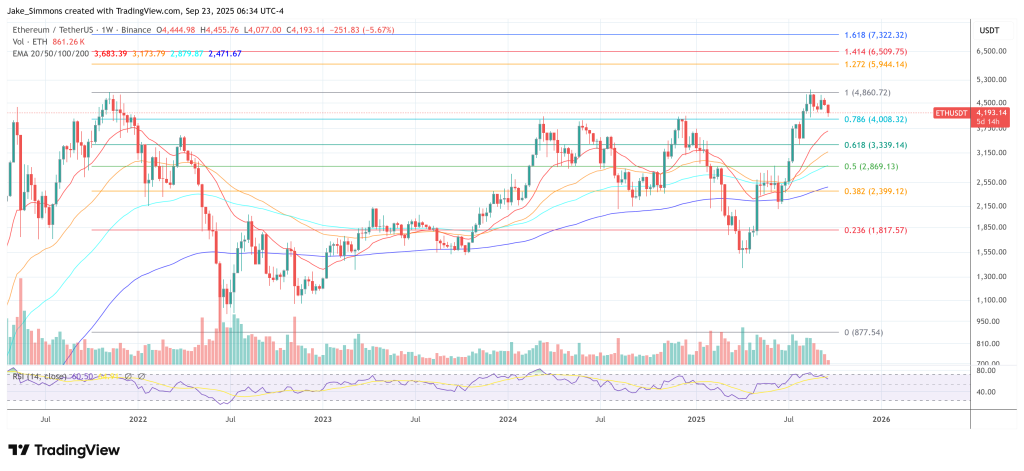
At press time, ETH traded at $4,193.
Ethereum price
ETH remains above the 0.786 FIb, 1-week chart | Source: ETHUSDT on TradingView.com
Featured image created with DALL.E, chart from TradingView.com
Editorial Process for bitcoinist is centered on delivering thoroughly researched, accurate, and unbiased content. We uphold strict sourcing standards, and each page undergoes diligent review by our team of top technology experts and seasoned editors. This process ensures the integrity, relevance, and value of our content for our readers.

Jake Simmons has been a Bitcoin enthusiast since 2016. Ever since he heard about Bitcoin, he has been studying the topic every day and trying to share his knowledge with others. His goal is to contribute to Bitcoin's financial revolution, which will replace the fiat money system. Besides BTC and crypto, Jake studied Business Informatics at a university. After graduation in 2017, he has been working in the blockchain and crypto sector. You can follow Jake on Twitter at @realJakeSimmons.

Trending Cryptos

Related Reads

a16z: In the AI Era, Company Competition for Talent Starts with Job Title Naming

The article discusses how companies in the AI era are competing for talent through strategic "title arbitrage," or the renaming of key roles to reflect and attract new, high-value capabilities. It uses Palantir's creation of the "Forward-Deployed Engineer" (FDE) as a prime example. This title reframed client-facing technical work from a peripheral "implementation" role into a core, high-status engineering function. The move was strategic, allowing Palantir to attract talent that blended technical skill with business acumen and to dominate the market's perception of this capability. The piece argues that job titles are an organizational language that signals the value and authority of certain work. Effective new titles, like "Data Scientist" or "Site Reliability Engineer," emerge when a role's strategic importance genuinely outgrows its old name. Conversely, mere title inflation without substantive change is ineffective. For AI companies, particularly in B2B, this is a crucial strategy. AI transformation creates new high-leverage roles (e.g., "Legal Engineer," "GTM Engineer") that combine domain expertise with technical automation. By naming these roles, a company can help clients internally legitimize these change-makers. This, in turn, builds market mindshare, associating the company with the new capability. In conclusion, as AI blurs the lines between product and service, the ability to accurately name and organize the critical, client-adjacent work that defines product learning will be a key competitive advantage. The first to define this new organizational language plants a flag in the market's mind.

marsbit29m ago

a16z: In the AI Era, Company Competition for Talent Starts with Job Title Naming

marsbit29m ago

Interview with Strategy CEO: Can STRC Recover After Selling Bitcoin?

Interview with Strategy CEO Phong Le on the recent sale of 32 Bitcoin and its impact. He clarifies the move was a small, strategic action to demonstrate liquidity to debt holders, test internal processes, and prove operational discipline—not a response to fears of a "death spiral" from DeFi protocols leveraging STRC (Strategy's preferred stock product), which he notes holds less than 10% of STRC. Le emphasizes Strategy’s long-term focus as the largest corporate Bitcoin holder, using the adage that markets are a "voting machine" short-term but a "weighing machine" long-term. Decision-making is data-driven, involving the board, complex modeling, and multiple stakeholder considerations, moving beyond a founder-centric model. He outlines various capital options but stresses the strategic importance of "doing nothing" as a valid choice, citing resilience built during the 2022 bear market. Le expresses unwavering belief in Bitcoin's foundational value for global sovereignty and its future role in an AI-driven economy with trillions of autonomous agents. Addressing STRC's current price below its $100 face value, Le explains recent pressure was due to using dollar reserves for bond buybacks. He expects STRC to return to par as reserves are replenished and its semi-monthly dividend payments begin, noting the product is heavily over-collateralized. Finally, Le confirms the company sold Bitcoin the week prior to May 31st, as disclosed in an 8-K filing, leaving prediction market interpretations to others. The overarching philosophy remains "Spread Bitcoin with love," embracing all methods of gaining Bitcoin exposure.

marsbit1h ago

Interview with Strategy CEO: Can STRC Recover After Selling Bitcoin?

marsbit1h ago

IOSG Founder: Ethereum Doesn't Need Another Leap of Technical Faith, It Needs a Musk-style Compromise

Jocy, founder of IOSG Ventures, argues that Ethereum does not need renewed technological faith but a "Musk-like compromise." The recent formation of ETHLabs—funded by major ETH holders like BitMine and Lubin—highlights a market-driven move to fill a gap left by the Ethereum Foundation (EF), signaling a loss of confidence in its decentralized, hands-off approach. The core critique contrasts Vitalik Buterin's (V) idealistic, technology-first vision with Elon Musk's pragmatic, business-driven execution. The author asserts Ethereum's current shortage is not another technical roadmap but a clear, real-world application narrative and a leader willing to engage directly with commercial realities—like Musk. Internal issues are emphasized, citing EF's management problems and talent drain. While the new decentralized model with independent nodes like ETHLabs addresses the single foundation's limitations, it risks fragmentation without cohesive direction. True cohesion, the author suggests, must come from a shared, compelling narrative around ETH's value, not just from aligned financial interests. Independence claims for new entities are seen as aspirational, needing years of transparency to build trust. The ultimate threat is not competitors like Solana, but the broader shift of attention and talent toward AI. Ethereum has a limited window—12 to 18 months—to recapture focus by delivering tangible, real-world applications. The conclusion urges V to shift from abstract ideals to grounded, pragmatic leadership. The time for this crucial pivot is running out.

marsbit2h ago

IOSG Founder: Ethereum Doesn't Need Another Leap of Technical Faith, It Needs a Musk-style Compromise

marsbit2h ago

Trading

Spot
Futures

Hot Articles

Discussions

Welcome to the HTX Community. Here, you can stay informed about the latest platform developments and gain access to professional market insights. Users' opinions on the price of ETH (ETH) are presented below.

活动图片