Why Bitcoin Hyper’s Layer-2 Could Make Bitcoin Relevant for Developers & Modern Demands

bitcoinistPublished on 2025-09-23Last updated on 2025-09-23

Abstract

Bitcoin is arguably the most popular cryptocurrency in the world. When someone talks about crypto, they’re almost always referring to...

Trusted Editorial content, reviewed by leading industry experts and seasoned editors. Ad Disclosure

Bitcoin is arguably the most popular cryptocurrency in the world. When someone talks about crypto, they’re almost always referring to Bitcoin.

$BTC commands around 57% of the total crypto market cap, sitting at $2.52T. Most of the crypto rags-to-riches stories you’ve heard are more often than not attributed to Bitcoin.

However, despite all the pomp and ceremony around the ‘digital gold,’ it’s still not a complete cryptocurrency when compared to the likes of Ethereum and Solana.

Beyond being one of the best wealth creators of the past decade, Bitcoin has done little to advance the development of crypto blockchains themselves.

Bitcoin is still not compatible with smart contracts, dApps, or the broader Web3 space. Here’s where Bitcoin Hyper ($HYPER) comes into the picture.

$HYPER is a Layer-2 Bitcoin solution that solves the issues of scalability, speed, and transaction costs, adding a whole new arm of utility to the network.

In this article, we’ll discuss $HYPER in detail and explain why it’s arguably the best crypto to buy in 2025.

Problems with Bitcoin

Bitcoin can currently process just seven transactions per second. Compare this with Solana’s average of 65K transactions per second.

In a recent test run in April 2025, Solana even clocked 100K transactions per second. Against such massive throughputs, Bitcoin still has a mountain to climb.

Also, the current Bitcoin block time is 10 minutes. This means it takes Bitcoin 10 minutes to add a new block of transactions to the blockchain.

By contrast, Solana has a block time of only 0.4 seconds. In other words, by the time Bitcoin processes one transaction, Solana can process around 1.5K.

This sluggishness also translates into higher transaction costs. The average cost on Bitcoin is $0.84 per transaction, which might not seem like a lot for large transfers.

However, it makes micro-transactions and small interactions quite expensive. Solana, on the other hand, has an average cost of just $0.00025 per transaction.

All in all, it’s easy to see why developers gravitate toward the likes of Solana and Ethereum for Web3 applications.

This is a massive missed opportunity for Bitcoin, as it’s losing out on potential revenue. For instance, Solana has generated $1.25B in revenue year-to-date, while Ethereum sits at $523M.

A more developer-friendly, faster, and cheaper Bitcoin blockchain could open new doors of alternate revenue for the network.

$HYPER Turbocharges Bitcoin with More Speed

But what if the same speeds – or at least comparable ones – were introduced on the Bitcoin network?

That’s exactly what Bitcoin Hyper ($HYPER) aims to achieve through its Solana Virtual Machine (SVM) integration, aka the very execution environment that powers Solana’s high throughputs.

SVM’s secret sauce is parallel execution: a model where multiple transactions are processed simultaneously, as long as they’re not related to each other.

This stands in stark contrast to Bitcoin’s one-at-a-time approach, which is simply not enough in today’s fast-moving blockchain environment.

Bitcoin Hyper is a Layer-2 (L2) solution, meaning it’s built on the Bitcoin Layer-1 blockchain. As with any L2, transactions are processed off-chain. That said, you don’t end up compromising the security of Layer-1 Bitcoin in the process, which makes it a win-win.

In this setup, Bitcoin Hyper batches the results of all transactions and sends them to the Bitcoin mainchain, giving you the dual benefits of fast execution and Bitcoin’s top-notch security.

Build dApps and Execute Smart Contracts on Bitcoin

Bitcoin Hyper not only solves the problem of speed on the Bitcoin blockchain but also opens up a new realm of dApps and Web3 compatibility through its non-custodial, decentralized canonical bridge.

This bridge serves as the connecting point between Bitcoin’s Layer-1 and its Layer-2 solution.

Here’s how it works: let’s say you hold one Bitcoin and want to engage with a dApp. Currently, that’s not possible; you’d have to convert your Bitcoin into another cryptocurrency, such as Ethereum or Solana.

Bitcoin Hyper's layer-2 ecosystem explained, step by step.

With the canonical bridge, however, you can send your Layer-1 Bitcoin to the bridge, which verifies and locks it. In return, it mints you an equivalent amount of Layer-2 Bitcoin tokens as wrapped $BTC.

These L2 tokens can then be freely used across dApps, the Web3 space, NFT marketplaces, and more. We’re talking staking, lending, borrowing, and just about everything else you can imagine under the Web3 umbrella.

This means you don’t have to give up the security of Bitcoin to participate in Web3 – something that wasn’t possible before.

Why Should You Buy $HYPER Now?

$HYPER is not like other BTC-themed cryptocurrency projects that simply want to cash in on Bitcoin’s popularity or bull run.

It has actually gone back to the drawing board and solved key problems on the Bitcoin blockchain, which makes it one of the best altcoins to buy right now.

Needless to say, a solution-based crypto platform that adds real utility to the most popular cryptocurrency is an unmissable investment opportunity.

This is why the Bitcoin Hyper ($HYPER) presale has been a huge success, having already raised more than $17.7M.
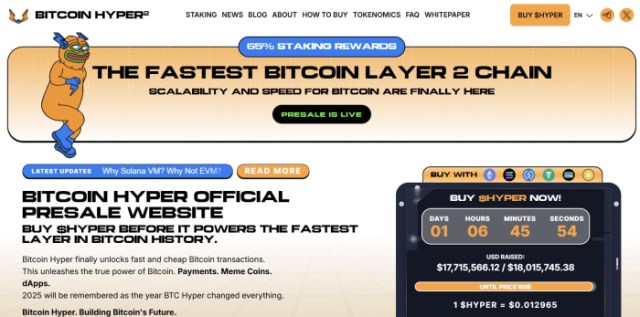
$HYPER live presale info.

And it’s not just retail enthusiasm driving the numbers; several crypto whales have been spotted scooping up large chunks of $HYPER in multiple transactions.

For example, two whales recently bought $17.6K and $12.9K worth of $HYPER respectively. That’s the kind of institutional confidence worth paying attention to.

Each token today is available at $0.012965, which you can stake for 65% APY. And according to our $HYPER price prediction, it has the potential to soar to $0.32 by the end of 2025, offering mouth-watering returns of over 2,300%.

The next token price increase is less than two days away, so you may not get another chance to buy $HYPER at this low price. Interested? Here’s a step-by-step guide on how to buy Bitcoin Hyper.

Visit $HYPER’s official website to learn more about how it’s bringing Bitcoin up to modern blockchain standards.

Disclaimer: None of the above is financial advice. Crypto is highly risky and unpredictable, so kindly always do your own research before investing.

Authored by Krishi Chowdhary, Bitcoinist – https://bitcoinist.com/bitcoin-hyper-layer2-makes-bitcoin-relevant-for-developers

Editorial Process for bitcoinist is centered on delivering thoroughly researched, accurate, and unbiased content. We uphold strict sourcing standards, and each page undergoes diligent review by our team of top technology experts and seasoned editors. This process ensures the integrity, relevance, and value of our content for our readers.

As a crypto writer, Krishi splits his time between decoding the chaos of the markets and writing about it in a way that doesn’t put you to sleep. He’s been at it for nearly two years in the crypto trenches. Yes, he regrets missing the magnificent rallies that came before that (who doesn’t!), but he’s more than ready to put his money where his words are. Before diving headfirst into crypto, Krishi spent over five years writing for some of the biggest names in tech, including TechRadar, Tom’s Guide, and PC Gaming, covering everything from gadgets and cybersecurity to gaming and software. When he’s not scouring and writing about the latest happenings in crypto, Krishi trades the forex market while keeping crypto in his long-term HODL plans. He’s a Bitcoin believer, though he never lets that bias creep into his writing.

Trending Cryptos

Related Reads

The Full Story Behind Encryption Unicorn Blockstream's Deep Entanglement in Serious Fraud Allegations

This article details allegations of serious fraud surrounding the crypto company Blockstream, founded by Bitcoin pioneer Adam Back. Investigation account NatInfoSec accuses Blockstream of raising billions through its Blockstream Mining Note (BMN) products, which offer high fixed yields of up to 20% from purported mining revenue. The core allegations are: 1) Blockstream's public mining hash rate (15 EH/s) appears insufficient to cover the massive payout obligations from sold BMN notes, raising questions about the true source of investor payouts. 2) Key executive Christopher William Cook, central to the mining operations, has a prior federal conviction for mail fraud, a fact not disclosed to investors. Cook's background and lavish lifestyle are highlighted as red flags. 3) The structure allows payouts from any source of BTC, not necessarily mining revenue, which critics argue gives it Ponzi-like characteristics. The controversy also touches on Bitcoin Standard Treasury Company (BSTR), a related entity planning a SPAC上市. Critics question whether BMN's liabilities and Cook's record should be disclosed in BSTR's filings. BitMEX Research offered a tempered analysis, confirming Cook's criminal record is likely true and the high yields concerning, but found other claims like insufficient抵押证据 less substantiated. Community debate centers on the need for verifiable proof of Blockstream's mining output and revenue. The article concludes that while fraud is not proven, BMN presents significant, unresolved questions regarding its actual scale, the source of its high fixed returns, the verifiability of its mining operations and payouts, and the full disclosure of associated risks and personnel backgrounds. Blockstream has not yet issued a formal response.

链捕手46m ago

The Full Story Behind Encryption Unicorn Blockstream's Deep Entanglement in Serious Fraud Allegations

链捕手46m ago

a16z: In the AI Era, Company Competition for Talent Starts with Job Title Naming

The article discusses how companies in the AI era are competing for talent through strategic "title arbitrage," or the renaming of key roles to reflect and attract new, high-value capabilities. It uses Palantir's creation of the "Forward-Deployed Engineer" (FDE) as a prime example. This title reframed client-facing technical work from a peripheral "implementation" role into a core, high-status engineering function. The move was strategic, allowing Palantir to attract talent that blended technical skill with business acumen and to dominate the market's perception of this capability. The piece argues that job titles are an organizational language that signals the value and authority of certain work. Effective new titles, like "Data Scientist" or "Site Reliability Engineer," emerge when a role's strategic importance genuinely outgrows its old name. Conversely, mere title inflation without substantive change is ineffective. For AI companies, particularly in B2B, this is a crucial strategy. AI transformation creates new high-leverage roles (e.g., "Legal Engineer," "GTM Engineer") that combine domain expertise with technical automation. By naming these roles, a company can help clients internally legitimize these change-makers. This, in turn, builds market mindshare, associating the company with the new capability. In conclusion, as AI blurs the lines between product and service, the ability to accurately name and organize the critical, client-adjacent work that defines product learning will be a key competitive advantage. The first to define this new organizational language plants a flag in the market's mind.

marsbit2h ago

a16z: In the AI Era, Company Competition for Talent Starts with Job Title Naming

marsbit2h ago

Trading

Spot
Futures

Hot Articles

What is $BITCOIN

DIGITAL GOLD ($BITCOIN): A Comprehensive Analysis Introduction to DIGITAL GOLD ($BITCOIN) DIGITAL GOLD ($BITCOIN) is a blockchain-based project operating on the Solana network, which aims to combine the characteristics of traditional precious metals with the innovation of decentralized technologies. While it shares a name with Bitcoin, often referred to as “digital gold” due to its perception as a store of value, DIGITAL GOLD is a separate token designed to create a unique ecosystem within the Web3 landscape. Its goal is to position itself as a viable alternative digital asset, although specifics regarding its applications and functionalities are still developing. What is DIGITAL GOLD ($BITCOIN)? DIGITAL GOLD ($BITCOIN) is a cryptocurrency token explicitly designed for use on the Solana blockchain. In contrast to Bitcoin, which provides a widely recognized value storage role, this token appears to focus on broader applications and characteristics. Notable aspects include: Blockchain Infrastructure: The token is built on the Solana blockchain, known for its capacity to handle high-speed and low-cost transactions. Supply Dynamics: DIGITAL GOLD has a maximum supply capped at 100 quadrillion tokens (100P $BITCOIN), although details regarding its circulating supply are currently undisclosed. Utility: While precise functionalities are not explicitly outlined, there are indications that the token could be utilized for various applications, potentially involving decentralized applications (dApps) or asset tokenization strategies. Who is the Creator of DIGITAL GOLD ($BITCOIN)? At present, the identity of the creators and development team behind DIGITAL GOLD ($BITCOIN) remains unknown. This situation is typical among many innovative projects within the blockchain space, particularly those aligning with decentralized finance and meme coin phenomena. While such anonymity may foster a community-driven culture, it intensifies concerns about governance and accountability. Who are the Investors of DIGITAL GOLD ($BITCOIN)? The available information indicates that DIGITAL GOLD ($BITCOIN) does not have any known institutional backers or prominent venture capital investments. The project seems to operate on a peer-to-peer model focused on community support and adoption rather than traditional funding routes. Its activity and liquidity are primarily situated on decentralized exchanges (DEXs), such as PumpSwap, rather than established centralized trading platforms, further highlighting its grassroots approach. How DIGITAL GOLD ($BITCOIN) Works The operational mechanics of DIGITAL GOLD ($BITCOIN) can be elaborated on based on its blockchain design and network attributes: Consensus Mechanism: By leveraging Solana’s unique proof-of-history (PoH) combined with a proof-of-stake (PoS) model, the project ensures efficient transaction validation contributing to the network's high performance. Tokenomics: While specific deflationary mechanisms have not been extensively detailed, the vast maximum token supply implies that it may cater to microtransactions or niche use cases that are still to be defined. Interoperability: There exists the potential for integration with Solana’s broader ecosystem, including various decentralized finance (DeFi) platforms. However, the details regarding specific integrations remain unspecified. Timeline of Key Events Here is a timeline that highlights significant milestones concerning DIGITAL GOLD ($BITCOIN): 2023: The initial deployment of the token occurs on the Solana blockchain, marked by its contract address. 2024: DIGITAL GOLD gains visibility as it becomes available for trading on decentralized exchanges like PumpSwap, allowing users to trade it against SOL. 2025: The project witnesses sporadic trading activity and potential interest in community-led engagements, although no noteworthy partnerships or technical advancements have been documented as of yet. Critical Analysis Strengths Scalability: The underlying Solana infrastructure supports high transaction volumes, which could enhance the utility of $BITCOIN in various transaction scenarios. Accessibility: The potential low trading price per token could attract retail investors, facilitating wider participation due to fractional ownership opportunities. Risks Lack of Transparency: The absence of publicly known backers, developers, or an audit process may yield skepticism regarding the project's sustainability and trustworthiness. Market Volatility: The trading activity is heavily reliant on speculative behavior, which can result in significant price volatility and uncertainty for investors. Conclusion DIGITAL GOLD ($BITCOIN) emerges as an intriguing yet ambiguous project within the rapidly evolving Solana ecosystem. While it attempts to leverage the “digital gold” narrative, its departure from Bitcoin's established role as a store of value underscores the need for a clearer differentiation of its intended utility and governance structure. Future acceptance and adoption will likely depend on addressing the current opacity and defining its operational and economic strategies more explicitly. Note: This report encompasses synthesised information available as of October 2023, and developments may have transpired beyond the research period.

441 Total ViewsPublished 2025.05.13Updated 2025.05.13

What is $BITCOIN

Discussions

Welcome to the HTX Community. Here, you can stay informed about the latest platform developments and gain access to professional market insights. Users' opinions on the price of BTC (BTC) are presented below.

活动图片