VivoPower будет приобретать XRP в рамках казначейской стратегии

cryptonews.ruPublished on 2025-03-16Last updated on 2025-09-17

VivoPower International PLC, которая имеет казначейскую стратегию, ориентированную на XRP, объявила о том, что ее подразделение по майнингу цифровых активов Caret Digital получило оптовые скидки на дополнительные майнинговые установки и расширит свои операции по майнингу.

С ростом цен в секторе майнинга цифровых активов, экономика майнинга ещё больше улучшилась. VivoPower продолжит обменивать добытые токены на XRP в рамках своей двойной стратегии управления казначейскими активами. Ключевая цель этой стратегии — обеспечить доступ к XRP по максимально низкой средней стоимости за счёт сочетания обмена токенов, полученных в результате майнинга цифровых активов, и покупки акций Ripple Lab. VivoPower будет динамически управлять распределением активов в рамках процессов управления своим портфелем.

О VivoPower

Компания VivoPower International PLC (NASDAQ: VVPR) переживает стратегическую трансформацию, становясь первой в мире компанией, специализирующейся на цифровых активах XRP. Новое направление деятельности компании сосредоточено на приобретении, управлении и долгосрочном владении цифровыми активами XRP, в том числе через акции Ripple Labs, в рамках диверсифицированной стратегии цифрового казначейства. Благодаря этому переходу VivoPower стремится способствовать росту и повышению эффективности XRP Ledger (XRPL), поддерживая инфраструктуру децентрализованных финансов (DeFi) и реальные блокчейн-приложения.

Trending Cryptos

Related Reads

Olympus DAO Myth Reappears? A "Sovereign On-Chain Central Bank" Written with 4000 Lines of Immutable Code

A new project called The Standard Reserve has emerged, branding itself as a "sovereign on-chain central bank." It aims to replicate core central bank functions—currency issuance, money supply adjustment, and reserve accumulation—entirely through 4,000 lines of immutable code, with no human governance. Its core mechanism is a "reflexive monetary policy" based on a single signal: the net ETH flow into or out of the system's sole Uniswap v4 ETH/$STANDARD pool. Sustained net ETH inflows trigger an "expansion" phase, increasing $STANDARD issuance and using protocol fees to buy tokenized gold as a permanent hard reserve. Net outflows (or zero flow) trigger an immediate "contraction" phase, reducing issuance and using fees to buy back and burn $STANDARD. The system involves six key entities: the $STANDARD token (hard-capped at 1 billion), the central Uniswap pool, the Central Bank contract, Charter NFTs (acting as "banking licenses"), Branch units under each Charter (which earn a share of newly minted $STANDARD), and separate Vaults for expansion (buying gold) and contraction (buying back $STANDARD). To participate, users ideally acquire a Founding Charter NFT (initially 1,000 are free via allowlist/public mint). Each Charter comes with one Branch; more can be opened by burning $STANDARD for "expansion permits," increasing revenue share. Retiring a Branch lets users claim accumulated $STANDARD but imposes a dynamic exit fee (higher if many exit simultaneously), with half the fee burned and half distributed to remaining participants. All protocol revenue (from pool fees and Charter auctions) is allocated: 70% to the active Vault (for gold or buybacks), 15% to permanent protocol-owned liquidity, and 15% to the team. The project presents an innovative, game-theoretic model where user actions (expanding Branches by burning tokens or exiting) align with system goals of building reserves or inducing deflation. However, it is fully anonymous, with key parameters undefined and unaudited code, posing significant risks.

marsbit14m ago

Olympus DAO Myth Reappears? A "Sovereign On-Chain Central Bank" Written with 4000 Lines of Immutable Code

marsbit14m ago

US Jobs, China PMI, and Inflation on Stage: Can Global Growth Maintain Resilience?

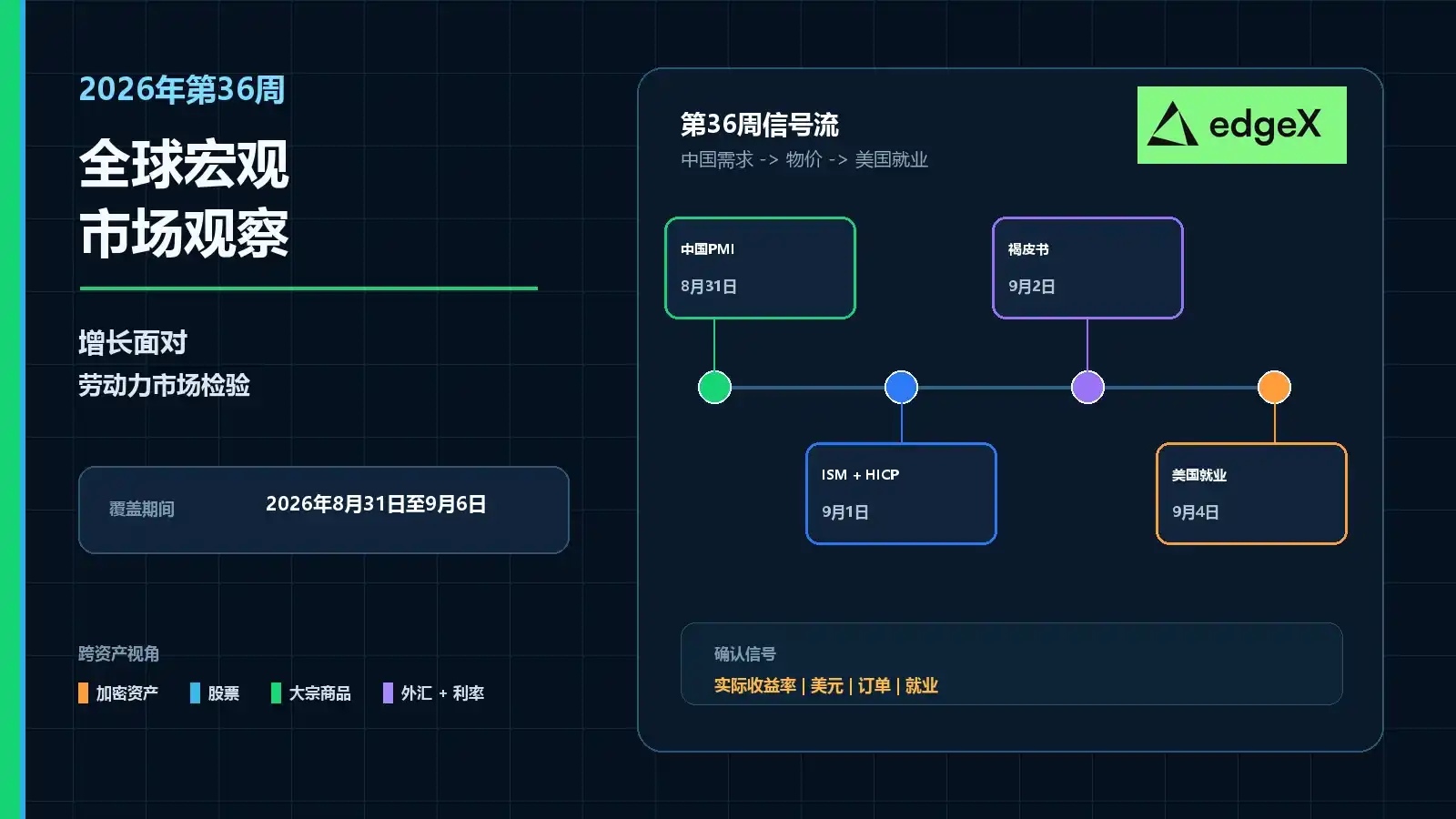
**Week 36 Macro Outlook: Key Data to Test Global Growth Resilience** The week from August 31 to September 6 will shift focus from policy discussions to a critical test of global economic activity. The sequence of events is key, starting with China's official August PMI on Aug 31, which will provide early signals on factory orders, services, and employment following July's contraction. The data flow then broadens. On September 1, US ISM Manufacturing PMI and the Eurozone's flash inflation estimate will offer simultaneous checks on demand, prices, and regional divergence. The subsequent US Federal Reserve Beige Book on September 2 adds granular, qualitative evidence on consumer spending, wages, and regional conditions. Australian Q2 GDP and Canadian trade and jobs data will test resilience in other major economies. The week's pivotal event, however, is the US August employment report on September 4. It will decisively influence expectations for interest rates, the US dollar, and broader risk appetite, acting as a final cross-check for the preceding data. The core question for markets is whether global growth can remain resilient. An ideal outcome would combine a rebound in China's PMI, stable US jobs growth, cooling inflation, and signs of a gradual demand slowdown. Conversely, weak Chinese manufacturing, sticky Eurozone prices, and disappointing US non-farm payrolls would create a more complex scenario of reduced corporate confidence and limited room for aggressive monetary easing, increasing pressure on cyclical assets. Investors should monitor the breadth of improvements—such as new orders and employment—rather than headline PMI figures alone. Confirmation across different data points is crucial. A positive combination of steady activity and disinflation could support equities, industrial commodities, and risk assets like crypto. However, if a growth slowdown triggers lower yields, it must be distinguished from a scenario of rising recession risks that would pressure corporate earnings, potentially limiting rallies. The market's final reaction will hinge on whether the week's signals align to either reinforce or challenge the current growth narrative.

marsbit17m ago

US Jobs, China PMI, and Inflation on Stage: Can Global Growth Maintain Resilience?

marsbit17m ago

Trading

Spot

Hot Articles

What is XRP 2.0

XRP 2.0: A New Frontier in the Cryptocurrency Landscape Introduction to XRP 2.0 In the ever-evolving realm of cryptocurrency, new projects continuously emerge, vying for attention and adoption. One such promising initiative is XRP 2.0, a novel cryptocurrency project designed to leverage advanced blockchain technology and robust encryption methodologies. While the name draws parallels with Ripple’s XRP, it’s crucial to note that XRP 2.0 operates independently, focusing on enhancing transaction security, privacy, and scalability. As the digital financial landscape increasingly embraces decentralized solutions, XRP 2.0 aims to contribute meaningfully to web3 and the overall expansion of crypto projects. What is XRP 2.0? At its core, XRP 2.0 is a cryptocurrency project that aims to create a secure and decentralized digital currency ecosystem. Its foundational technology integrates sophisticated blockchain principles with cutting-edge encryption techniques. The overarching goal of XRP 2.0 is to establish itself as a reliable and efficient platform enabling swift transaction execution while prioritizing enhanced privacy protections for its users. The project is promoted as a solution to many limitations faced by existing cryptocurrencies, proposing a system that can handle a higher volume of transactions with improved speed and privacy. This versatility positions XRP 2.0 as a significant contender in a marketplace riddled with various digital currencies. Who is the Creator of XRP 2.0? The identity of the creator behind XRP 2.0 has been flagged as ‘Wilbur.’ However, comprehensive details regarding Wilbur or their associated entity remain elusive. The anonymity of many cryptocurrency creators is not an uncommon phenomenon in the industry, often designed to maintain a degree of privacy and security. Who are the Investors of XRP 2.0? As of now, specific information related to the investment foundations or organizations supporting XRP 2.0 is not publicly available. In the cryptocurrency sector, the backing by reputed investors can significantly influence a project's credibility and success, yet the transparency regarding the financial supporters of XRP 2.0 has not been established. How Does XRP 2.0 Work? XRP 2.0 stands out by employing a combination of blockchain technology and advanced encryption algorithms that ensures secure and decentralized transactions. Its innovative structure includes unique features designed to foster user engagement and broaden functionalities beyond conventional cryptocurrency transactions. Among these features, XRP 2.0 incorporates AI-powered capabilities, such as text-to-image and text-to-speech functionalities. These additions are designed to enhance the interactive experience for users, promoting broader applicability across various sectors. By bridging technological advancements with user-centered design, XRP 2.0 aims to capture the attention of a diverse range of individuals and enterprises looking to integrate cryptocurrency solutions into their operational frameworks. Timeline of XRP 2.0 Understanding XRP 2.0 requires examining the milestones that have defined its journey thus far: July 23, 2023: XRP 2.0 is introduced as a novel cryptocurrency project, aiming to revolutionize secure and decentralized transaction capabilities in the blockchain domain. September 8, 2023: The launching of another project, XRP20, occurs, marking the emergence of an ERC-20 token on the Ethereum blockchain that remains unrelated to XRP 2.0. November 13, 2023: The XRP Ledger undergoes a significant update with the release of rippled server software version 2.0.0. It is essential to note that this development is disconnected from the XRP 2.0 cryptocurrency project. Key Points About XRP 2.0 To distill the essence of XRP 2.0, several critical factors emerge: Unique Features: The inclusion of features like AI-powered text-to-image and text-to-speech further diversifies the potential applications of XRP 2.0. Blockchain Technology: The framework utilizes advanced blockchain mechanisms and encryption protocols, ensuring a secure and decentralized environment for transactions. Scalability and Privacy: XRP 2.0 prioritizes enhanced privacy protections in transaction processes and the scalability necessary to accommodate a growing user base. No Affiliation with Ripple: Importantly, despite its name, XRP 2.0 does not have any allegiance or collaboration with Ripple’s XRP, distinguishing its operational framework and objectives within the cryptocurrency ecosystem. Conclusion XRP 2.0 represents an ambitious venture into the cryptocurrency sphere, aiming to offer a combination of security, privacy, and efficiency in digital transactions. By integrating sophisticated technologies and user-friendly features, the project sets out to broaden the horizons of what cryptocurrency can achieve in today's digital economy. While the anonymity of its creator and lack of disclosed investors might raise questions for some, XRP 2.0's focus on advanced functionalities and decentralisation enhances its appeal amidst an increasingly crowded crypto market. As the cryptocurrency landscape continues to evolve, XRP 2.0 may yet emerge as a pivotal player in the expansion of secure and scalable blockchain solutions.

1.6k Total ViewsPublished 2024.04.01Updated 2024.12.03

What is XRP 2.0

Discussions

Welcome to the HTX Community. Here, you can stay informed about the latest platform developments and gain access to professional market insights. Users' opinions on the price of XRP (XRP) are presented below.

活动图片