Gold Price Hits $4,620 as Treasury Buyback Reignites Dollar Devaluation Speculation

cryptonews.ruPublished on 2026-08-24Last updated on 2026-08-24

Abstract

Gold price surged to a three-month high above $4,620 per ounce as the U.S. Treasury Department's plan to double its long-term bond buybacks from September 9 to November 4 reignited fears of a weakening U.S. dollar. The dollar index dropped to a low not seen since mid-May following the announcement. Analysts noted the buyback program effectively shifts government borrowing towards short-term bills, a move markets view as negative for the dollar. This served as a catalyst, pushing spot gold as high as $4,600 with futures nearing $4,650. Technical analysts identified a breakout above the 200-day moving average, with the next key resistance level seen above $4,770. Some traders now speculate gold could reach $5,000 if the dollar's decline continues. Notably, the World Gold Council's optimistic 2026 scenario had been $4,500, a level already significantly surpassed. The same dollar-devaluation narrative also fueled a roughly 20% surge in Bitcoin following the Treasury's announcement, though some strategists remain skeptical of equating Bitcoin with traditional safe-havens like gold and silver.

Analysts at Bloomberg noted that gold rose to a three-month high above $4,620 per ounce as Treasury Department intervention in the bond market revived concerns about dollar weakness. Throughout the week, spot gold traded in the range of $4,580 to $4,600, while futures broke towards the $4,650 mark.
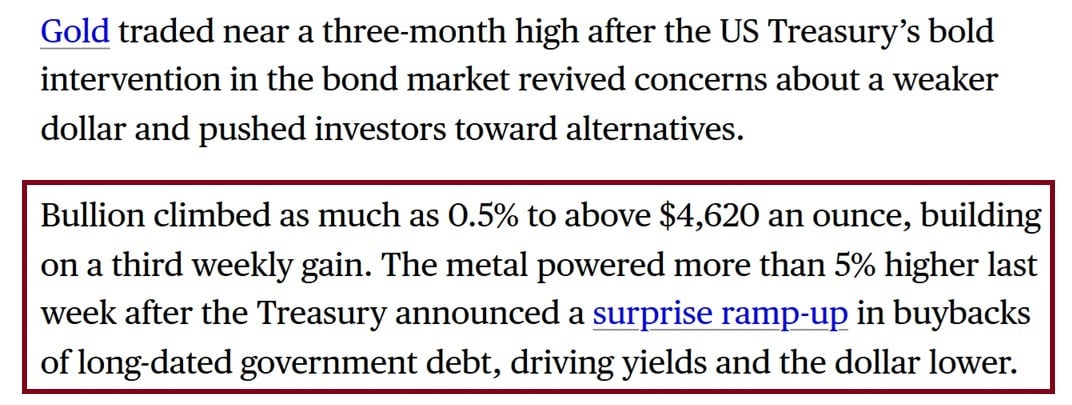
Image Source: Bloomberg.com

Saxo Bank's Commodity Strategist Ole Hansen stated that gold "continues its confident climb, adding 1.8% for the day and 5.1% for the week," calling the break above the 200-day moving average a technical trigger for new purchases in an uptrend and identifying a level above $4,770 as the next resistance mark.

Some traders view a breakout above this level as confirmation that the rally has potential for further gains and talk about a price of $5,000 per ounce if the dollar continues to fall. This rise has been more significant than most analysts expected, and in its June-published semi-annual forecast, the World Gold Council considered reaching the $4,500 mark as an optimistic scenario requiring a "strong and clear signal" from policymakers.

The Treasury Department's buyback decision appears to have been that signal, as gold is now trading significantly above the level the Council outlined as the optimistic scenario for 2026.

Treasury's Buyback Bet – The Reason for the Rise

The catalyst was the U.S. Treasury Department's announcement on August 19th that it would double the volume of long-term bond buyback operations from September 9th to November 4th. This announcement came just days after the yield on 30-year Treasury bonds surged to a 19-year high of 5.337% – a sell-off that rattled the bond markets and spurred officials into action.

The buyback plan lowered yields to 5.198% but hit the dollar: the dollar index fell to 98.723 – its lowest level since May 14th. Analysts, including ING's Global Markets Head Chris Turner and Capital Economics economist Ariane Curtis, pointed to the expansion of the buyback program as the trigger, noting that this move effectively reorients government borrowing towards short-term bills (a compromise that markets view as negative for the dollar, even though it stabilizes long-term debt).

The buyback of its own bonds allows the Treasury to retire old, less liquid bonds, purchasing them with proceeds from the sale of new bonds – a tool it has repeatedly used this year to prevent a spiral in long-term borrowing costs after a yield spike shook auctions.

Robert Kiyosaki, author of "Rich Dad Poor Dad," went even further, calling the expansion of the bond buyback program a form of quantitative easing and urging his followers to invest in Bitcoin, gold, silver, and select real estate assets. This comparison is not entirely accurate, given that the Treasury finances the buyback of its own bonds from debt issuance proceeds, not by injecting new central bank money, unlike true quantitative easing. Nonetheless, the market's reaction to the dollar this week looked practically the same in both cases.

Bitcoin "Picks Up" the Same Devaluation Trend

As reported by Bitcoin.com News, when the Treasury Department's buyback program expansion first hit the markets, Bitcoin jumped about 20% in the days after the announcement, continuing a recovery that has become closely linked to the same narrative of dollar weakness driving gold prices. Economist Mohamed El-Erian noted that Bitcoin's rise to the $79,000 mark alongside gold's price rise above $4,600 were stark examples of the same trade succeeding, but not everyone seems convinced that Bitcoin should be in that basket.

Robin Brooks, former chief currency strategist at Goldman Sachs who first popularized the "devaluation trade" theory, stated that he "would stay away from Bitcoin," arguing that markets do not perceive it the same way as gold and silver.

end-content
Related Questions

QWhat was the main catalyst for the recent surge in the price of gold, as described in the article?

AThe main catalyst was the U.S. Treasury's announcement on August 19th to double the size of its long-term bond buyback operations from September 9th to November 4th, which reignited concerns about dollar depreciation.

QAccording to Saxo Bank strategist Ole Hansen, what technical level did gold break through, and what is the next resistance level mentioned?

AGold broke through the 200-day moving average, which was a technical trigger for new buying. The next resistance level mentioned is above $4,770 per ounce.

QHow did the World Gold Council's mid-year forecast from June compare to the actual gold price discussed in the article?

AThe World Gold Council's optimistic scenario for 2026 considered reaching $4,500 per ounce, requiring a 'strong and clear signal' from policymakers. The actual price discussed is significantly higher, trading above $4,620.

QWhat impact did the Treasury's bond buyback plan have on the U.S. dollar and bond yields according to analysts cited?

AThe buyback plan lowered long-term bond yields (from a 19-year high of 5.337% to 5.198%) but hurt the dollar, pushing the dollar index down to 98.723, its lowest level since May 14th.

QWhat other major asset, besides gold, is described as benefiting from the same 'dollar depreciation' narrative, and what was a key dissenting opinion regarding it?

ABitcoin is described as benefiting from the same narrative, surging around 20% after the Treasury announcement. Former Goldman Sachs currency strategist Robin Brooks dissented, stating he would 'stay away from Bitcoin' as markets don't perceive it the same way as gold and silver.

Related Reads

Olympus DAO Myth Reappears? A "Sovereign On-Chain Central Bank" Written with 4000 Lines of Immutable Code

A new project called The Standard Reserve has emerged, branding itself as a "sovereign on-chain central bank." It aims to replicate core central bank functions—currency issuance, money supply adjustment, and reserve accumulation—entirely through 4,000 lines of immutable code, with no human governance. Its core mechanism is a "reflexive monetary policy" based on a single signal: the net ETH flow into or out of the system's sole Uniswap v4 ETH/$STANDARD pool. Sustained net ETH inflows trigger an "expansion" phase, increasing $STANDARD issuance and using protocol fees to buy tokenized gold as a permanent hard reserve. Net outflows (or zero flow) trigger an immediate "contraction" phase, reducing issuance and using fees to buy back and burn $STANDARD. The system involves six key entities: the $STANDARD token (hard-capped at 1 billion), the central Uniswap pool, the Central Bank contract, Charter NFTs (acting as "banking licenses"), Branch units under each Charter (which earn a share of newly minted $STANDARD), and separate Vaults for expansion (buying gold) and contraction (buying back $STANDARD). To participate, users ideally acquire a Founding Charter NFT (initially 1,000 are free via allowlist/public mint). Each Charter comes with one Branch; more can be opened by burning $STANDARD for "expansion permits," increasing revenue share. Retiring a Branch lets users claim accumulated $STANDARD but imposes a dynamic exit fee (higher if many exit simultaneously), with half the fee burned and half distributed to remaining participants. All protocol revenue (from pool fees and Charter auctions) is allocated: 70% to the active Vault (for gold or buybacks), 15% to permanent protocol-owned liquidity, and 15% to the team. The project presents an innovative, game-theoretic model where user actions (expanding Branches by burning tokens or exiting) align with system goals of building reserves or inducing deflation. However, it is fully anonymous, with key parameters undefined and unaudited code, posing significant risks.

marsbit12m ago

Olympus DAO Myth Reappears? A "Sovereign On-Chain Central Bank" Written with 4000 Lines of Immutable Code

marsbit12m ago

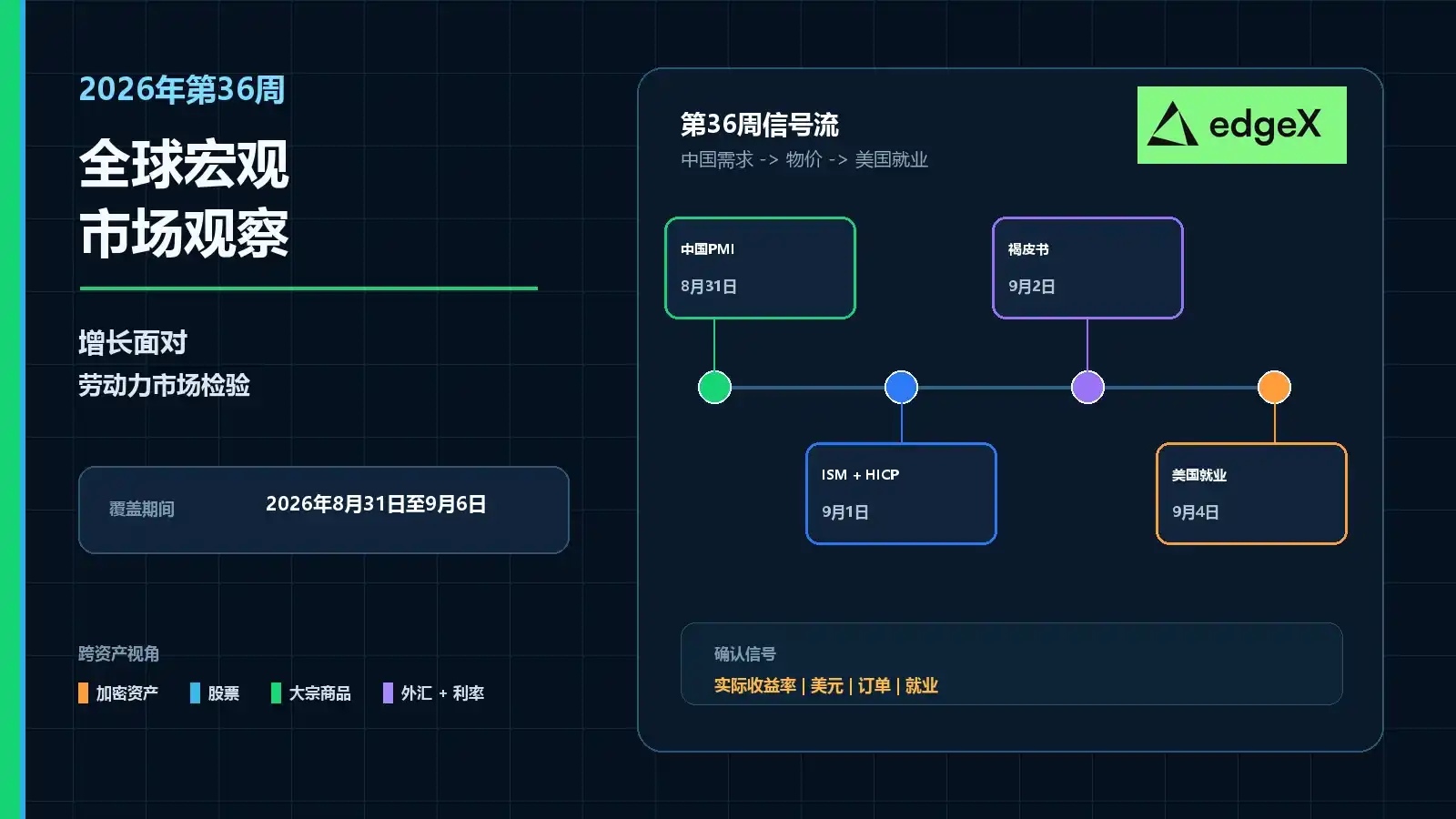
US Jobs, China PMI, and Inflation on Stage: Can Global Growth Maintain Resilience?

**Week 36 Macro Outlook: Key Data to Test Global Growth Resilience** The week from August 31 to September 6 will shift focus from policy discussions to a critical test of global economic activity. The sequence of events is key, starting with China's official August PMI on Aug 31, which will provide early signals on factory orders, services, and employment following July's contraction. The data flow then broadens. On September 1, US ISM Manufacturing PMI and the Eurozone's flash inflation estimate will offer simultaneous checks on demand, prices, and regional divergence. The subsequent US Federal Reserve Beige Book on September 2 adds granular, qualitative evidence on consumer spending, wages, and regional conditions. Australian Q2 GDP and Canadian trade and jobs data will test resilience in other major economies. The week's pivotal event, however, is the US August employment report on September 4. It will decisively influence expectations for interest rates, the US dollar, and broader risk appetite, acting as a final cross-check for the preceding data. The core question for markets is whether global growth can remain resilient. An ideal outcome would combine a rebound in China's PMI, stable US jobs growth, cooling inflation, and signs of a gradual demand slowdown. Conversely, weak Chinese manufacturing, sticky Eurozone prices, and disappointing US non-farm payrolls would create a more complex scenario of reduced corporate confidence and limited room for aggressive monetary easing, increasing pressure on cyclical assets. Investors should monitor the breadth of improvements—such as new orders and employment—rather than headline PMI figures alone. Confirmation across different data points is crucial. A positive combination of steady activity and disinflation could support equities, industrial commodities, and risk assets like crypto. However, if a growth slowdown triggers lower yields, it must be distinguished from a scenario of rising recession risks that would pressure corporate earnings, potentially limiting rallies. The market's final reaction will hinge on whether the week's signals align to either reinforce or challenge the current growth narrative.

marsbit14m ago

US Jobs, China PMI, and Inflation on Stage: Can Global Growth Maintain Resilience?

marsbit14m ago

Trading

Spot
活动图片