Solana News: Wie der Einstieg von SOL Strategies in den NASDAQ andere Coins pusht

bitcoinistPublished on 2025-09-15Last updated on 2025-09-15

Abstract

Solana geht immer weiter Richtung Institutionalisierung. SOL Strategies wagt den Sprung an die Nasdaq. Die Firma setzt voll auf Solana...

Trusted Editorial content, reviewed by leading industry experts and seasoned editors. Ad Disclosure
  • Solana geht immer weiter Richtung Institutionalisierung.
  • SOL Strategies wagt den Sprung an die Nasdaq.
  • Die Firma setzt voll auf Solana und vertraut auf langfristiges Wachstum.
  • CEO Leah Wald sieht in der Rolle des Underdogs einen echten Vorteil.

Eine Firma, die sich selbst als Außenseiter sieht, mischt nun an der weltberühmten Nasdaq mit: SOL Strategies. Das Unternehmen setzt voll auf die Kryptowährung Solana und möchte zeigen, dass auch kleine Spieler groß rauskommen können. CEO Leah Wald glaubt fest daran, dass unterschätzt zu werden ein echter Vorteil ist.

Neues Gesicht an der Nasdaq

Die Aktie von SOL Strategies ist seit kurzem an der Nasdaq handelbar. Zuvor war das Unternehmen nur in Kanada und im sogenannten OTC-Markt vertreten. Der Schritt an die US-Börse ist für die Firma ein Meilenstein und bringt deutlich mehr Aufmerksamkeit.

Anfangs war die Freude groß, denn die Aktie legte am ersten Handelstag zu. Doch schon nach wenigen Tagen folgte die Ernüchterung. Die Kurse schwankten stark und am Ende der Woche stand ein Minus. Für CEO Wald ist das kein Grund zur Sorge, denn sie denkt in Jahren, nicht in Tagen.

Wer steckt hinter SOL Strategies?

Seit Sommer 2024 leitet Leah Wald das Unternehmen. Sie bringt Erfahrung aus der Kryptobranche mit und scheut sich nicht davor, gegen große Namen anzutreten. Ihr Motto: Lieber unterschätzt werden als überbewertet.

Lies hier eine langfristige Prognose für die nächsten Jahre für Solana (SOL).

Wald ist überzeugt, dass gerade in der Kryptoszene Substanz wichtiger ist als Hype. Wer in Ruhe arbeiten kann, hat am Ende bessere Chancen. Für sie bedeutet „Underdog“ zu sein daher kein Nachteil, sondern eine Gelegenheit.

Ein kurzer Blick auf Solana

Bevor wir über die Pläne von SOL Strategies sprechen, ein kurzer Exkurs: Solana ist eine Kryptowährung, die besonders für ihre schnellen Transaktionen bekannt ist. Das Netzwerk gilt als eine Art „Expresszug“ unter den Blockchains und zieht viele Entwickler an, die darauf neue Projekte bauen.
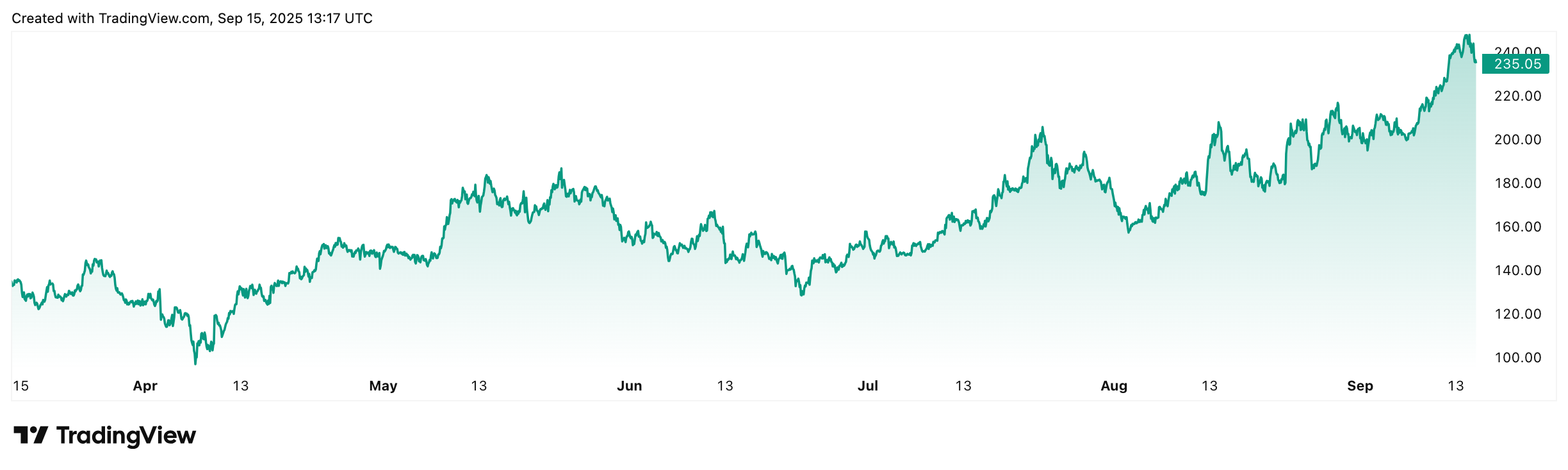
SOL/USD Kurs im Verlauf der letzten 6 Monate Quelle: Trading View

Solana hat schon Höhen und Tiefen erlebt, ist aber in den letzten Jahren immer wichtiger geworden. Genau darauf setzt SOL Strategies – sie wollen ein Teil dieses wachsenden Ökosystems sein.

Warum die Firma auf Solana setzt

SOL Strategies sieht in Solana die Zukunft. Statt viele verschiedene Kryptowährungen zu halten, konzentriert sich das Unternehmen klar auf diesen einen Bereich. CEO Wald glaubt, dass die Community und die Technik hinter Solana für langfristigen Erfolg sorgen können. Das vor kurzem bestätigte Update “Alpenglow” hat auch sehr für Optimismus in der Solana Bubble und noch bessere technische Vernetzung im Netzwerk gesorgt.

Dabei verfolgt die Firma eine klare Strategie: Sie will nicht nur mitreden, sondern aktiv am Aufbau des Solana-Netzwerks beteiligt sein. Mit dieser Spezialisierung will sie sich von anderen Unternehmen abheben.

Von Cypherpunk zu SOL Strategies

Der Name SOL Strategies ist noch relativ neu. Früher hieß das Unternehmen Cypherpunk Holdings und hatte einen breiteren Fokus. Doch vor einem Jahr kam die Neuausrichtung: weg von Bitcoin und anderen Investments, hin zu Solana. Einige Experten gehen davon aus, dass SOL noch dieses Jahr ein neues Allzeithoch erreichen wird.

Dieser Schritt war mutig, aber auch konsequent. Heute passt der Name perfekt zur Vision des Unternehmens, und er zeigt nach außen klar, worum es geht. Die Botschaft: Wir stehen für Solana – ohne Umwege.

Die Vision für die Zukunft

Leah Wald denkt langfristig. Ihr Ziel ist es, SOL Strategies zu einer wichtigen Adresse im Solana-Bereich zu machen. Dabei setzt sie nicht auf schnelle Gewinne, sondern auf den Aufbau von Vertrauen.

In den nächsten Jahren möchte sie beweisen, dass auch ein Außenseiter groß rauskommen kann. Ihre Botschaft ist einfach: Substanz schlägt Hype – und Geduld zahlt sich aus.

Bitcoin Hyper – Die Zukunft von Bitcoin

Bitcoin Hyper bringt frischen Wind in die Welt von Bitcoin: superschnelle Transaktionen, minimale Gebühren und die Möglichkeit, endlich richtige Apps und DeFi-Projekte direkt auf Bitcoin zu nutzen. Während die klassische Bitcoin-Blockchain langsam und teuer ist, öffnet Bitcoin Hyper die Tür zu Echtzeit-Zahlungen, Spielen, Finanz-Apps und vielem mehr – alles abgesichert durch die bewährte Stärke des Bitcoin-Netzwerks. Dank einer smarten Brücke können Nutzer ihre Bitcoins einbringen, als Wrapped BTC im Hyper-Universum nutzen und jederzeit wieder zurückholen. Damit wird Bitcoin nicht nur ein Wertaufbewahrungsmittel, sondern auch ein echter Alltags-Coin.

Hier findest du eine detaillierte Prognose für Bitoin Hyper.
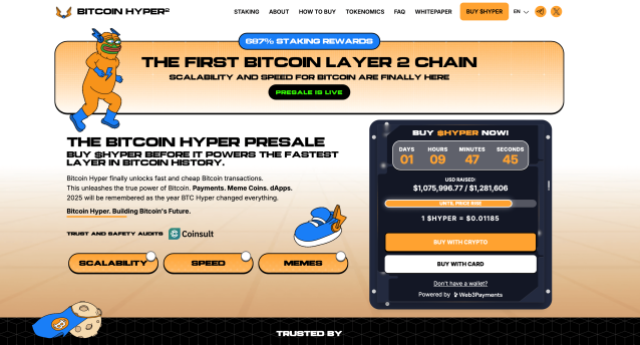
 

Bitcoin Hyper Presale Solana
Bitcoin Hyper Presale

Warum jetzt in $HYPER investieren?

Der Token $HYPER ist der Treibstoff dieses neuen Ökosystems: Er zahlt Gebühren, bringt Staking-Rewards, Mitspracherecht in der Community und Zugang zu exklusiven Features. Momentan läuft der Presale – die günstigste Möglichkeit, früh einzusteigen, bevor der Coin auf den Markt kommt. Kein Insider-Deal, keine versteckten Vorteile: Jeder hat die gleiche Chance. Mit dem Rückenwind, den aktuell Projekte wie Solana durch Unternehmen und Investoren bekommen, stehen die Chancen gut, dass auch Bitcoin Hyper einen ähnlichen Boom erlebt. Wer also nach dem nächsten großen Krypto-Hype sucht, sollte $HYPER jetzt genauer anschauen.

 
Jetzt rechtzeitig einsteigen und $HYPER im Presale kaufen.

Hinweis: Investieren ist spekulativ. Bei der Anlage ist Ihr Kapital in Gefahr. Diese Website ist nicht für die Verwendung in Rechtsordnungen vorgesehen, in denen der beschriebene Handel oder die beschriebenen Investitionen verboten sind, und sollte nur von Personen und auf gesetzlich zulässige Weise verwendet werden. Ihre Investition ist in Ihrem Land oder Wohnsitzstaat möglicherweise nicht für den Anlegerschutz geeignet. Führen Sie daher Ihre eigene Due Diligence durch. Diese Website steht Ihnen kostenlos zur Verfügung, wir erhalten jedoch möglicherweise Provisionen von den Unternehmen, die wir auf dieser Website anbieten.

Editorial Process for bitcoinist is centered on delivering thoroughly researched, accurate, and unbiased content. We uphold strict sourcing standards, and each page undergoes diligent review by our team of top technology experts and seasoned editors. This process ensures the integrity, relevance, and value of our content for our readers.

Trending Cryptos

Related Reads

Automotive Chips Initiate a New Round of Game

After two years of deep inventory correction, the global automotive semiconductor industry is signaling a turning point in the second half of 2026, entering a structural upcycle. Unlike the broad-based shortages of 2022, this recovery is characterized by significant divergence across different chip segments, driven by 800V high-voltage platforms, high-level autonomous driving, and ongoing localization of supply chains in China. The industry-wide destocking cycle has concluded, with inventory levels at automakers and Tier 1 suppliers returning to healthy ranges. Key indicators, including rising OEM orders, lengthening component lead times, improving vendor revenues, and the initiation of price hikes by major suppliers like Infineon and Texas Instruments, confirm the start of a replenishment cycle. Segments are diverging into three tiers based on demand and supply dynamics. The first and strongest tier includes Silicon Carbide (SiC), high-voltage IGBTs, and automotive power management chips, fueled by the rapid adoption of 800V platforms. The second tier, experiencing a moderate recovery, comprises high-end 32-bit MCUs and automotive NOR Flash/DRAM, benefiting from advanced compute domains and AI-driven capacity constraints on mature nodes. The third tier, consisting of low-voltage MOSFETs and basic body electronics, remains stable with ample supply. The core growth logic has shifted from pure vehicle sales volume to increasing semiconductor content per vehicle. This is propelled by the transition to domain/centralized E/E architectures, software-defined vehicles, and new applications like commercial vehicle electrification and V2X communications. While the domestic Chinese supply chain is seizing this window for localization, risks remain, including potential softness in end-demand, future SiC oversupply, and possible easing of 8-inch wafer capacity constraints. In the near term, key segments are expected to see simultaneous volume and price increases, with the industry's cyclicality gradually giving way to more prominent long-term growth characteristics.

marsbit5m ago

Automotive Chips Initiate a New Round of Game

marsbit5m ago

Domestic RF Filters, Finally Starting to Compete?

China's domestic filter industry, particularly in the challenging BAW (Bulk Acoustic Wave) segment, has reached a significant inflection point, moving from solving the "availability" problem to entering a phase of commercial competition and scale. The market is attractive, with the global mobile terminal RF filter market projected to reach $9.2 billion in 2025, and BAW filters showing strong growth. However, the sector is historically dominated by giants like Broadcom and Qorvo, protected by deep patent walls, as evidenced by lawsuits that have bankrupted competitors like Akoustis. Previously, high-frequency BAW filter production in China was nearly zero. Now, domestic players like Nous Micro, Wuhan Memsensing, Hansky, and others are forming a genuine industrial cluster, achieving mass production and shipping hundreds of millions of chips to clients. Different business models are emerging, including IDM and fab-lite approaches through partnerships with foundries like Sai Microelectronics and Runxin Sensing. A key signal of this new competitive phase is a patent lawsuit filed by Nous Micro against Wuhan Memsensing in June 2025, alleging infringement of a core BAW resonator patent. This conflict, rather than mere internal friction, underscores that the industry now has substantial products and market stakes to contest. The challenge is no longer just technical breakthrough but transforming technological leads into sustainable commercial success through superior patents, product performance, cost control, and customer acquisition. Chinese companies are finally positioned to compete for a share of this lucrative market long held by foreign leaders.

marsbit30m ago

Domestic RF Filters, Finally Starting to Compete?

marsbit30m ago

Zhang Lei: How He Became the Biggest Money-Maker This Year

Zhang Lei's company Pinzhun Laser (频准激光) became the biggest "meat sign" (highly profitable new share) of the year on its A-share market debut. Its stock price skyrocketed nearly 600% from its IPO price, generating potential single-lot profits of over 550,000 RMB for lucky subscribers. Founded by Zhang Lei, a 2014 Ph.D. graduate from the Shanghai Institute of Optics and Fine Mechanics, Pinzhun Laser specializes in ultra-stable, narrow-linewidth lasers critical for quantum computing. Its lasers are used by leading global research teams at Harvard, Caltech, and France's PASQAL. The company later successfully applied its core frequency conversion technology to the semiconductor sector, developing deep-ultraviolet lasers for advanced chip manufacturing and inspection. This move diversified its revenue, with semiconductor sales growing rapidly to account for over 25% of its business by 2025. The company boasts gross margins consistently above 69%. Remarkably, Pinzhun Laser required only two major external funding rounds before its IPO, a testament to its early profitability. Key strategic investors in its IPO included major downstream players like BOE,佰维存储 (BIWIN), and中微半导体 (AMEC), signaling strong industry validation. The article highlights the crucial early-stage support from Hangzhou-based capital, particularly funds associated with the Hangzhou Institute of Optics and Fine Mechanics. This "patient capital" model, part of Hangzhou's broader 300-billion-yuan industrial fund strategy, focuses on partnering with scientist-entrepreneurs through the risky valley of death from lab to market. The success of Pinzhun Laser and another Hangzhou-backed firm,宇树科技 (Unitree Robotics), showcases how this supportive ecosystem helps build leading hard-tech companies.

marsbit35m ago

Zhang Lei: How He Became the Biggest Money-Maker This Year

marsbit35m ago

3-Month Loss of $10 Billion, DAT Companies Begin to Return to Rationality

During the recent earnings season, major Digital Asset Treasury (DAT) companies reported staggering combined losses of approximately $10 billion for Q2 and over $30 billion for the first half, primarily due to markdowns on their bitcoin holdings. However, contrary to expectations, their stock prices have rebounded from June lows, indicating the market had already priced in these losses. The key shift is a collective return to rationality. Companies like Strategy, Sharplink, and Metaplanet are now prioritizing a new core metric: increasing the amount of crypto assets per share. This marks a departure from last year's aggressive growth-at-all-costs narrative. To achieve this, they are adopting disciplined capital allocation—issuing stock to buy crypto when trading at a premium, and halting dilution or initiating buybacks when at a discount. Some, like Strategy, have even broken "never sell" pledges to uphold this discipline. A major tool enabling this strategy is the STRC model—perpetual preferred shares offering high dividends (e.g., 12-13%) to raise fixed-income capital for purchasing bitcoin. Strive, Bitmine, and Metaplanet have launched their own variants. Sharplink pursues a different path, staking its vast Ethereum holdings to generate native yield. While the premium of DAT stocks over their underlying crypto asset value has declined and may not fully return, the model is evolving rather than ending. Stripped of hype, DAT firms are becoming actively managed, leveraged thematic funds. Their survival through massive losses and continued institutional investment (with major funds adding billions to positions during downturns) suggests the industry is maturing into a more calculated, long-term business focused on compounding crypto per share.

marsbit40m ago

3-Month Loss of $10 Billion, DAT Companies Begin to Return to Rationality

marsbit40m ago

Trading

Spot

Hot Articles

Discussions

Welcome to the HTX Community. Here, you can stay informed about the latest platform developments and gain access to professional market insights. Users' opinions on the price of SOL (SOL) are presented below.

活动图片