Dogecoin’s 35% ROI vs. Ethereum’s 6% – What it means for you

ambcryptoPublished on 2025-09-14Last updated on 2025-09-14

Key Takeaways

DOGE leads the high-risk, high-reward trade with 35% ROI, Open Interest at ATH, and a clean setup for a $0.30 breakout.


Dogecoin [DOGE] is finally flexing its meme strength against high-cap alts. Backing this shift is the DOGE/ETH ratio. It has risen 25% month-to-date off the 0.000049 support zone.

In fact, this marked the first retest of the 0.000060 resistance level since the Q1 breakdown.

So, what was the outcome? Well, DOGE has delivered a staggering 35% monthly ROI, compared with Ethereum’s [ETH] 6.18%.

That’s about 5× the gains, marking a level of outperformance not seen since the election rotation.

Echoes of election cycle

DOGEDOGE

Source: TradingView (DOGE/ETH)

In fact, the DOGE/ETH ratio was bouncing off a similar support. 

Back during the election cycle, Dogecoin closed November with a 160.83% surge to a three-year high of $0.48, while Ethereum remained restrained at 48%, just as the DOGE/ETH ratio ripped 78% off 0.000047 support.

Why does this matter?

Because at press time, technicals were lining up, suggesting DOGE’s surge isn’t a fluke. Instead, capital had been rotating back into memecoins, with Dogecoin leading the pack and keeping altcoins sidelined.

Speculative flows enter a critical test zone

The memecoin market has been at a key inflection point. 

September’s upside has been carried by speculative flows, with nearly $20 billion pouring in and pushing total market cap to a two-month high of $83.12 billion.

But the real test kicks in now.

In the July run, the market capped at $85 billion, right in line with DOGE’s $0.28 resistance. That peak came as over $30 billion rotated into meme assets and DOGE’s RSI pushed deep into overbought territory.

DogecoinDogecoin

Source: CoinMarketCap

In short, the memecoin market overheated. And, capital unwounded almost as fast as it rotated in.

Roughly $20 billion bled out in under two weeks. The result? DOGE saw a nearly 35% dump as realized profits topped $600 million. 

The big question: Are we staring at a repeat setup?

High-risk appetite points strongly to DOGE’s edge

Dogecoin’s outperformance vs. the majors was on full display. 

With a 35% ROI, DOGE has pushed to $0.29, setting up its first real shot at reclaiming the $0.30 resistance since Q1. Hence, momentum is heating up.

Realized Profits spiked to $728 million at $0.28, the largest profit-taking wave since the election cycle. This showed HODLers cashed in as DOGE ground into resistance.

DogecoinDogecoin

Source: Glassnode

Still, a few divergences stood out from past cycles. 

Unlike the July run, DOGE’s RSI hasn’t broken past the 85 band, staying clear of the overheated “green zone.”

Translation: Momentum isn’t maxed out yet, leaving room for extension before overbought signals kick in.

Plus, with Open Interest (OI) printing a new ATH and the DOGE/ETH divergence confirming relative strength, the structure points to bullish continuation.

Consequently, a clean break above $0.30 looks highly likely.

Share

Trending Cryptos

Related Reads

EIP-8363 Quantitative Review: Cutting Staking 'Subsidies' – What Does Ethereum Hope to Gain?

**EIP-8363 Quantitative Review: Reducing Staking "Subsidies" – What Does Ethereum Want in Return?** EIP-8363 proposes burning an increasing portion of validator rewards as the staking rate rises, reaching 100% burn when 50% of ETH is staked. This analysis models its impact on issuance, yield, and staking equilibrium, examines whether ETH's yield explains its price, quantifies the chain economy's reliance on this yield, and presents conclusions. Key findings: 1. **EIP-1559 Burns Are Ineffective:** Post-merge, burning (via base fees) has collapsed by 98% and now offsets only 2.4% of new ETH issuance, making issuance policy Ethereum's sole remaining supply lever. 2. **EIP-8363's Real Impact:** At the current ~42.2M ETH staked, the proposal would cut issuance by ~58.6% and staking APR by ~56.4%, removing ~633k ETH ($1.55B) in annual dilution (0.53% of market cap). It's not zero issuance; that would require 43% more ETH staked. 3. **Self-Limiting Mechanism:** The design has a built-in equilibrium. At reasonable required returns (e.g., 2%), the system stabilizes at ~26% staking rate and ~0.48% annual inflation. 4. **Yield vs. Price:** No detectable statistical relationship exists between changes in staking yield and ETH price returns over 43 months. The natural 37% yield decline since 2023 did not drive price action. 5. **Chain Economy Dependence:** While LSTs like wstETH form ~34% of collateral in major lending markets, their utility as collateral remains if yield is positive. The direct revenue hit to protocols like Lido is significant (~50% of fee income) but not systemic. Staking-focused ETFs represent only 0.19% of ETH supply. 6. **Core Conflict:** The debate masks a zero-sum redistribution: cutting ~$1.55B in annual issuance transfers value from concentrated staking intermediaries (LST/LRT protocols, leverage players) to the dispersed majority of non-staking ETH holders. 7. **Outlook:** The proposal is economically sound for ETH's scarcity but politically difficult due to concentrated opposition. It is unlikely to pass in its current form.

marsbit5m ago

EIP-8363 Quantitative Review: Cutting Staking 'Subsidies' – What Does Ethereum Hope to Gain?

marsbit5m ago

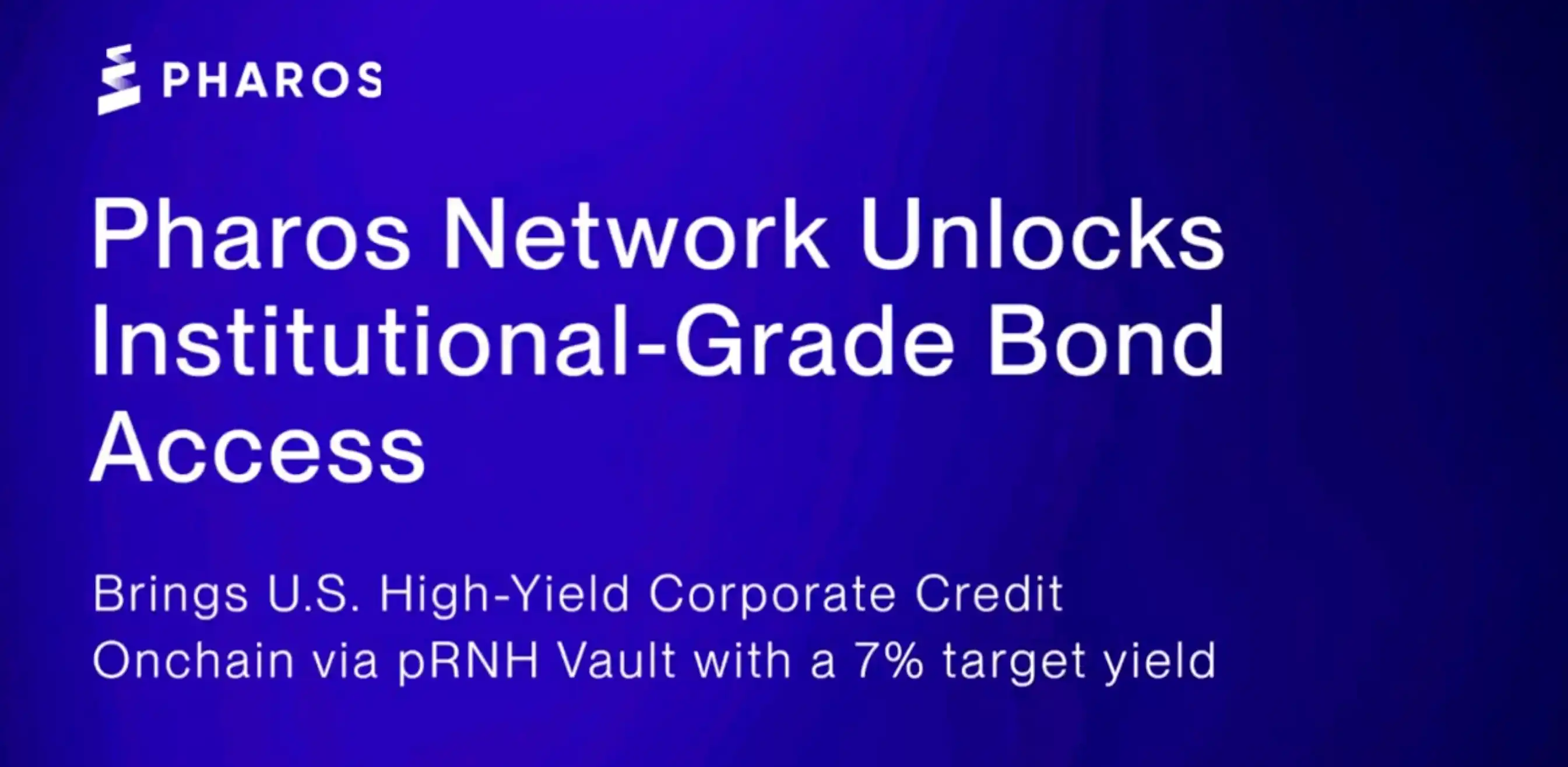
Pharos Introduces On-Chain Institutional-Grade U.S. Corporate Bond Credit, Expanding Its RealFi Asset Portfolio

Pharos Network has launched the pRNH Vault, introducing institutional-grade US corporate high-yield bond exposure to its on-chain RealFi (Real World Finance) ecosystem. Developed by the R25 protocol, the vault provides qualified users access to a tokenized portfolio of high-yield corporate debt, broadening Pharos's asset offerings beyond stablecoins and cash-equivalents. The vault's underlying asset is the NYLIM Anemoy US High Yield Corporate Bond separate account (HYB), managed by New York Life Investment Management (NYLIM) and tokenized in collaboration with Anemoy and Centrifuge. Users can deposit USDC into the vault to receive pRNH tokens, representing indirect ownership of the HYB portfolio, which targets an annualized yield of approximately 7%. The structure offers programmability and composability for on-chain financial applications. Pharos views this move as a key evolution from basic asset tokenization towards building a dynamic marketplace where institutional assets can be actively discovered, evaluated, and utilized programmatically. The pRNH Vault architecture incorporates agent-assisted functionalities for credit screening, liquidity monitoring, and on-chain operations, signaling tighter integration between real-world finance and intelligent on-chain systems. To support this vision, Pharos employs a technical stack including the SALI engine for parallel execution, modular SPNs, protocol-level compliance, ZK-KYC/AML, and native AI agent support. The network positions itself as the "value discovery layer" for the agent economy, aiming to make real-world value, smart agents, and institutional assets widely accessible. The pRNH launch adds a core credit asset to this ecosystem and serves as a practical test case for its infrastructure.

marsbit21m ago

Pharos Introduces On-Chain Institutional-Grade U.S. Corporate Bond Credit, Expanding Its RealFi Asset Portfolio

marsbit21m ago

Trading

Spot

Hot Articles

Discussions

Welcome to the HTX Community. Here, you can stay informed about the latest platform developments and gain access to professional market insights. Users' opinions on the price of ETH (ETH) are presented below.

活动图片