Author: Mario Chow, IOSG
EIP-8363 Proposal: As the staking ratio increases, an ever-larger portion of validator rewards is burned, reaching 100% burn when 50% of the supply is staked. This article models its impact on issuance, yield, and staking equilibrium; examines whether ETH's yield has truly ever explained its price; quantifies how much of the on-chain economy actually depends on this yield; and presents our conclusions.
All calculations are based on on-chain data and the original EIP text. The model is independently built, with less than 2% discrepancy compared to published third-party data. Data updated to August 24, 2026.
The Thesis in One Sentence
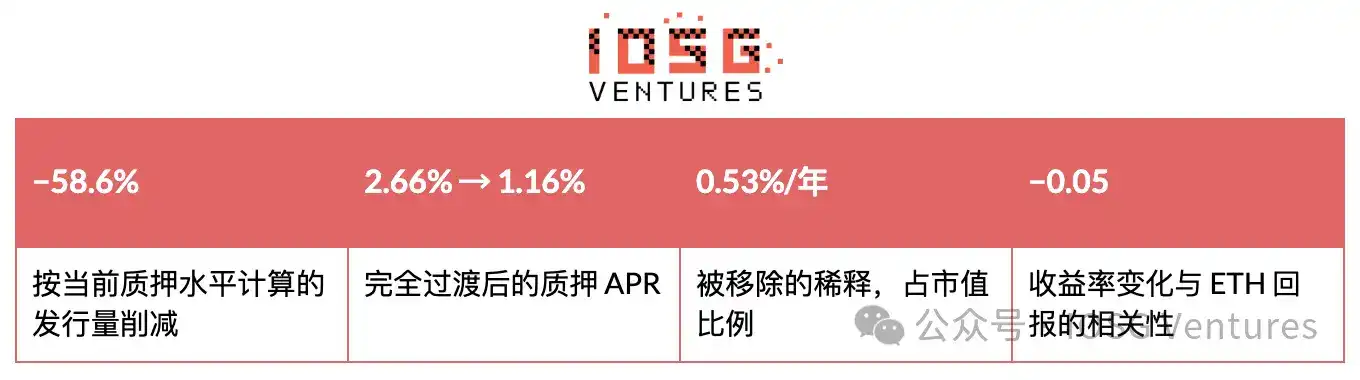
The fee burn is dead, leaving issuance as the only lever Ethereum still holds over ETH supply. This proposal halves issuance at current staking levels, not zeroes it out; and it is self-limiting: under any reasonable staker hurdle rate, the system will eventually stabilize with 26–34% of supply staked and 0.3–0.5%/year issuance. Meanwhile, there is no detectable relationship between the portion of yield it cuts and the price of ETH.
I. The Burn Mechanism Is Already Broken
EIP-1559 burned 1.48 million ETH in 2022. EIP-1559 burns the base fee, which is essentially congestion pricing. Once blobs moved rollup data off L1 and the gas limit was raised, congestion disappeared: gas usage doubled, while the average base fee fell 96%, and burn volume has declined 98% since 2022. In the past twelve months, it burned a total of 25,660 ETH, and the last 30-day run rate is even lower: 39 ETH per day, annualized to ~14.3k ETH.
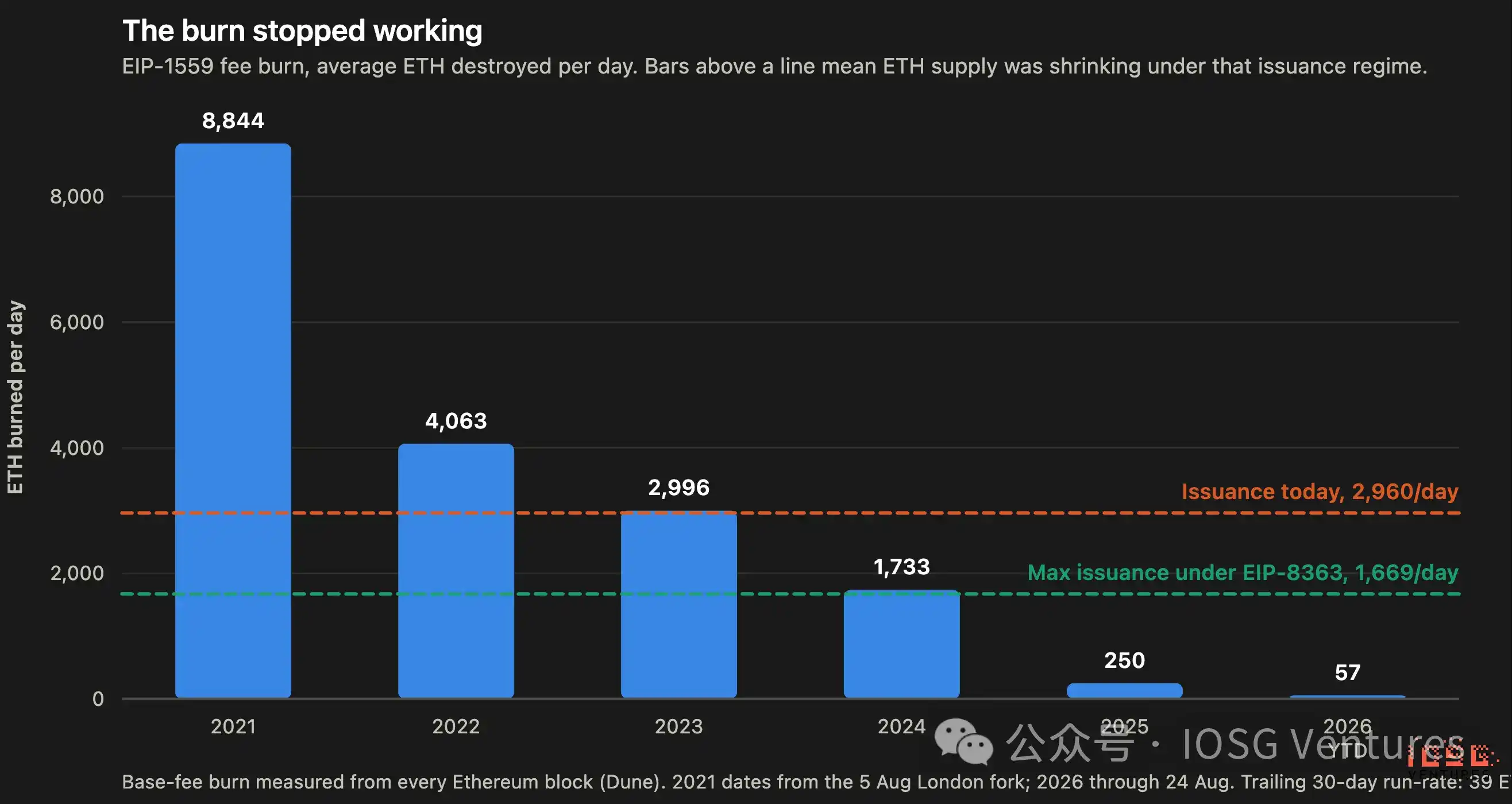
▲ EIP-1559 daily fee burn volume by year: from 8,844 ETH per day in 2021 to 57 ETH per day in 2026 – far below the current issuance curve, and also far below the maximum issuance curve under EIP-8363.
Compared to total issuance of ~1.08 million ETH/year, burning currently offsets only 2.4% of new supply. As a mechanism, "ultrasound money" is over. L2 migration and blob expansion moved the fee base away from L1: L1 gas usage actually doubled in the same period (3.4 billion → 6.7 billion units per month), while the average base fee dropped from 4.00 gwei to 0.17 gwei: this is a price effect, not a demand effect.
Net Issuance: What's Happening to Supply
Burning is only half the ledger. When viewed alongside issuance, the picture is even starker: issuance has never stopped growing, while the offsetting term has simply vanished beneath it.
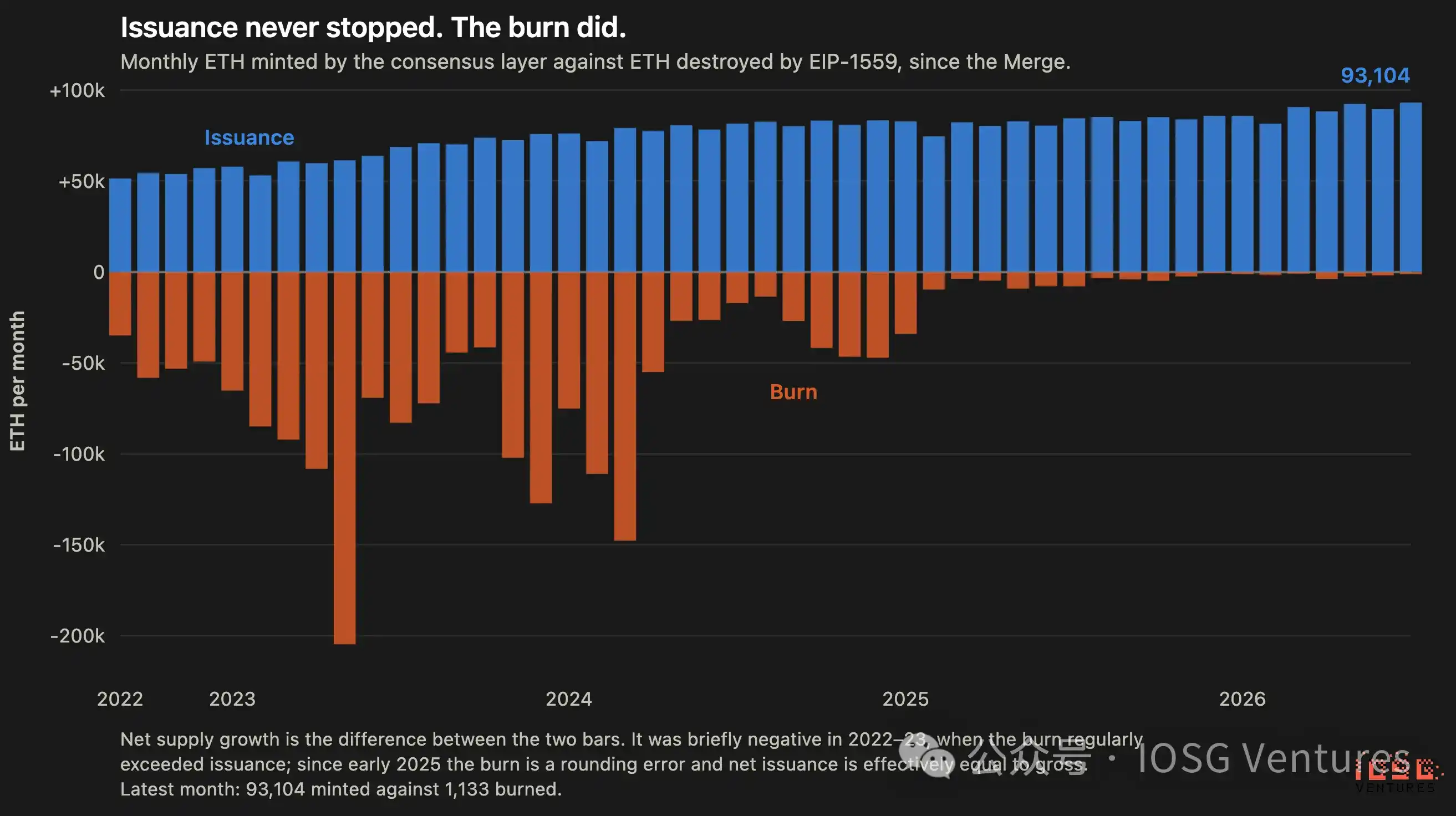
▲ Monthly ETH minted by the consensus layer vs. ETH burned by EIP-1559 since the Merge. Issuance bars grow steadily; burn bars shrivel to almost zero by 2025.
In the 47 months since the Merge, only 13 months were deflationary: the last one was in March 2024. ETH has been in an inflationary state for 28 consecutive months, and the rate has roughly tripled during this period, from +0.26%/year to +0.87%/year. The reason is not that issuance has increased much (only +4% since 2024), but that the offsetting term has vanished.
This reframes the entire debate. EIP-8363 is often described as a choice between staker rewards and monetary scarcity. But a more accurate understanding is narrower and more forced: issuance policy is now the only lever Ethereum has left over ETH supply, because the demand-driven one no longer works. Whether legislated or not, all supply issues now pass through the issuance curve.
II. What Does EIP-8363 Actually Do?
Before dissecting the mechanism, we need to state the official core motivation: safeguarding network security. The proposal authors believe that once the network staking ratio crosses the 50% red line, Ethereum will lose its ability for 'social layer defense' and face the systemic parasitic risk of LST oligarchs becoming 'too big to fail'. Therefore, this proposal attempts to lock in a staking cap via forced interest rate cuts. However, grand security philosophies often obscure the real flesh and blood in the ledger. Setting aside metaphysical debates about decentralization, what does this mechanism actually mean in the real on-chain economy? Here is a purely quantitative deduction.
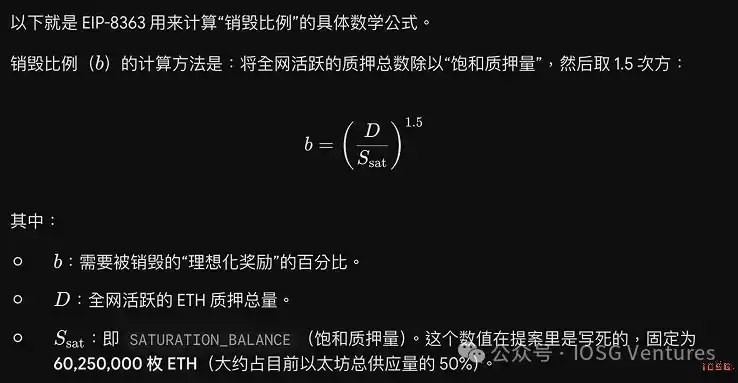
How Is the Money Cut? (Core Mechanism)
-
Pay First, Burn Later: Validators initially earn the full rewards for all their duties as usual, but then the system directly "burns" a portion of those rewards according to a proportion (denoted as b).
-
Burn Based on 'Theoretical Max', No Double Punishment: The key here is that the system calculates the burn amount based on the theoretical maximum reward you should have earned, not on the reward you actually received. Why? Because if you accidentally go offline, you already don't get the reward; if the system then cut based on your actual situation, it would be doubly unfair to offline participants. Basing it on the "theoretical" value ensures the incentive to work remains unchanged, and offline participants are not punished twice.
-
Extreme Case Protection: If the Ethereum network encounters severe problems (entering inactivity leak state), this portion of the burn targeting attestation rewards is paused.
-
Side Earnings Unaffected: This proposal only touches consensus layer rewards. Your node's "side income": MEV and Priority Fees, are not touched at all, entirely unaffected.
Two Most Common Community Misconceptions
Misconception 1: "Ethereum's issuance will be directly cut to zero."
-
Truth: Not even close. Current staking is roughly 42.2 million ETH; at this level, the burn proportion b is 58.6%.
-
To bring issuance to absolute zero, staking would need to surge to 60.25 million ETH (43% higher than now). So the accurate statement is: at this stage, the proposal only cuts issuance by about half, far from zeroing it out.
Misconception 2: "Yields plummet instantly, triggering a DeFi collapse on day one."
-
Truth: An 18-month "soft landing" period is officially designed, making the impact almost imperceptible on day one.
-
To prevent an instant shock, upon activation, the proposal temporarily doubles the base reward factor parameter to 128. This doubling operation exactly offsets the 58.6% burn proportion mentioned earlier.
-
Meaning, on the first day of the upgrade, net issuance remains around 83% of current levels. Then, over the next 18 months, the parameter gradually returns to the normal 64, and issuance slowly slides to 41% of current levels.
-
Summary: The yield decline is spread thinly over a year and a half, not an overnight crash. Fears of "instantly popping the DeFi bubble" overlook this buffer mechanism.
III. Baseline: Where Ethereum Is Right Now
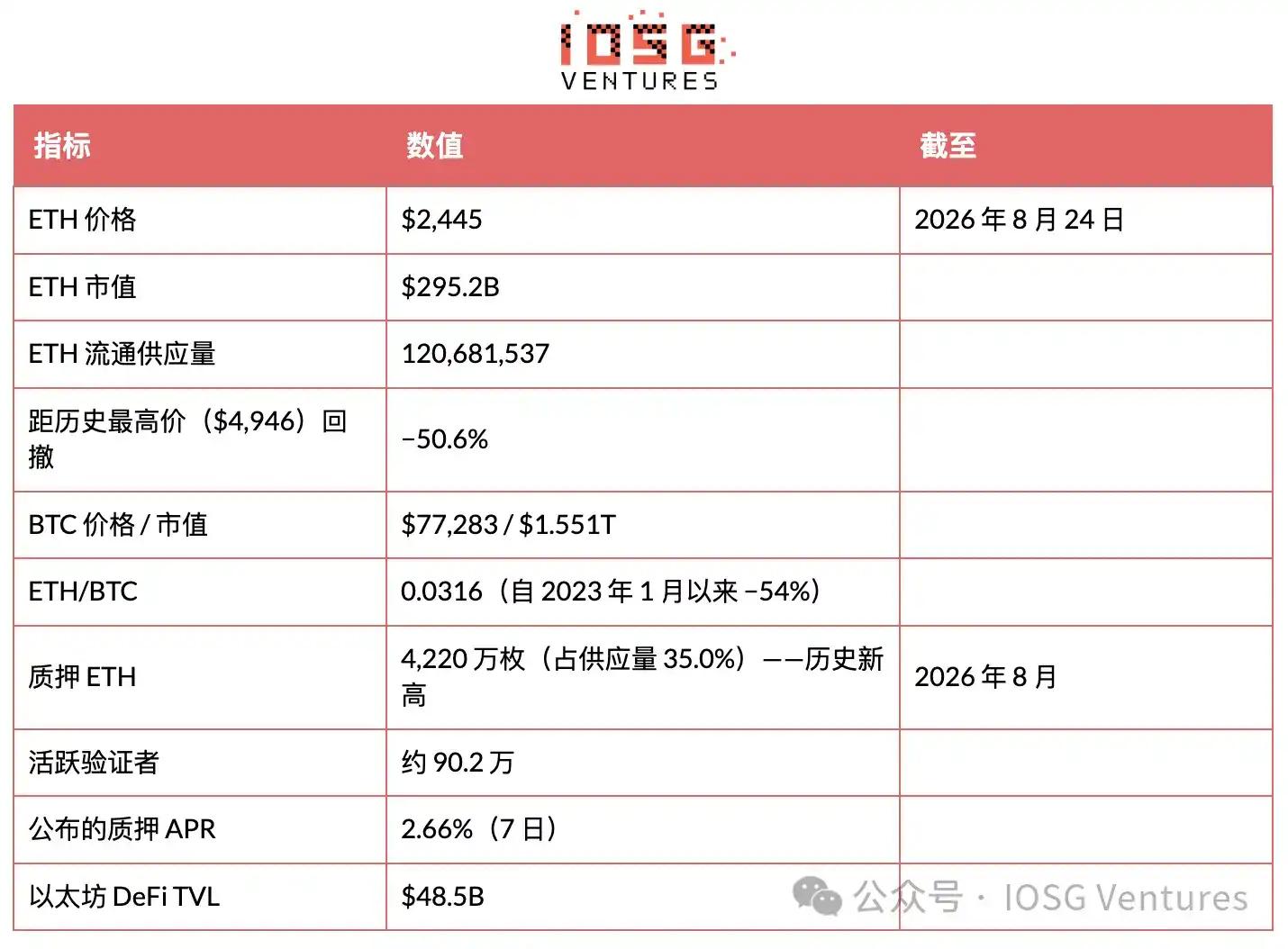
Supply Dynamics
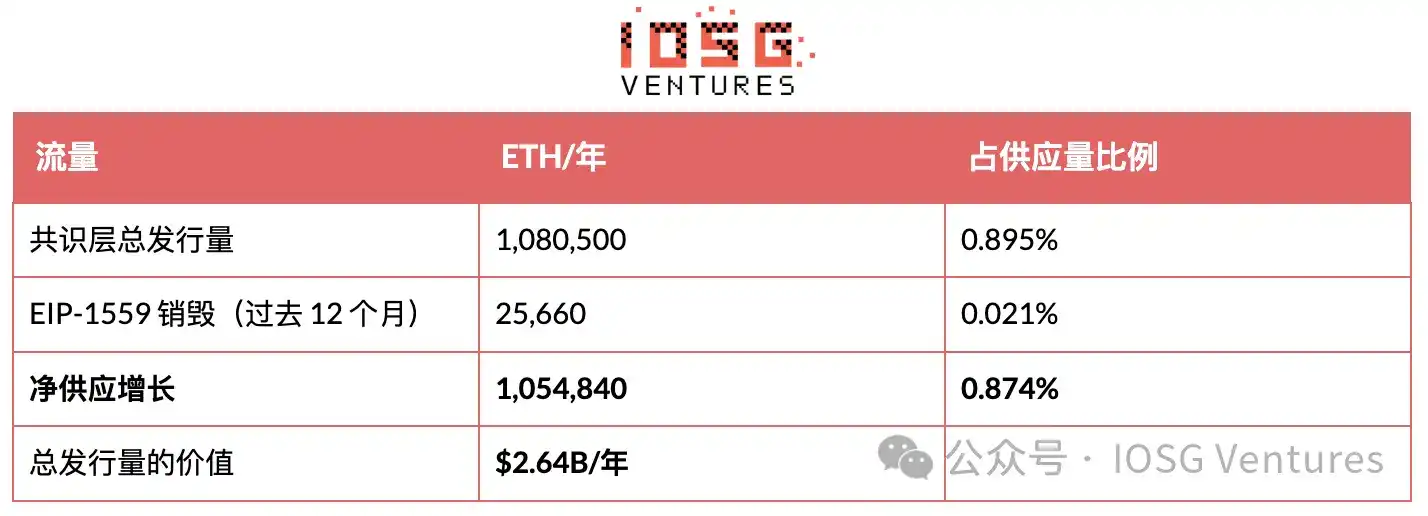
Where Does Issuance Come From?
All from staking rewards. Post-Merge, new ETH has only one source: payments from the consensus layer to validators, distributed according to a fixed canonical weight (denominator 64) across three duties: Attestations 54/64 (84.4%, 911,672 ETH/year), Block Proposals 8/64 (12.5%, 135,063 ETH), and Sync Committees 2/64 (3.1%, 33,766 ETH).
Issuance is modeled as I(S) = 940.9 · √(S/32) ETH/year, i.e., the protocol's own reward curve. At S = 42.2 million, this corresponds to a consensus layer APR of 2.560%. Measured priority fees for the first 23 days of August were 2,623 ETH, annualized to 41.5k ETH: equivalent to 0.098% on the staking base. Combined, this yields 2.658%, almost exactly matching the published 2.66%.
Using measured priority fees, at least 96% of validator income comes from issuance, at most 4% from fees. Proposer payments in MEV-boost beyond pass-through priority fees are not captured, so the fee share is a lower bound. Regardless, issuance dominates absolutely, and this proportion is the crux of the entire debate.
IV. Modeling the Proposal
The earliest attempts were to design a whole network around 'hiding', not patching an existing one. Two currencies lead this path, with completely opposite bets. The third case is built for banks, not individuals, but belongs to the same family.
Applied at Current Staking Levels, No Behavioral Response Considered
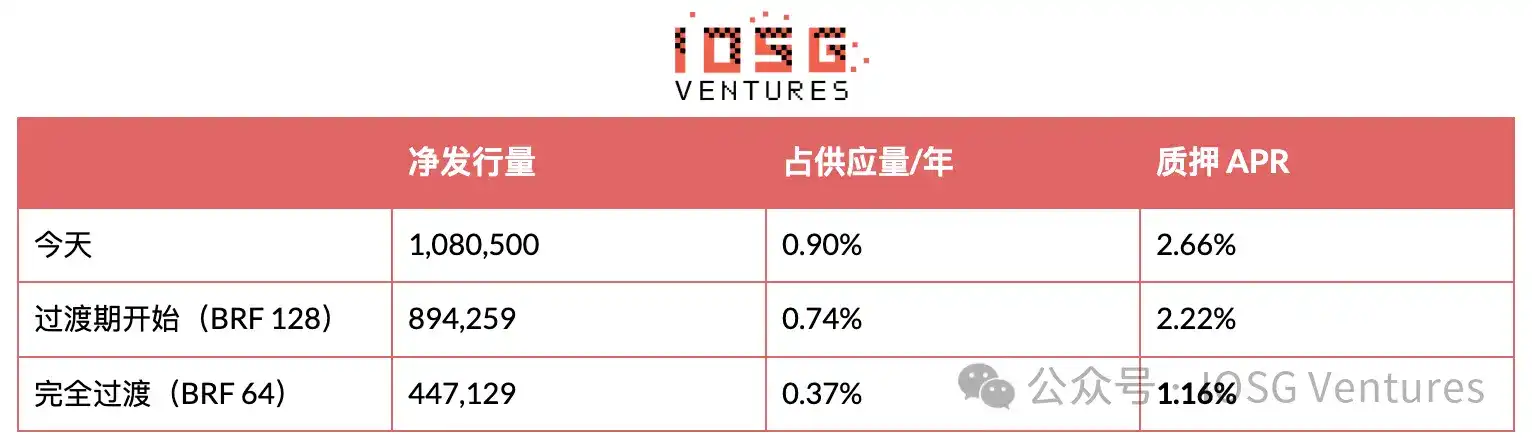
Issuance Cut: −58.6%. Staking APR Cut: −56.4%. Dilution Removed: 633k ETH/year = $1.55B/year = 0.53% of ETH market cap annually.
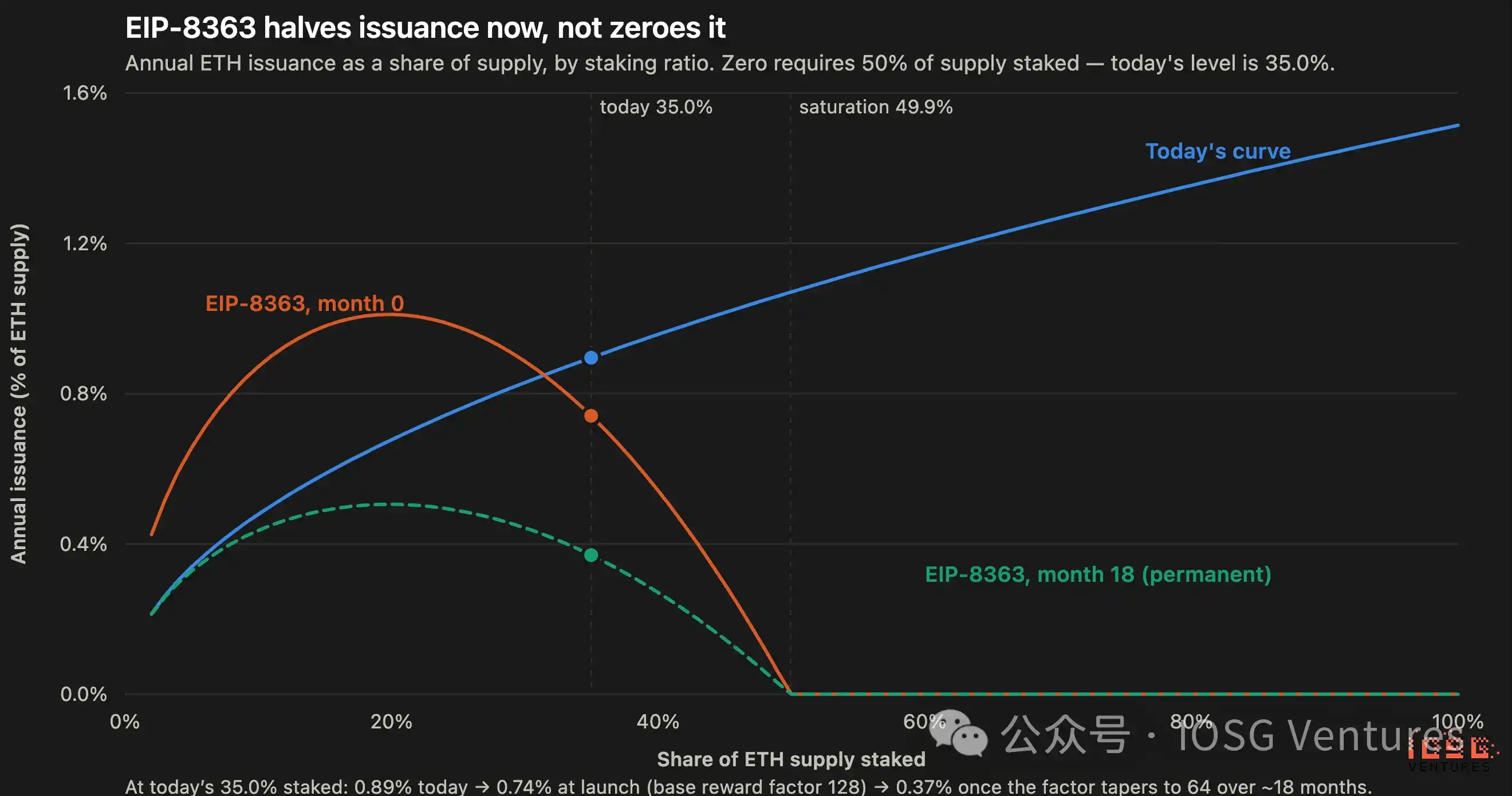
▲ Annual ETH issuance as a percentage of supply vs. staking ratio. Today's curve rises steadily; the EIP-8363 launch curve peaks around 1.0% near 20% staking ratio; the permanent curve peaks around 0.5%. Both curves drop to zero at 50% staking ratio.
Full Curve (After Complete Transition)
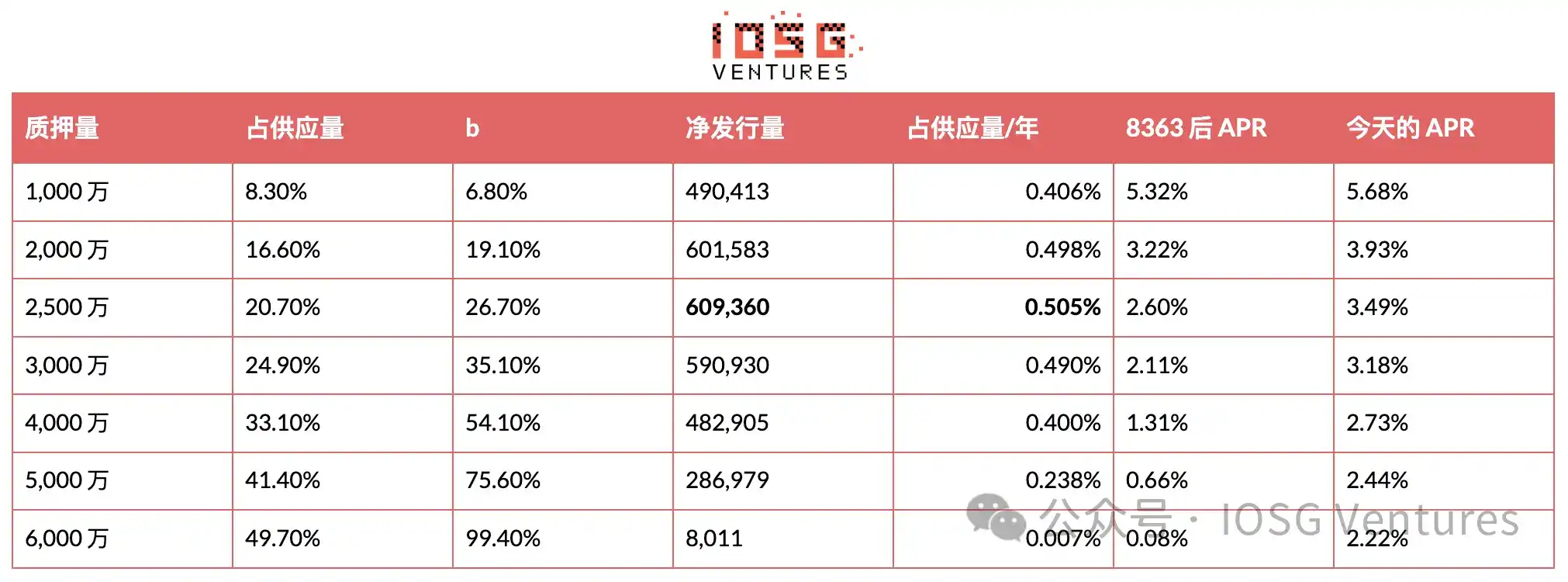
Issuance peaks near ~25 million ETH staked, at about 0.505% of supply, then declines – consistent with the EIP's own description.
Equilibrium – The Number That Truly Settles the Debate
Stakers are not passive. If the yield falls below their required return, they will exit, which both pushes up the gross APR and lowers b. Solving for the fixed point:
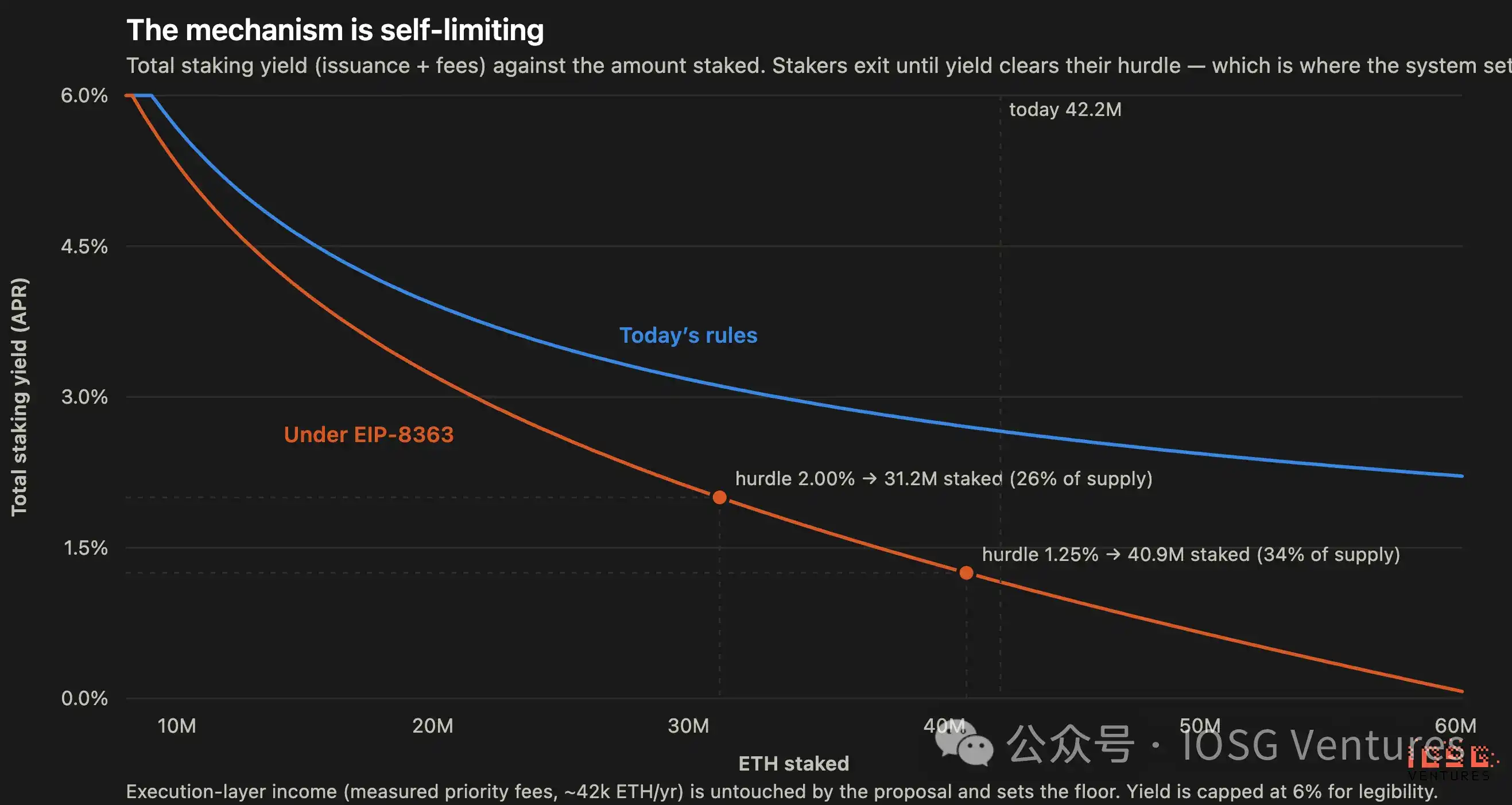
▲ Total staking yield vs. amount of ETH staked under current rules and EIP-8363. The EIP-8363 curve intersects the 2% hurdle at 31.2 million staked ETH and the 1.25% hurdle at 40.9 million.
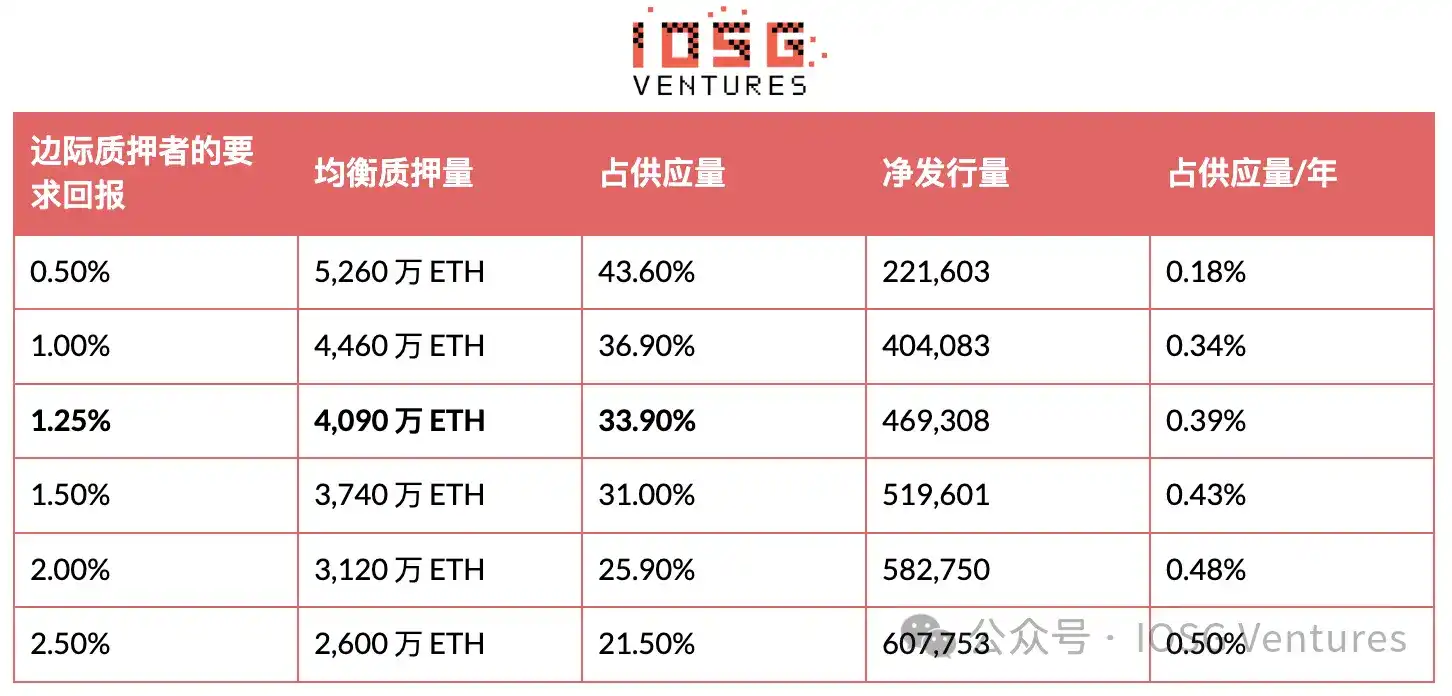
Read this table against the two loudest claims in the debate:
-
“Issuance will go to zero.” Only true if the marginal staker is willing to work for ~0.5% returns. Under any reasonable required return, ETH still inflates at 0.3–0.5%/year. Proponents exaggerate.
-
“Staking will collapse.” At a 2% hurdle, staking stabilizes at 26%: lower than today's 35%, but roughly the level for all of 2024. Critics also exaggerate.
This mechanism is self-limiting by design. This is the most interesting property of the design and the least discussed point.
V. Can Staking Yield Explain ETH's Price?
First, Addressing the 'Question Behind the Question'
Is the staking ratio correlated with yield? Yes: perfectly, and by definition, not by observation. This must be clarified first, as it determines what the data can and cannot say.
The protocol's reward pool scales with the square root of the staked balance, so the yield per ETH has a closed-form solution:
issuance(S) = 940.9 · √(S/32) ETH/year APR(S) = issuance(S)/S = 166.28 / √S
The correlation between the staking ratio and issuance yield is −1 by construction. Plotting them together is plotting an identity.
The only free variable is the difference between the published yield and the formula value: fee income. It was about 1.34 percentage points in 2022; today it's 0.10 percentage points.
The Correlation Itself
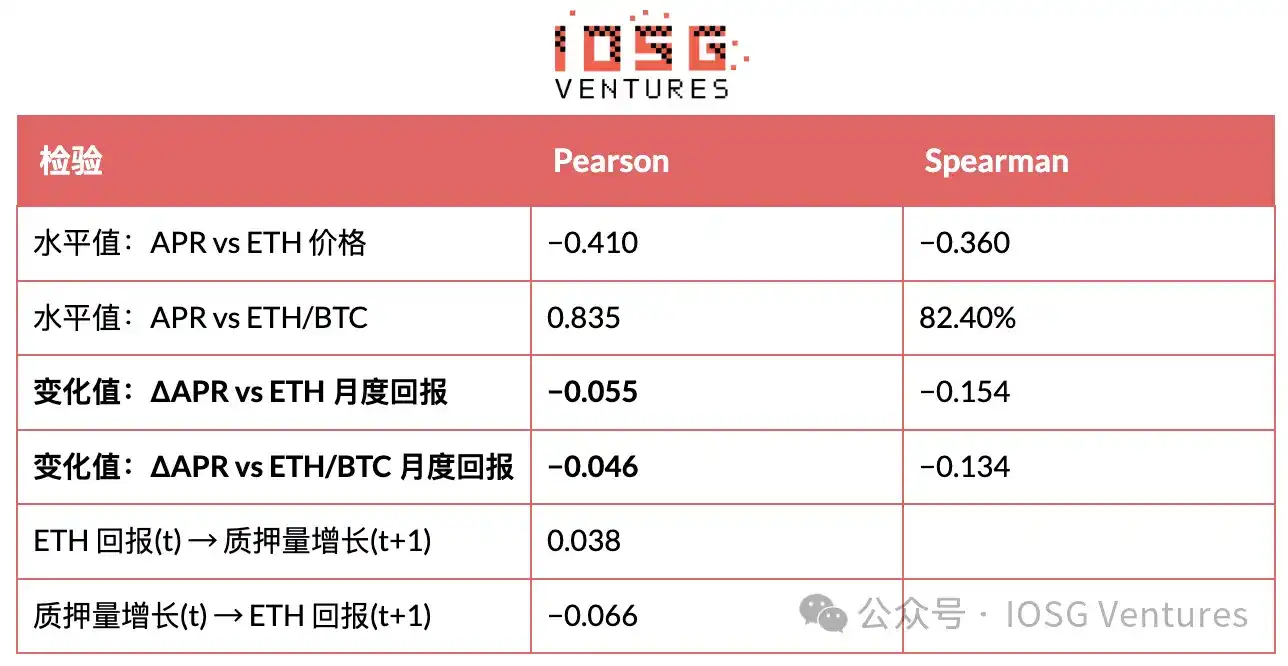
Answer: No correlation exists. 43 months, Jan 2023 → July 2026. (Data refresh on Aug 24 did not rerun this; window ends July 2026, subsequent price volatility does not affect this result.)
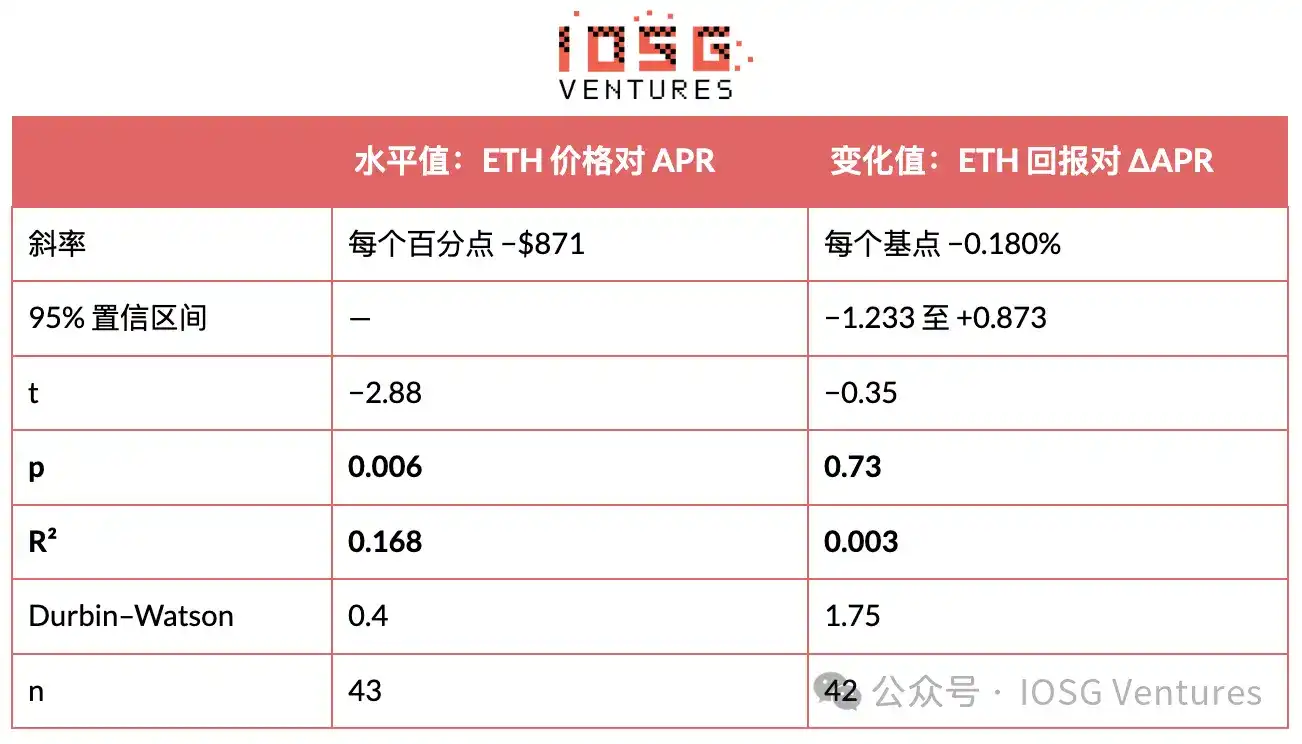
Regression Results
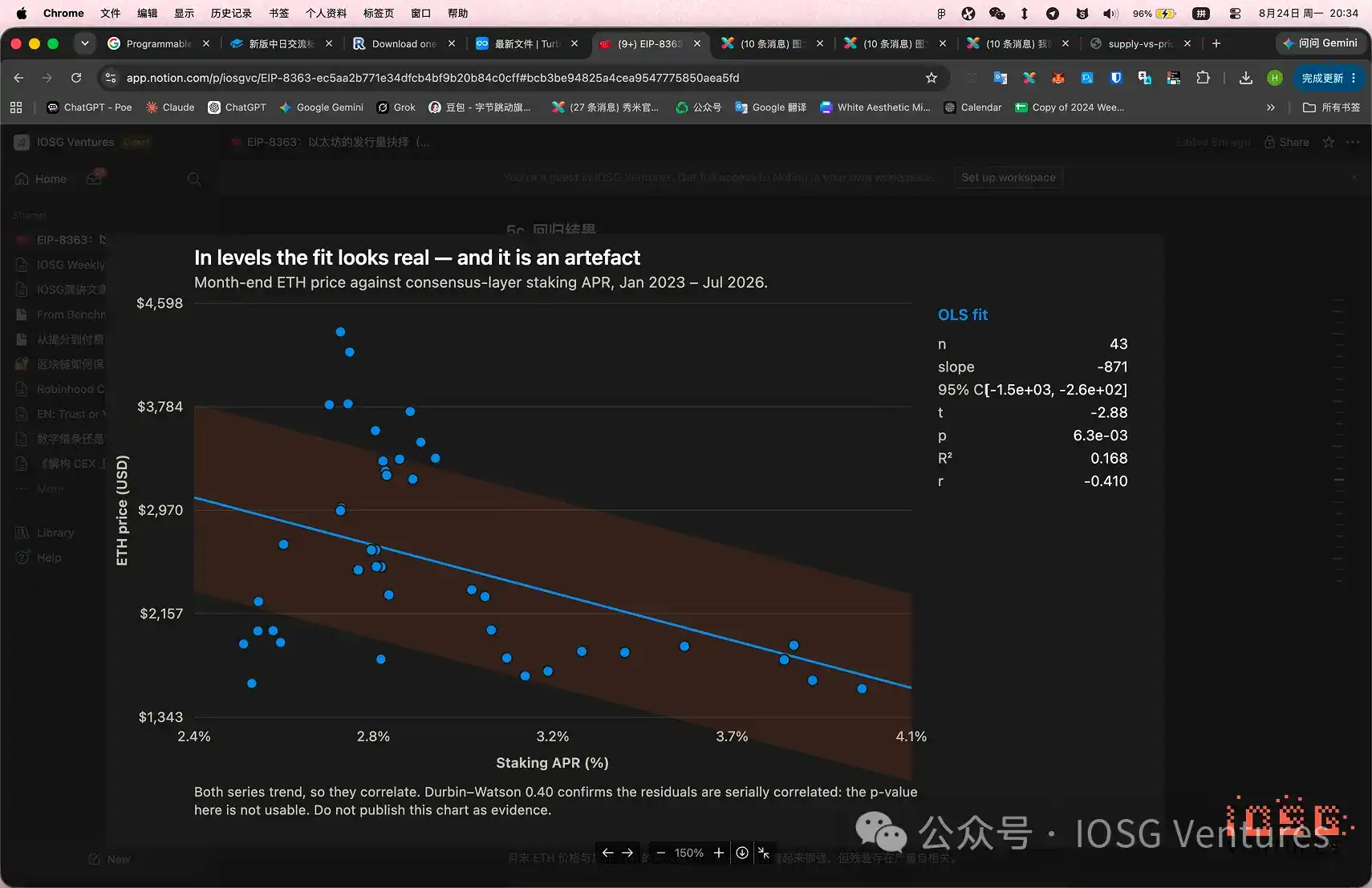
▲ End-of-month ETH price vs. staking APR relationship and OLS fit. The fit looks strong, but residuals show severe autocorrelation.
This level regression is "significant" at p = 0.006 – but it's worthless. Durbin–Watson is 0.40, indicating severe serial correlation in residuals, the textbook sign of spurious regression between two trending series. Both variables trend, so they correlate; standard errors are underestimated, p-values are unusable. This chart is kept as a warning, not as evidence.
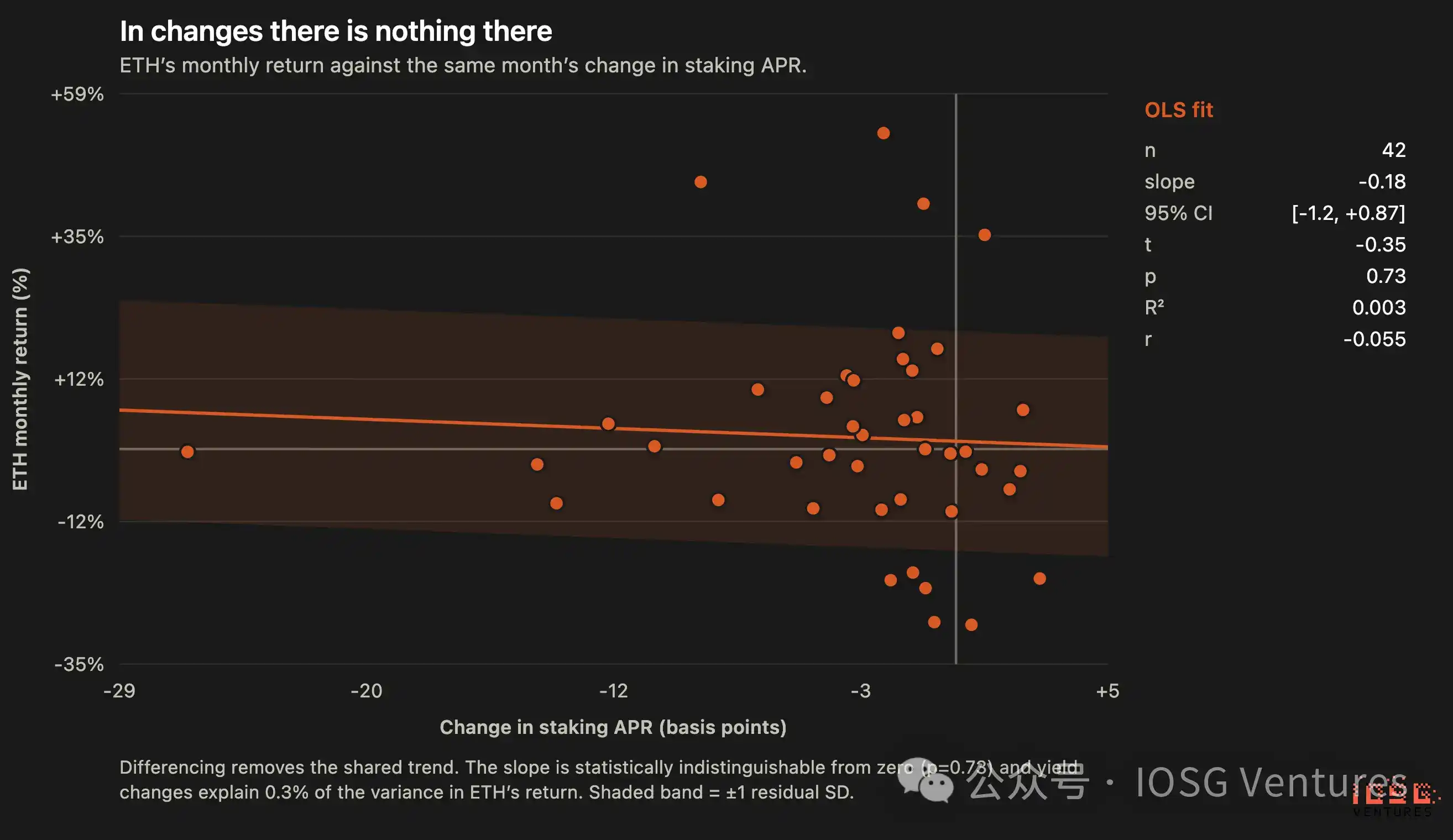
▲ Scatter plot of ETH monthly returns vs. change in monthly staking APR, OLS fit line near horizontal, wide residual band.
After differencing to remove the trend, the relationship disappears: p = 0.73, R2 = 0.003. Durbin–Watson is 1.75, indicating a clean setup. The 95% confidence interval comfortably crosses zero in both directions – the data can't even determine the sign of the effect, let alone its magnitude.
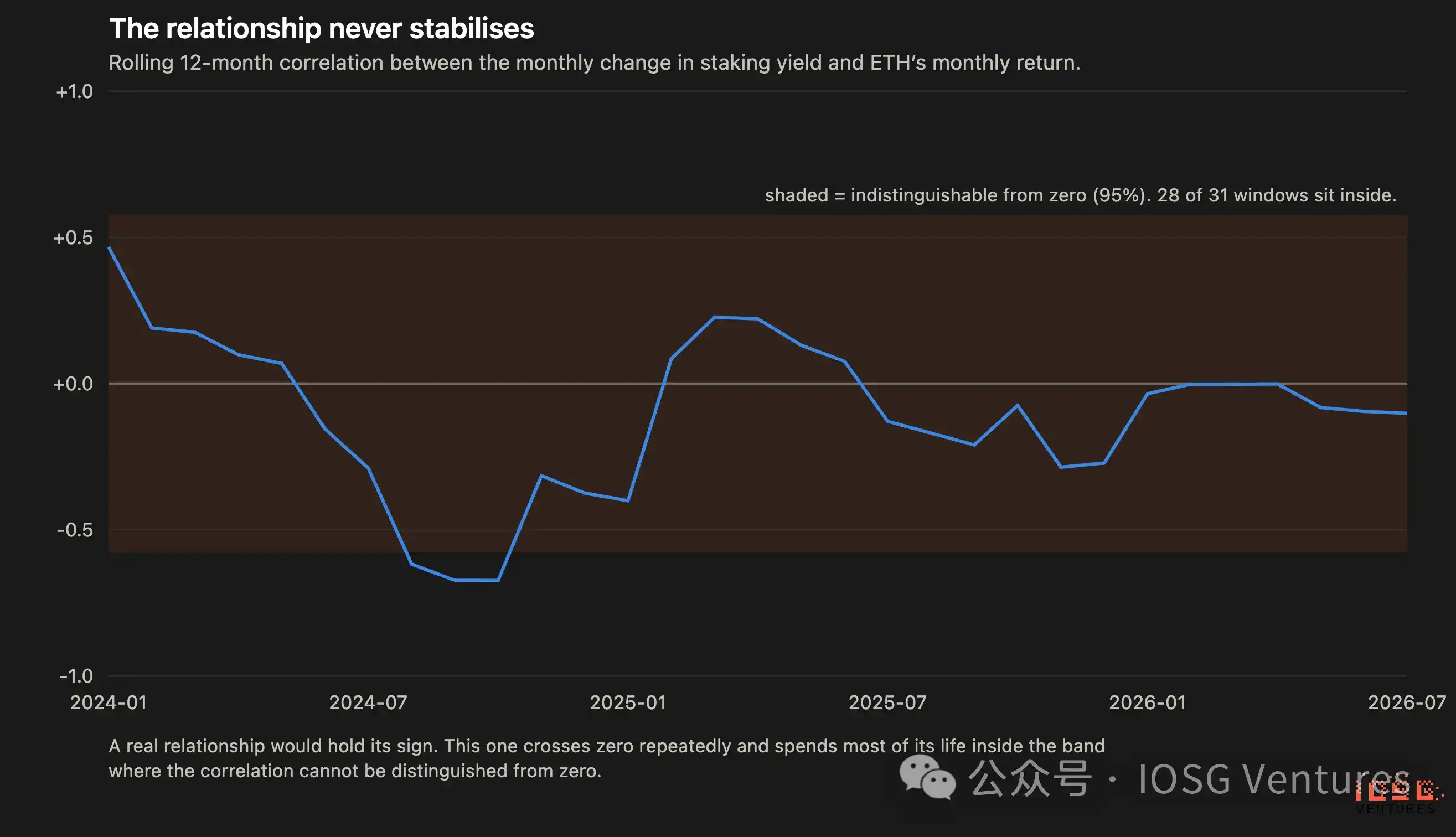
▲ 12-month rolling correlation between staking yield change and ETH returns, oscillating around zero, mostly within intervals indistinguishable from zero.
And this isn't a stable relationship hidden in noisy means either – the rolling correlation repeatedly crosses zero, spending the vast majority of time in intervals indistinguishable from zero.
From January 2023 to July 2026, ETH's staking yield fell from 3.98% to 2.50%, and ETH/BTC fell 57%. In the same window, the monthly correlation between staking yield changes and ETH returns was −0.05. The yield was there the whole time.
It didn't protect the price, and its compression didn't cause the drop. If a 37% yield reduction naturally delivered by the existing reward curve had no detectable price effect, the burden of proof lies on anyone claiming "another cut will have an effect."
Note: The staking series is reconstructed from on-chain flows, ~5% higher than published data. Direction and shape are reliable, but absolute level is not precise.
Supply Growth Doesn't Explain It Either
If yield doesn't affect price, what about the supply numbers this proposal actually changes? Same test, same window, replacing yield with net supply growth.
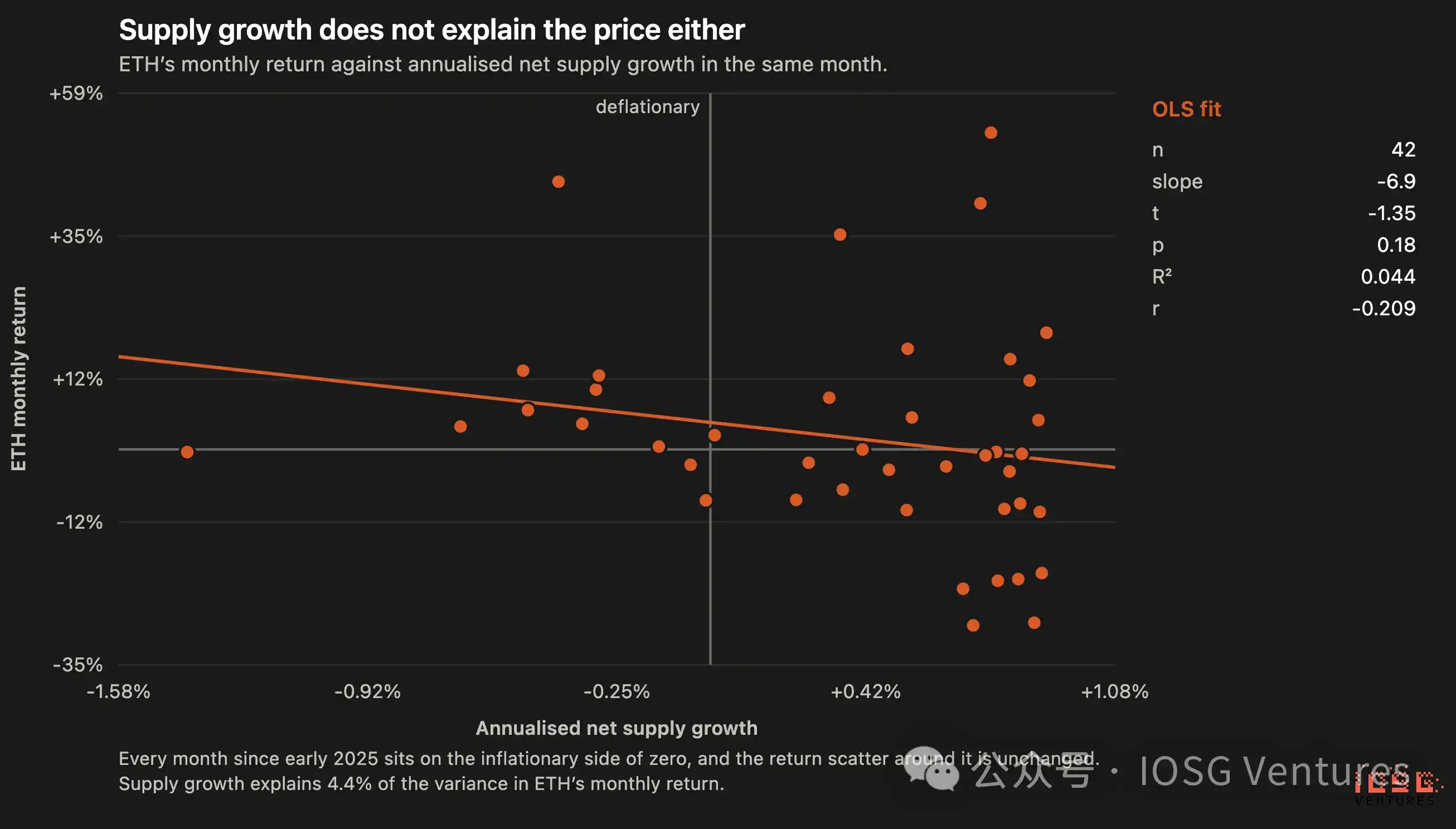
▲ ETH monthly returns vs. annualized net supply growth. Fitted line slopes downward, but scatter is wide, relationship not significant.
Slope −6.9 (one percentage point higher annual supply growth corresponds to 6.9 percentage points lower monthly return), p = 0.18, R2 = 0.044, Durbin–Watson 1.82. The 95% interval for the slope is −17.1 to +3.4.
Read this result honestly, as it cuts both ways. The relationship is statistically insignificant, the interval crosses zero, so it's not evidence that "cutting supply growth will raise the price." But it's about fifteen times stronger than the yield relationship (R2 4.4% vs. 0.3%), and the sign aligns with theoretical predictions. If either variable has any marginal effect, the data points to supply, not yield – and that's precisely the trade EIP-8363 makes.
VI. How Deeply Does the On-Chain Economy Depend on ETH Yield?
Liquid Staking
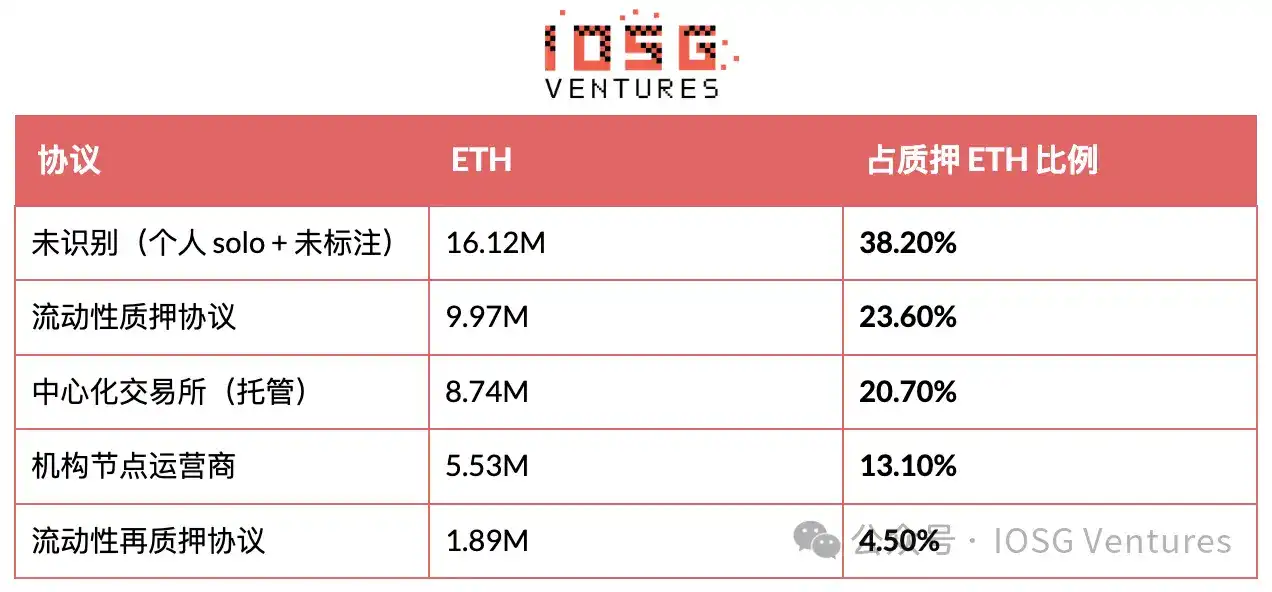
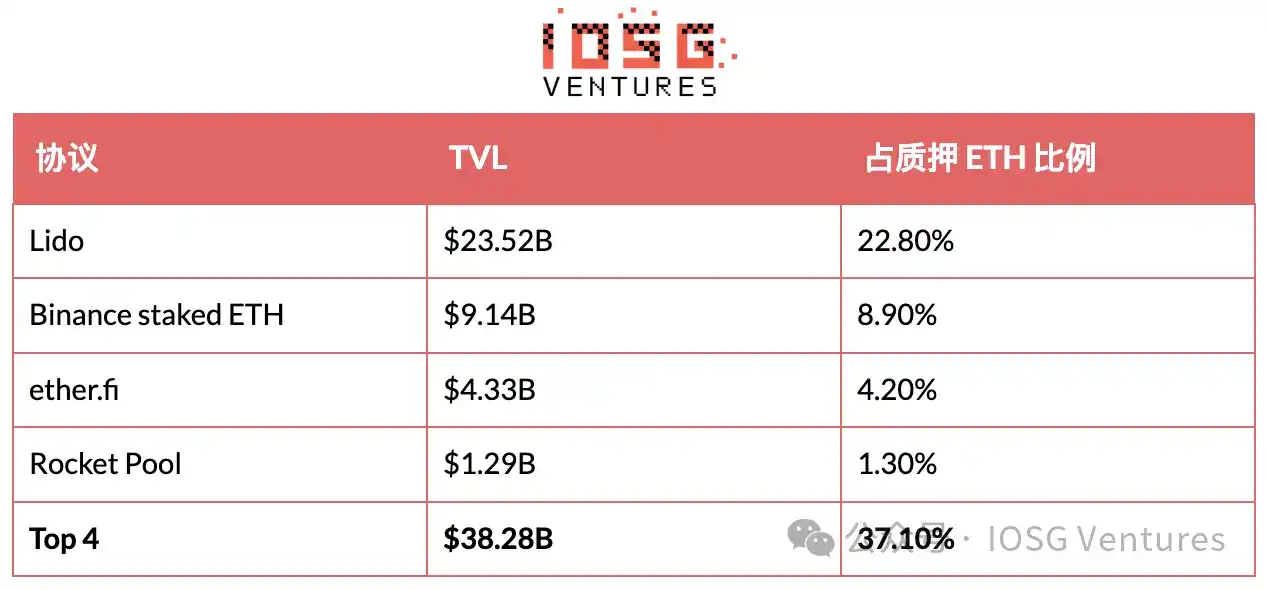
Lido alone is equivalent to 48% of Ethereum's entire $48.5B DeFi TVL. Any claim that "DeFi will be fine" must first withstand this number.
What Does the Yield Cut Mean for Each?
Liquid Staking: Impaired revenue. Lido handles ~$602M in annual staking rewards, taking a 10% fee (~$60M/year). Cutting 58.6% of issuance means ~633k fewer ETH in rewards issued annually; at Lido's 22.8% share, that's about $35M less in annual fees: roughly half its revenue from this segment. Not small for Lido, but inconsequential at the Ethereum level. And regardless of yield changes, wstETH remains vastly superior to WETH for any borrower seeking ETH exposure; its role as collateral stands firm.
LSTs as Lending Collateral – The Real Dependency
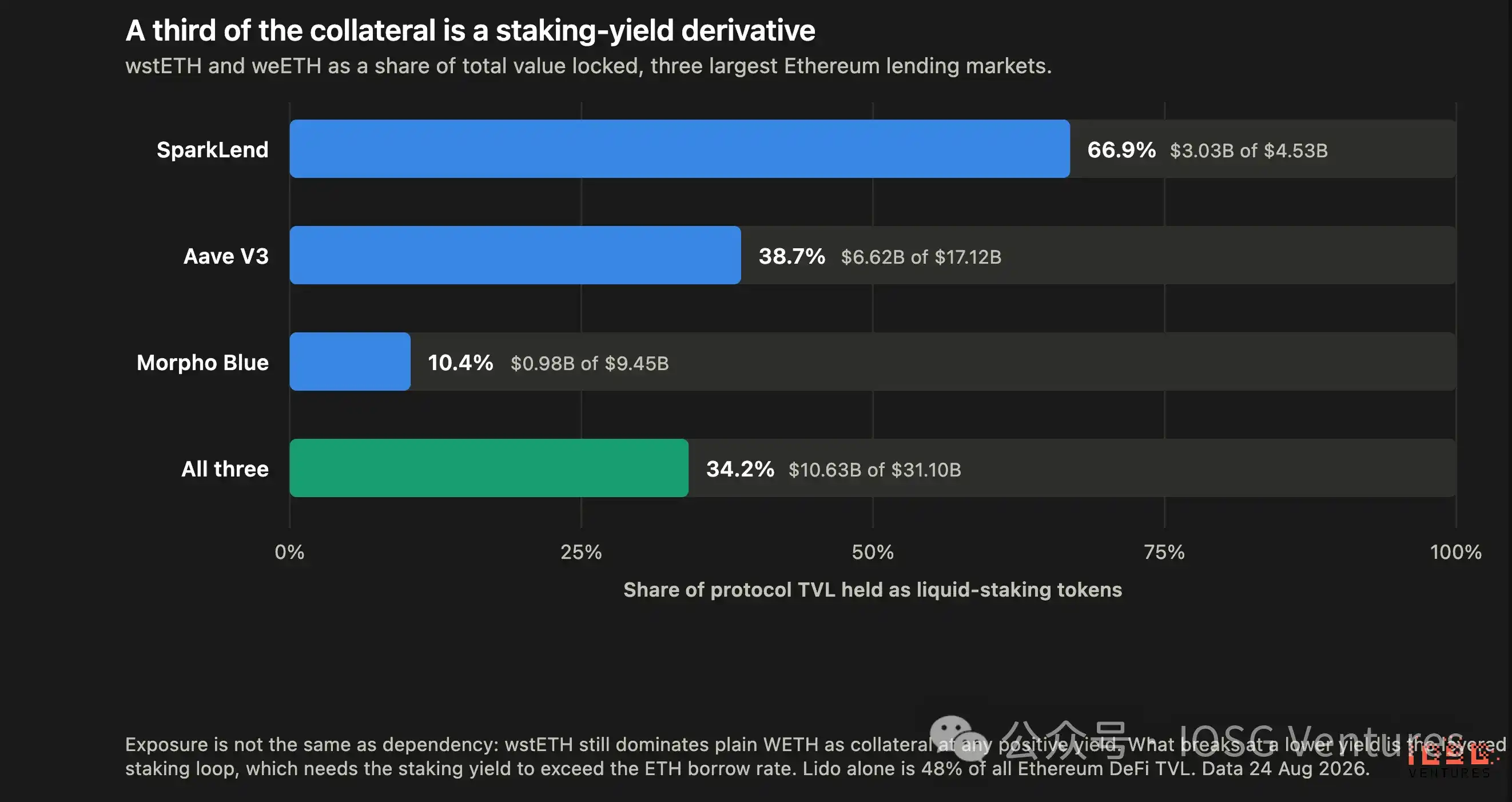
▲ Proportion of Liquid Staking Tokens in TVL: SparkLend 66.9%, Aave V3 38.7%, Morpho Blue 10.4%, combined 34.2%.
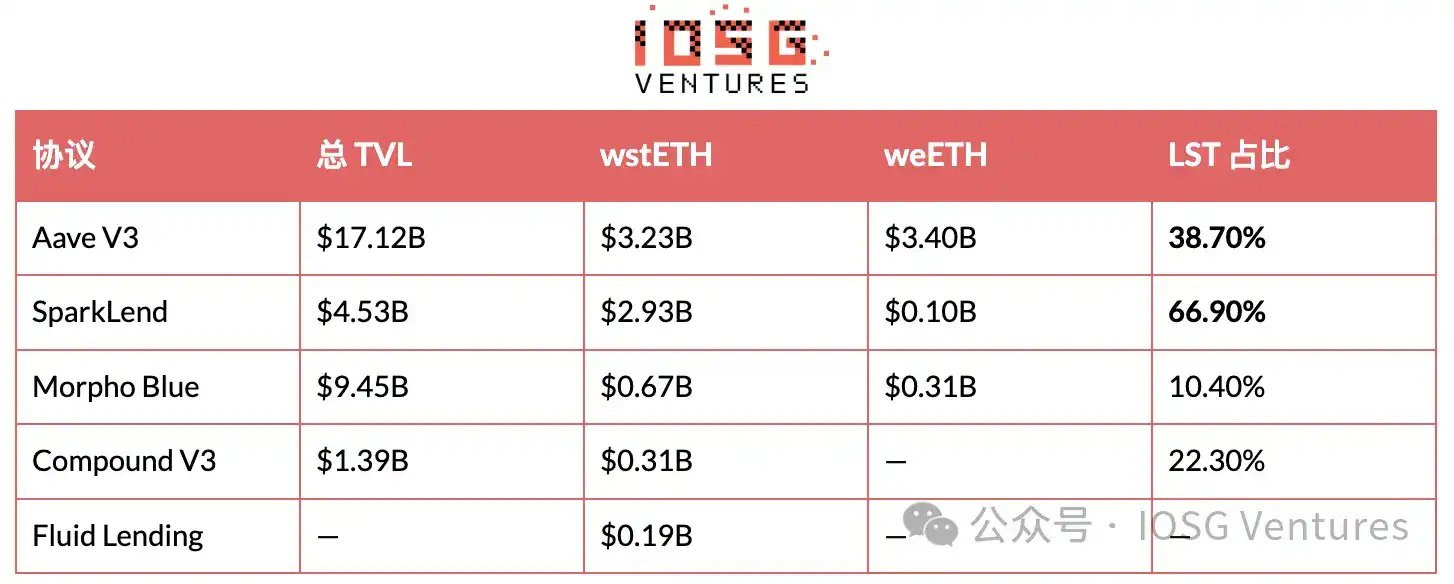
In Ethereum's three major lending markets, $106.3 billion (34.2%) of the $311.0 billion in collateral is staking yield derivatives. SparkLend is a typical single point of failure: two-thirds of it is wstETH.
The ETF Channel, Quantified
The most cited objection: cutting yield will drain institutional buying because staking ETH ETFs market yield to allocators who can't directly access it. This channel is real. But it's also very small today.
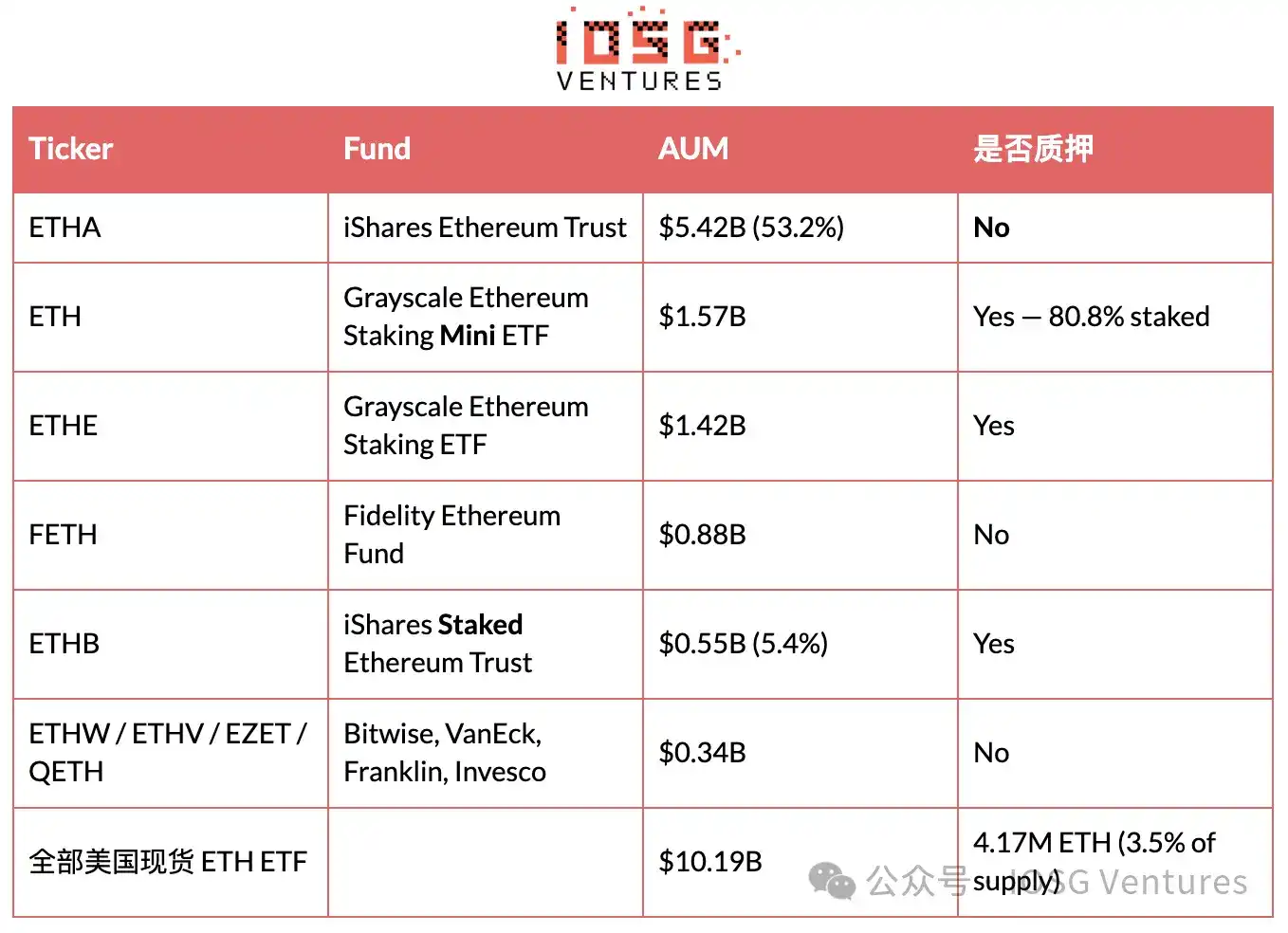
Products explicitly marketing yield constitute only 5.4% of ETF assets, 0.53% of all staked ETH, and 0.19% of total ETH supply. BlackRock's non-staking ETH product is ten times its size. Whatever is driving institutional capital into ETH, staking yield is not the main pitch – allocator money overwhelmingly buys non-staking exposure.
Two points prevent this conclusion from being absolute. First, the staking ETF category is young and growing: Bitwise and Grayscale are already doing it for Solana, and Grayscale has one for Hyperliquid, so future risk is larger than current AUM. Second, lower yields will likely slow the conversion rate of existing non-staking ETF assets into staking share classes, but this is a growth rate effect, not capital outflow. Neither changes the magnitude: ultimately, it's a $0.5B group arguing over a $1.55B/year wealth transfer.
VII. Conclusion and Outlook: When "Security Anxiety" Collides with "Wealth Redistribution"
First, set aside the grand security narrative.
We must acknowledge that the original intent of EIP-8363's core authors (like Justin Drake, Jerome) is extremely serious network security. In a game theory perspective, once the network staking ratio crosses the 50% red line, Ethereum would lose its ability for "Social Layer Defense" against extreme attacks and face systemic parasitic risks from LST oligarchs becoming "too big to fail." Therefore, this proposal attempts to use forced interest rate cuts as an economic tool to lock the staking ratio into a safe zone.
But behind the security philosophy, the reality of on-chain data is even colder.
Since 2022, Ethereum's "Burn" mechanism has been dead in all but name: burn volume has plummeted 98%, now offsetting a mere 2.4% of issuance. Regardless of your stance on EIP-8363's security origins, an unavoidable fact is: the old mechanism that "let ETH supply adjust dynamically with market demand" has stalled. In today's Blob-dominated L2 economics, hoping for a resurgence of L1 fees to revive the burn mechanism is a pipe dream. Ethereum's monetary policy has entered a state of "autopilot without a steering wheel," and adjusting issuance is the only trigger we can still pull.
Setting aside emotion, the real policy impact lies between the two extreme narratives.
Proponents cry "end ETH inflation," opponents warn "staking system collapse," both rhetorics deviate from mathematical fact. At the current 42.2 million ETH staked, this proposal only cuts issuance by ~58.6% and staking APR by ~56%. To bring issuance to absolute zero? That requires staking to surge to 60.25 million ETH (43% higher than now). More importantly, this mechanism has its own brake: as yields fall, some stakers exit, and the system ultimately stabilizes around "26% staking ratio, 0.48% annual inflation." What it actually delivers is halving the dilution rate, not destroying or overturning anything.
Is this saved "half-percentage point" truly important? Numbers are more honest than words.
At current prices, cutting 633k ETH of annual issuance saves $1.55B, about 0.53% of total market cap. Don't think this ratio is small; it's roughly 5 times the size of Ethereum's entire current L1 fee economy (~0.10%/year). For an asset whose fee revenue has already dried up, plugging a 0.5% annual structural bleed is not a "rounding error," but the biggest economic lever currently available.
And the cost? Will DeFi really collapse? Risks do exist.
Opponents often cite collateral, like two-thirds of SparkLend being wstETH. But we must distinguish between "exposure" and "dependence": as long as wstETH has positive yield, it will always be superior to plain WETH as collateral, this foundation is solid. What EIP-8363 would actually break is "leverage staking loops" (Looping). When the base staking yield falls below ~1.16%, unable to cover the interest on borrowed ETH, this leveraged arbitrage capital will unwind. In other words, what shrinks is the leverage bubble, not the collateral system itself. As for direct protocol-side losses, Lido would lose about $35M annually: roughly half their fee revenue.
Regarding fears that "cutting yields will crash the price," the market has already delivered its verdict.
In 43 months of data, there's no detectable significant correlation (p = 0.73, R2 = 0.003) between staking yield fluctuations and ETH price performance. The staking yield fell from 3.98% to 2.50% without preventing ETH/BTC from crashing 57% by July 2026. Yield was neither a price moat, nor did its compression act as a crash catalyst. If a prior 37% yield reduction naturally delivered by the curve didn't make a dent in price, those claiming "another cut will cause Ethereum to plummet" need harder evidence.
Why Is This Debate So Fierce?
Because this is a zero-sum game where "losses are highly concentrated, gains are extremely diffuse."
Stripping away obscure technical jargon and grand security rhetoric, EIP-8363's essence is a crude wealth redistribution: Currently, stakers take 100% of newly issued ETH, but they only hold 35% of the network's tokens. This means they pass the inflation cost onto the other 65% of holders. Cutting this $1.55B of annual issuance is equivalent to forcibly returning ~$1B in implicit wealth annually from stakers (intermediaries) to all non-staking ETH holders.
This is the real reason parties are at each other's throats:
-
Highly Concentrated Losers: Lido, LST issuers, restaking protocols, leveraged players. This is a small, well-funded, highly organized interest group. They know exactly how much real money this proposal takes from their pockets (Lido directly loses half its profit, leverage loops die outright).
-
Extremely Diffuse Winners: The 65% of ordinary token holders. They suffer 0.5% less dilution annually, but this money, spread across a ~$300B market cap, is virtually silent. No one will take to the streets for it.
This explains why the current debate is often filled with "grandiose empty" slogans. When an interest group cannot openly say "this will take $1B of annual profit from us," they raise the shield of "this will destroy DeFi"; and when researchers want to forcibly reclaim the monetary issuance faucet, the most politically correct weapon is "defending network security." Please interpret the volume of opposition and support as the concentration of interest distribution, not the mathematical correctness of the proposal itself.
Our Final Outlook
Strategy: Mildly bullish on ETH denomination, clearly bearish on staking intermediaries/infrastructure. And the proposal is highly likely to be rejected.
-
At the asset level, we are bullish not because of "scarcity myths," but based on common sense: when the only lever left to adjust supply is broken, removing a $1.55B annual structural sell pressure (issued to people who aren't truly paying for the yield) is a high-value trade. It might not be a dramatic reversal, but the compounding effect is not negligible.
-
At the intermediary system level, the logic is airtight. The core valuation logic for Lido, LSTs, LRTs, is entirely built on that "staking yield" about to be cut in half. This isn't emotional panic, it's a real 58.6% shrinkage of the profit line.
-
As for the proposal's fate? The probability of passing is extremely low. In decentralized governance, "concentrated losses vs. diffuse benefits" is the standard script for killing a good proposal. Economically correct, but politically difficult to pass, is our baseline expectation.
Conditions that would change our view (Falsification Indicators):
-
On-chain data proves "issuance is re-staked, not sold": If fund flows show that newly minted ETH globally stays in auto-compounding LSTs and does not flow to exchanges for selling, then our sell-pressure assumption doesn't hold.
-
Staking ETFs bring massive buying waves: The current $0.5B scale is negligible. But if it expands tenfold, the power of marginal demand would outweigh the significance of inflation cuts.
-
L1 fees miraculously recover: If the burn mechanism reasserts dominance over fundamentals, the urgency of artificially intervening in issuance disappears entirely.
-
The negative correlation between supply and price is definitively empirically proven: Currently, the relationship is very weak. If data over the next year solidly proves "reducing supply must push up price," this would become the most unassailable quantitative pillar for being bullish on ETH.