«Сезон Solana». Почему токен SOL поднялся до максимума за восемь месяцев

RBK-cryptoPublished on 2025-09-12Last updated on 2025-09-12

Solana подорожала за месяц на 20%, криптокомпании наращивают ее резервы

«РБК-Крипто» не дает инвестиционных советов, материал опубликован исключительно в ознакомительных целях. Криптовалюта — это волатильный актив, который может привести к финансовым убыткам.

Криптовалюта Solana (SOL) подорожала за 30 дней на 20%, и только за последние сутки — на 6%. SOL торгуется на максимальных отметках за восемь месяцев.
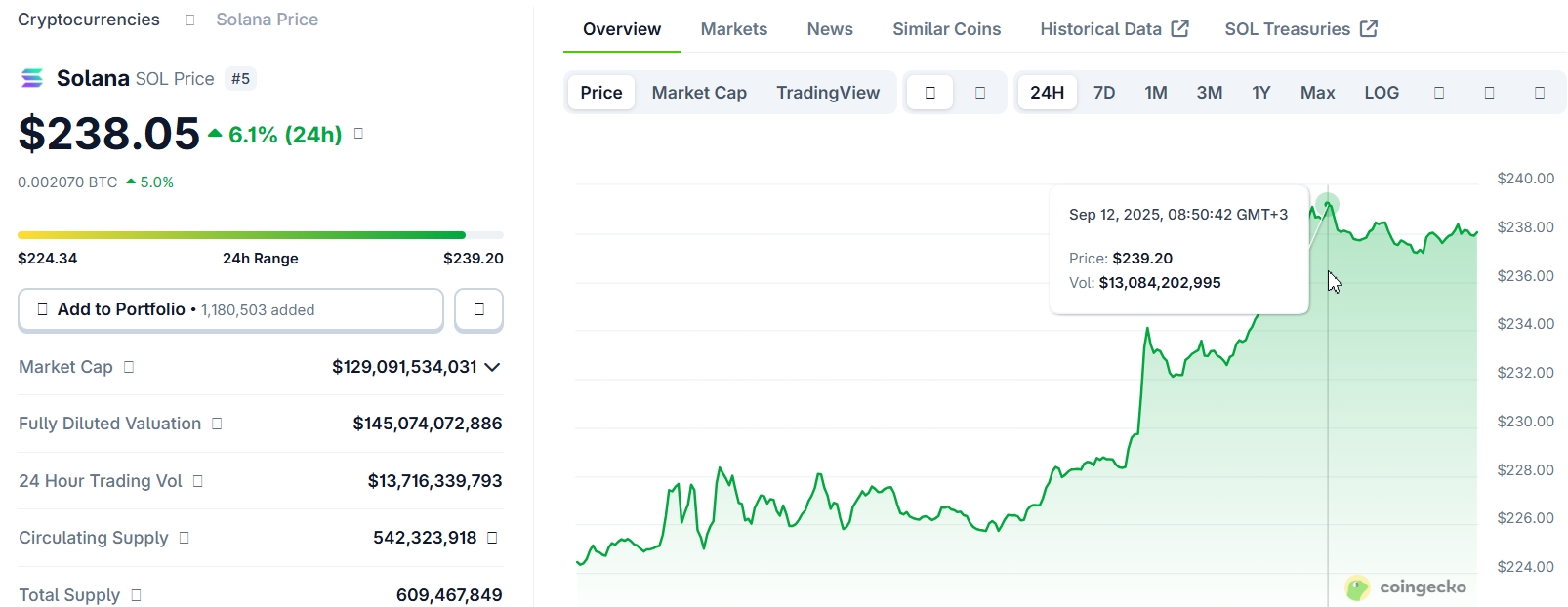
График цены Solana. Источник: CoinGecko

В январе SOL установила рекорд около $294, но затем цена монеты начала падать, достигнув локального дна около $105 в апреле. В конце лета цена SOL начала расти и 12 сентября превысила $239.

Рост курса Solana проходит как в рамках общего подъема крипторынка, капитализация которого вновь превысила $4 трлн, так и на фоне увеличения инвестиций в компании, принявшие стратегию накопления SOL.

Такие компании получили название Digital assets treasury (DAT), они работают по аналогии с со Strategy Майкла Сэйлора — привлекают заемные средства для формирования резерва криптовалют. Многие организаторы подобных проектов применяют подход «обратного слияния» — приобретают публично торгуемые компании, зачастую никак ранее не связанные с криптовалютами, и превращают их в DAT-компании.

В случае, например, с Ethereum или Solana компании используют криптоактивы для последующей их передачи в стейкинг или децентрализованные финансовые приложения для получения дополнительной доходности.

Чит-код для рынка. Как и зачем компании скупают биткоин на чужие деньги

8 августа Galaxy Digital вместе с Jump Crypto и Multicoin Capital объявили, что они возглавляют частное размещение акций Forward Industries (FORD) на сумму $1,65 млрд, которая переходит в статус компании по управлению цифровыми активами Solana. Три ведущих инвестора заявили, что намерены предоставить Forward Industries капитал и стратегическую поддержку с целью сделать этот проект ведущим публичным институциональным участником экосистемы Solana.

В четверг, 11 сентября, компания Forward Industries заявила, что завершила частное размещение акций и начнет покупать Solana на вырученные средства, пишет The Block, называя рыночную тенденцию к накоплению SOL «сезоном Solana».

Позже аналитики Lookonchain заявили, что Galaxy помогает Forward Industries накапливать SOL. К вечеру четверга инвесткомпания перевела с бирж 1,45 млн SOL ($326 млн). А в ночь на пятницу увеличила эту сумму еще на 706 тыс. SOL ($160 млн).

Телеграм-канал «РБК-Крипто» — подпишитесь и будьте в курсе самых главных и актуальных новостей о криптовалюте.

Присоединяйтесь к форуму «РБК-Крипто» в Telegram для обсуждения новостей и тенденций криптомира.

Остается неясно, есть ли у этих покупок прямая связь с DAT-проектом Forward Industries. Но в общей сложности, по данным аналитиков, Galaxy Digital купила за 24 часа более 2,1 млн SOL ($486 млн).

Резервы Solana решили формировать уже 8 компаний из трех стран, согласно информации CoinGecko. В общей сложности, эти проекты накопили уже 6,5 млн SOL ($1,56 млрд). Forward Industries еще не включена в этот список.

За последние пять дней бумаги FORD на Nasdaq выросли на 135%, согласно данным TradingView. В то же время акции ранее запустившихся DAT-проектов упали на десятки процентов с летних пиков.

Опрошенные «РБК-Крипто» эксперты предупреждают, что рост курса криптовалют на новостях о крупных покупках не стоит принимать за начало общего сезона альткоинов. Тенденция на создание крипторезервов не подразумевает переток ликвидности из крупнейших монет в другие активы, что являлось бы основным признаком «альтсезона», говорят аналитики.

Криптобиржу Gemini оценили в $3,3 млрд на IPO. Ее партнером стала NASDAQ

Биткоин впервые с лета превысил $116 тыс. Что произошло на крипторынке

Более 1000%. Топ-5 криптовалют с наибольшим ростом за неделю

Trending Cryptos

Related Reads

AI Boosting Efficiency and Cutting Costs Makes VC Increasingly Expensive

"AI for Cost Reduction Makes VC Funding More Expensive" Despite the "cost-reduction and efficiency" narrative of AI, venture capital (VC) investment in the AI sector is becoming increasingly costly. While AI tools lower the initial costs for many startups—with team sizes shrinking across funding stages—the market is polarizing. For top-tier AI teams, especially those from leading companies like Google and OpenAI, funding rounds are now larger and valuations are higher than ever at the seed and early stages. For example, new ventures by prominent researchers are securing billions in funding with valuations reaching tens of billions before having a mature product. This creates a "barbell" market: lightweight startups need less capital, while elite AI firms attract massive investments early on. This dynamic raises the cost for VCs to acquire and maintain meaningful ownership stakes. As valuations soar early, securing the same equity percentage requires significantly larger capital commitments. VCs must now invest more upfront and reserve substantial funds for follow-on rounds to avoid dilution, prompting large firms like Accel and a16z to raise massive new funds. Consequently, capital is concentrating intensely in a few perceived winners like OpenAI and Anthropic, widening the gap between large and small VC funds. While high valuations bake in future growth expectations, they also compress potential returns, demanding that portfolio companies achieve unprecedented scale. For major VCs, the core strategy is clear: secure early positions in potential winners and maintain the capital to keep investing as valuations rapidly escalate.

marsbit21m ago

AI Boosting Efficiency and Cutting Costs Makes VC Increasingly Expensive

marsbit21m ago

An Eight-Year Investment Takes a Sharp Turn: Why Did Ethereum Suddenly Abandon Poseidon?

On August 13, Ethereum researcher Justin Drake announced a significant shift in Ethereum's Layer-1 cryptographic roadmap: abandoning the SNARK-friendly hash function Poseidon in favor of traditional functions like SHA2 or BLAKE2. This decision ends eight years of research and investment, marking a major revision to the post-quantum security strategy. Poseidon, introduced in 2019, was highly efficient for zkRollups and zkVMs within SNARK circuits. However, its need for prolonged cryptanalysis and the pressing timeline for quantum resistance revealed limitations. Recent breakthroughs in SNARK design, specifically using binary fields, now enable traditional, battle-tested hash functions to perform as efficiently as Poseidon within SNARKs. Benchmarks show modern laptops can now verify over a million traditional hash calls per second. This change is partly driven by accelerated concerns over quantum computing threats. Reports warn that "Cryptographically Relevant Quantum Computers" could break current blockchain signatures like ECDSA by the early 2030s, risking trillions in assets. Ethereum's response focuses on hash-based post-quantum signature schemes, deemed more quantum-resistant than some lattice-based alternatives under pressure from AI cryptanalysis. Ethereum's updated post-quantum roadmap targets a production-ready "leanVM" for signature aggregation by 2027, with full deployment across consensus, execution, and data layers by 2028. The shift to mature hash functions like SHA2 reduces reliance on newer algorithms and aligns with the goal of using widely analyzed cryptographic primitives. Other major blockchains are also preparing. Solana's core teams have independently chosen the NIST-standardized Falcon signature scheme for its compact size. Starknet plans a phased migration, starting with replacing its Pedersen hash with BLAKE2. Ethereum's move signifies a strategic pivot towards proven security foundations for the quantum era.

marsbit1h ago

An Eight-Year Investment Takes a Sharp Turn: Why Did Ethereum Suddenly Abandon Poseidon?

marsbit1h ago

Programmers Worldwide Are Wasting Money on Anthropic! The Company Can't Stand It Anymore

Anthropic recently published guidelines to help developers using Claude Code reduce unnecessary token costs. The key recommendations include: 1) Clear (/clear) conversations after completing a task to avoid carrying irrelevant file reads and command outputs into the next task. 2) Set the model and reasoning effort level at the start of a session, as switching mid-session invalidates the prompt cache, requiring a full-price recalculation of the entire dialog history. 3) Attach files using @ references instead of typing paths manually to avoid extra tool calls and searches that bloat the context. 4) Add quiet flags to verbose commands (e.g., in CLAUDE.md) to minimize lengthy output in the dialog history. 5) Use /compact while the session cache is still warm (before breaks) to compress the dialog at one-tenth the cost. 6) Offload large-output tasks to a sub-agent, which runs in an isolated context and only returns conclusions, preventing intermediate outputs from polluting the main dialog. The article explains token pricing: input tokens (prefill) are processed in parallel, while output tokens (decode) are generated serially, making output tokens five times more expensive. Caching is crucial for savings—if a request's prefix (system prompt, CLAUDE.md, dialog history) matches the previous one byte-for-byte, reading it costs only 10% of the standard input price. However, cache invalidation occurs when changing models, effort levels, fast mode, compressing dialogs, after cache expiration, or when resuming old sessions. Dialog history also grows quadratically (O(n²)) as file contents and command outputs accumulate, increasing costs per round. Proactive context management—like isolating noisy tasks, using /rewind to trim unproductive turns, and task-based session clearing—is becoming an essential skill for cost-effective AI-assisted development.

marsbit3h ago

Programmers Worldwide Are Wasting Money on Anthropic! The Company Can't Stand It Anymore

marsbit3h ago

Pax Silica vs. WAICO: The US Wants to Prohibit Europe from Using Chinese Artificial Intelligence

The United States is preparing to demand that European and other partners abandon Chinese artificial intelligence initiatives, threatening exclusion from the American-led "Pax Silica" coalition, according to a leaked U.S. State Department document. This ultimatum forces signatories of the "AI Opportunity Statement" to choose between the Western technological ecosystem and alternative frameworks, with China not explicitly named but clearly targeted. Pax Silica is a U.S. strategy for AI and semiconductor hegemony, launched in late 2025. Its European presence expanded significantly in mid-2026. Concurrently, China, Russia, and 27 other nations established the World AI Cooperation Organization (WAICO) in July 2026 as an independent intergovernmental platform promoting AI governance based on UN principles. This situation creates a difficult choice, especially for European nations balancing strategic autonomy with dependence on U.S. tech and security. It also pressures Global South countries with pragmatic ties to both Washington and Beijing. The formation of competing blocks risks fragmenting the global tech landscape, forcing companies to split supply chains, increasing costs, and potentially leading to incompatible standards and protocols. The era of open globalization in AI may be ending, replaced by geopolitical confrontation where technological sovereignty trumps economic efficiency. The decisions made will shape the global digital economy for decades.

cryptonews.ru5h ago

Pax Silica vs. WAICO: The US Wants to Prohibit Europe from Using Chinese Artificial Intelligence

cryptonews.ru5h ago

Trading

Spot

Hot Articles

Discussions

Welcome to the HTX Community. Here, you can stay informed about the latest platform developments and gain access to professional market insights. Users' opinions on the price of SOL (SOL) are presented below.

活动图片