Прогноз цены XRP (XRP) на 12 сентября

cryptonews.ruPublished on 2025-09-10Last updated on 2025-09-11

  • XRP торгуется около $3,00, упираясь в нисходящую линию тренда с сопротивлением на уровне $3,10–$3,18.
  • Аналитики видят потенциал прорыва к $3,68–$5,85, если XRP закроется выше $3,20.
  • Приток средств в размере 10,78 млн долларов США через сеть свидетельствует о самом высоком спросе за последние недели, что указывает на возобновление накопления.

Сегодня цена XRP колеблется около $3,00, консолидируясь после отскока от зоны поддержки $2,91–$2,92. Восстановление возвращает цену к нисходящей линии тренда, которая сдерживала рост с начала августа, заставляя трейдеров сосредоточиться на том, сможет ли импульс спровоцировать прорыв к $3,20.

Цена XRP встречает сопротивление нисходящему тренду

Динамика цены XRP (Источник: TradingView)

На дневном графике XRP неоднократно тестировал нисходящую линию сопротивления, простирающуюся от июльских максимумов. Сейчас цена находится чуть выше $3,00, а ближайшее сопротивление находится в районе $3,10–$3,18, где пересекаются индикатор Supertrend и верхняя линия тренда.

По теме: Прогноз цен на породу сиба-ину (SHIB) на 12 сентября

Уровни поддержки остаются многоуровневыми: $2,92 и $2,79, определяемые 20- и 50-дневными экспоненциальными скользящими средними (EMA). Более глубокий уровень поддержки находится на уровне $2,54, определяемом 200-дневной экспоненциальной скользящей средней (EMA), которая исторически служила долгосрочным уровнем снижения.

Аналитики отмечают потенциал недельного прорыва

#XRP is breaking the initial weekly resistance! pic.twitter.com/HxG1vx3nOq

— Dark Defender (@DefendDark) September 11, 2025

Аналитик Dark Defender отметил, что XRP пробивает своё первоначальное недельное сопротивление. На их графике обозначена структура прорыва с целевыми уровнями Фибоначчи на уровнях $3,68, $4,39 и $5,85, если импульс сохранится.

Анализ предполагает, что коррекционная волна XRP, возможно, завершилась, и потенциально начинается следующая импульсная фаза. Для подтверждения бычьего сценария покупателям необходимо добиться закрытия выше $3,20.

Потоки внутри сети демонстрируют возобновление спроса
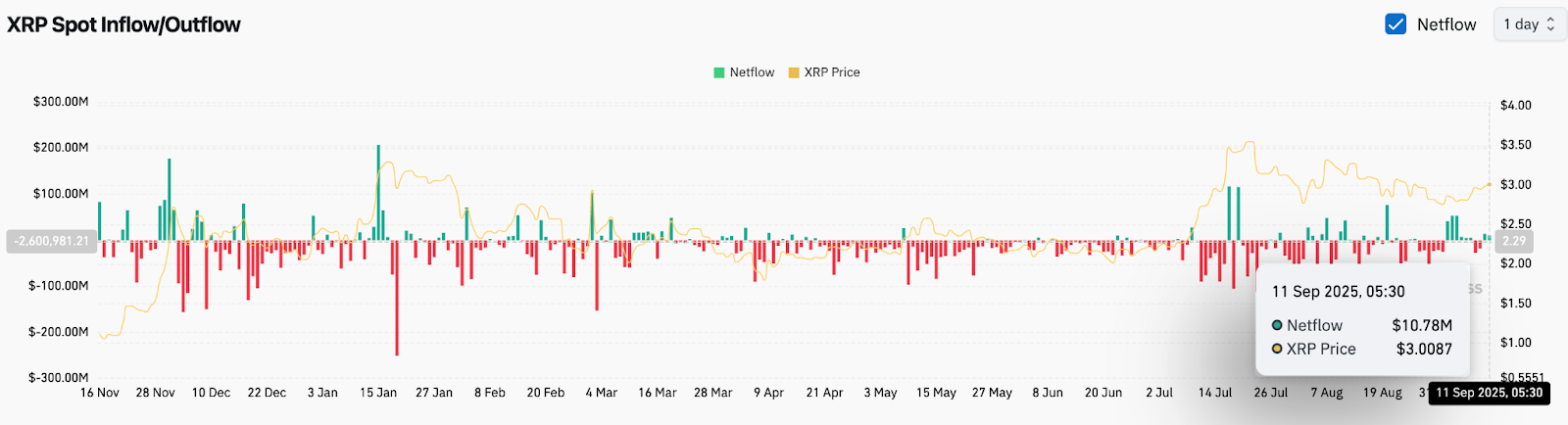
Приток/отток XRP Spot (Источник: Coinglass)

Данные о блокчейне подтверждают накопление. 11 сентября Coinglass зафиксировал чистый приток в размере 10,78 млн долларов, что стало крупнейшим однодневным положительным притоком XRP за последние несколько недель.

По теме: Прогноз цены биткоина (BTC) на 12 сентября

Этот поворот событий после постоянного оттока капитала сигнализирует о том, что инвесторы готовятся к потенциальному прорыву. Устойчивый приток средств свыше 20 миллионов долларов укрепит бычий настрой, обеспечив ликвидность, необходимую для преодоления более высоких зон сопротивления.

Технический прогноз цены XRP

Техническая дорожная карта XRP определяется четкими уровнями:

  • Потенциал роста: прорыв выше $3,10–$3,18 откроет путь к $3,20 с расширенными целями на $3,45 и $3,68 на основе прогнозов Фибоначчи.
  • Недостаток: Неспособность преодолеть сопротивление грозит новым откатом к $2,92. Потеря этого уровня открывает доступ к $2,79, а дальнейшее снижение может привести к повторному тестированию $2,54.

Индикаторы импульса склоняются к нейтральному или бычьему тренду, при этом RSI держится около середины 50-х и сигнализирует о возможном дальнейшем росте.

Перспективы: вырастет ли курс XRP?

Цена XRP остаётся на решающем этапе. Сочетание растущего ончейн-притока, прочной поддержки на уровне $2,92 и технического сжатия против нисходящей линии тренда указывает на близость прорыва.

По теме: Прогноз цены MYX Finance: аналитики проявляют осторожность, поскольку обвинения в эйрдропе могут привести к прорыву отметки в $20

Аналитики сохраняют осторожный оптимизм. Подтверждённый рост выше $3,20 подтвердит бычью структуру, открыв более высокие цели в диапазоне $3,40–$3,68. До тех пор трейдеры XRP по-прежнему внимательно следят за риском очередного отскока, который может вернуть цену в зону долгосрочной консолидации.


Trending Cryptos

Related Reads

$2 Trillion: Countdown to AI's Largest IPO in History

The countdown for the largest IPO in AI history, a potential $2 trillion listing for Anthropic, is underway for October. The staggering valuation, reportedly projected by several investors, contrasts with the company's own internal restraint on setting a public target. Founded five years ago by former OpenAI core members, Anthropic's growth has been meteoric. Annual recurring revenue (ARR) surged from ~$9B in late 2025 to $47B by May 2026, with Q2 2026 revenue of $11.5B marking a 14x year-over-year increase. Bank valuations are even based on internal 2028 revenue forecasts of $190-200B. A key growth driver is Claude Code, its AI coding assistant. Its ARR quintupled in five months to $2.5B by February 2026, now constituting nearly 20% of total revenue. Surveys indicate Anthropic commands roughly 40% of enterprise LLM spending, doubling OpenAI's share in programming-specific use. However, alongside this explosive growth, reports detail significant internal cultural strife. Critics describe a divisive "priesthood" of PhD executives, led by CEO Dario Amodei, who promote a "save humanity" narrative that some employees find cult-like and alienating. This has reportedly created a demoralized workforce and a covert "underground network" of dissent among engineers torn between lucrative pre-IPO equity and a toxic work environment. Anthropic now faces a pivotal paradox: pursuing its mission of "safe" AI requires immense capital for compute, yet that capital demands relentless commercial growth. As it approaches its historic IPO, the company must navigate intense regulatory scrutiny, soaring operational costs, and internal tensions—any of which could destabilize its post-listing trajectory, much like SpaceX's significant post-IPO stock drop. The stage is set for a defining moment in tech history.

marsbit52m ago

$2 Trillion: Countdown to AI's Largest IPO in History

marsbit52m ago

AI Boosting Efficiency and Cutting Costs Makes VC Increasingly Expensive

"AI for Cost Reduction Makes VC Funding More Expensive" Despite the "cost-reduction and efficiency" narrative of AI, venture capital (VC) investment in the AI sector is becoming increasingly costly. While AI tools lower the initial costs for many startups—with team sizes shrinking across funding stages—the market is polarizing. For top-tier AI teams, especially those from leading companies like Google and OpenAI, funding rounds are now larger and valuations are higher than ever at the seed and early stages. For example, new ventures by prominent researchers are securing billions in funding with valuations reaching tens of billions before having a mature product. This creates a "barbell" market: lightweight startups need less capital, while elite AI firms attract massive investments early on. This dynamic raises the cost for VCs to acquire and maintain meaningful ownership stakes. As valuations soar early, securing the same equity percentage requires significantly larger capital commitments. VCs must now invest more upfront and reserve substantial funds for follow-on rounds to avoid dilution, prompting large firms like Accel and a16z to raise massive new funds. Consequently, capital is concentrating intensely in a few perceived winners like OpenAI and Anthropic, widening the gap between large and small VC funds. While high valuations bake in future growth expectations, they also compress potential returns, demanding that portfolio companies achieve unprecedented scale. For major VCs, the core strategy is clear: secure early positions in potential winners and maintain the capital to keep investing as valuations rapidly escalate.

marsbit1h ago

AI Boosting Efficiency and Cutting Costs Makes VC Increasingly Expensive

marsbit1h ago

An Eight-Year Investment Takes a Sharp Turn: Why Did Ethereum Suddenly Abandon Poseidon?

On August 13, Ethereum researcher Justin Drake announced a significant shift in Ethereum's Layer-1 cryptographic roadmap: abandoning the SNARK-friendly hash function Poseidon in favor of traditional functions like SHA2 or BLAKE2. This decision ends eight years of research and investment, marking a major revision to the post-quantum security strategy. Poseidon, introduced in 2019, was highly efficient for zkRollups and zkVMs within SNARK circuits. However, its need for prolonged cryptanalysis and the pressing timeline for quantum resistance revealed limitations. Recent breakthroughs in SNARK design, specifically using binary fields, now enable traditional, battle-tested hash functions to perform as efficiently as Poseidon within SNARKs. Benchmarks show modern laptops can now verify over a million traditional hash calls per second. This change is partly driven by accelerated concerns over quantum computing threats. Reports warn that "Cryptographically Relevant Quantum Computers" could break current blockchain signatures like ECDSA by the early 2030s, risking trillions in assets. Ethereum's response focuses on hash-based post-quantum signature schemes, deemed more quantum-resistant than some lattice-based alternatives under pressure from AI cryptanalysis. Ethereum's updated post-quantum roadmap targets a production-ready "leanVM" for signature aggregation by 2027, with full deployment across consensus, execution, and data layers by 2028. The shift to mature hash functions like SHA2 reduces reliance on newer algorithms and aligns with the goal of using widely analyzed cryptographic primitives. Other major blockchains are also preparing. Solana's core teams have independently chosen the NIST-standardized Falcon signature scheme for its compact size. Starknet plans a phased migration, starting with replacing its Pedersen hash with BLAKE2. Ethereum's move signifies a strategic pivot towards proven security foundations for the quantum era.

marsbit2h ago

An Eight-Year Investment Takes a Sharp Turn: Why Did Ethereum Suddenly Abandon Poseidon?

marsbit2h ago

Programmers Worldwide Are Wasting Money on Anthropic! The Company Can't Stand It Anymore

Anthropic recently published guidelines to help developers using Claude Code reduce unnecessary token costs. The key recommendations include: 1) Clear (/clear) conversations after completing a task to avoid carrying irrelevant file reads and command outputs into the next task. 2) Set the model and reasoning effort level at the start of a session, as switching mid-session invalidates the prompt cache, requiring a full-price recalculation of the entire dialog history. 3) Attach files using @ references instead of typing paths manually to avoid extra tool calls and searches that bloat the context. 4) Add quiet flags to verbose commands (e.g., in CLAUDE.md) to minimize lengthy output in the dialog history. 5) Use /compact while the session cache is still warm (before breaks) to compress the dialog at one-tenth the cost. 6) Offload large-output tasks to a sub-agent, which runs in an isolated context and only returns conclusions, preventing intermediate outputs from polluting the main dialog. The article explains token pricing: input tokens (prefill) are processed in parallel, while output tokens (decode) are generated serially, making output tokens five times more expensive. Caching is crucial for savings—if a request's prefix (system prompt, CLAUDE.md, dialog history) matches the previous one byte-for-byte, reading it costs only 10% of the standard input price. However, cache invalidation occurs when changing models, effort levels, fast mode, compressing dialogs, after cache expiration, or when resuming old sessions. Dialog history also grows quadratically (O(n²)) as file contents and command outputs accumulate, increasing costs per round. Proactive context management—like isolating noisy tasks, using /rewind to trim unproductive turns, and task-based session clearing—is becoming an essential skill for cost-effective AI-assisted development.

marsbit4h ago

Programmers Worldwide Are Wasting Money on Anthropic! The Company Can't Stand It Anymore

marsbit4h ago

Pax Silica vs. WAICO: The US Wants to Prohibit Europe from Using Chinese Artificial Intelligence

The United States is preparing to demand that European and other partners abandon Chinese artificial intelligence initiatives, threatening exclusion from the American-led "Pax Silica" coalition, according to a leaked U.S. State Department document. This ultimatum forces signatories of the "AI Opportunity Statement" to choose between the Western technological ecosystem and alternative frameworks, with China not explicitly named but clearly targeted. Pax Silica is a U.S. strategy for AI and semiconductor hegemony, launched in late 2025. Its European presence expanded significantly in mid-2026. Concurrently, China, Russia, and 27 other nations established the World AI Cooperation Organization (WAICO) in July 2026 as an independent intergovernmental platform promoting AI governance based on UN principles. This situation creates a difficult choice, especially for European nations balancing strategic autonomy with dependence on U.S. tech and security. It also pressures Global South countries with pragmatic ties to both Washington and Beijing. The formation of competing blocks risks fragmenting the global tech landscape, forcing companies to split supply chains, increasing costs, and potentially leading to incompatible standards and protocols. The era of open globalization in AI may be ending, replaced by geopolitical confrontation where technological sovereignty trumps economic efficiency. The decisions made will shape the global digital economy for decades.

cryptonews.ru6h ago

Pax Silica vs. WAICO: The US Wants to Prohibit Europe from Using Chinese Artificial Intelligence

cryptonews.ru6h ago

Trading

Spot

Hot Articles

What is XRP 2.0

XRP 2.0: A New Frontier in the Cryptocurrency Landscape Introduction to XRP 2.0 In the ever-evolving realm of cryptocurrency, new projects continuously emerge, vying for attention and adoption. One such promising initiative is XRP 2.0, a novel cryptocurrency project designed to leverage advanced blockchain technology and robust encryption methodologies. While the name draws parallels with Ripple’s XRP, it’s crucial to note that XRP 2.0 operates independently, focusing on enhancing transaction security, privacy, and scalability. As the digital financial landscape increasingly embraces decentralized solutions, XRP 2.0 aims to contribute meaningfully to web3 and the overall expansion of crypto projects. What is XRP 2.0? At its core, XRP 2.0 is a cryptocurrency project that aims to create a secure and decentralized digital currency ecosystem. Its foundational technology integrates sophisticated blockchain principles with cutting-edge encryption techniques. The overarching goal of XRP 2.0 is to establish itself as a reliable and efficient platform enabling swift transaction execution while prioritizing enhanced privacy protections for its users. The project is promoted as a solution to many limitations faced by existing cryptocurrencies, proposing a system that can handle a higher volume of transactions with improved speed and privacy. This versatility positions XRP 2.0 as a significant contender in a marketplace riddled with various digital currencies. Who is the Creator of XRP 2.0? The identity of the creator behind XRP 2.0 has been flagged as ‘Wilbur.’ However, comprehensive details regarding Wilbur or their associated entity remain elusive. The anonymity of many cryptocurrency creators is not an uncommon phenomenon in the industry, often designed to maintain a degree of privacy and security. Who are the Investors of XRP 2.0? As of now, specific information related to the investment foundations or organizations supporting XRP 2.0 is not publicly available. In the cryptocurrency sector, the backing by reputed investors can significantly influence a project's credibility and success, yet the transparency regarding the financial supporters of XRP 2.0 has not been established. How Does XRP 2.0 Work? XRP 2.0 stands out by employing a combination of blockchain technology and advanced encryption algorithms that ensures secure and decentralized transactions. Its innovative structure includes unique features designed to foster user engagement and broaden functionalities beyond conventional cryptocurrency transactions. Among these features, XRP 2.0 incorporates AI-powered capabilities, such as text-to-image and text-to-speech functionalities. These additions are designed to enhance the interactive experience for users, promoting broader applicability across various sectors. By bridging technological advancements with user-centered design, XRP 2.0 aims to capture the attention of a diverse range of individuals and enterprises looking to integrate cryptocurrency solutions into their operational frameworks. Timeline of XRP 2.0 Understanding XRP 2.0 requires examining the milestones that have defined its journey thus far: July 23, 2023: XRP 2.0 is introduced as a novel cryptocurrency project, aiming to revolutionize secure and decentralized transaction capabilities in the blockchain domain. September 8, 2023: The launching of another project, XRP20, occurs, marking the emergence of an ERC-20 token on the Ethereum blockchain that remains unrelated to XRP 2.0. November 13, 2023: The XRP Ledger undergoes a significant update with the release of rippled server software version 2.0.0. It is essential to note that this development is disconnected from the XRP 2.0 cryptocurrency project. Key Points About XRP 2.0 To distill the essence of XRP 2.0, several critical factors emerge: Unique Features: The inclusion of features like AI-powered text-to-image and text-to-speech further diversifies the potential applications of XRP 2.0. Blockchain Technology: The framework utilizes advanced blockchain mechanisms and encryption protocols, ensuring a secure and decentralized environment for transactions. Scalability and Privacy: XRP 2.0 prioritizes enhanced privacy protections in transaction processes and the scalability necessary to accommodate a growing user base. No Affiliation with Ripple: Importantly, despite its name, XRP 2.0 does not have any allegiance or collaboration with Ripple’s XRP, distinguishing its operational framework and objectives within the cryptocurrency ecosystem. Conclusion XRP 2.0 represents an ambitious venture into the cryptocurrency sphere, aiming to offer a combination of security, privacy, and efficiency in digital transactions. By integrating sophisticated technologies and user-friendly features, the project sets out to broaden the horizons of what cryptocurrency can achieve in today's digital economy. While the anonymity of its creator and lack of disclosed investors might raise questions for some, XRP 2.0's focus on advanced functionalities and decentralisation enhances its appeal amidst an increasingly crowded crypto market. As the cryptocurrency landscape continues to evolve, XRP 2.0 may yet emerge as a pivotal player in the expansion of secure and scalable blockchain solutions.

1.5k Total ViewsPublished 2024.04.01Updated 2024.12.03

What is XRP 2.0

Discussions

Welcome to the HTX Community. Here, you can stay informed about the latest platform developments and gain access to professional market insights. Users' opinions on the price of XRP (XRP) are presented below.

活动图片