Bitcoin Lightning Payment Zaps Across Satellite In Historic First

bitcoinistPublished on 2025-09-11Last updated on 2025-09-11

Abstract

A Bitcoin Lightning payment request has been relayed through a geostationary satellite and then paid, in what appears to be...

Trusted Editorial content, reviewed by leading industry experts and seasoned editors. Ad Disclosure

A Bitcoin Lightning payment request has been relayed through a geostationary satellite and then paid, in what appears to be the first public demonstration of a Lightning invoice transmitted “through actual space.”

Bitcoin Lightning Blasts Into Space

The experiment, carried out by the X user “Printer” (@Printer_Gobrrr), uplinked a Lightning invoice as an image to the QO-100 (Es’hail-2) amateur radio transponder and downlinked it back to Earth, where it was decoded and settled over the Lightning Network. “Achievement unlocked: Received and paid the first lighting [sic] invoice which was sent through actual space,” the user wrote on Sept. 9, 2025.

Unlike earlier satellite-based Bitcoin milestones that focused on on-chain transactions or blockchain distribution, the novelty here is Lightning-specific: the payment request itself—encoded as a BOLT11 invoice and rendered as a QR image—was delivered via satellite rather than the terrestrial internet.

According to technical descriptions, the process began with a wallet generating a Lightning invoice. That invoice was converted to an image and injected into an AMSAT-DL Multimedia HS Modem, which digitally modulated and uplinked the file to QO-100’s wideband amateur transponder.

The satellite rebroadcast the data back to Earth; the downlink was decoded, the QR scanned, and the Lightning payment executed normally. In other words, the settlement path remained Lightning’s standard network, but the “last-mile” delivery of the invoice was fully off-grid.

QO-100 (Es’hail-2) is a geostationary satellite positioned over 25.5°E with amateur S-band uplink and 10 GHz downlink transponders that cover a footprint spanning Europe, Africa, the Middle East and parts of Asia—making it a favorite platform for amateur radio digital experiments. The use of its wideband digital transponder for file/image transmission is consistent with AMSAT-DL’s guidance for experimental digital modulation on QO-100.

The demonstration underscores a broader theme that’s been developing for years: satellite infrastructure can harden Bitcoin’s communications layer against last-mile failures, censorship, and disaster scenarios.

Blockstream’s Satellite network, for example, continuously broadcasts the Bitcoin blockchain around the world, allowing nodes to stay in sync without a terrestrial connection; developers can also pay Lightning invoices to broadcast arbitrary messages over that network via the Satellite API. Today’s Lightning-over-satellite invoice adds a complementary capability: off-grid dissemination of payment requests, not just blocks or messages.

It also invites careful parsing. While headlines describe a “Lightning payment sent via satellite,” the architecture shown indicates that what traveled through space was the invoice, not the channel-routed payment itself. Once decoded, a wallet still needed normal Lightning connectivity—direct or via a routing node—to settle the invoice before it expired. That distinction matters for reliability claims and for evaluating what parts of the payments stack can operate during internet outages.

Bitcoin’s History In Outer Space

Historically, Bitcoin’s “space” experiments have ranged from block broadcasts to in-orbit signing. In August 2020, SpaceChain executed a multi-signature Bitcoin transaction using hardware aboard the International Space Station, illustrating that private-key operations can be anchored off-planet.

Blockstream’s satellite service, meanwhile, has matured into a 24/7 global broadcast of the Bitcoin blockchain with developer tooling. The Lightning invoice relay through QO-100 slots into that lineage as the first widely publicized Lightning-specific satellite hop.

There are practical constraints. QO-100’s footprint does not cover the Americas, and lawful use of amateur transponders requires adherence to band plans and licensing in each jurisdiction. The hardware profile—parabolic dish, RF front-end, and specialized modem—puts this squarely in the “enthusiast” tier for now.

Lightning-specific considerations persist as well: invoices are time-limited; channel liquidity and route availability still govern payment success; and any truly “air-gapped” settlement would require additional relays or satellite-capable Lightning networking beyond today’s proof-of-concept.

Still, the signal is clear: Bitcoin’s communications resiliency keeps expanding. With satellites broadcasting blocks, APIs that accept Lightning for satellite message uplinks, and now a public demo of a Lightning invoice delivered through space and successfully paid, the system is incrementally decoupling itself from single points of terrestrial failure. Whether for disaster recovery, censorship resistance, or simply engineering curiosity, the frontier of off-grid Bitcoin just pushed a little farther into orbit.

At press time, BTC traded at $114,266.
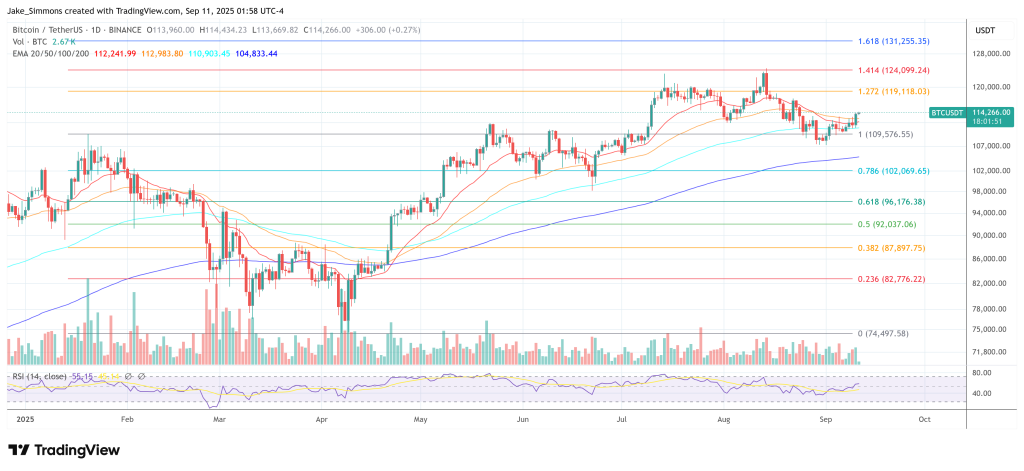
Bitcoin price
BTC rises back above $114,000, 1-day chart | Source: BTCUSDT on TradingView.com
Featured image created with DALL.E, chart from TradingView.com
Editorial Process for bitcoinist is centered on delivering thoroughly researched, accurate, and unbiased content. We uphold strict sourcing standards, and each page undergoes diligent review by our team of top technology experts and seasoned editors. This process ensures the integrity, relevance, and value of our content for our readers.

Jake Simmons has been a Bitcoin enthusiast since 2016. Ever since he heard about Bitcoin, he has been studying the topic every day and trying to share his knowledge with others. His goal is to contribute to Bitcoin's financial revolution, which will replace the fiat money system. Besides BTC and crypto, Jake studied Business Informatics at a university. After graduation in 2017, he has been working in the blockchain and crypto sector. You can follow Jake on Twitter at @realJakeSimmons.

Trending Cryptos

Related Reads

Aave Founder Dismisses Reports Of Payward’s ‘70% Discount’ Stake Purchase

Aave founder Stani Kulechov has dismissed reports claiming that Kraken's parent company, Payward, was negotiating to purchase a 15% stake in Aave Group at a steep 70% discount. The reported deal proposed a $71 million investment at a $385 million valuation, which was framed as a significant discount compared to AAVE's fully diluted token valuation. Kulechov rejected this narrative, stating AAVE would not be sold at such a discount, and highlighted Aave's protocol revenue. The article clarifies the distinction between different entities within the Aave ecosystem—Aave Group, Aave Labs, Aave DAO, and AAVE token holders—noting that an equity discussion in a related company does not equate to selling the protocol or transferring DAO control. It underscores the sensitivity of major DeFi protocols to strategic investment rumors and the importance of accurate terminology to avoid misleading readers. While strategic discussions are common in the crypto sector, Kulechov specifically denied the discounted sale framing. The situation highlights that future developments should be monitored via official Aave channels, and market reactions may depend on whether token holders view the denial as value-supportive or focus on potential future distributions. The key takeaway is the founder's rejection of the 70% discount story, while leaving room for strategic partnerships under different terms.

bitcoinist4h ago

Aave Founder Dismisses Reports Of Payward’s ‘70% Discount’ Stake Purchase

bitcoinist4h ago

Trading

Spot

Hot Articles

What is $BITCOIN

DIGITAL GOLD ($BITCOIN): A Comprehensive Analysis Introduction to DIGITAL GOLD ($BITCOIN) DIGITAL GOLD ($BITCOIN) is a blockchain-based project operating on the Solana network, which aims to combine the characteristics of traditional precious metals with the innovation of decentralized technologies. While it shares a name with Bitcoin, often referred to as “digital gold” due to its perception as a store of value, DIGITAL GOLD is a separate token designed to create a unique ecosystem within the Web3 landscape. Its goal is to position itself as a viable alternative digital asset, although specifics regarding its applications and functionalities are still developing. What is DIGITAL GOLD ($BITCOIN)? DIGITAL GOLD ($BITCOIN) is a cryptocurrency token explicitly designed for use on the Solana blockchain. In contrast to Bitcoin, which provides a widely recognized value storage role, this token appears to focus on broader applications and characteristics. Notable aspects include: Blockchain Infrastructure: The token is built on the Solana blockchain, known for its capacity to handle high-speed and low-cost transactions. Supply Dynamics: DIGITAL GOLD has a maximum supply capped at 100 quadrillion tokens (100P $BITCOIN), although details regarding its circulating supply are currently undisclosed. Utility: While precise functionalities are not explicitly outlined, there are indications that the token could be utilized for various applications, potentially involving decentralized applications (dApps) or asset tokenization strategies. Who is the Creator of DIGITAL GOLD ($BITCOIN)? At present, the identity of the creators and development team behind DIGITAL GOLD ($BITCOIN) remains unknown. This situation is typical among many innovative projects within the blockchain space, particularly those aligning with decentralized finance and meme coin phenomena. While such anonymity may foster a community-driven culture, it intensifies concerns about governance and accountability. Who are the Investors of DIGITAL GOLD ($BITCOIN)? The available information indicates that DIGITAL GOLD ($BITCOIN) does not have any known institutional backers or prominent venture capital investments. The project seems to operate on a peer-to-peer model focused on community support and adoption rather than traditional funding routes. Its activity and liquidity are primarily situated on decentralized exchanges (DEXs), such as PumpSwap, rather than established centralized trading platforms, further highlighting its grassroots approach. How DIGITAL GOLD ($BITCOIN) Works The operational mechanics of DIGITAL GOLD ($BITCOIN) can be elaborated on based on its blockchain design and network attributes: Consensus Mechanism: By leveraging Solana’s unique proof-of-history (PoH) combined with a proof-of-stake (PoS) model, the project ensures efficient transaction validation contributing to the network's high performance. Tokenomics: While specific deflationary mechanisms have not been extensively detailed, the vast maximum token supply implies that it may cater to microtransactions or niche use cases that are still to be defined. Interoperability: There exists the potential for integration with Solana’s broader ecosystem, including various decentralized finance (DeFi) platforms. However, the details regarding specific integrations remain unspecified. Timeline of Key Events Here is a timeline that highlights significant milestones concerning DIGITAL GOLD ($BITCOIN): 2023: The initial deployment of the token occurs on the Solana blockchain, marked by its contract address. 2024: DIGITAL GOLD gains visibility as it becomes available for trading on decentralized exchanges like PumpSwap, allowing users to trade it against SOL. 2025: The project witnesses sporadic trading activity and potential interest in community-led engagements, although no noteworthy partnerships or technical advancements have been documented as of yet. Critical Analysis Strengths Scalability: The underlying Solana infrastructure supports high transaction volumes, which could enhance the utility of $BITCOIN in various transaction scenarios. Accessibility: The potential low trading price per token could attract retail investors, facilitating wider participation due to fractional ownership opportunities. Risks Lack of Transparency: The absence of publicly known backers, developers, or an audit process may yield skepticism regarding the project's sustainability and trustworthiness. Market Volatility: The trading activity is heavily reliant on speculative behavior, which can result in significant price volatility and uncertainty for investors. Conclusion DIGITAL GOLD ($BITCOIN) emerges as an intriguing yet ambiguous project within the rapidly evolving Solana ecosystem. While it attempts to leverage the “digital gold” narrative, its departure from Bitcoin's established role as a store of value underscores the need for a clearer differentiation of its intended utility and governance structure. Future acceptance and adoption will likely depend on addressing the current opacity and defining its operational and economic strategies more explicitly. Note: This report encompasses synthesised information available as of October 2023, and developments may have transpired beyond the research period.

468 Total ViewsPublished 2025.05.13Updated 2025.05.13

What is $BITCOIN

Discussions

Welcome to the HTX Community. Here, you can stay informed about the latest platform developments and gain access to professional market insights. Users' opinions on the price of BTC (BTC) are presented below.

活动图片