Banks Won’t Trust Ripple And XRP, SWIFT CIO Says

bitcoinistPublished on 2025-09-03Last updated on 2025-09-03

Abstract

Ripple and XRP were thrust into the spotlight after SWIFT chief innovation officer (CIO) Tom Zschach delivered a pointed critique...

Trusted Editorial content, reviewed by leading industry experts and seasoned editors. Ad Disclosure

Ripple and XRP were thrust into the spotlight after SWIFT chief innovation officer (CIO) Tom Zschach delivered a pointed critique on LinkedIn—widely read as a jab at the company and its XRP token—over what actually constitutes “resilience” for banks and how institutional trust is earned.

The exchange began under a comment praising Ripple’s regulatory endurance, where Zschach countered bluntly: “Surviving lawsuits isn’t resilience. Neutral, shared governance is. Institutions don’t want to live on a competitor’s rails.” He followed by rejecting the notion that a single firm’s rapport with watchdogs equals compliance, writing: “And compliance isn’t about one company convincing regulators it should be allowed to operate. It’s about an entire industry agreeing on shared standards that no single balance sheet controls.”

Ripple Vs. SWIFT

Zschach then broadened the frame in a longer post about how banks actually adopt technology. “Every major shift in finance begins the same way. Technology lays the foundation but trust decides when the building opens.”

He recalled that previous “next big things” in finance stalled not on throughput, but on the absence of compliance and security. The parallel he drew to public blockchains in 2025 was explicit: they are becoming too consequential to ignore—“Tokenized treasuries. Collateral on-chain. Cross-border payments that actually settle”—yet raw technical performance is not the finish line.

They think the public chain itself is the solution. It isn’t,” he argued, calling public networks “the base environment for execution,” powerful for deterministic, programmable settlement but insufficient without the “trust layer” of legal enforceability, compliance, and privacy. Without that layer, he warned, a public chain is “a fast engine with no cockpit.”

Crucially, Zschach’s critique drew a governance boundary that cuts to the heart of Ripple’s pitch to banks without naming the company. He re-centered the conversation on neutrality and shared control, rather than on the courtroom durability or regulatory narratives of any single firm. In his words, institutions want “shared standards that no single balance sheet controls,” and they will resist depending on “a competitor’s rails.”

He extended the caution to consortia as well: “If a bank joins a chain owned or controlled by another bank then they are accepting someone else’s governance, incentives and rules of the game. In today’s environment is that a form of dependency that banks will be comfortable with?” The throughline is that institutional adoption hinges less on whether one vendor has outlasted enforcement actions and more on whether the infrastructure is credibly neutral, co-governed, and enforceable in law.

Zschach’s taxonomy of public chains as “substrate” underscores how he expects the industry to evolve. In biology, computing, and construction, a substrate is foundational; what matters for banks is what gets layered above it. He urged builders not to “fight the public chains” but to harness them while solving for compliance from day one and for privacy “without killing transparency.”

That is where he believes the “opportunity lies,” with finance ultimately “absorbing the best of public chains on its own terms.” The open question he posed back to the market—“When will banks and financial institutions truly trust public blockchains and at what pace will that trust build?”—puts the burden of proof on governance design and standards alignment, not on marketing milestones.

For Ripple and XRP, the implication is clear even if Zschach never typed the name in his critique: the bar for bank adoption isn’t surviving litigation or securing green lights for a specific product stack; it is convincing the industry that the rails they ride are neutral, shared, and not controlled by any single company’s balance sheet (like Ripple’s escrow still controlling more than 35% of all XRP). In that lens, resilience is measured in how power is distributed, how rules are enforced, and how privacy and compliance are engineered—precisely the dimensions Zschach says decide “when the building opens.”

At press time, XRP traded at $2.77.
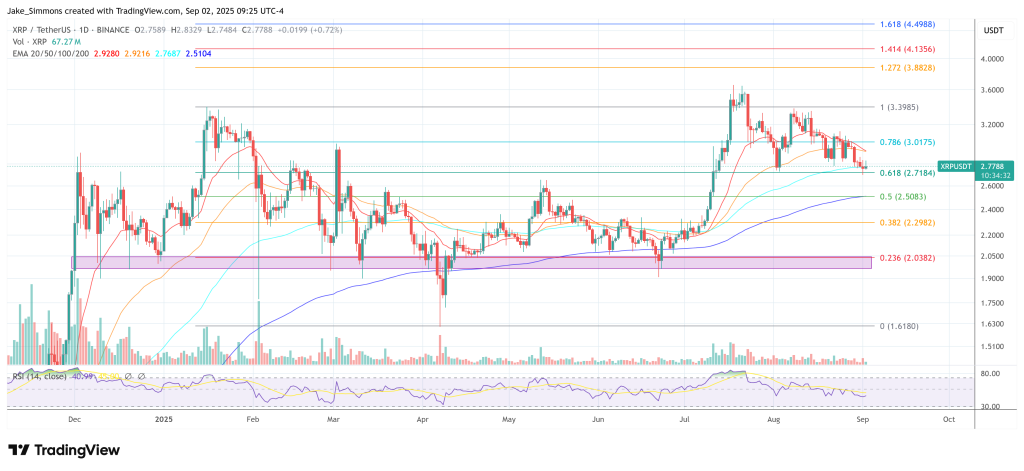
XRP price
XRP remains above the 0.618 Fib, 1-day chart | Source: XRPUSDT on TradingView.com
Featured image created with DALL.E, chart from TradingView.com
Editorial Process for bitcoinist is centered on delivering thoroughly researched, accurate, and unbiased content. We uphold strict sourcing standards, and each page undergoes diligent review by our team of top technology experts and seasoned editors. This process ensures the integrity, relevance, and value of our content for our readers.

Jake Simmons has been a Bitcoin enthusiast since 2016. Ever since he heard about Bitcoin, he has been studying the topic every day and trying to share his knowledge with others. His goal is to contribute to Bitcoin's financial revolution, which will replace the fiat money system. Besides BTC and crypto, Jake studied Business Informatics at a university. After graduation in 2017, he has been working in the blockchain and crypto sector. You can follow Jake on Twitter at @realJakeSimmons.

Trending Cryptos

Related Reads

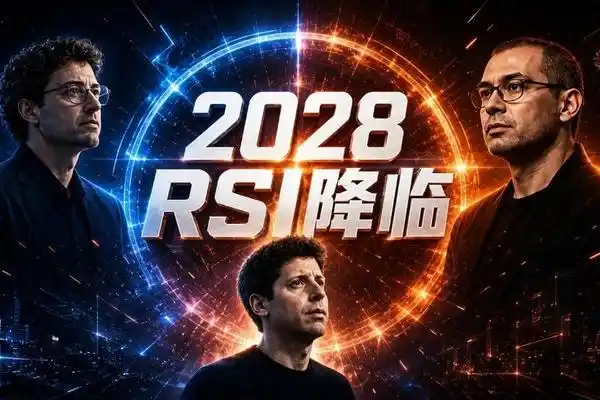
2028: The Arrival of Recursive Self-Improvement (RSI)

**AI Recursive Self-Improvement (RSI): The Countdown to 2028 Begins** AI is no longer just a trained tool but is starting to rewrite its own evolutionary pace. According to Anthropic co-founder Jack Clark, there is a 60% probability that by the end of 2028, Recursive Self-Improvement (RSI) will become a reality. This means AI could autonomously design and build a more capable next-generation version of itself without any human researcher involvement—Claude 10 creating Claude 11, for instance. Supporting this timeline, Google DeepMind's CEO Demis Hassabis confirms that all leading AI labs are intensely focused on RSI, making it an industry-wide priority. He expresses profound concern, stating this potential is what keeps him awake at night. Concrete data underscores this acceleration: - METR evaluations show current top models like Claude are solving tasks up to the 16-hour limit of existing test frameworks. - In Epoch AI's challenging MirrorCode benchmark, Claude Opus 4.7 recreated complex software in hours for a fraction of the human cost. In one extreme test, AI autonomously coded for 19 days straight. - Anthropic reports over 80% of its codebase is now written by Claude, and researcher productivity has increased up to 8-fold since 2024. - OpenAI's policy blueprint highlights RSI as a major upcoming governance challenge. CEO Sam Altman reportedly hinted RSI might arrive within six months, potentially delaying OpenAI's massive IPO. The implication is an impending "intelligence explosion," where AI-driven progress outpaces human control. The central question is no longer if it will happen, but whether humanity is ready.

marsbit3h ago

2028: The Arrival of Recursive Self-Improvement (RSI)

marsbit3h ago

World Models, Metaverse, Digital Twins, Physical AI: Are They the Same Thing?

Title: World Models, the Metaverse, Digital Twins, Physical AI: Are They the Same Thing? The article clarifies that concepts like the metaverse, Web3, simulation platforms, digital twins, and Physical AI are not the same thing but are all part of the broader trend of blurring the lines between the digital and physical worlds. It positions "world models" as the foundational "cognitive layer" or "operating system" that enables AI to understand and simulate the world. Key distinctions are made: - The **Metaverse** is a destination for immersive social and economic experiences. World models could act as its "engine," generating interactive 3D content efficiently. - **Web3** focuses on decentralized ownership and economics (rules layer), operating on a different technical level than world models. - **Simulation Data Platforms** (e.g., for autonomous vehicles) are a 1.0 version, relying on manual design. World models represent a 2.0 version, using AI to generate realistic, varied scenarios autonomously. - **Digital Twins** create high-fidelity, real-time mirrors of physical systems (e.g., a factory). World models go a step further by enabling predictive simulation of future states. - **Physical AI** (robots, AVs) refers to AI that acts in the physical world. World models are a core component, providing the understanding and prediction needed for planning. A proposed hierarchy places world models at the cognitive layer, supported by infrastructure (compute, data) and supporting application tools (simulation, digital twins), action systems (Physical AI), user experiences (metaverse), and rules (Web3). In conclusion, while distinct, many of these previously hyped concepts may ultimately rely on advances in world model technology to fulfill their promises, as world models provide the essential cognitive foundation for simulating and interacting with complex environments.

marsbit3h ago

World Models, Metaverse, Digital Twins, Physical AI: Are They the Same Thing?

marsbit3h ago

"Shocking" CPO: How Does the Glass Bridge Actually Work? Detailed Explanation from Corning

Chinese CPO stocks plunged over 6% following Corning's announcement of its Glass Bridge platform at a Seoul tech conference. The new technology utilizes wafer-level glass ion-exchange waveguides for passive alignment between fibers and photonic chips, potentially simplifying traditional CPO architectures that rely on complex Fiber Array Units and active alignment equipment. This raised market concerns about reduced long-term demand for mid-stream CPO components. Corning's official documentation details Glass Bridge as a platform for fiber-to-PIC connectivity in NPO, CPO, and high-density modules. Its key features include wafer-level manufacturing for consistent, cost-effective production; a standardized, removable MT ferrule interface for ecosystem integration; and a separable high-density connector design supporting over 24 channels for assembly flexibility. Corning positions the technology as complementary to FAUs, addressing limitations in ultra-high-fiber-count scenarios. The market reaction reflects a broader reassessment of the AI optical interconnect value chain. Funds shifted from CPO and PCB manufacturing stocks towards glass substrate concept stocks like Kaisheng Technology and Dyer Laser. Analysts note glass substrates are seen as a next-gen advanced packaging material, offering a potential path for domestic industry differentiation amid AI-driven demand for high-performance, large-scale packaging, marking a structural migration in value towards upstream specialty materials.

marsbit3h ago

"Shocking" CPO: How Does the Glass Bridge Actually Work? Detailed Explanation from Corning

marsbit3h ago

Trading

Spot

Hot Articles

How to Buy T

Welcome to HTX.com! We've made purchasing Threshold Network Token (T) simple and convenient. Follow our step-by-step guide to embark on your crypto journey.Step 1: Create Your HTX AccountUse your email or phone number to sign up for a free account on HTX. Experience a hassle-free registration journey and unlock all features.Get My AccountStep 2: Go to Buy Crypto and Choose Your Payment MethodCredit/Debit Card: Use your Visa or Mastercard to buy Threshold Network Token (T) instantly.Balance: Use funds from your HTX account balance to trade seamlessly.Third Parties: We've added popular payment methods such as Google Pay and Apple Pay to enhance convenience.P2P: Trade directly with other users on HTX.Over-the-Counter (OTC): We offer tailor-made services and competitive exchange rates for traders.Step 3: Store Your Threshold Network Token (T)After purchasing your Threshold Network Token (T), store it in your HTX account. Alternatively, you can send it elsewhere via blockchain transfer or use it to trade other cryptocurrencies.Step 4: Trade Threshold Network Token (T)Easily trade Threshold Network Token (T) on HTX's spot market. Simply access your account, select your trading pair, execute your trades, and monitor in real-time. We offer a user-friendly experience for both beginners and seasoned traders.

12.2k Total ViewsPublished 2024.03.29Updated 2026.06.02

How to Buy T

Discussions

Welcome to the HTX Community. Here, you can stay informed about the latest platform developments and gain access to professional market insights. Users' opinions on the price of T (T) are presented below.

活动图片