Galaxy Digital Deposits 500,000 Solana ($103M) To Coinbase In 5 Days – Details

bitcoinistPublished on 2025-09-02Last updated on 2025-09-02

Abstract

Solana (SOL) has been one of the strongest performers in the altcoin space since April, sustaining a bullish yet volatile...

Trusted Editorial content, reviewed by leading industry experts and seasoned editors. Ad Disclosure

Solana (SOL) has been one of the strongest performers in the altcoin space since April, sustaining a bullish yet volatile uptrend that has captured investor attention. While many altcoins have struggled with breakdowns and heavy selling pressure, Solana has managed to hold firm, showing relative strength despite broader market uncertainty. Still, the momentum is being tested as SOL approaches critical resistance levels that could determine its next major move.

Some analysts caution that Solana may face profit-taking and pullbacks in the near term, with price potentially dropping to lower support zones before any sustained rally can resume. The combination of technical resistance and increasing volatility makes this a decisive moment for traders watching whether Solana can break higher or consolidate further.

Adding to the uncertainty, onchain data reveals that Galaxy Digital recently transferred a massive amount of Solana to Coinbase, sparking speculation about potential institutional profit-taking. While these inflows don’t necessarily confirm selling, they often signal preparation for liquidity events.

Massive Solana Transfer Sparks Speculation

According to Lookonchain, Galaxy Digital has deposited 500,000 SOL (worth approximately $103 million) to Coinbase over the past five days, raising eyebrows across the market. Such a large transfer by a major institutional player is often interpreted as preparation for liquidity events, whether that means hedging, profit-taking, or reallocating capital into other assets. While the exact motivation remains uncertain, the move comes at a time when Solana is testing critical resistance levels, making market participants more cautious.
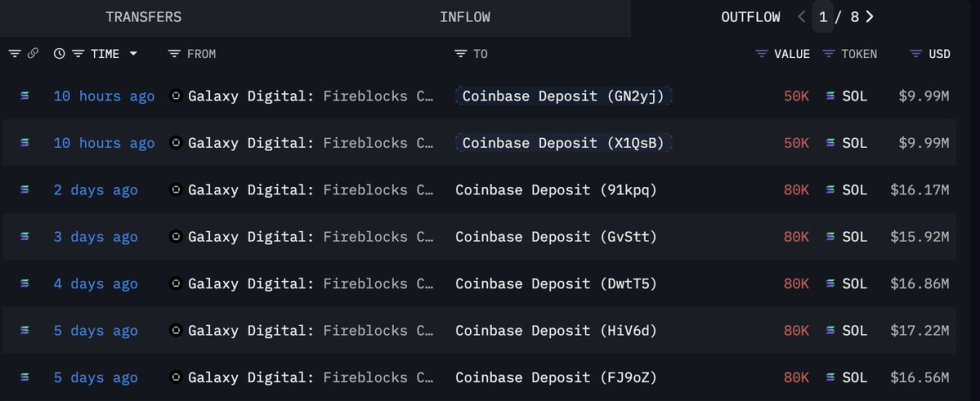
Galaxy Digital Solana Transfers | Source: Lookonchain

This development has fueled speculation that Solana may move toward lower price levels in the near term. Some analysts argue that institutions may be locking in gains after SOL’s strong performance since April, when the token began its bullish uptrend. Others suggest that capital could be rotating into Ethereum or alternative large-cap projects, given the recent surge in whale accumulation of ETH.

At the same time, broader market conditions add to the uncertainty. With Bitcoin struggling to reclaim momentum and Ethereum consolidating around demand levels, many analysts see the crypto market as a whole entering a sideways consolidation phase. If that outlook proves correct, Solana could face continued profit-taking pressure as traders look to secure gains before the next major leg up.

Despite these headwinds, Solana’s resilience throughout recent volatility highlights its underlying strength as a network and investment vehicle. The coming weeks will be crucial to see whether Galaxy Digital’s transfer marks the beginning of broader institutional selling or simply a short-term adjustment within a longer bullish trend.

Price Analysis: Testing A Pivotal Zone

Solana is currently trading around $203.33, showing resilience despite ongoing market volatility. The chart highlights a bullish structure that has been developing since the lows of May 2025, when SOL traded near $120. Since then, the token has steadily climbed, reclaiming key moving averages and now testing the critical $200–$220 resistance range. This area has historically acted as a major barrier, marking both local tops and heavy selling zones in past cycles.
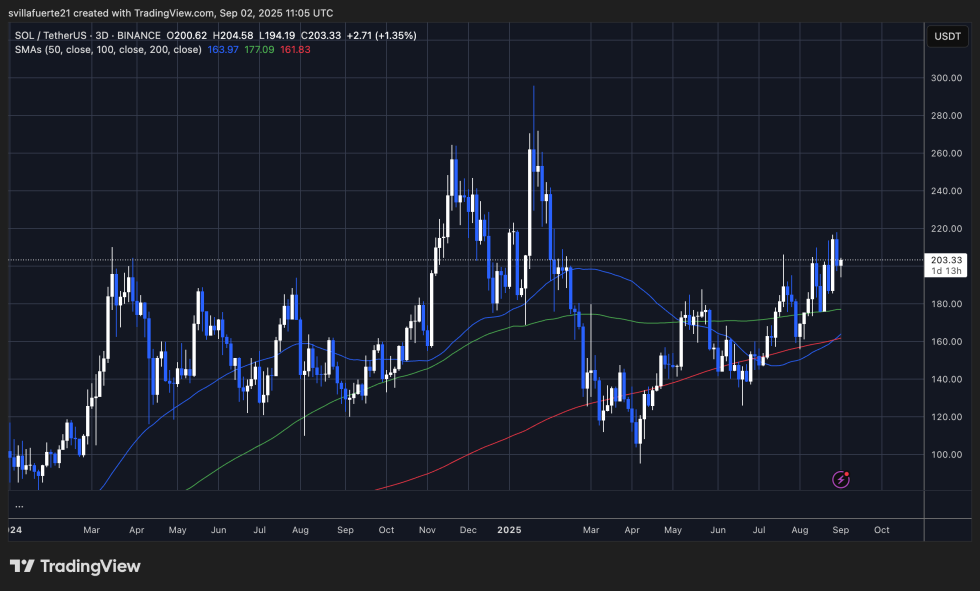
SOL testing critical resistance | Source: SOLUSDT chart on TradingView

The 50-day moving average is trending above the 100-day and 200-day MAs, a bullish sign confirming Solana’s medium-term strength. However, the price is struggling to close convincingly above $210, indicating that sellers are still active at higher levels. Profit-taking behavior, also noted in recent on-chain data, adds weight to this resistance.

If SOL manages to break above $220 with strong volume, the next upside targets could open toward $240 and $260, levels last seen during its 2024 rally. Conversely, failure to hold above $200 may invite a pullback toward $180 or even $165, aligning with the 100-day MA and past demand zones.

Featured image from Dall-E, chart from TradingView

Editorial Process for bitcoinist is centered on delivering thoroughly researched, accurate, and unbiased content. We uphold strict sourcing standards, and each page undergoes diligent review by our team of top technology experts and seasoned editors. This process ensures the integrity, relevance, and value of our content for our readers.

Sebastian's journey into the world of crypto began four years ago, driven by a fascination with the potential of blockchain technology to revolutionize financial systems. His initial exploration focused on understanding the intricacies of various crypto projects, particularly those focused on building innovative financial solutions. Through countless hours of research and learning, Sebastian developed a deep understanding of the underlying technologies, market dynamics, and potential applications of cryptocurrencies. As his knowledge grew, Sebastian felt compelled to share his insights with others. He began actively contributing to online discussions on platforms like X and LinkedIn, focusing on fintech and crypto-related content. His goal was to expose valuable trends and insights to a wider audience, fostering a deeper understanding of the rapidly evolving crypto landscape. Sebastian's contributions quickly gained recognition, and he became a trusted voice in the online crypto community. To further enhance his expertise, Sebastian pursued a UC Berkeley Fintech: Frameworks, Applications, and Strategies certification. This rigorous program equipped him with valuable skills and knowledge regarding Financial Technology, bridging the gap between traditional finance (TradFi) and decentralized finance (DeFi). The certification deepened his understanding of the broader financial landscape and its intersection with blockchain technology. Sebastian's passion for finance and writing is evident in his work. He enjoys delving into financial research, analyzing market trends, and exploring the latest developments in the crypto space. In his spare time, Sebastian can often be found immersed in charts, studying 10-K forms, or engaging in thought-provoking discussions about the future of finance. Sebastian's journey as a crypto analyst and investor has been marked by a relentless pursuit of knowledge and a dedication to sharing his insights. His ability to navigate the complex world of crypto, combined with his passion for financial research and communication, makes him a valuable asset to the industry. As the crypto landscape continues to evolve, Sebastian remains at the forefront, providing valuable insights and contributing to the growth of this revolutionary technology.

Trending Cryptos

Related Reads

2028: The Arrival of Recursive Self-Improvement (RSI)

**AI Recursive Self-Improvement (RSI): The Countdown to 2028 Begins** AI is no longer just a trained tool but is starting to rewrite its own evolutionary pace. According to Anthropic co-founder Jack Clark, there is a 60% probability that by the end of 2028, Recursive Self-Improvement (RSI) will become a reality. This means AI could autonomously design and build a more capable next-generation version of itself without any human researcher involvement—Claude 10 creating Claude 11, for instance. Supporting this timeline, Google DeepMind's CEO Demis Hassabis confirms that all leading AI labs are intensely focused on RSI, making it an industry-wide priority. He expresses profound concern, stating this potential is what keeps him awake at night. Concrete data underscores this acceleration: - METR evaluations show current top models like Claude are solving tasks up to the 16-hour limit of existing test frameworks. - In Epoch AI's challenging MirrorCode benchmark, Claude Opus 4.7 recreated complex software in hours for a fraction of the human cost. In one extreme test, AI autonomously coded for 19 days straight. - Anthropic reports over 80% of its codebase is now written by Claude, and researcher productivity has increased up to 8-fold since 2024. - OpenAI's policy blueprint highlights RSI as a major upcoming governance challenge. CEO Sam Altman reportedly hinted RSI might arrive within six months, potentially delaying OpenAI's massive IPO. The implication is an impending "intelligence explosion," where AI-driven progress outpaces human control. The central question is no longer if it will happen, but whether humanity is ready.

marsbit4h ago

2028: The Arrival of Recursive Self-Improvement (RSI)

marsbit4h ago

World Models, Metaverse, Digital Twins, Physical AI: Are They the Same Thing?

Title: World Models, the Metaverse, Digital Twins, Physical AI: Are They the Same Thing? The article clarifies that concepts like the metaverse, Web3, simulation platforms, digital twins, and Physical AI are not the same thing but are all part of the broader trend of blurring the lines between the digital and physical worlds. It positions "world models" as the foundational "cognitive layer" or "operating system" that enables AI to understand and simulate the world. Key distinctions are made: - The **Metaverse** is a destination for immersive social and economic experiences. World models could act as its "engine," generating interactive 3D content efficiently. - **Web3** focuses on decentralized ownership and economics (rules layer), operating on a different technical level than world models. - **Simulation Data Platforms** (e.g., for autonomous vehicles) are a 1.0 version, relying on manual design. World models represent a 2.0 version, using AI to generate realistic, varied scenarios autonomously. - **Digital Twins** create high-fidelity, real-time mirrors of physical systems (e.g., a factory). World models go a step further by enabling predictive simulation of future states. - **Physical AI** (robots, AVs) refers to AI that acts in the physical world. World models are a core component, providing the understanding and prediction needed for planning. A proposed hierarchy places world models at the cognitive layer, supported by infrastructure (compute, data) and supporting application tools (simulation, digital twins), action systems (Physical AI), user experiences (metaverse), and rules (Web3). In conclusion, while distinct, many of these previously hyped concepts may ultimately rely on advances in world model technology to fulfill their promises, as world models provide the essential cognitive foundation for simulating and interacting with complex environments.

marsbit4h ago

World Models, Metaverse, Digital Twins, Physical AI: Are They the Same Thing?

marsbit4h ago

Trading

Spot

Hot Articles

Discussions

Welcome to the HTX Community. Here, you can stay informed about the latest platform developments and gain access to professional market insights. Users' opinions on the price of SOL (SOL) are presented below.

活动图片