Bitcoin News: Warum El Salvador jetzt seine BTC bewegt

bitcoinistPublished on 2025-08-31Last updated on 2025-09-01

Abstract

El Salvador verteilt seine staatlichen Bitcoin-Reserven auf viele kleinere Adressen, um potenzielle Risiken zu reduzieren. Grund dafür sind theoretische Gefahren...

Trusted Editorial content, reviewed by leading industry experts and seasoned editors. Ad Disclosure
  • El Salvador verteilt seine staatlichen Bitcoin-Reserven auf viele kleinere Adressen, um potenzielle Risiken zu reduzieren.
  • Grund dafür sind theoretische Gefahren durch künftige Quantencomputer.
  • Experten sind sich uneinig, ob diese Bedrohung schon realistisch ist, doch das Land setzt frühzeitig auf Vorsorge.

El Salvador als Bitcoin-Pionier

El Salvador schrieb 2021 Geschichte, als das Land Bitcoin als offizielles Zahlungsmittel neben dem US-Dollar einführte. Unter Präsident Nayib Bukele wurde dazu ein spezielles Gesetz verabschiedet, das den digitalen Token auf eine Stufe mit der Landeswährung stellte. Damit begann ein wirtschaftliches Experiment, das weltweit für Aufmerksamkeit sorgte und zugleich viele Diskussionen auslöste.

Von Anfang an kaufte die Regierung aktiv Bitcoin mit Staatsmitteln ein. Bukele nutzte Marktbewegungen geschickt aus, um die Bestände weiter aufzustocken. Heute besitzt das Land nach offiziellen Angaben 6.285 Bitcoin, was die Entschlossenheit seiner Politik zeigt. Anfang diesen Jahres wurde der Status der Währung für Bitcoin jedoch wieder zurückgezogen. Grund dafür ist zu einem die schlechte Wirtschaftslage und hohe Verschuldung des Landes, außerdem war die Entscheidung, BTC als Landeswährung einzuführen, in der Bevölkerung eher unbeliebt.

Die Rolle des Bitcoin Office

Für Transparenz sorgt das staatliche Bitcoin Office, das regelmäßig Informationen zu den Beständen veröffentlicht. Diese Praxis hebt El Salvador von vielen anderen Staaten ab, da die Entwicklung der Reserven öffentlich dokumentiert wird. Bürger und internationale Beobachter können so nachvollziehen, wie sich das Engagement des Landes im Kryptomarkt entwickelt.

Doch mit den wachsenden Beständen kamen auch Fragen zur Sicherheit auf. Bitcoin ist zwar durch seine Blockchain-Technologie dezentral geschützt, doch einzelne Verwahrungsstrategien können Schwachstellen aufweisen. El Salvador reagierte nun auf diese Kritik und kündigte eine neue Strategie an.

Neue Sicherheitsstrategie

Das Bitcoin Office teilte offiziell mit, dass die Bestände nicht mehr zentral in einer Adresse liegen. Stattdessen werden die 6.285 Bitcoins auf viele ungenutzte Adressen verteilt. Jede Adresse soll maximal 500 BTC enthalten, um das Risiko bei Angriffen deutlich zu verringern.

Der Schritt hat klare Vorteile: Private Schlüssel, die bisher auf einer bekannten Adresse öffentlich sichtbar waren, bleiben bei den neuen Adressen verborgen, solange sie nicht verwendet werden. Damit sinkt die Angriffsfläche und die Reserven sind sicherer vor potenziellen Angriffen.

Quantencomputer als Auslöser

Hintergrund dieser Entscheidung ist die Debatte um mögliche Bedrohungen durch Quantencomputer. Forscher verweisen darauf, dass Shor’s Algorithmus theoretisch in der Lage wäre, aktuelle Verschlüsselungssysteme zu knacken. Bitcoin wäre damit langfristig gefährdet, wenn die Technologie die nötige Rechenleistung erreicht.

El Salvador will diesem Szenario vorbeugen. Die Regierung zeigt, dass sie die Diskussion ernst nimmt und ihre Reserven schon heute vor einem Risiko absichert, das möglicherweise erst in vielen Jahren Realität wird.

Expertenmeinungen zum Risiko

Viele Analysten halten die Vorsorge für sinnvoll, betonen jedoch, dass Quantencomputer aktuell noch nicht in der Lage sind, Bitcoin effektiv anzugreifen. Heutige Systeme verfügen lediglich über wenige Hundert Qubits und sind zudem fehleranfällig. Für einen realen Angriff wären Millionen stabiler Qubits nötig.

Kritiker argumentieren daher, dass kurzfristig keine Bedrohung besteht und die Zukunft für Bitcoin vorerst sicher ist. Sie verweisen darauf, dass die meisten Bitcoin ohnehin auf Adressen liegen, deren öffentliche Schlüssel noch nicht preisgegeben wurden. Diese gelten selbst bei fortschreitender Quantenforschung als sicher.

Transparenz bleibt erhalten

Trotz der sicherheitsorientierten Neuausrichtung hält El Salvador am Prinzip der Transparenz fest. Das Bitcoin Office hat ein neues Dashboard veröffentlicht, auf dem die offiziellen Reserve-Adressen eingesehen werden können. Bürger und Beobachter können so weiterhin den Überblick behalten.

Damit gelingt es dem Land, Sicherheit und Offenheit miteinander zu verbinden. El Salvador bleibt so seiner Linie treu, neue Wege im Umgang mit Kryptowährungen zu beschreiten, ohne Vertrauen durch Geheimhaltung zu gefährden.

Fazit und Ausblick

El Salvador setzt ein deutliches Signal: Sicherheit geht vor, auch wenn die Bedrohung derzeit noch weit entfernt ist. Mit der neuen Strategie will das Land langfristig vorbereitet sein und zugleich Vertrauen in seine Bitcoin-Politik stärken.

Ob andere Länder diesem Beispiel folgen, bleibt abzuwarten. Klar ist jedoch, dass El Salvador erneut eine Vorreiterrolle einnimmt und die globale Debatte um Kryptowährungen und Quantencomputer neu belebt hat. Während Bitcoin in El Salvador vor allem wegen seiner Sicherheit und Wertstabilität als Wertspeicher dient, macht sich ein “neuer” Bitcoin daran, die Herzen der Investoren zu erobern.

Bitcoin Hyper – Die neue Ära von Bitcoin

Bitcoin Hyper ist die erste echte Layer-2-Lösung für Bitcoin, die Geschwindigkeit, niedrige Gebühren und moderne Smart Contracts möglich macht. Während Bitcoin selbst sicher, aber langsam und teuer ist, bringt Bitcoin Hyper Solana-ähnliche Performance direkt ins Bitcoin-Ökosystem. Mit Hilfe der Solana Virtual Machine und einer dezentralen Bridge entstehen so schnelle, günstige und skalierbare Anwendungen – von DeFi bis hin zu dApps – abgesichert durch die Bitcoin-Blockchain.
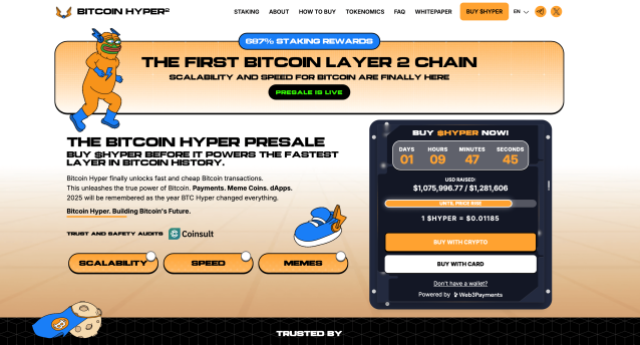
Bitcoin Hyper Landing Page
Presale Page von Bitcoin Hyper

Der $HYPER Token und seine Vorteile

Im Presale erhalten Käufer $HYPER zum niedrigsten Preis – ohne Insider-Deals. Der Token dient als Treibstoff für Transaktionen und Smart Contracts, kann gestakt werden, um hohe Belohnungen zu verdienen, und eröffnet exklusive Plattformfunktionen. Mit voller Transparenz, fairer Verteilung und einer klaren Ausrichtung auf Wachstum bietet $HYPER die Chance, früh Teil der nächsten großen Bitcoin-Entwicklung zu sein.

Jetzt rechtzeitig einsteigen und $HYPER im Presale kaufen.

Editorial Process for bitcoinist is centered on delivering thoroughly researched, accurate, and unbiased content. We uphold strict sourcing standards, and each page undergoes diligent review by our team of top technology experts and seasoned editors. This process ensures the integrity, relevance, and value of our content for our readers.

Trending Cryptos

Related Reads

Terence Tao's Remote Dialogue with Wang Hong: Mathematics Must Learn to 'Digest' AI

Two Fields Medalists, Terence Tao and Maryna Viazovska, share a common view on the flood of AI-generated proofs in mathematics: the community must learn to "digest" them. While AI can rapidly produce and even formally verify proofs, Tao argues that a correct proof is only the first step. For a result to become usable knowledge, it must be understood, absorbed, and integrated into the existing mathematical framework by human mathematicians. He illustrates this by spending several days "digesting" an AI-assisted proof of the long-standing Sendov conjecture. His process involved tracing sources, identifying key ideas, simplifying the argument, and rewriting it into a human-readable narrative. This digestion not only verified the proof but also revealed it could solve a stronger conjecture and be presented with more elementary tools. Tao criticizes the current race for priority based solely on who announces a proof first, often skipping verification and explanation. He proposes shifting value to the crucial work of interpreting, reviewing, and consolidating results. In his recent ICM talk, he emphasized that if authors cannot explain their AI-generated proof to peers, it shouldn't be published. To facilitate this new workflow, Tao introduced "Palomar," a registry for Lean-verified results. It serves as a digestion hub, cataloging problems, proof code, and AI involvement, aiming to coordinate efforts and ensure completeness. Under this model, full credit for a result would require multiple milestones: generation, verification, explanation, and final publication. The core message is clear: as AI transforms the front end of mathematical discovery, the irreplaceable role of mathematicians will be to synthesize, contextualize, and communicate these advances, turning raw outputs into enduring knowledge.

marsbit12m ago

Terence Tao's Remote Dialogue with Wang Hong: Mathematics Must Learn to 'Digest' AI

marsbit12m ago

The U.S. Treasury Department Doubles Treasury Repurchases to Stabilize the Market, But U.S. Stocks Only Edge Up Slightly — Is the Real Signal Hidden in Bitcoin?

The US Treasury significantly boosted its long-term bond repurchase program to curb surging yields, sparking a notable rally in Bitcoin while leaving the stock market with only modest gains. Facing high long-term bond yields that pressured equities, especially tech stocks, the Treasury announced it would double the maximum size of its repurchases for 10- to 30-year bonds. This move, seen as the government stepping in to provide liquidity and stabilize confidence, initially pushed bond yields lower. However, the market reaction was unusual. While liquidity-sensitive Bitcoin surged from around $64,000 toward $70,000, major US stock indices posted only minor gains. Previously high-flying AI-related sectors like semiconductors continued to weaken, largely ignoring the news. The article interprets Bitcoin's sharp rise as the key signal, reflecting its role as a gauge for dollar liquidity. The Treasury's action is seen as injecting fresh money into the system. While stocks remain preoccupied with sector-specific concerns, Bitcoin immediately priced in this loosening of financial conditions. This shift suggests the market's underlying dynamic may be transitioning from a fight for existing capital to an expectation of new inflows, potentially broadening the rally beyond the concentrated AI trade that dominated recent months.

marsbit17m ago

The U.S. Treasury Department Doubles Treasury Repurchases to Stabilize the Market, But U.S. Stocks Only Edge Up Slightly — Is the Real Signal Hidden in Bitcoin?

marsbit17m ago

Trading

Spot

Hot Articles

What is $BITCOIN

DIGITAL GOLD ($BITCOIN): A Comprehensive Analysis Introduction to DIGITAL GOLD ($BITCOIN) DIGITAL GOLD ($BITCOIN) is a blockchain-based project operating on the Solana network, which aims to combine the characteristics of traditional precious metals with the innovation of decentralized technologies. While it shares a name with Bitcoin, often referred to as “digital gold” due to its perception as a store of value, DIGITAL GOLD is a separate token designed to create a unique ecosystem within the Web3 landscape. Its goal is to position itself as a viable alternative digital asset, although specifics regarding its applications and functionalities are still developing. What is DIGITAL GOLD ($BITCOIN)? DIGITAL GOLD ($BITCOIN) is a cryptocurrency token explicitly designed for use on the Solana blockchain. In contrast to Bitcoin, which provides a widely recognized value storage role, this token appears to focus on broader applications and characteristics. Notable aspects include: Blockchain Infrastructure: The token is built on the Solana blockchain, known for its capacity to handle high-speed and low-cost transactions. Supply Dynamics: DIGITAL GOLD has a maximum supply capped at 100 quadrillion tokens (100P $BITCOIN), although details regarding its circulating supply are currently undisclosed. Utility: While precise functionalities are not explicitly outlined, there are indications that the token could be utilized for various applications, potentially involving decentralized applications (dApps) or asset tokenization strategies. Who is the Creator of DIGITAL GOLD ($BITCOIN)? At present, the identity of the creators and development team behind DIGITAL GOLD ($BITCOIN) remains unknown. This situation is typical among many innovative projects within the blockchain space, particularly those aligning with decentralized finance and meme coin phenomena. While such anonymity may foster a community-driven culture, it intensifies concerns about governance and accountability. Who are the Investors of DIGITAL GOLD ($BITCOIN)? The available information indicates that DIGITAL GOLD ($BITCOIN) does not have any known institutional backers or prominent venture capital investments. The project seems to operate on a peer-to-peer model focused on community support and adoption rather than traditional funding routes. Its activity and liquidity are primarily situated on decentralized exchanges (DEXs), such as PumpSwap, rather than established centralized trading platforms, further highlighting its grassroots approach. How DIGITAL GOLD ($BITCOIN) Works The operational mechanics of DIGITAL GOLD ($BITCOIN) can be elaborated on based on its blockchain design and network attributes: Consensus Mechanism: By leveraging Solana’s unique proof-of-history (PoH) combined with a proof-of-stake (PoS) model, the project ensures efficient transaction validation contributing to the network's high performance. Tokenomics: While specific deflationary mechanisms have not been extensively detailed, the vast maximum token supply implies that it may cater to microtransactions or niche use cases that are still to be defined. Interoperability: There exists the potential for integration with Solana’s broader ecosystem, including various decentralized finance (DeFi) platforms. However, the details regarding specific integrations remain unspecified. Timeline of Key Events Here is a timeline that highlights significant milestones concerning DIGITAL GOLD ($BITCOIN): 2023: The initial deployment of the token occurs on the Solana blockchain, marked by its contract address. 2024: DIGITAL GOLD gains visibility as it becomes available for trading on decentralized exchanges like PumpSwap, allowing users to trade it against SOL. 2025: The project witnesses sporadic trading activity and potential interest in community-led engagements, although no noteworthy partnerships or technical advancements have been documented as of yet. Critical Analysis Strengths Scalability: The underlying Solana infrastructure supports high transaction volumes, which could enhance the utility of $BITCOIN in various transaction scenarios. Accessibility: The potential low trading price per token could attract retail investors, facilitating wider participation due to fractional ownership opportunities. Risks Lack of Transparency: The absence of publicly known backers, developers, or an audit process may yield skepticism regarding the project's sustainability and trustworthiness. Market Volatility: The trading activity is heavily reliant on speculative behavior, which can result in significant price volatility and uncertainty for investors. Conclusion DIGITAL GOLD ($BITCOIN) emerges as an intriguing yet ambiguous project within the rapidly evolving Solana ecosystem. While it attempts to leverage the “digital gold” narrative, its departure from Bitcoin's established role as a store of value underscores the need for a clearer differentiation of its intended utility and governance structure. Future acceptance and adoption will likely depend on addressing the current opacity and defining its operational and economic strategies more explicitly. Note: This report encompasses synthesised information available as of October 2023, and developments may have transpired beyond the research period.

2.0k Total ViewsPublished 2025.05.13Updated 2025.05.13

What is $BITCOIN

Discussions

Welcome to the HTX Community. Here, you can stay informed about the latest platform developments and gain access to professional market insights. Users' opinions on the price of BTC (BTC) are presented below.

活动图片