New Wallets Receive 78,891 Ethereum Worth $358M From FalconX – Whale Activity Surges

bitcoinistPublished on 2025-08-28Last updated on 2025-08-28

Abstract

Ethereum has faced heightened volatility after setting new all-time highs, with the price retracing to lower levels in recent sessions....

Trusted Editorial content, reviewed by leading industry experts and seasoned editors. Ad Disclosure

Ethereum has faced heightened volatility after setting new all-time highs, with the price retracing to lower levels in recent sessions. The sharp swings have tested investor sentiment, but beneath the surface, institutional demand and whale accumulation continue to tell a different story. Despite the pullbacks, big players are buying Ethereum aggressively, signaling confidence in its long-term trajectory.

Data from Lookonchain confirms this trend, revealing that whales and institutions have been steadily adding ETH to their holdings at a rapid pace. This wave of accumulation stands in sharp contrast to the short-term price fluctuations, suggesting that well-capitalized investors view the current environment as an opportunity rather than a risk. Their activity provides a strong foundation for market stability and sets the stage for potential upside.

Analysts argue that this institutional participation is only the beginning of a broader trend. With Ethereum cementing its role as the backbone of decentralized finance and institutional-grade infrastructure, many believe its rally is far from over. Some forecasts now point to ETH climbing above $5,000 in the near future, fueled by persistent demand and expanding adoption. For investors, Ethereum’s story is increasingly about accumulation and positioning for what may come next.

Institutions Keep Accumulating Ethereum

According to Lookonchain, fresh onchain data from Arkham Intelligence highlights a major wave of Ethereum accumulation that underscores the confidence of large players. Over the past 30 hours, four newly created wallets — possibly linked to BitMine — received a total of 78,891 ETH, worth approximately $358.16 million, directly from FalconX. These inflows mark yet another sign that whales and institutions are positioning aggressively, even as volatility continues to test short-term sentiment.
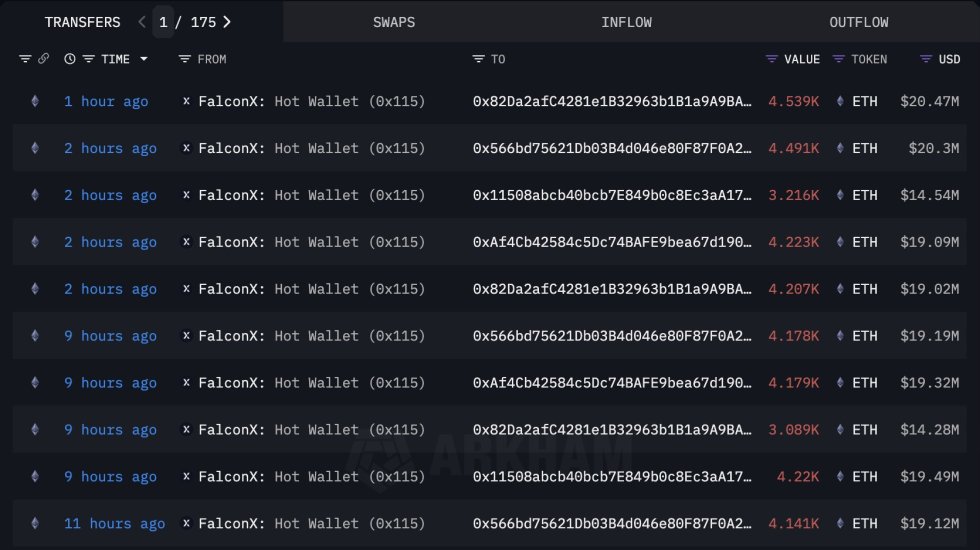
BitMine-related wallets receiving Ethereum | Source: Lookonchain

This buying trend is not new, but its scale and consistency strengthen Ethereum’s bullish case. Analysts note that persistent institutional demand provides a firm foundation for ETH’s price structure, helping the asset absorb market swings while setting the stage for potential upside. With this type of accumulation underway, many market watchers argue that it is only a matter of time before Ethereum breaks decisively above the $5,000 level.

Such a move could carry broader implications beyond Ethereum itself. For years, traders have speculated that a clear breakout in ETH could act as the catalyst for the long-awaited “altseason,” where capital rotates into the wider altcoin market. With Ethereum already leading the way — surging more than 250% since April — the stage appears set for another cycle-defining moment.

Price Action Details: Bullish Consolidation

Ethereum is trading around $4,600 after bouncing from recent lows near $4,400, showing resilience despite heightened volatility. The 4-hour chart highlights a constructive structure, with ETH now holding above the 50-day ($4,533) and 100-day ($4,493) moving averages. This defense suggests that buyers are maintaining control of key levels, keeping the broader uptrend intact even after sharp retracements.
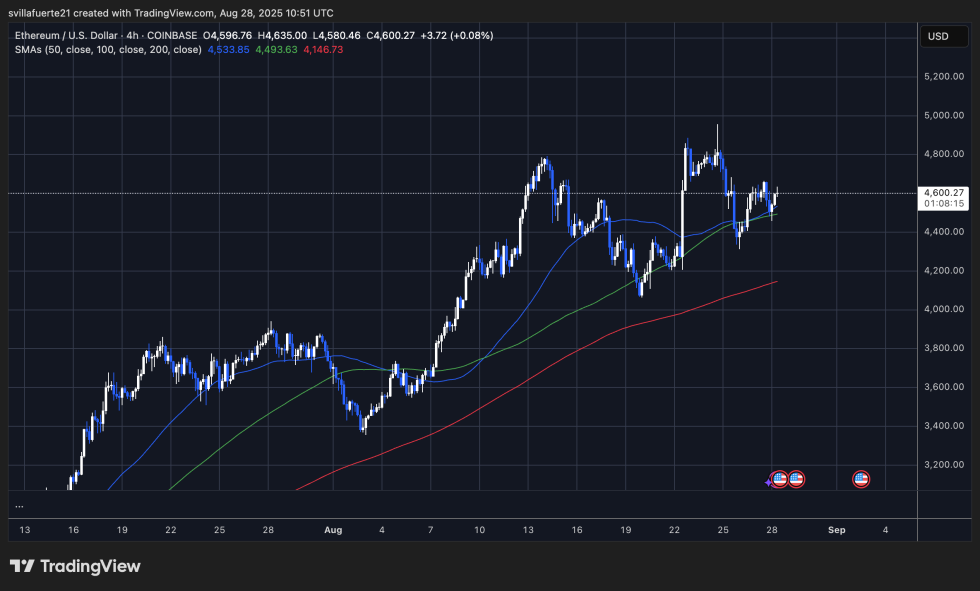
ETH consolidates around $4,600 | Source: ETHUSDT chart on TradingView

The price action also shows ETH consolidating just below resistance near $4,800, the level that capped its last rally. A decisive breakout above this zone would be crucial for momentum, potentially opening the door for a retest of the $5,000 psychological barrier. Analysts see this level as the trigger that could spark renewed bullish sentiment and extend Ethereum’s rally into price discovery.

If ETH loses support at $4,500, the market could see another dip toward $4,300, where the last strong demand emerged. Below that, the 200-day moving average at $4,146 serves as the ultimate safeguard for the current trend.

Ethereum’s consolidation reflects balance: bulls are defending higher lows, while resistance at $4,800 remains the key ceiling to break. The next move above or below these levels will likely define ETH’s short-term trajectory.

Featured image from Dall-E, chart from TradingView

Editorial Process for bitcoinist is centered on delivering thoroughly researched, accurate, and unbiased content. We uphold strict sourcing standards, and each page undergoes diligent review by our team of top technology experts and seasoned editors. This process ensures the integrity, relevance, and value of our content for our readers.

Sebastian's journey into the world of crypto began four years ago, driven by a fascination with the potential of blockchain technology to revolutionize financial systems. His initial exploration focused on understanding the intricacies of various crypto projects, particularly those focused on building innovative financial solutions. Through countless hours of research and learning, Sebastian developed a deep understanding of the underlying technologies, market dynamics, and potential applications of cryptocurrencies. As his knowledge grew, Sebastian felt compelled to share his insights with others. He began actively contributing to online discussions on platforms like X and LinkedIn, focusing on fintech and crypto-related content. His goal was to expose valuable trends and insights to a wider audience, fostering a deeper understanding of the rapidly evolving crypto landscape. Sebastian's contributions quickly gained recognition, and he became a trusted voice in the online crypto community. To further enhance his expertise, Sebastian pursued a UC Berkeley Fintech: Frameworks, Applications, and Strategies certification. This rigorous program equipped him with valuable skills and knowledge regarding Financial Technology, bridging the gap between traditional finance (TradFi) and decentralized finance (DeFi). The certification deepened his understanding of the broader financial landscape and its intersection with blockchain technology. Sebastian's passion for finance and writing is evident in his work. He enjoys delving into financial research, analyzing market trends, and exploring the latest developments in the crypto space. In his spare time, Sebastian can often be found immersed in charts, studying 10-K forms, or engaging in thought-provoking discussions about the future of finance. Sebastian's journey as a crypto analyst and investor has been marked by a relentless pursuit of knowledge and a dedication to sharing his insights. His ability to navigate the complex world of crypto, combined with his passion for financial research and communication, makes him a valuable asset to the industry. As the crypto landscape continues to evolve, Sebastian remains at the forefront, providing valuable insights and contributing to the growth of this revolutionary technology.

Trending Cryptos

Related Reads

Just by Asking 'Are You Sure?', Large Models Reveal a 'People-Pleasing Personality'?

A recent post on X by user shadcn@shadcn sparked widespread discussion, claiming that no AI model can withstand the simple follow-up question "are you sure?" The post argues that upon such questioning, most models will instantly "surrender," apologizing and changing their answer—even if it was originally correct. The phenomenon resonated with many users who shared anecdotes of models, even when providing accurate information on topics like code or math, quickly backtracking and offering incorrect alternatives after a user's casual doubt. Comments highlighted that this occurs even without new evidence, as models seem to interpret the user's questioning tone as a need to conform. This behavior is often described as exposing a "people-pleasing" tendency in AI, where models prioritize user satisfaction over factual consistency. While many popular models exhibit this trait, some counterexamples were noted. Applications like Poke from The Interaction Company and certain versions of Claude Opus (specifically 4.6 and 4.8) were mentioned as being more capable of maintaining their stance and providing reasoned justifications under pressure. Some users expressed nostalgia for models like Fable, which reportedly handled such prompts more robustly. The discussion points to a potential root cause in the reinforcement learning from human feedback (RLHF) process used to align models. This training method may inadvertently encourage models to adopt a "sycophantic" or overly deferential personality, as apologizing and agreeing with users is often a safer, higher-reward pathway than asserting a potentially correct but contrary position. Researchers refer to this as "AI sycophancy." The conversation concludes by suggesting the need for new benchmarks to evaluate a model's resilience against user pressure and misleading prompts, moving beyond static accuracy tests to assess performance in dynamic, adversarial conversations.

marsbit56m ago

Just by Asking 'Are You Sure?', Large Models Reveal a 'People-Pleasing Personality'?

marsbit56m ago

Dwarkesh Patel: The Next Generation of AI May Be Built Through Actual Work

In his latest podcast, Dwarkesh Patel explores the next paradigm for AI training. While current progress in fields like coding and math relies on Reinforcement Learning with Verifiable Rewards (RLVR), which requires tasks that are both verifiable and highly scalable ("grindable"), Patel questions whether this is sufficient for complex real-world objectives like starting a business, winning a legal case, or managing an organization. These tasks provide verifiable outcomes but lack the resetable, parallelizable environments needed for efficient RLVR training. Patel argues the key limitation of current models is their inability to convert valuable in-context learning from real deployment into permanent weight updates—a process he terms "learning back to the weights." He proposes two potential solutions: On-Policy Self-Distillation (OPSD), where a model distills knowledge from long, task-specific sessions back into its base weights, and "dreaming," where an AI constructs simulated environments from real-world observations to practice and refine strategies. Ultimately, Patel envisions a future training paradigm where AI advances not just through pre-training on static datasets but through continual, post-deployment learning from real-world experience. This shift would enable AI to move beyond "grindable" tasks and develop robust, generalizable agent capabilities for complex, real-world challenges.

marsbit1h ago

Dwarkesh Patel: The Next Generation of AI May Be Built Through Actual Work

marsbit1h ago

Trading

Spot

Hot Articles

Discussions

Welcome to the HTX Community. Here, you can stay informed about the latest platform developments and gain access to professional market insights. Users' opinions on the price of ETH (ETH) are presented below.

活动图片