Ethereum Whales Strike Again: $456.8M Bought Across 9 Addresses

bitcoinistPublished on 2025-08-27Last updated on 2025-08-27

Abstract

Ethereum has entered a volatile phase after breaking its 2021 all-time highs last week, sparking both excitement and caution across...

Trusted Editorial content, reviewed by leading industry experts and seasoned editors. Ad Disclosure

Ethereum has entered a volatile phase after breaking its 2021 all-time highs last week, sparking both excitement and caution across the market. After the surge, ETH retraced and tested critical demand levels, where buyers stepped in to defend support. Bulls are showing resilience, with analysts pointing to the possibility of Ethereum rallying past $5,000 in the near term.

Still, the risks of a deeper correction weigh heavily, fueling uncertainty among traders and investors. Fear is beginning to creep into sentiment, as some wonder if Ethereum’s rally is sustainable or if another pullback is on the horizon.

Yet in this environment, one undeniable trend stands out: whales are accumulating. Arkham Intelligence revealed that nine whale addresses collectively purchased around $450 million worth of Ethereum yesterday alone, signaling confidence from the largest market participants. This wave of accumulation highlights how deep-pocketed investors are taking advantage of retracements, potentially preparing for the next leg upward.

Ethereum Whales Signal Confidence

According to Arkham Intelligence, Ethereum whales are making decisive moves that could shape the next phase of the market. Data shows that nine massive addresses collectively purchased $456.8 million worth of ETH in a single day. Out of these, five wallets received inflows directly from Bitgo, a leading institutional custodian, while the other four acquired their positions through Galaxy Digital’s over-the-counter (OTC) desk. These transactions reflect not only individual whale confidence but also the growing role of institutional-grade platforms in facilitating large-scale Ethereum accumulation.

Ethereum Whale Portfolio | Source: Arkham

This surge in whale activity highlights a critical market dynamic: deep-pocketed investors are positioning themselves for what could be the next leg higher in Ethereum’s price cycle. Historically, whale accumulation during periods of volatility has preceded significant upward momentum, providing a strong foundation for bullish narratives. With ETH already testing crucial demand zones after its breakout above 2021 all-time highs, these inflows may help stabilize price action and build momentum toward uncharted territory.

Beyond whales, public companies are also entering the picture. Firms like Bitmine and Sharplink Gaming have recently disclosed Ethereum positions, further validating ETH’s role as an institutional-grade asset. Their involvement echoes what Bitcoin experienced in its early corporate adoption phase—when public companies added BTC to their balance sheets, fueling strong market confidence.

Taken together, the combination of whale accumulation, institutional OTC purchases, and public company adoption paints a clear picture: confidence in Ethereum’s long-term trajectory is strengthening. While short-term risks remain, these trends reinforce a bullish case for ETH to move toward price discovery and potentially surpass $5,000. The market is watching closely, but whales and institutions appear to be leading the charge.

Ethereum Holds Ground as Bulls Eye $5,000

Ethereum is trading around $4,592 after rebounding from a sharp retrace off local highs near $4,850. The 4-hour chart shows ETH regaining strength above the 50-day and 100-day moving averages, signaling that buyers are stepping back in to defend key levels. This move restores confidence in the short-term uptrend, even as volatility keeps traders on edge.
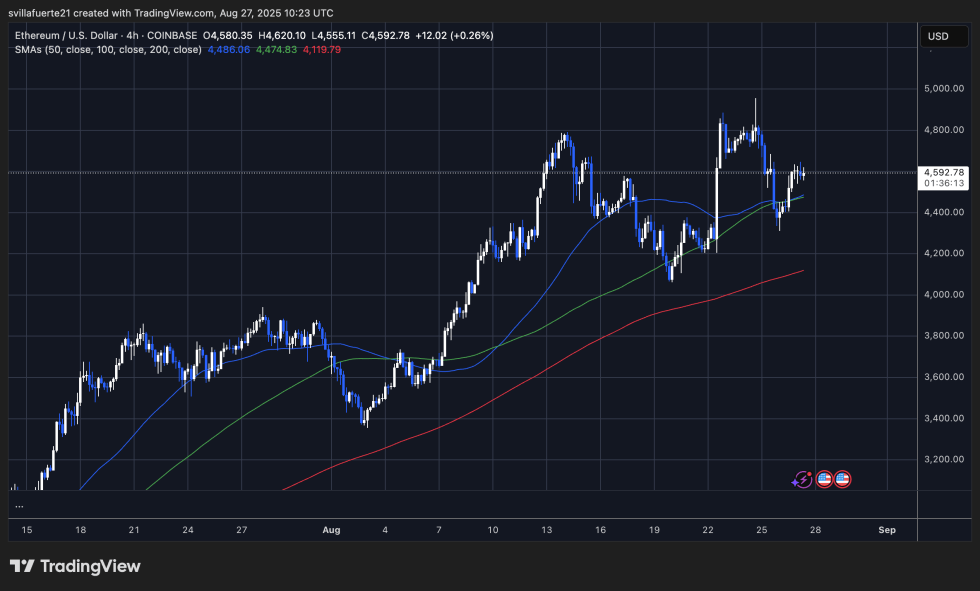
ETH consolidates below its ATH | Source: ETHUSDT chart on TradingView

The broader picture remains supportive. With the 200-day moving average sitting at $4,119, Ethereum has a comfortable cushion that highlights its resilience despite recent swings. Holding above the faster averages not only stabilizes momentum but also sets the stage for another attempt at resistance. The critical barrier ahead lies at $4,800, where sellers previously capped the rally. A decisive break could clear the path toward $5,000, a milestone that analysts believe would fuel fresh enthusiasm and potentially kickstart a new leg of price discovery.

Still, risks of another pullback linger. A drop below $4,400 could send ETH back toward the $4,200 demand zone, where prior buying pressure emerged. For now, though, sentiment leans cautiously bullish. Whales continue to accumulate, technicals remain constructive, and Ethereum appears poised to test higher levels if momentum carries through.

Featured image from Dall-E, chart from TradingView

Editorial Process for bitcoinist is centered on delivering thoroughly researched, accurate, and unbiased content. We uphold strict sourcing standards, and each page undergoes diligent review by our team of top technology experts and seasoned editors. This process ensures the integrity, relevance, and value of our content for our readers.

Sebastian's journey into the world of crypto began four years ago, driven by a fascination with the potential of blockchain technology to revolutionize financial systems. His initial exploration focused on understanding the intricacies of various crypto projects, particularly those focused on building innovative financial solutions. Through countless hours of research and learning, Sebastian developed a deep understanding of the underlying technologies, market dynamics, and potential applications of cryptocurrencies. As his knowledge grew, Sebastian felt compelled to share his insights with others. He began actively contributing to online discussions on platforms like X and LinkedIn, focusing on fintech and crypto-related content. His goal was to expose valuable trends and insights to a wider audience, fostering a deeper understanding of the rapidly evolving crypto landscape. Sebastian's contributions quickly gained recognition, and he became a trusted voice in the online crypto community. To further enhance his expertise, Sebastian pursued a UC Berkeley Fintech: Frameworks, Applications, and Strategies certification. This rigorous program equipped him with valuable skills and knowledge regarding Financial Technology, bridging the gap between traditional finance (TradFi) and decentralized finance (DeFi). The certification deepened his understanding of the broader financial landscape and its intersection with blockchain technology. Sebastian's passion for finance and writing is evident in his work. He enjoys delving into financial research, analyzing market trends, and exploring the latest developments in the crypto space. In his spare time, Sebastian can often be found immersed in charts, studying 10-K forms, or engaging in thought-provoking discussions about the future of finance. Sebastian's journey as a crypto analyst and investor has been marked by a relentless pursuit of knowledge and a dedication to sharing his insights. His ability to navigate the complex world of crypto, combined with his passion for financial research and communication, makes him a valuable asset to the industry. As the crypto landscape continues to evolve, Sebastian remains at the forefront, providing valuable insights and contributing to the growth of this revolutionary technology.

Trending Cryptos

Related Reads

Building the Bright Path While Secretly Crossing Chencang: Is Walsh Paving the Way for a September "Rate Cut"?

The title "Building the Plank Road Openly While Secretly Crossing at Chencang: Is Walsh Paving the Way for a September 'Rate Cut'?" suggests Federal Reserve Chair Kevin Walsh's hawkish stance may be a deliberate smokescreen. Academy Securities analyst Peter Tchir argues in a report that markets, currently pricing a 75% chance of a September hike, are missing a potential path to a September rate cut that Walsh himself might be quietly preparing. Tchir posits that Walsh's hawkish rhetoric aims to suppress long-term yield risks (with the 10-year Treasury yield falling recently) while creating room for a narrative shift based on upcoming data. The potential political endgame, according to this view, could be rate cuts in September and October, ahead of the midterm elections. This hinges on a political logic where the Trump administration's preference for lower rates remains unchanged. A core part of Tchir's argument involves redefining inflation metrics. He contends the Fed under Walsh may deprioritize the PCE index, criticizing its lagging components like Owners' Equivalent Rent (OER). Instead, he points to alternative, more real-time indicators like the New Tenant Repeat Rent Index (NTRR) and the Truflation daily index, which shows core inflation around 1.45%. He suggests the Fed could shift its data narrative to justify policy easing. Furthermore, Tchir downplays AI-driven inflation fears. He argues that consumer price sensitivity, evidenced by negative market reactions to price hikes (e.g., Apple), contradicts persistent inflation narratives. He also separates AI/data center spending—which he sees as relatively rate-insensitive—from broader consumer affordability issues, implying rate hikes are misdirected. Based on this analysis, Tchir sees a re-pricing of rate cut expectations as likely, creating opportunities in short-duration Treasuries. He maintains a neutral-to-slightly-bullish view on the long end of the yield curve. For equities, he recommends a significant overweight in energy (especially global nuclear assets) and, within defense/security themes, an overweight in biotech/pharma versus an underweight in semiconductors, expressing caution on AI/data center valuations.

marsbit28m ago

Building the Bright Path While Secretly Crossing Chencang: Is Walsh Paving the Way for a September "Rate Cut"?

marsbit28m ago

"King of Shilling" Hayes Strikes Again, This Time Setting His Sights on Deribit

On June 29, BitMEX co-founder Arthur Hayes acquired approximately 6.16 million SYN tokens via OTC platform Flowdesk, valued at around $2.2 million. Subsequently, Hayes publicly endorsed SYN on X, calling it one of the most asymmetric investments he's seen since HYPE and declaring it time for an on-chain options DEX to challenge industry leader Deribit, naming Hypercall as that challenger. The article details the evolution of the Synapse Protocol, originally launched in 2021 as a cross-chain messaging and liquidity network. While its TVL peaked above $1 billion during the last bull market, it has since declined. The protocol's team has since built Hypercall, an on-chain options trading platform on Hyperliquid's HyperEVM, which supports trading options on "any asset" with features like 24/7 trading and defined risk limited to the premium paid. Deribit, founded in 2016, is highlighted as the dominant centralized crypto options exchange, commanding roughly 85% market share in BTC and ETH options. Its strengths include deep liquidity and professional tools, though it faces critiques over custody risk, KYC requirements, and regulatory uncertainty. The analysis suggests Hypercall's potential lies in decentralization, permissionless access, and transparency, potentially carving a niche in DeFi-native and emerging asset options. However, it faces significant challenges competing with Deribit's established network effect and liquidity depth. The piece concludes by noting Hayes's recent and mixed "call" history, referencing his previous promotion and subsequent sale of HYPE, as well as a controversial price target report for CARDS from his family office, Maelstrom, which was followed by a significant price drop for the asset. This activity has drawn criticism, with some accusing Hayes of creating exit liquidity for his followers.

Foresight News1h ago

"King of Shilling" Hayes Strikes Again, This Time Setting His Sights on Deribit

Foresight News1h ago

One Year After the Crash of Crypto Treasury Companies, Copycats Are Already Making a Comeback

One year after the collapse of digital asset treasury (DAT) companies, which wiped out up to 99% for early investors, the scheme has returned in a new guise. Recently, Triller Group announced it would become a "SpaceX treasury company," causing its market cap to surge. This follows the rebranding of another firm, LGHL, now targeting a token called HYPE. The original model, popularized by MicroStrategy (MSTR) and its "Bitcoin yield" narrative, saw companies trading at massive premiums to their underlying crypto holdings. However, most followers like TwentyOne, Metaplanet, and Nakamoto have crashed 80-95%+ from their peaks, erasing nearly all value for late investors. The author argues these structures have no fundamental reason to trade at premiums when low-fee Bitcoin ETFs or direct ownership exist. The cycle persists due to speculative demand driven by FOMO, gamification, and a belief the system is rigged, met by insiders and promoters who profit from the pump-and-dump dynamics. Drawing a parallel to the 1637 Tulip Mania, the piece concludes that such frenzies are not a bug but a recurring product of markets, where greater fools provide demand and insiders supply the schemes. Despite holding Bitcoin personally, the author condemns this specific packaging of assets into leveraged corporate vehicles marketed as innovation, a cycle seemingly unstoppable until a major crash.

marsbit1h ago

One Year After the Crash of Crypto Treasury Companies, Copycats Are Already Making a Comeback

marsbit1h ago

Trading

Spot

Hot Articles

Discussions

Welcome to the HTX Community. Here, you can stay informed about the latest platform developments and gain access to professional market insights. Users' opinions on the price of ETH (ETH) are presented below.

活动图片