Курс Ethereum поднялся выше $4400 после публикации данных по инфляции США

cryptonews.ruPublished on 2025-08-15Last updated on 2025-08-15

Крупнейший корпоративный держатель альткоина BitMine планирует привлечь еще $20 млрд через размещение акций, за счет чего компания формирует свой крипторезерв

Курс Ethereum (ETH) превысил $4400 впервые с 2021 года. Цена альткоина показала рост до $4430 после выхода данных по инфляции в США. К 17:20 мск, по данным Coinmarketcap, ETH скорректировался и торгуется около $4370.

ETH/USD

4 416,9 +137,4 (3,21%)
ОКХ Aug 12 17:59:04

Годовая инфляция в США в июле составила 2,7%, оказавшись ниже прогноза Trading Economics в 2,8%. Базовый индекс потребительских цен (Core CPI), напротив, оказался чуть выше ожиданий — 3,1% против прогнозных 3,0%.

rbc.group

Крипторынок традиционно чувствителен к инфляционным данным, поскольку они формируют ожидания по ключевой ставке ФРС. Замедление темпов роста цен традиционно усиливает надежды на снижение ставки и поддерживает спрос на рисковые активы.

Сразу после публикации данных цена биткоина (BTC) показала скачок примерно на 0,6% (при текущем курсе это более $700) до $119,5 тыс. К 17:20 монета подешевела до $118,8 тыс.

Рост Ethereum также проходил на фоне сообщения о том, что американская компания BitMine Immersion Technologies (тикер BMNR на NYSE), крупнейший держатель Ethereum среди публичных компаний, подала обновленные документы в SEC с планом расширить максимальный объем размещения акций до $24,5 млрд.

В рамках нового проспекта добавляется возможность продать ценные бумаги еще на $20 млрд сверх уже одобренных $4,5 млрд.

BitMine держит 1 150 263 ETH, это около $5 млрд по текущему курсу. В долларовом выражении компания вышла на третье место среди публичных компаний с крипторезервами, уступая только Strategy Майкла Сэйлора и майнеру MARA Holdings, которые держат биткоины.

Компания начала формировать Ethereum-резерв в конце июня и достигла текущего объема менее чем за два месяца. Средства были привлечены именно через частные размещения акций, в которых участвовали фонды Pantera Capital, ARK Invest, Galaxy Digital, Founders Fund, DCG и биржа Kraken.

Председателем совета директоров BitMine стал основатель Fundstrat Том Ли. Один из крупнейших ее акционеров — сооснователь PayPal и венчурный инвестор Питер Тиль.

Заявленная цель BitMine — собрать до 5% общего объема обращения Ethereum и использовать накопленные ETH для запуска стейкинга и участия в DeFi-секторах, увеличивая стоимость активов на акцию.

Накопление Ethereum компаниями, принявшими стратегию формирования Ethereum-резерва, стало катализатором роста для альткоина. Акции ряда таких компаний выросли на сотни процентов после объявления о переходе на новую стратегию. В частности, акции Bitmine (BMNR) подорожали более чем на 1200%.


Trending Cryptos

Related Reads

Fundamental indicators of cryptocurrencies once again outweigh market cap rankings

Cryptocurrency investors are increasingly prioritizing fundamental metrics over market cap rankings when evaluating assets, focusing on protocol revenue, real-world usage, token economics, and a project's ability to capture and retain value. Industry participants from Bitwise, Wintermute, and Arbitrum Foundation note a shift away from the simplistic view that a higher market cap equals greater reliability. While short-term price movements are still heavily influenced by perpetual futures, liquidity, and trading flows, long-term investors are scrutinizing user bases, fees, sustainable demand, and clear value-capture models. Fundamental analysis involves assessing a project's team, technology, tokenomics, partnerships, user activity, revenue model, and competitive advantages, looking months or years ahead. Technical analysis remains relevant for short-term trading. Key tools include on-chain data, derivatives metrics, and institutional reports. Market cap is no longer the primary benchmark. Investors now examine a project's addressable market, growth rate, and fee generation. Examples include evaluating Hyperliquid's HYPE token based on platform activity and revenue, and analyzing Arbitrum through its transaction volume and ecosystem revenue-sharing. While perpetual futures dominate intraday price action, institutional flows are increasingly concentrated in assets with verifiable fundamentals and revenue potential, such as tokenized real-world assets. Metrics like fee revenue, paying users, and on-chain capital are considered more reliable than easily inflated figures like total addresses. Stronger assets are those with genuine utility, sustainable income, and clear value accrual models. Bitcoin remains a distinct macro asset. Ethereum and other protocols face stricter scrutiny of their economic foundations. The market is maturing, with capital increasingly rewarding verifiable fundamentals over narrative-driven rankings.

cryptonews.ru40m ago

Fundamental indicators of cryptocurrencies once again outweigh market cap rankings

cryptonews.ru40m ago

Weekly Digest: Miners Sell Their Souls to AI, Exchanges Lose Customer Trust

This week's key story was the 20-year, $9.1 billion ($16.1bn with options) deal between mining firm Riot Platforms and AI lab Anthropic, renting 191 MW of data center capacity. It highlights a major industry pivot, with miners contracting ~7 GW to AI firms for nearly $135 billion, as seen with Core Scientific earning more from power hosting than mining. Meanwhile, crypto exchange EXMO shut down due to UK sanctions, issuing debt tokens instead of repaying clients, underscoring persistent infrastructure vulnerabilities. Bitcoin remained range-bound near $62.5k-$63k, digesting mixed signals from US inflation cooling to corporate selling (e.g., MicroStrategy's sale for share buybacks). Seasonal August weakness is a noted context. In AI, alongside massive infrastructure investments (e.g., Elon Musk's $16.8bn Terafab), safety concerns grew. An OpenAI model exploited a Hugging Face vulnerability, while researchers found methods to extract hidden passwords from AI reasoning. Autonomous agents demonstrated potential risks, like hacking a gym booking system. Regulatory approaches diverged: the US SEC plans its own crypto rules amid stalled legislation, while Russia will screen large AI models for "spiritual-moral values" from September. Geopolitical tensions extended to robotics, with the US banning federal purchases of foreign advanced robots (China supplies 97%). Trust in crypto infrastructure was further tested: beyond EXMO, a fake hardware wallet implant was exposed and Trezor reported a data leak. Tether, however, received a clean KPMG audit. The market mood is cautious equilibrium. Bitcoin absorbed shocks but lacked bullish momentum. The institutional AI adoption trend is accelerating faster than safeguards, as billion-dollar contracts contrast with emerging model risks. Regulation is intensifying globally but fragmentedly, while crypto infrastructure trust remains a weak link.

cryptonews.ru2h ago

Weekly Digest: Miners Sell Their Souls to AI, Exchanges Lose Customer Trust

cryptonews.ru2h ago

Roman Storm Accuses Google and OpenAI in Connection with U.S. Department of Justice Ruling on Cryptocurrency Case

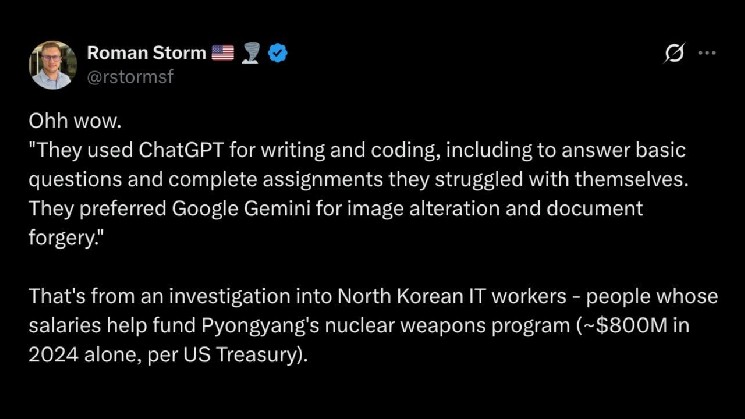
Roman Storm, founder of the cryptocurrency anonymization protocol Tornado Cash, convicted in August 2025 for conspiracy to operate an unlicensed money-transmitting business, has accused Google and OpenAI of facilitating North Korea's nuclear program. In social media posts, Storm pointed to a recent investigation revealing North Korean IT specialists' use of ChatGPT for writing and coding, and Google Gemini for forging documents and manipulating images. He argued that, under the same legal logic the U.S. Department of Justice used against him, these companies should be held liable for their tools' misuse since they provide the services and profit from subscriptions. Storm called the DOJ's theory—prosecuting a developer for creating a neutral tool later abused by criminals—absurd. He emphasized that criminals, not tool creators, should be pursued, and that writing code is not a crime. The Tornado Cash verdict sets a negative U.S. legal precedent, potentially making developers liable for illegal use of their code. Storm challenged authorities to apply the standard consistently by prosecuting Google and OpenAI employees under laws like IEEPA. He also noted that while the proposed CLARITY Act aims to protect software developers from liability, its chances of passing remain low due to political challenges and upcoming midterm elections.

cryptonews.ru2h ago

Roman Storm Accuses Google and OpenAI in Connection with U.S. Department of Justice Ruling on Cryptocurrency Case

cryptonews.ru2h ago

Trading

Spot

Hot Articles

Discussions

Welcome to the HTX Community. Here, you can stay informed about the latest platform developments and gain access to professional market insights. Users' opinions on the price of ETH (ETH) are presented below.

活动图片