Прогноз цены биткоина (BTC) на 12 августа

cryptonews.ruPublished on 2025-09-10Last updated on 2025-09-10

Цена биткоина сегодня колеблется вблизи $121 964, преодолев отметку $118 803, которая ограничила восходящий импульс в начале месяца. Это движение привело к выходу из многонедельного симметричного треугольника на 4-часовом графике и тестированию области $122 000.
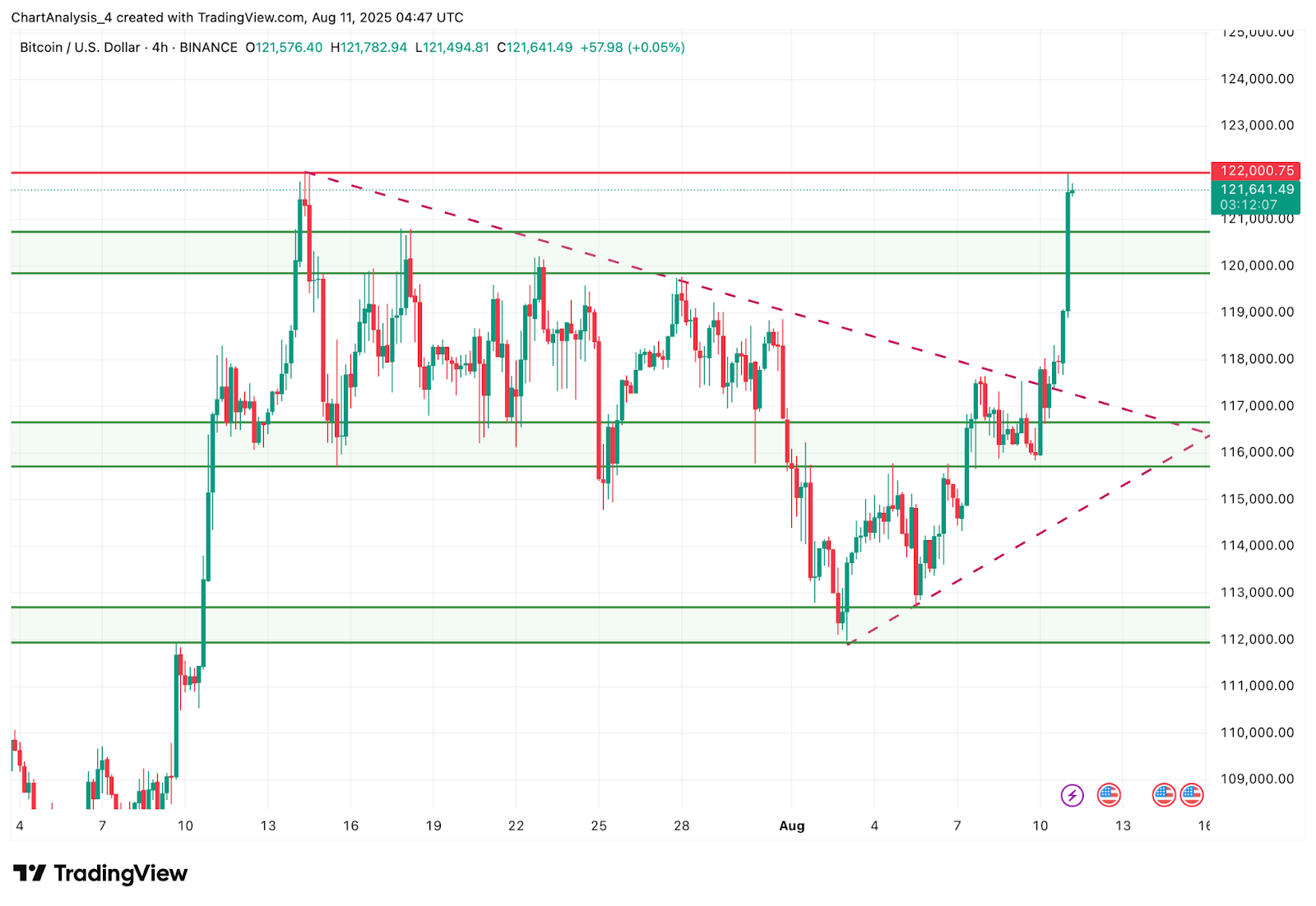
Динамика цены BTC (Источник: TradingView)

Это тот же уровень, который ранее служил максимумом колебания на дневном графике Smart Money Concepts и отмечен как «слабый максимум», где ликвидность остаётся невостребованной. Если покупателям удастся обеспечить уверенное дневное закрытие выше этого уровня, есть потенциал для роста к $124 193.
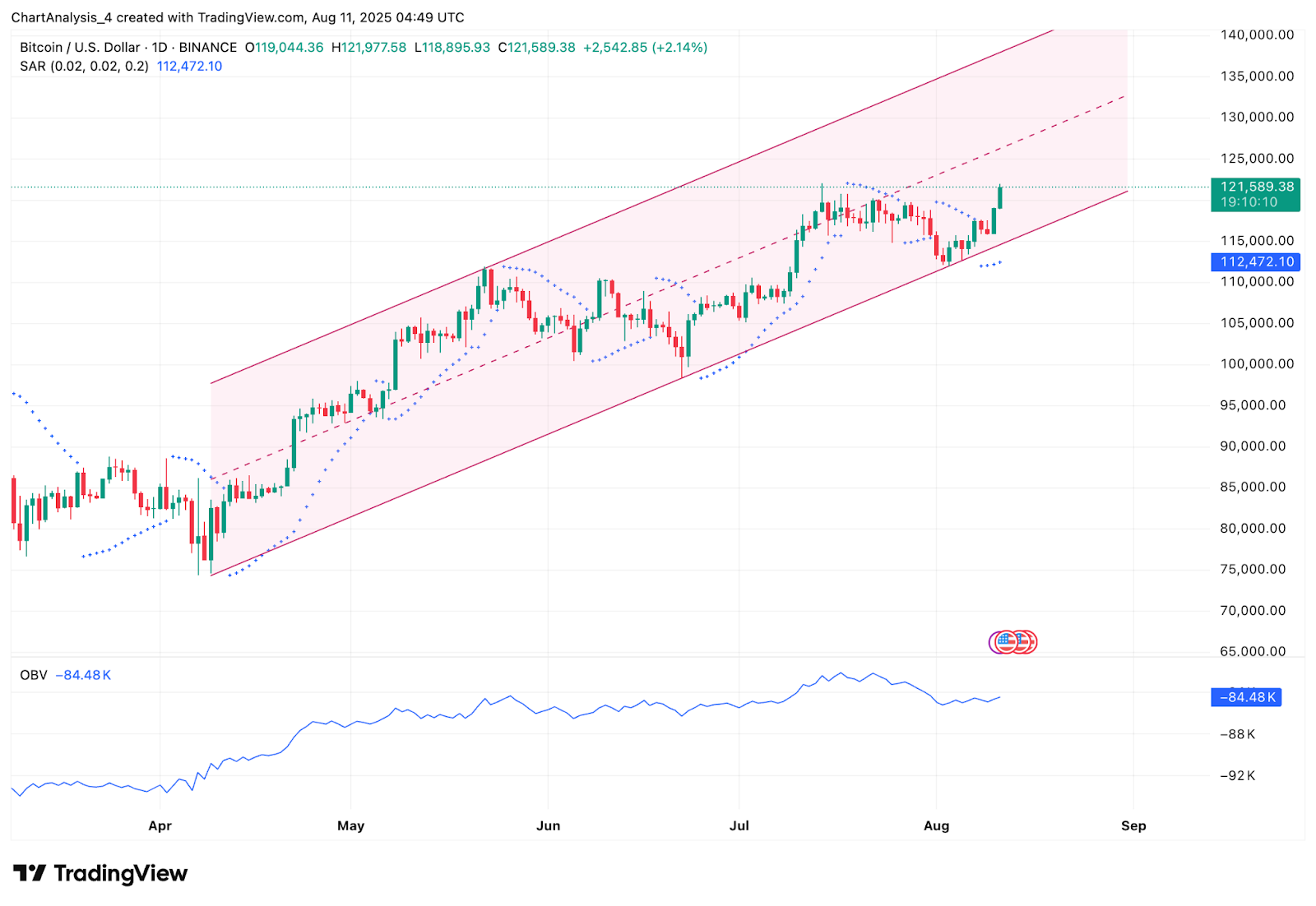
Динамика цены BTC (Источник: TradingView)

На дневном таймфрейме BTC остаётся в пределах восходящего параллельного канала, сформированного в апреле. Срединная линия в районе $121 500 была преодолена, что открывает рынок для потенциального роста к верхней границе канала в районе $125 785. Дневной сигнал Parabolic SAR находится значительно ниже текущей цены на уровне $112 472, что подтверждает силу преобладающего восходящего тренда.

Дневной балансовый объем держится выше -84,48 тыс., что указывает на отсутствие существенного распределения, несмотря на недавний рост.

Почему цена биткоина сегодня растет?
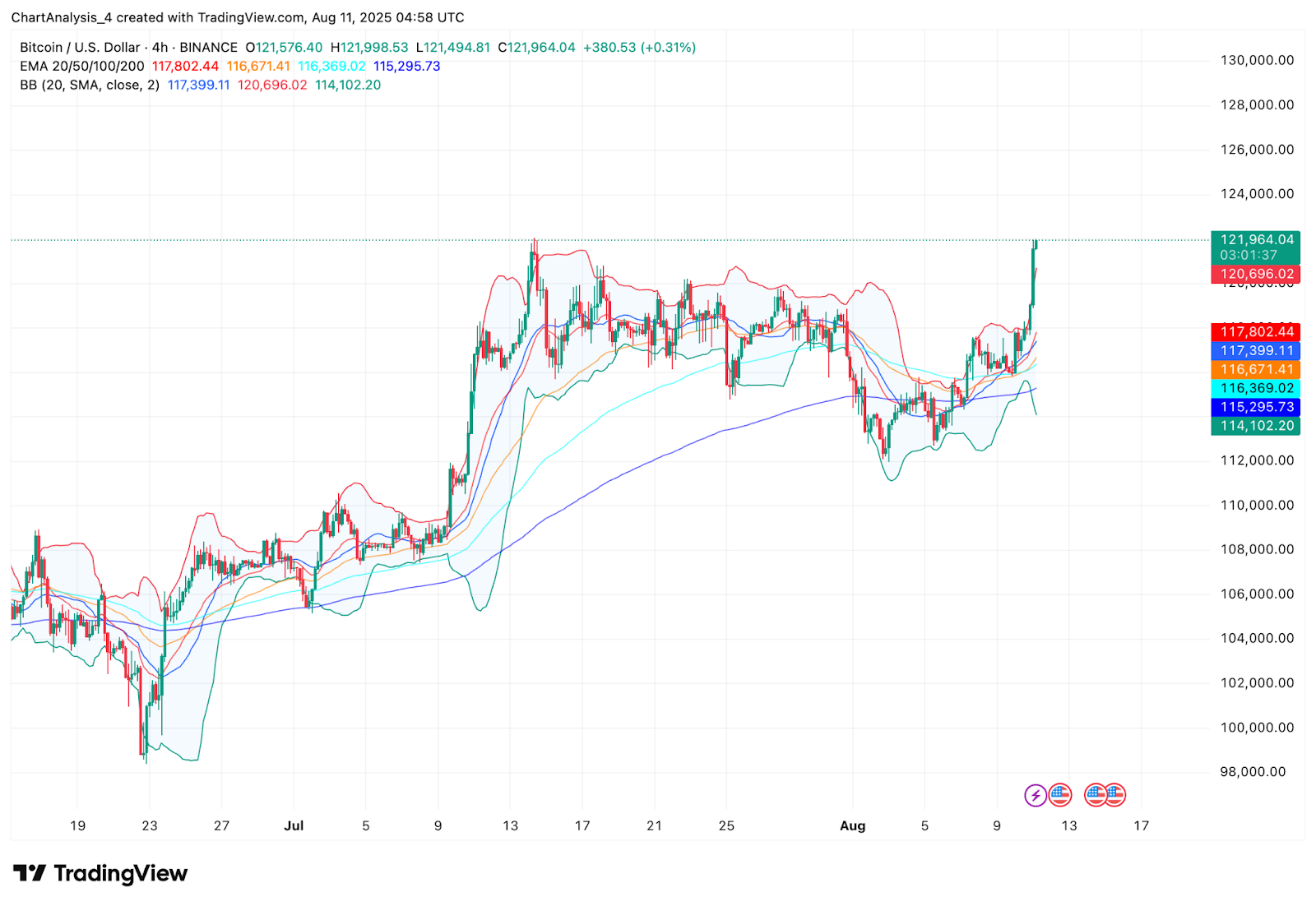
Динамика цены BTC (Источник: TradingView)

Несколько факторов работают на пользу быкам. На 4-часовом графике BTC пробил плотный кластер экспоненциальных скользящих средних (EMA): EMA20 на уровне $117 802, EMA50 на уровне $116 671, EMA100 на уровне $116 369 и EMA200 на уровне $115 295. Эти скользящие средние теперь выступают в качестве поддержки под рынком.
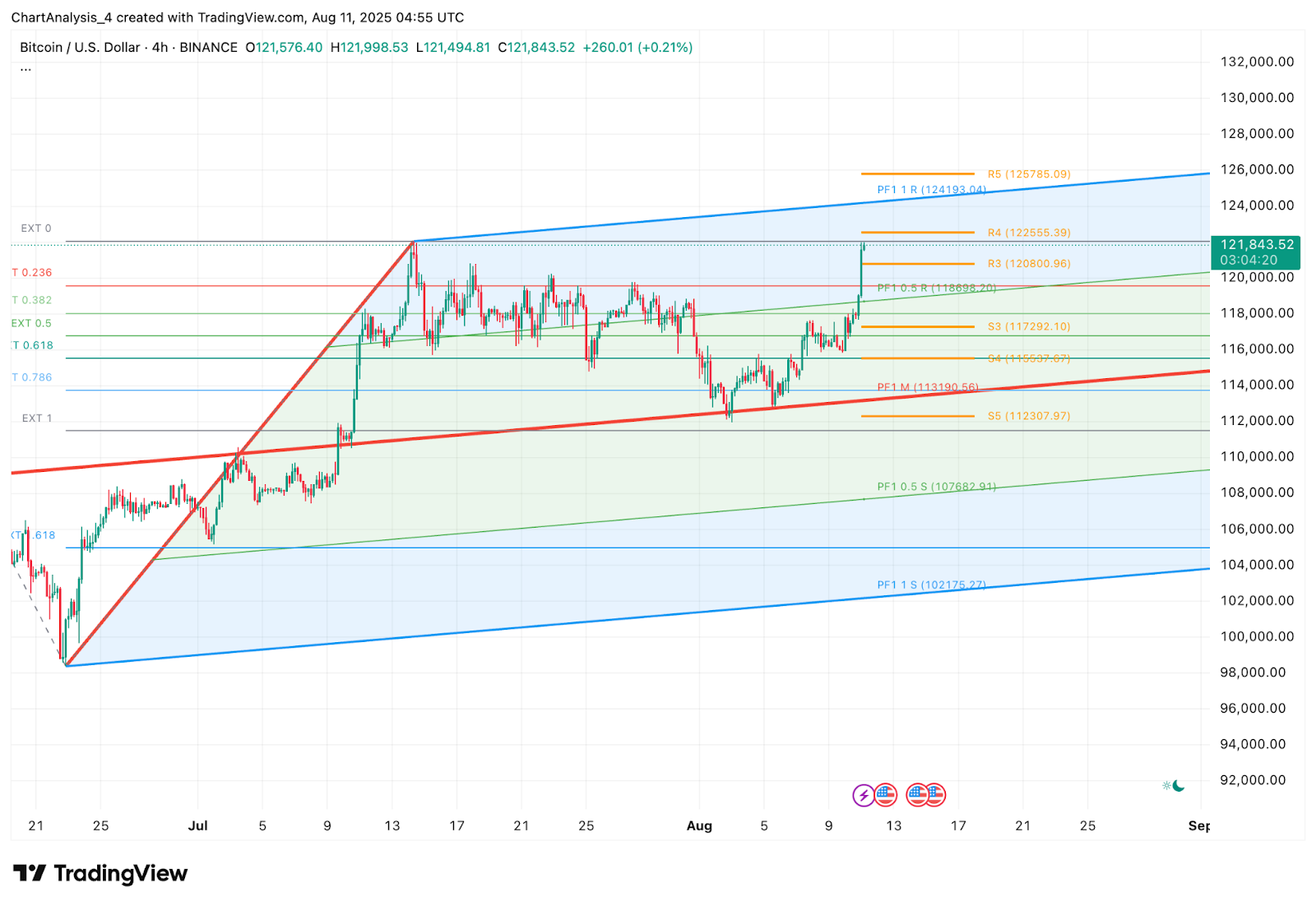
Динамика цены BTC (Источник: TradingView)

Полосы Боллинджера заметно расширяются, а верхняя полоса на уровне $120 696 теперь отстаёт от цены, указывая на активную фазу роста волатильности. Модель разворота Фибоначчи показывает, что уровень R3 на уровне $120 800 был пробит, и следующим внутридневным уровнем сопротивления остаётся уровень R4 на уровне $122 655. Выше этого уровня R5 находится вблизи $125 785, что соответствует верхней границе канала.
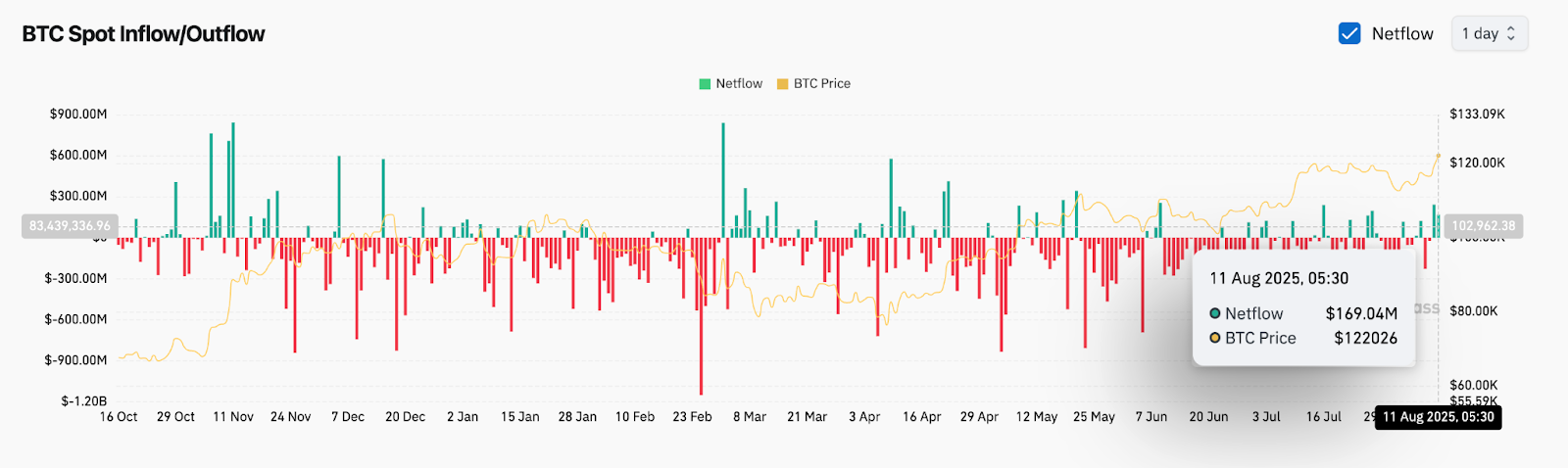
Данные по притоку/оттоку BTC Spot (Источник: Coinglass)

Также наблюдаются признаки агрессивного накопления. Данные о чистом потоке капитала от 11 августа зафиксировали приток в размере 169,04 млн долларов США во время прорыва.
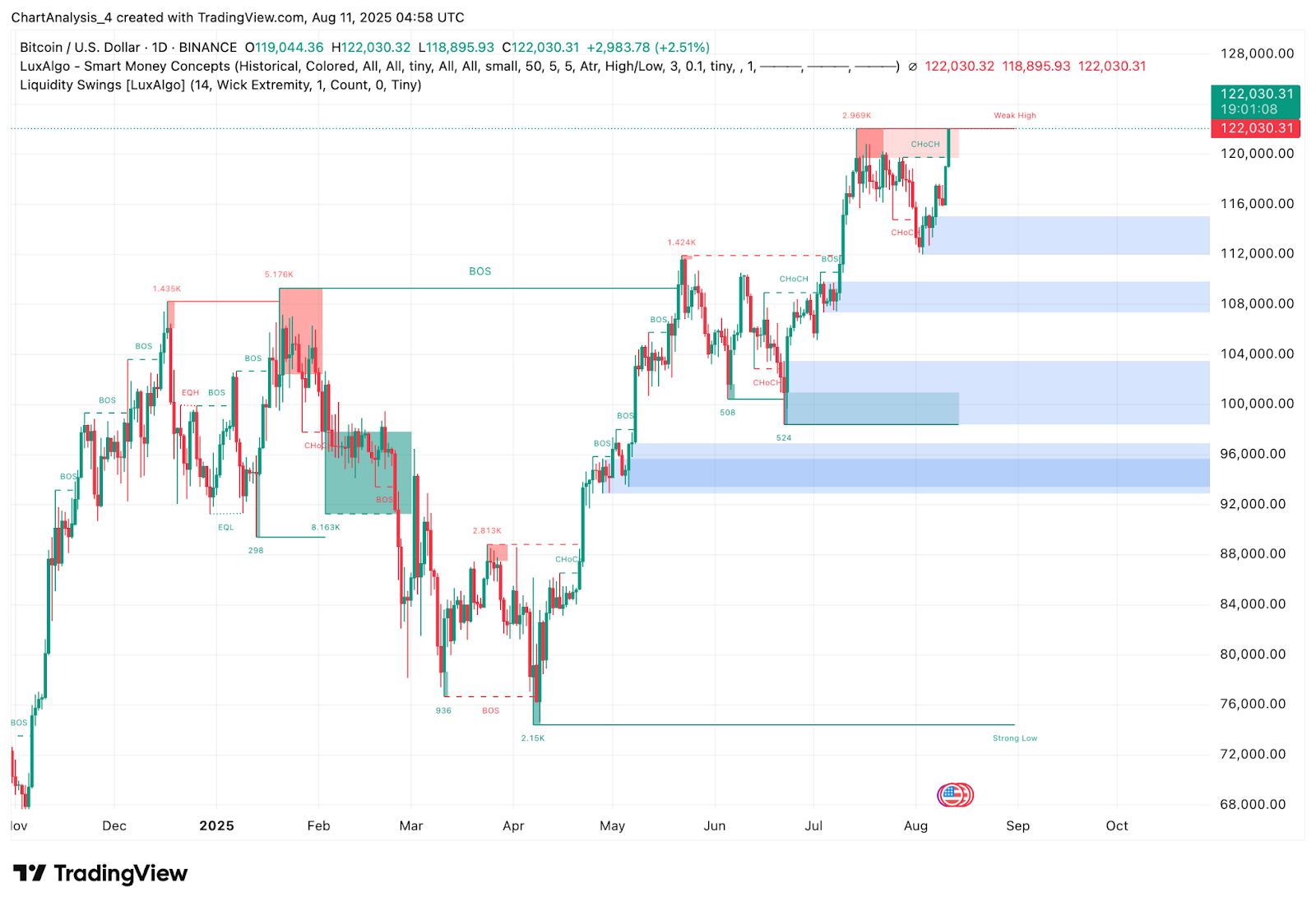
Динамика цены BTC (Источник: TradingView)

В структурном плане последний прорыв структуры на дневном графике SMC произошёл выше $118 000, оставив $122 030 следующим, слабо защищённым максимумом. Зоны спроса между $112 300 и $113 190 остаются непроверенными и образуют наиболее явную область аннулирования в случае провала ралли.

Прогноз цены биткоина: краткосрочный прогноз (24 часа)

Если бычий импульс сохранится, и BTC закроется выше $122 030, это подтвердит приток ликвидности и откроет путь к $124 193. В этом случае станет возможным дальнейшее движение к $125 785 вблизи верхней границы восходящего канала. Бычий прогноз будет опровергнут закрытием ниже $118 803, что может спровоцировать более глубокий откат к $116 671 и, возможно, к зоне спроса $113 190–$112 300.

В медвежьем сценарии отскок от $122 030 и последующее падение ниже $120 800 может привести к фиксации прибыли. Закрытие ниже $118 803 откроет нисходящую ликвидность на уровне $117 292 и, возможно, на уровне поддержки $115 507. Прорыв ниже $113 190 сменит краткосрочные настроения на медвежьи, а следующей целью станет зона спроса на уровне $112 300.

Уровень уверенности: высокий. Совпадение на нескольких таймфреймах, сильный приток спотовых средств и подтверждённая структура прорыва поддерживают бычий настрой. Однако близость к уровню ликвидности около $122 тыс. означает, что для продолжения роста всё ещё важно получить подтверждение прорыва.

Таблица прогноза цены биткоина: 12 августа 2025 г.

Индикатор/Зона Уровень/Сигнал
Текущая цена $121,964
Сопротивление 1 122 030 долларов США (слабый максимум)
Сопротивление 2 124 193 долл. США (целевой показатель ликвидности)
Растянуть цель 125 785 долларов США (верхняя часть канала)
Поддержка 1 118 803 долл. США (база прорыва)
Поддержка 2 116 671 долл. США (EMA50)
EMA20 / EMA50 / EMA100 / EMA200 (4H) $117,802 / $116,671 / $116,369 / $115,295
Полосы Боллинджера (4H) Верхний $120 696 / Средний $117 399 / Нижний $114 102
Поворотный R3 / R4 / R5 $120,800 / $122,655 / $125,785
Супертренд (Ежедневно) Бычий тренд выше $112 472
Ключевая зона спроса $113,190 – $112,300
Spot netflow (11 августа) +$169.04M
Статус шаблона Симметричный прорыв треугольника (4H) и восходящий канал (дневной)
Цели ликвидности $122,030 / $124,193

Trending Cryptos

Related Reads

$2 Trillion: Countdown to AI's Largest IPO in History

The countdown for the largest IPO in AI history, a potential $2 trillion listing for Anthropic, is underway for October. The staggering valuation, reportedly projected by several investors, contrasts with the company's own internal restraint on setting a public target. Founded five years ago by former OpenAI core members, Anthropic's growth has been meteoric. Annual recurring revenue (ARR) surged from ~$9B in late 2025 to $47B by May 2026, with Q2 2026 revenue of $11.5B marking a 14x year-over-year increase. Bank valuations are even based on internal 2028 revenue forecasts of $190-200B. A key growth driver is Claude Code, its AI coding assistant. Its ARR quintupled in five months to $2.5B by February 2026, now constituting nearly 20% of total revenue. Surveys indicate Anthropic commands roughly 40% of enterprise LLM spending, doubling OpenAI's share in programming-specific use. However, alongside this explosive growth, reports detail significant internal cultural strife. Critics describe a divisive "priesthood" of PhD executives, led by CEO Dario Amodei, who promote a "save humanity" narrative that some employees find cult-like and alienating. This has reportedly created a demoralized workforce and a covert "underground network" of dissent among engineers torn between lucrative pre-IPO equity and a toxic work environment. Anthropic now faces a pivotal paradox: pursuing its mission of "safe" AI requires immense capital for compute, yet that capital demands relentless commercial growth. As it approaches its historic IPO, the company must navigate intense regulatory scrutiny, soaring operational costs, and internal tensions—any of which could destabilize its post-listing trajectory, much like SpaceX's significant post-IPO stock drop. The stage is set for a defining moment in tech history.

marsbit55m ago

$2 Trillion: Countdown to AI's Largest IPO in History

marsbit55m ago

AI Boosting Efficiency and Cutting Costs Makes VC Increasingly Expensive

"AI for Cost Reduction Makes VC Funding More Expensive" Despite the "cost-reduction and efficiency" narrative of AI, venture capital (VC) investment in the AI sector is becoming increasingly costly. While AI tools lower the initial costs for many startups—with team sizes shrinking across funding stages—the market is polarizing. For top-tier AI teams, especially those from leading companies like Google and OpenAI, funding rounds are now larger and valuations are higher than ever at the seed and early stages. For example, new ventures by prominent researchers are securing billions in funding with valuations reaching tens of billions before having a mature product. This creates a "barbell" market: lightweight startups need less capital, while elite AI firms attract massive investments early on. This dynamic raises the cost for VCs to acquire and maintain meaningful ownership stakes. As valuations soar early, securing the same equity percentage requires significantly larger capital commitments. VCs must now invest more upfront and reserve substantial funds for follow-on rounds to avoid dilution, prompting large firms like Accel and a16z to raise massive new funds. Consequently, capital is concentrating intensely in a few perceived winners like OpenAI and Anthropic, widening the gap between large and small VC funds. While high valuations bake in future growth expectations, they also compress potential returns, demanding that portfolio companies achieve unprecedented scale. For major VCs, the core strategy is clear: secure early positions in potential winners and maintain the capital to keep investing as valuations rapidly escalate.

marsbit1h ago

AI Boosting Efficiency and Cutting Costs Makes VC Increasingly Expensive

marsbit1h ago

An Eight-Year Investment Takes a Sharp Turn: Why Did Ethereum Suddenly Abandon Poseidon?

On August 13, Ethereum researcher Justin Drake announced a significant shift in Ethereum's Layer-1 cryptographic roadmap: abandoning the SNARK-friendly hash function Poseidon in favor of traditional functions like SHA2 or BLAKE2. This decision ends eight years of research and investment, marking a major revision to the post-quantum security strategy. Poseidon, introduced in 2019, was highly efficient for zkRollups and zkVMs within SNARK circuits. However, its need for prolonged cryptanalysis and the pressing timeline for quantum resistance revealed limitations. Recent breakthroughs in SNARK design, specifically using binary fields, now enable traditional, battle-tested hash functions to perform as efficiently as Poseidon within SNARKs. Benchmarks show modern laptops can now verify over a million traditional hash calls per second. This change is partly driven by accelerated concerns over quantum computing threats. Reports warn that "Cryptographically Relevant Quantum Computers" could break current blockchain signatures like ECDSA by the early 2030s, risking trillions in assets. Ethereum's response focuses on hash-based post-quantum signature schemes, deemed more quantum-resistant than some lattice-based alternatives under pressure from AI cryptanalysis. Ethereum's updated post-quantum roadmap targets a production-ready "leanVM" for signature aggregation by 2027, with full deployment across consensus, execution, and data layers by 2028. The shift to mature hash functions like SHA2 reduces reliance on newer algorithms and aligns with the goal of using widely analyzed cryptographic primitives. Other major blockchains are also preparing. Solana's core teams have independently chosen the NIST-standardized Falcon signature scheme for its compact size. Starknet plans a phased migration, starting with replacing its Pedersen hash with BLAKE2. Ethereum's move signifies a strategic pivot towards proven security foundations for the quantum era.

marsbit2h ago

An Eight-Year Investment Takes a Sharp Turn: Why Did Ethereum Suddenly Abandon Poseidon?

marsbit2h ago

Programmers Worldwide Are Wasting Money on Anthropic! The Company Can't Stand It Anymore

Anthropic recently published guidelines to help developers using Claude Code reduce unnecessary token costs. The key recommendations include: 1) Clear (/clear) conversations after completing a task to avoid carrying irrelevant file reads and command outputs into the next task. 2) Set the model and reasoning effort level at the start of a session, as switching mid-session invalidates the prompt cache, requiring a full-price recalculation of the entire dialog history. 3) Attach files using @ references instead of typing paths manually to avoid extra tool calls and searches that bloat the context. 4) Add quiet flags to verbose commands (e.g., in CLAUDE.md) to minimize lengthy output in the dialog history. 5) Use /compact while the session cache is still warm (before breaks) to compress the dialog at one-tenth the cost. 6) Offload large-output tasks to a sub-agent, which runs in an isolated context and only returns conclusions, preventing intermediate outputs from polluting the main dialog. The article explains token pricing: input tokens (prefill) are processed in parallel, while output tokens (decode) are generated serially, making output tokens five times more expensive. Caching is crucial for savings—if a request's prefix (system prompt, CLAUDE.md, dialog history) matches the previous one byte-for-byte, reading it costs only 10% of the standard input price. However, cache invalidation occurs when changing models, effort levels, fast mode, compressing dialogs, after cache expiration, or when resuming old sessions. Dialog history also grows quadratically (O(n²)) as file contents and command outputs accumulate, increasing costs per round. Proactive context management—like isolating noisy tasks, using /rewind to trim unproductive turns, and task-based session clearing—is becoming an essential skill for cost-effective AI-assisted development.

marsbit4h ago

Programmers Worldwide Are Wasting Money on Anthropic! The Company Can't Stand It Anymore

marsbit4h ago

Pax Silica vs. WAICO: The US Wants to Prohibit Europe from Using Chinese Artificial Intelligence

The United States is preparing to demand that European and other partners abandon Chinese artificial intelligence initiatives, threatening exclusion from the American-led "Pax Silica" coalition, according to a leaked U.S. State Department document. This ultimatum forces signatories of the "AI Opportunity Statement" to choose between the Western technological ecosystem and alternative frameworks, with China not explicitly named but clearly targeted. Pax Silica is a U.S. strategy for AI and semiconductor hegemony, launched in late 2025. Its European presence expanded significantly in mid-2026. Concurrently, China, Russia, and 27 other nations established the World AI Cooperation Organization (WAICO) in July 2026 as an independent intergovernmental platform promoting AI governance based on UN principles. This situation creates a difficult choice, especially for European nations balancing strategic autonomy with dependence on U.S. tech and security. It also pressures Global South countries with pragmatic ties to both Washington and Beijing. The formation of competing blocks risks fragmenting the global tech landscape, forcing companies to split supply chains, increasing costs, and potentially leading to incompatible standards and protocols. The era of open globalization in AI may be ending, replaced by geopolitical confrontation where technological sovereignty trumps economic efficiency. The decisions made will shape the global digital economy for decades.

cryptonews.ru6h ago

Pax Silica vs. WAICO: The US Wants to Prohibit Europe from Using Chinese Artificial Intelligence

cryptonews.ru6h ago

Trading

Spot

Hot Articles

What is $BITCOIN

DIGITAL GOLD ($BITCOIN): A Comprehensive Analysis Introduction to DIGITAL GOLD ($BITCOIN) DIGITAL GOLD ($BITCOIN) is a blockchain-based project operating on the Solana network, which aims to combine the characteristics of traditional precious metals with the innovation of decentralized technologies. While it shares a name with Bitcoin, often referred to as “digital gold” due to its perception as a store of value, DIGITAL GOLD is a separate token designed to create a unique ecosystem within the Web3 landscape. Its goal is to position itself as a viable alternative digital asset, although specifics regarding its applications and functionalities are still developing. What is DIGITAL GOLD ($BITCOIN)? DIGITAL GOLD ($BITCOIN) is a cryptocurrency token explicitly designed for use on the Solana blockchain. In contrast to Bitcoin, which provides a widely recognized value storage role, this token appears to focus on broader applications and characteristics. Notable aspects include: Blockchain Infrastructure: The token is built on the Solana blockchain, known for its capacity to handle high-speed and low-cost transactions. Supply Dynamics: DIGITAL GOLD has a maximum supply capped at 100 quadrillion tokens (100P $BITCOIN), although details regarding its circulating supply are currently undisclosed. Utility: While precise functionalities are not explicitly outlined, there are indications that the token could be utilized for various applications, potentially involving decentralized applications (dApps) or asset tokenization strategies. Who is the Creator of DIGITAL GOLD ($BITCOIN)? At present, the identity of the creators and development team behind DIGITAL GOLD ($BITCOIN) remains unknown. This situation is typical among many innovative projects within the blockchain space, particularly those aligning with decentralized finance and meme coin phenomena. While such anonymity may foster a community-driven culture, it intensifies concerns about governance and accountability. Who are the Investors of DIGITAL GOLD ($BITCOIN)? The available information indicates that DIGITAL GOLD ($BITCOIN) does not have any known institutional backers or prominent venture capital investments. The project seems to operate on a peer-to-peer model focused on community support and adoption rather than traditional funding routes. Its activity and liquidity are primarily situated on decentralized exchanges (DEXs), such as PumpSwap, rather than established centralized trading platforms, further highlighting its grassroots approach. How DIGITAL GOLD ($BITCOIN) Works The operational mechanics of DIGITAL GOLD ($BITCOIN) can be elaborated on based on its blockchain design and network attributes: Consensus Mechanism: By leveraging Solana’s unique proof-of-history (PoH) combined with a proof-of-stake (PoS) model, the project ensures efficient transaction validation contributing to the network's high performance. Tokenomics: While specific deflationary mechanisms have not been extensively detailed, the vast maximum token supply implies that it may cater to microtransactions or niche use cases that are still to be defined. Interoperability: There exists the potential for integration with Solana’s broader ecosystem, including various decentralized finance (DeFi) platforms. However, the details regarding specific integrations remain unspecified. Timeline of Key Events Here is a timeline that highlights significant milestones concerning DIGITAL GOLD ($BITCOIN): 2023: The initial deployment of the token occurs on the Solana blockchain, marked by its contract address. 2024: DIGITAL GOLD gains visibility as it becomes available for trading on decentralized exchanges like PumpSwap, allowing users to trade it against SOL. 2025: The project witnesses sporadic trading activity and potential interest in community-led engagements, although no noteworthy partnerships or technical advancements have been documented as of yet. Critical Analysis Strengths Scalability: The underlying Solana infrastructure supports high transaction volumes, which could enhance the utility of $BITCOIN in various transaction scenarios. Accessibility: The potential low trading price per token could attract retail investors, facilitating wider participation due to fractional ownership opportunities. Risks Lack of Transparency: The absence of publicly known backers, developers, or an audit process may yield skepticism regarding the project's sustainability and trustworthiness. Market Volatility: The trading activity is heavily reliant on speculative behavior, which can result in significant price volatility and uncertainty for investors. Conclusion DIGITAL GOLD ($BITCOIN) emerges as an intriguing yet ambiguous project within the rapidly evolving Solana ecosystem. While it attempts to leverage the “digital gold” narrative, its departure from Bitcoin's established role as a store of value underscores the need for a clearer differentiation of its intended utility and governance structure. Future acceptance and adoption will likely depend on addressing the current opacity and defining its operational and economic strategies more explicitly. Note: This report encompasses synthesised information available as of October 2023, and developments may have transpired beyond the research period.

1.9k Total ViewsPublished 2025.05.13Updated 2025.05.13

What is $BITCOIN

Discussions

Welcome to the HTX Community. Here, you can stay informed about the latest platform developments and gain access to professional market insights. Users' opinions on the price of BTC (BTC) are presented below.

活动图片