Bitcoin Hyper ($HYPER) Live News Today: Latest Insights for Bitcoin Maxis (August 8)

bitcoinistPublished on 2025-08-08Last updated on 2025-08-08

Abstract

Stay Ahead with Our Immediate Analysis of Today's Bitcoin & Bitcoin Hyper Insights Check out our Live Bitcoin Hyper Updates...

Trusted Editorial content, reviewed by leading industry experts and seasoned editors. Ad Disclosure

Stay Ahead with Our Immediate Analysis of Today’s Bitcoin & Bitcoin Hyper Insights

Check out our Live Bitcoin Hyper Updates for August 8, 2025!

In 2010, Bitcoin was worth a few cents. One year later, it hit $20. In six years, it was $17,000, and now it’s sitting at $116K, after hitting an ATH of $123K in July.

Historically, if you’d invested in Bitcoin at launch, you’d have an ROI of 188,643,000%. The likes of Mastercard, JP Morgan, and scores of S&P 500 companies are buying Bitcoin in droves. There’s never been anything like Bitcoin before, and investors are waking up to that reality.

However, Bitcoin is getting old for modern standards. No dApps, no smart contracts, and almost non-existent DeFi scalability. It needs an upgrade. And that’s what Bitcoin Hyper ($HYPER) is here to do with Layer-2 technology.

Click to learn more about Bitcoin Hyper

Bitcoin Hyper ($HYPER) is a crypto project planning to launch the fastest Layer-2 chain for Bitcoin. Its goal – to bring Bitcoin’s blockchain to modern standards. This means compatibility with dApps, smart contracts, and seamless DeFi programmability for developers.

The L2 will run on a Canonical Bridge, combined with the Solana Virtual Machine (SVM), for native compatibility with Solana. You’ll be able to build token programs, LP logic, oracles, games, NFT infrastructure, DAOs, and much more. All without reinventing the wheel.

To engage with the L2, you’ll deposit $BTC to a designated address monitored by the Canonical Bridge. The Relay Program verifies the details, and then mints an equivalent number of wrapped $BTC on the L2. You can also withdraw your original $BTC at any time.

If you’re looking for the newest insights on Bitcoin and Bitcoin Hyper, you’re in the right place.

We update this page regularly throughout the day with the latest insider insights for Bitcoin maxis and Bitcoin Hyper fans. Keep refreshing to stay ahead of the pack!

Disclaimer: No crypto investment comes without risk. Our content is for informational purposes, not financial advice. We may earn affiliate commissions at no extra cost to you.


Today’s Bitcoin Technical Analysis

Bitcoin formed a higher low – a classic bullish signal – on the daily chart on August 5, and has since gained around 2.20% in under three days.

The best part? This mini rally is emerging right from the key 50% Fibonacci retracement level, drawn from the July 1 low of 105,145.
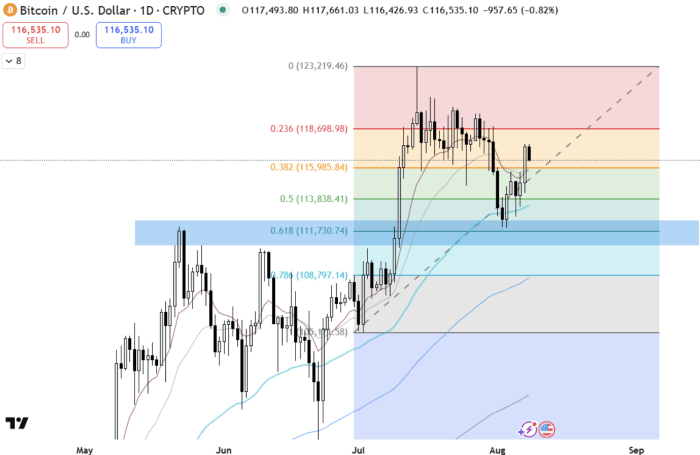
$BTC price chart TradingView

In plain English: Bitcoin has pulled back just the right amount after hitting its highs, and this textbook correction might now be setting the stage for another leg up, one that could see the token charge toward its all-time highs. At least that’s what the technicals are hinting at.

Even more convincing? The bounce came precisely from a zone that previously acted as strong resistance, which has now flipped into support – another picture-perfect scenario.

With $BTC now holding firm above both its 10 and 20 EMAs, a fresh aggressive move may just be around the corner, especially if the price continues to stay above these key short-term EMAs.


NFTs Record $530M in Sales in July, Doubling Their Average Price and Fueling Projects Like Bitcoin Hyper ($HYPER)

August 8, 2025 • 11:00 UTC

The NFT market recorded $530M in sales in July, outperforming DeFi and doubling their average trade price, from $52 to $105, compared to June.

This performance comes in the context of a 4% drop in the sale count, which can only mean one thing: NFTs sell in lower numbers but at higher prices.

Analysts attribute the surge to several factors, the primary one being the fact that NFTs moved from meme-only to utility-based assets by moving into sectors like gaming and tokenized Real-World Assets (RWA.)

The recent regulatory changes brought forth by Trump’s GENIUS Act and the CLARITY Act have also contributed to the trend.

The same regulatory changes set the stage for a wider crypto surge, with Bitcoin Hyper being among the top beneficiaries.

Bitcoin Hyper aims to solve Bitcoin’s poor performance by enabling lightning-fast execution of smart contracts and DeFi apps and decongesting the Bitcoin network with the help of tools like Canonical Bridge and Solana Virtual Machine (SVM.)

Learn more about Bitcoin Hyper ($HYPER) on the presale page.


Retirement Goes Crypto: What Trump’s Latest Executive Order Signals for Bitcoin and Bitcoin Hyper

August 8, 2025 • 10:00 UTC

US President Trump has just signed an executive order allowing 401(k) plans to invest in alternative assets like cryptocurrencies for the first time.

This move unlocks access to crypto for over 90 million Americans, who were previously restricted from making such investments for retirement.

The crypto market reacted positively: Bitcoin rose above $117,6K, and crypto stocks like Coinbase and Robinhood saw notable gains. For Bitcoin, this signals its growing legitimacy as a long-term store of value.

As for Bitcoin Hyper ($HYPER), currently in presale, it’s a strategic boost for its utility proposition.

Bitcoin Hyper offers a way to extend BTC’s utility into the modern crypto economy. Its presale has already raised over $7.6M, signaling strong investor belief in its potential to reshape how Bitcoin is used.

As mainstream retirement portfolios embrace crypto, demand for scalable, fast, and programmable Bitcoin side chains, like Bitcoin Hyper’s Solana-powered Layer-2 solution, could surge.

Read our Bitcoin Hyper Price Prediction for 2025–2030.

Editorial Process for bitcoinist is centered on delivering thoroughly researched, accurate, and unbiased content. We uphold strict sourcing standards, and each page undergoes diligent review by our team of top technology experts and seasoned editors. This process ensures the integrity, relevance, and value of our content for our readers.

Leah is a British journalist with a BA in Journalism, Media, and Communications and nearly a decade of content writing experience. Over the last four years, her focus has primarily been on Web3 technologies, driven by her genuine enthusiasm for decentralization and the latest technological advancements. She has contributed to leading crypto and NFT publications – Cointelegraph, Coinbound, Crypto News, NFT Plazas, Bitcolumnist, Techreport, and NFT Lately – which has elevated her to a senior role in crypto journalism. Whether crafting breaking news or in-depth reviews, she strives to engage her readers with the latest insights and information. Her articles often span the hottest cryptos, exchanges, and evolving regulations. As part of her ploy to attract crypto newbies into Web3, she explains even the most complex topics in an easily understandable and engaging way. Further underscoring her dynamic journalism background, she has written for various sectors, including software testing (TEST Magazine), travel (Travel Off Path), and music (Mixmag). When she's not deep into a crypto rabbit hole, she's probably island-hopping (with the Galapagos and Hainan being her go-to's). Or perhaps sketching chalk pencil drawings while listening to the Pixies, her all-time favorite band.

Trending Cryptos

Related Reads

Bitwise CIO: STRC Plunge is a Bottom Signal, Bull Market to Begin in Autumn

Matt Hougan, Chief Investment Officer at Bitwise, explains the recent Bitcoin price drop below $60,000 and its connection to the steep decline in MicroStrategy's STRC (Strategy's Perpetual Preferred Stock). STRC, designed as a high-yield, stable-price instrument, fell from its $100 target to $75 due to market fears over MicroStrategy's ability to sustain its dividend amid Bitcoin's price weakness. Hougan clarifies that while MicroStrategy's overall financial position remains strong, with significant Bitcoin holdings and cash, the core market anxiety centered on the optional nature of the dividend payments. In response, MicroStrategy announced a new operational framework: it will sell some Bitcoin as needed to fund dividends, will no longer actively defend the $100 share price through dividend hikes, and may repurchase STRC on the open market. This shift marks a change in MicroStrategy's role from a consistent, one-way buyer of Bitcoin to a more dynamic participant that may both buy and sell. According to Hougan, the STRC volatility is a classic late-cycle event, signaling the painful but necessary process of flushing out excessive leverage from the market. He draws parallels to the unwinding of the GBTC premium in the previous cycle. He identifies key potential bottoming signals: MSTR trading at a discount to its net asset value (NAV), extreme readings on the Crypto Fear & Greed Index, and persistently negative Bitcoin funding rates. Hougan concludes that while the exact timing of the market bottom is unpredictable, the current deleveraging phase suggests it is near. He expresses confidence that a new bull market will begin in the fall of this year, with the next major wave of buying expected to come from institutional investors like banks, asset managers, and pension funds.

Foresight News19m ago

Bitwise CIO: STRC Plunge is a Bottom Signal, Bull Market to Begin in Autumn

Foresight News19m ago

ENS Founder Seeks to 'Seize Power' from DAO

On June 29th, the ENS community entered the on-chain voting phase for a proposal to renew the ENS DAO Security Council's veto power for two more years. Shortly after voting began, ENS founder Nick Johnson used his substantial ENS holdings to cast over 3.55 million votes against the proposal, swinging the outcome despite initial strong support. The Security Council was established in July 2024 with a 4/8 multisig veto power to protect the DAO's treasury (valued over $350 million) from malicious proposals during a period of low voter participation. Its powers were limited to vetoing only harmful proposals, not normal ones. Nick Johnson's opposition stems from broader concerns about ENS DAO's governance. In late 2025, he and others expressed frustration that the DAO had become mired in political gamesmanship, with capable contributors leaving and leadership falling to less experienced or misaligned parties. This context set the stage for a major restructuring proposal by ENS COO Katherine Wu on June 19th, titled "Next Era of ENS DAO: Empowering the ENS Foundation." The controversial proposal aims to transfer daily operations, treasury management, and long-term strategy to a restructured ENS Foundation with a professional board, while the DAO would retain core protocol governance powers. Critics, including original ENS constitution author Brantly Millegan, argue this effectively transfers treasury control from token holders to ENS Labs (the core development team), undermining the DAO's original decentralized design. Nick's massive "no" vote on the Security Council renewal is seen as the first move in this power struggle. He explained his vote was due to concerns about insufficient checks on the Council's power and the potential for its veto to be used politically. In response, Katherine Wu submitted a revised proposal with higher execution thresholds (5/8 instead of 4/8) and stricter limits. The push for change comes as ENS's annual revenue has declined significantly, from over $10 million in 2023 to under $2 million in 2025, increasing pressure to manage the treasury more effectively. Nick Johnson now faces the challenge of proving that a more structured foundation can steer ENS better than the current DAO model.

Foresight News49m ago

ENS Founder Seeks to 'Seize Power' from DAO

Foresight News49m ago

Predicting World Cup Knockout Matches: Why Are Different AI Models So Far Apart?

AI performance in predicting the 2026 FIFA World Cup knockout matches varied significantly, according to an analysis of models including ChatGPT, Grok, DeepSeek, Gemini, and Claude. The standout predictions came from DeepSeek and Gemini for the Netherlands vs. Morocco match. Gemini precisely forecasted a 1-1 draw and a penalty shootout win for Morocco, while DeepSeek correctly identified the high probability of a draw and Morocco's potential to advance via a defensive and counter-attacking strategy. Grok and Tongyi Qianwen (千问) demonstrated strength in predicting accurate scores for matches with clearer favorites. They correctly called the narrow 1-0 win for Canada over South Africa and Brazil's 2-1 victory over Japan, as well as Norway's 2-1 win over Ivory Coast. ChatGPT and Claude excelled more in match process analysis than in predicting exact scores or upsets. They frequently identified potential challenges for favorites, such as Japan's pressing against Brazil or DR Congo's defensive tactics against England, even when predicting the favorite's ultimate victory. A notable failure was the unanimous misjudgment of Germany vs. Paraguay. All models incorrectly favored Germany, underestimating Paraguay's ability to force a penalty shootout and cause an upset. In summary, Gemini and DeepSeek showed the most insight for high-stakes, unpredictable matches. Grok and Qianwen were reliable "score predictors" for less volatile games. ChatGPT and Claude were strong "analytical models," adept at outlining match dynamics but often hesitant to predict upsets.

Odaily星球日报1h ago

Predicting World Cup Knockout Matches: Why Are Different AI Models So Far Apart?

Odaily星球日报1h ago

Trading

Spot

Hot Articles

What is $BITCOIN

DIGITAL GOLD ($BITCOIN): A Comprehensive Analysis Introduction to DIGITAL GOLD ($BITCOIN) DIGITAL GOLD ($BITCOIN) is a blockchain-based project operating on the Solana network, which aims to combine the characteristics of traditional precious metals with the innovation of decentralized technologies. While it shares a name with Bitcoin, often referred to as “digital gold” due to its perception as a store of value, DIGITAL GOLD is a separate token designed to create a unique ecosystem within the Web3 landscape. Its goal is to position itself as a viable alternative digital asset, although specifics regarding its applications and functionalities are still developing. What is DIGITAL GOLD ($BITCOIN)? DIGITAL GOLD ($BITCOIN) is a cryptocurrency token explicitly designed for use on the Solana blockchain. In contrast to Bitcoin, which provides a widely recognized value storage role, this token appears to focus on broader applications and characteristics. Notable aspects include: Blockchain Infrastructure: The token is built on the Solana blockchain, known for its capacity to handle high-speed and low-cost transactions. Supply Dynamics: DIGITAL GOLD has a maximum supply capped at 100 quadrillion tokens (100P $BITCOIN), although details regarding its circulating supply are currently undisclosed. Utility: While precise functionalities are not explicitly outlined, there are indications that the token could be utilized for various applications, potentially involving decentralized applications (dApps) or asset tokenization strategies. Who is the Creator of DIGITAL GOLD ($BITCOIN)? At present, the identity of the creators and development team behind DIGITAL GOLD ($BITCOIN) remains unknown. This situation is typical among many innovative projects within the blockchain space, particularly those aligning with decentralized finance and meme coin phenomena. While such anonymity may foster a community-driven culture, it intensifies concerns about governance and accountability. Who are the Investors of DIGITAL GOLD ($BITCOIN)? The available information indicates that DIGITAL GOLD ($BITCOIN) does not have any known institutional backers or prominent venture capital investments. The project seems to operate on a peer-to-peer model focused on community support and adoption rather than traditional funding routes. Its activity and liquidity are primarily situated on decentralized exchanges (DEXs), such as PumpSwap, rather than established centralized trading platforms, further highlighting its grassroots approach. How DIGITAL GOLD ($BITCOIN) Works The operational mechanics of DIGITAL GOLD ($BITCOIN) can be elaborated on based on its blockchain design and network attributes: Consensus Mechanism: By leveraging Solana’s unique proof-of-history (PoH) combined with a proof-of-stake (PoS) model, the project ensures efficient transaction validation contributing to the network's high performance. Tokenomics: While specific deflationary mechanisms have not been extensively detailed, the vast maximum token supply implies that it may cater to microtransactions or niche use cases that are still to be defined. Interoperability: There exists the potential for integration with Solana’s broader ecosystem, including various decentralized finance (DeFi) platforms. However, the details regarding specific integrations remain unspecified. Timeline of Key Events Here is a timeline that highlights significant milestones concerning DIGITAL GOLD ($BITCOIN): 2023: The initial deployment of the token occurs on the Solana blockchain, marked by its contract address. 2024: DIGITAL GOLD gains visibility as it becomes available for trading on decentralized exchanges like PumpSwap, allowing users to trade it against SOL. 2025: The project witnesses sporadic trading activity and potential interest in community-led engagements, although no noteworthy partnerships or technical advancements have been documented as of yet. Critical Analysis Strengths Scalability: The underlying Solana infrastructure supports high transaction volumes, which could enhance the utility of $BITCOIN in various transaction scenarios. Accessibility: The potential low trading price per token could attract retail investors, facilitating wider participation due to fractional ownership opportunities. Risks Lack of Transparency: The absence of publicly known backers, developers, or an audit process may yield skepticism regarding the project's sustainability and trustworthiness. Market Volatility: The trading activity is heavily reliant on speculative behavior, which can result in significant price volatility and uncertainty for investors. Conclusion DIGITAL GOLD ($BITCOIN) emerges as an intriguing yet ambiguous project within the rapidly evolving Solana ecosystem. While it attempts to leverage the “digital gold” narrative, its departure from Bitcoin's established role as a store of value underscores the need for a clearer differentiation of its intended utility and governance structure. Future acceptance and adoption will likely depend on addressing the current opacity and defining its operational and economic strategies more explicitly. Note: This report encompasses synthesised information available as of October 2023, and developments may have transpired beyond the research period.

552 Total ViewsPublished 2025.05.13Updated 2025.05.13

What is $BITCOIN

Discussions

Welcome to the HTX Community. Here, you can stay informed about the latest platform developments and gain access to professional market insights. Users' opinions on the price of BTC (BTC) are presented below.

活动图片