Ethereum L2s Drain ETH, Centralize Control: Galaxy‘s Thorn Warns

bitcoinistPublished on 2025-08-07Last updated on 2025-08-08

Abstract

Galaxy Digital’s head of research Alex Thorn ignited a fresh debate over Ethereum’s roll-up economy on Wednesday, accusing leading Layer-2...

Trusted Editorial content, reviewed by leading industry experts and seasoned editors. Ad Disclosure

Galaxy Digital’s head of research Alex Thorn ignited a fresh debate over Ethereum’s roll-up economy on Wednesday, accusing leading Layer-2 networks of siphoning value from the main chain while leaving ETH holders with “pennies.” In a widely shared thread on X, Thorn argued that “after all these years, the ethereum community is apparently fine that most users are operating on centralized L2s controlled by single companies or foundations… very little value accrual back to ETH holders… sad!”

Ethereum L2s: Centralized, Profitable And Bleeding ETH Dry

According to Thorn, roll-ups now earn between $100 000 and $400 000 in daily fees yet “haven’t spent more than 1/1000 of a penny daily to buy blob objects since May,” pushing less than $10,000 per day to Ethereum for data availability. He highlighted Base—Coinbase’s OP-Stack roll-up—as the most conspicuous example: over the past 180 days Base paid just $3.05 million to Ethereum L1 while sending $4.4 million to the Optimism Collective that licenses its code. “Base is paying more daily to the Optimism Collective than all L2s combined (including Base) are paying to Ethereum L1,” Thorn wrote, calling the margin “a nice business.”

The numbers grow starker in Coinbase’s own filings. Thorn noted that in Q2 2025 Base generated $14.9 million in user fees, spent only $443,000 on Ethereum data costs and $2.16 million on Optimism royalties—just as the exchange disclosed a quarterly purchase of 2,509 BTC worth $247 million.

“Is Coinbase siphoning value from Ethereum and using the proceeds to buy bitcoin?” he asked, framing the decision as evidence that roll-ups can divert economic gravity away from ETH toward alternative assets. Coinbase’s July 31 X post confirms the bitcoin accumulation: 11,776 BTC held at a $740 million cost basis, now valued at $1.26 billion.

Buterin Highlights Technical Roadmap

While Thorn’s critique centered on economics and governance, Ethereum co-founder Vitalik Buterin shared a technocratic roadmap focused on L2 user experience. Celebrating that “so many major L2s are now at stage 1,” Buterin argued that the next milestone must be sub-one-hour native withdrawals—ultimately shrinking to a single slot—enabled by validity (ZK) proofs rather than optimistic schemes that require week-long challenge periods. “Waiting a week to withdraw is far too long… This creates incentives to instead use solutions with unacceptable trust assumptions that undermine the whole point of having L2s,” he wrote, urging builders to adopt hybrid proof systems (ZK + OP + TEE or variants) that deliver speed without sacrificing trustlessness.

Buterin acknowledged that frequent ZK proofs remain costly—single submissions today consume roughly 500,000 gas—yet anticipated near-term aggregation of many roll-up proofs into one, uploaded “once per slot,” unlocking near-instant cross-L2 liquidity while keeping Ethereum the settlement and asset-issuance hub. In his view, technical convergence on validity proofs will erode the advantage of centralized multi-sig bridges that Thorn decries, restoring both security and economic alignment.

For now the gulf between the two perspectives remains. Thorn views the status quo as extraction: centralized sequencers capture margins while remitting negligible fees to stakers, and governance remains anchored in corporate committees rather than permissionless validators. Buterin counters that the pathway to stronger alignment lies through cryptographic engineering that removes the week-long friction keeping capital parked in L2 coffers. Whether economics or engineering wins the argument may hinge on how quickly roll-ups can deploy cheap ZK systems— and whether users will wait for the upgrade or continue rewarding the most profitable sequencers in the meantime.

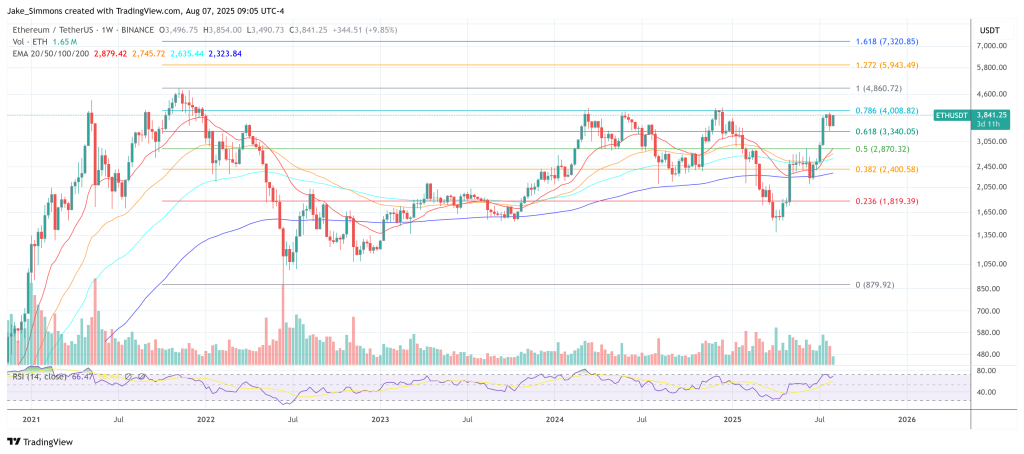
At press time, ETH traded at $3,841.
Ethereum price
ETH bounces back above $3,800, 1-week chart | Source: ETHUSDT on TradingView.com
Featured image created with DALL.E, chart from TradingView.com
Editorial Process for bitcoinist is centered on delivering thoroughly researched, accurate, and unbiased content. We uphold strict sourcing standards, and each page undergoes diligent review by our team of top technology experts and seasoned editors. This process ensures the integrity, relevance, and value of our content for our readers.

Jake Simmons has been a Bitcoin enthusiast since 2016. Ever since he heard about Bitcoin, he has been studying the topic every day and trying to share his knowledge with others. His goal is to contribute to Bitcoin's financial revolution, which will replace the fiat money system. Besides BTC and crypto, Jake studied Business Informatics at a university. After graduation in 2017, he has been working in the blockchain and crypto sector. You can follow Jake on Twitter at @realJakeSimmons.

Trending Cryptos

Related Reads

Robinhood Chain Mainnet Goes Live: Can Stocks Finally Be Moved Into Wallets?

Robinhood has officially launched its public mainnet, Robinhood Chain, along with stock-like tokens, the USDG yield product, and a DeFi lending portal. This marks a significant shift where a major online broker is integrating its user interface, regulatory compliance, self-custody wallet, and on-chain protocols into a single, streamlined experience. The goal is to simplify access to stock exposure, stablecoin yields, collateralized lending, and AMM trading for mainstream users. Eligible non-U.S. users can hold these "Stock Tokens"—structured as tokenized debt securities—in the Robinhood Wallet for 24/7 exposure to assets like U.S. stocks or ETFs. U.S. users can access an estimated ~7% APY on dollar-backed USDG through the Robinhood Earn program via self-custody wallets, with lending infrastructure powered by Morpho protocol. Built as a Layer 2 on Arbitrum, Robinhood Chain leverages existing DeFi protocols like Uniswap. The core strategy is not to reinvent DeFi but to channel Robinhood's large traditional finance user base (27.4 million funded customers as of Q1 2026) into on-chain finance, lowering the technical barriers. However, key limitations exist. The stock tokens are not direct equity ownership and are unavailable in the U.S. and some jurisdictions due to regulatory constraints. The ~7% yield is variable and carries inherent DeFi risks, not guaranteed principal protection. Furthermore, while AMMs enable trading, price discovery for major stocks will likely remain anchored in traditional markets like NASDAQ for the foreseeable future. Ultimately, Robinhood Chain is an early experiment in "on-chain brokerage." Its success will depend on real-world metrics like trading volume, sustained user migration to self-custody, stable yield performance, and regulatory feedback, rather than its launch narrative.

marsbit1h ago

Robinhood Chain Mainnet Goes Live: Can Stocks Finally Be Moved Into Wallets?

marsbit1h ago

Circle CEO Responds to OUSD Challenge: Stablecoin Market Is 'Winner-Takes-All', Consortium Model Doomed to Fail

Circle CEO Jeremy Allaire addresses market concerns following the announcement of the Open USD (OUSD) stablecoin project backed by 140 global companies. Allaire argues the stablecoin market exhibits "winner-takes-all" dynamics due to powerful network effects. He cites USDC's near-decade lead in three key areas: 1) **Application Integration & Protocol Development**: Thousands of integrated services and protocols (like CCTP) create utility and lock-in for developers and users. 2) **Liquidity Network Effects**: A deeply embedded, globally distributed liquidity infrastructure across primary and secondary markets, built over years. 3) **Regulatory Integration**: Extensive licensing and compliance groundwork ensuring USDC's acceptance in major markets like Europe and Japan. Allaire challenges OUSD's proposed advantages. He contends that promises of free redemption, while appealing, face market realities where such models can become exit routes for other stablecoins. He also questions the feasibility of fully distributing all revenue to an alliance, stating it would "starve" the critical infrastructure investments needed for scale and utility. Furthermore, he expresses skepticism about large alliance governance models, noting they often lead to slow decision-making and misaligned incentives. While welcoming OUSD to the ecosystem, Allaire reaffirms confidence in USDC's dominant position, backed by its long-term infrastructure investments and strong partnerships, including its ongoing collaboration with Coinbase.

marsbit1h ago

Circle CEO Responds to OUSD Challenge: Stablecoin Market Is 'Winner-Takes-All', Consortium Model Doomed to Fail

marsbit1h ago

Circle CEO Responds to OUSD Challenge: Alliance Model Doomed to Fail, It's a 'Winner-Takes-All' Game

Circle CEO Jeremy Allaire addresses the challenge posed by the new Open USD (OUSD) stablecoin project, backed by 140 global companies. He argues that the stablecoin market exhibits "winner-take-all" characteristics, where USDC's near-decade-long lead in application integrations, global liquidity, and regulatory compliance secures its dominant position. Allaire outlines three key network effects underpinning USDC's strength: 1) Extensive integration as an internet protocol layer, 2) Deep, globally distributed liquidity networks, and 3) Deep integration with global policy and regulatory frameworks. He cites data showing USDC facilitated 80% of on-chain USD stablecoin transaction volume in Q1 2026. He directly counters OUSD's proposed advantages: 1) "Free minting and redemption" may not be sustainable against market realities, which USDC addresses via contractual mechanisms. 2) "Sharing all revenue" risks starving the infrastructure of necessary investment for growth and reliability. 3) A "consortium model" often leads to slow innovation and poor coordination compared to focused, independent operators like Circle. Allaire reaffirms Circle's strong partnership with Coinbase and notes that Circle continues to collaborate with many OUSD founding members. He concludes by welcoming OUSD to the ecosystem while expressing confidence in USDC's entrenched network advantages and continued expansion.

Odaily星球日报1h ago

Circle CEO Responds to OUSD Challenge: Alliance Model Doomed to Fail, It's a 'Winner-Takes-All' Game

Odaily星球日报1h ago

Trading

Spot

Hot Articles

Discussions

Welcome to the HTX Community. Here, you can stay informed about the latest platform developments and gain access to professional market insights. Users' opinions on the price of ETH (ETH) are presented below.

活动图片