Mysterious Whale Buys $123M In Ethereum: Quiet Smart Money Accumulation?

bitcoinistPublished on 2025-08-07Last updated on 2025-08-07

Abstract

Ethereum is showing signs of renewed strength after a volatile week, gaining over 13% since last Sunday’s local low around...

Trusted Editorial content, reviewed by leading industry experts and seasoned editors. Ad Disclosure

Ethereum is showing signs of renewed strength after a volatile week, gaining over 13% since last Sunday’s local low around the $3,350 level. After facing selling pressure and fears of a deeper correction, bulls have stepped back in, pushing the price higher and regaining control of short-term market momentum. The uptick in volatility has brought fresh attention to ETH, with analysts watching closely as the asset attempts to reclaim key resistance zones.

The broader picture remains fundamentally strong. Institutional interest in Ethereum continues to grow, with large purchases reported in recent days. On-chain activity is also climbing, suggesting rising demand and user engagement across DeFi, NFTs, and Layer-2 ecosystems. Additionally, Ethereum’s role in real-world asset tokenization and smart contract infrastructure reinforces its long-term value proposition.

As ETH navigates its way through resistance levels, the next few sessions will be crucial. A successful consolidation above $3,700 could confirm bullish continuation, while a rejection may open the door for another pullback. Either way, Ethereum’s recent performance and underlying fundamentals suggest that investor confidence is returning—potentially setting the stage for a sustained move higher in the coming weeks.

Ethereum Whale Accumulation Signals Long-Term Confidence

According to top analyst Ted Pillows, a mysterious whale or institutional player has purchased $122,955,634 worth of ETH over the past two days. This massive accumulation comes as Ethereum rebounds from recent lows and attempts to reclaim the critical $3,800 level. The move is being interpreted by many analysts as a strong signal that smart money is quietly taking advantage of the recent dip to build long-term positions.
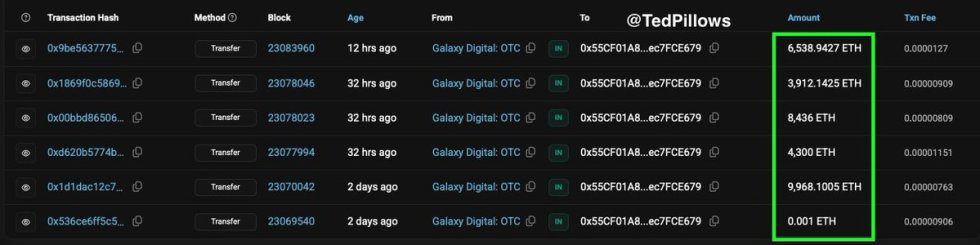
Mysterious whale/institution bought $122,955,634 ETH in the past 2 days | Source: Ted Pillows

The scale and timing of this buy suggest strategic intent—likely a reflection of confidence in Ethereum’s underlying fundamentals and its broader role in the evolving digital economy. As TradFi (traditional finance) money continues to flow into crypto, Ethereum is emerging as a core asset for institutional portfolios thanks to its programmability, robust developer ecosystem, and growing use cases in tokenization and DeFi.

Despite Bitcoin showing signs of overheating and many altcoins still trading below key levels, Ethereum’s relative strength stands out. While the broader market remains cautious, this accumulation trend highlights how informed investors are looking past short-term volatility and positioning for multi-year highs.

Price Action Details: ETH Retests Key Resistance

Ethereum (ETH) has surged over 13% since last Sunday and is now testing the critical resistance level at $3,860, as shown on the 4-hour chart. After forming a local bottom near $3,350, ETH has steadily climbed with increasing volume, signaling renewed buyer interest and bullish momentum.
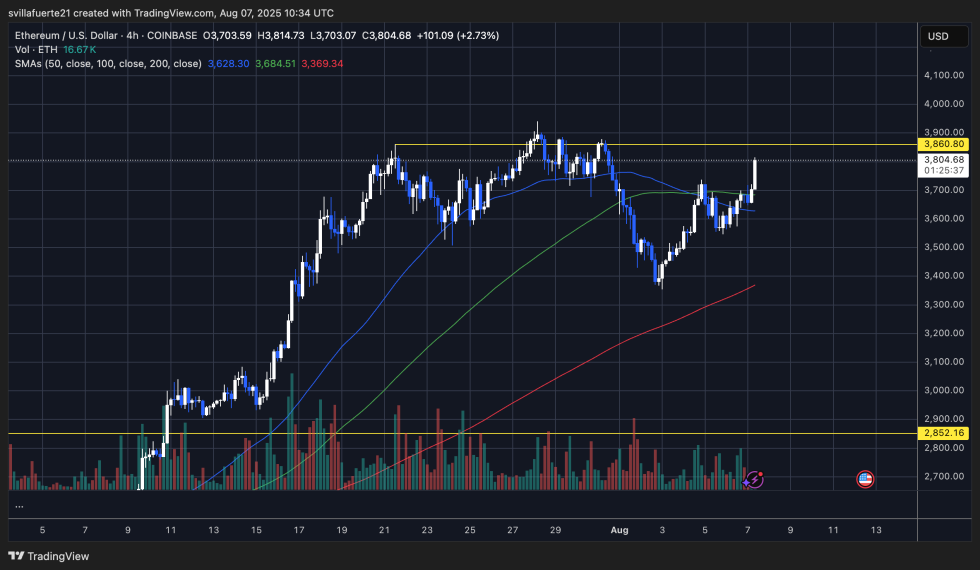
ETH testing key resistance | Source: ETHUSDT chart on TradingView

The recent breakout above the $3,700 mark came with strong green candles, supported by rising volume and a reclaim of the 50, 100, and 200 simple moving averages (SMAs). This alignment of SMAs below the current price strengthens the bullish outlook, as ETH establishes support zones between $3,630 and $3,685.

However, the $3,860 resistance level remains a key obstacle. It marked previous rejection zones in late July and has yet to be flipped into support. A confirmed breakout above this range, followed by sustained volume and consolidation, could open the door for ETH to challenge the $4,000–$4,200 region in the short term.

Featured image from Dall-E, chart from TradingView

Editorial Process for bitcoinist is centered on delivering thoroughly researched, accurate, and unbiased content. We uphold strict sourcing standards, and each page undergoes diligent review by our team of top technology experts and seasoned editors. This process ensures the integrity, relevance, and value of our content for our readers.

Sebastian's journey into the world of crypto began four years ago, driven by a fascination with the potential of blockchain technology to revolutionize financial systems. His initial exploration focused on understanding the intricacies of various crypto projects, particularly those focused on building innovative financial solutions. Through countless hours of research and learning, Sebastian developed a deep understanding of the underlying technologies, market dynamics, and potential applications of cryptocurrencies. As his knowledge grew, Sebastian felt compelled to share his insights with others. He began actively contributing to online discussions on platforms like X and LinkedIn, focusing on fintech and crypto-related content. His goal was to expose valuable trends and insights to a wider audience, fostering a deeper understanding of the rapidly evolving crypto landscape. Sebastian's contributions quickly gained recognition, and he became a trusted voice in the online crypto community. To further enhance his expertise, Sebastian pursued a UC Berkeley Fintech: Frameworks, Applications, and Strategies certification. This rigorous program equipped him with valuable skills and knowledge regarding Financial Technology, bridging the gap between traditional finance (TradFi) and decentralized finance (DeFi). The certification deepened his understanding of the broader financial landscape and its intersection with blockchain technology. Sebastian's passion for finance and writing is evident in his work. He enjoys delving into financial research, analyzing market trends, and exploring the latest developments in the crypto space. In his spare time, Sebastian can often be found immersed in charts, studying 10-K forms, or engaging in thought-provoking discussions about the future of finance. Sebastian's journey as a crypto analyst and investor has been marked by a relentless pursuit of knowledge and a dedication to sharing his insights. His ability to navigate the complex world of crypto, combined with his passion for financial research and communication, makes him a valuable asset to the industry. As the crypto landscape continues to evolve, Sebastian remains at the forefront, providing valuable insights and contributing to the growth of this revolutionary technology.

Trending Cryptos

Related Reads

Bitwise Chief Investment Officer: STRC Plunge is a Bottom Signal, Bull Market to Start in Autumn

Bitwise CIO: STRC's Plunge Signals Market Bottom, Bull Run Likely This Fall Bitwise CIO Matt Hougan analyzes the recent sharp decline of Strategy's perpetual preferred shares (STRC) and its implications for the bitcoin market. STRC, a product designed for stable, high-yield income, fell dramatically from its $100 target to $75 amid concerns about Strategy's ability to maintain dividends as bitcoin prices dropped. While Strategy's overall balance sheet remains strong, with ample assets to cover liabilities, market panic stemmed from its right to suspend STRC dividends. In response, Strategy introduced a new framework, committing to sell bitcoin as needed to fund dividends and allowing STRC to float freely, abandoning the $100 peg mechanism. This shift marks a change in Strategy's role from a consistent net buyer to a more dynamic participant in the bitcoin market. Hougan views the STRC volatility and related sell-off in MicroStrategy (MSTR) stock as classic late-cycle behavior, where mismatched leverage is being purged from the system. He draws parallels to the GBTC premium unwind after the 2021 bull market. This necessary deleveraging, he argues, is a precursor to finding a market bottom. Key bottoming signals to watch include MSTR trading at a discount to its net asset value (NAV), crypto fear & greed indices hitting extreme lows, and sustained negative bitcoin funding rates. Hougan concludes that as excess leverage is cleared, the market is nearing its bottom, setting the stage for a new bull cycle to begin in the autumn. The next major wave of buyers, he believes, will be institutional investors like banks, asset managers, and pension funds.

marsbit20m ago

Bitwise Chief Investment Officer: STRC Plunge is a Bottom Signal, Bull Market to Start in Autumn

marsbit20m ago

The Largest Upgrade Since The Merge? How Glamsterdam Will Affect Ethereum?

Ethereum's next major upgrade, Glamsterdam (combining consensus layer "Gloas" and execution layer "Amsterdam"), is scheduled for late 2026 and considered the most significant overhaul since The Merge. It aims to fundamentally enhance L1 performance and architecture to prepare for substantial capacity increases. The upgrade centers on three core changes: 1. **Enshrined PBS (ePBS - EIP-7732):** Integrates the Proposer-Builder Separation directly into the protocol, eliminating reliance on external relays. This extends the window for processing execution payloads, allowing nodes more time to handle larger blocks and more data, paving the way for a higher Gas Limit. 2. **Block-Level Access Lists (BALs - EIP-7928):** Provides a pre-declared "map" in the block header of all state data (accounts, storage) that transactions will access and modify. This enables potential parallel transaction processing and faster state synchronization for nodes. 3. **Gas Repricing (EIP-8037):** Overhauls the gas model to more accurately reflect the real resource costs for nodes. It separates computation costs from state storage costs, making operations that create permanent state data (like new accounts) more expensive, while computation-heavy operations become relatively cheaper. These changes work together to solve the trilemma of scaling: giving nodes more time to process larger blocks (ePBS), reducing execution bottlenecks (BALs), and controlling unsustainable state growth (Gas Repricing). The goal is a credible path to a higher Gas Limit (e.g., 200M gas) without compromising decentralization by overburdening node hardware. For users: * Transaction fees for simple transfers may decrease and become more stable due to increased block space, but state-intensive operations (contract deployment) may cost more. * Gas estimation by wallets will improve in accuracy. * L2 data posting costs could become more stable long-term due to increased Blob capacity. * EIP-7708 will standardize logs for ETH transfers, improving tracking for wallets and exchanges. Node operators must upgrade clients, but ETH holders need take no action. In essence, Glamsterdam doesn't just raise the block size limit; it re-engineers Ethereum's core block production, execution, and economic models to enable sustainable, decentralized scaling.

marsbit1h ago

The Largest Upgrade Since The Merge? How Glamsterdam Will Affect Ethereum?

marsbit1h ago

Trading

Spot

Hot Articles

Discussions

Welcome to the HTX Community. Here, you can stay informed about the latest platform developments and gain access to professional market insights. Users' opinions on the price of ETH (ETH) are presented below.

活动图片