We Asked ChatGPT and Grok if Bitcoin Will Ever Reach $1M — The Answer Might Shock You

ccn.comPublished on 2025-08-08Last updated on 2025-08-08

Key Takeaways
  • Both ChatGPT and Grok agree that Bitcoin could reach $1 million, but only under particular scenarios.
  • In the future, ChatGPT envisions Bitcoin operating in the background of traditional finance, while Grok envisions it becoming a stronger competitor to fiat.
  • According to CCN analyst Valdrin Tahiri, historical trends support $1.3 million as a theoretical upper bound by 2030.

As Bitcoin makes its way through its 16th year of existence, the question of its ultimate top value remains a topic of fierce debate.

To explore the future of the world’s first cryptocurrency, we turned to two of the most powerful AI models,  ChatGPT and Grok, and asked a simple question: Will Bitcoin ever reach $1 million?

The AI’s responses were surprisingly nuanced, but also startling.

Forecasts For Bitcoin

ChatGPT’s Forecast

When asked whether Bitcoin would ever cross the $1 million threshold, ChatGPT broke its answer down into three probabilistic paths:

  • Conservative: $150,000–$250,000
  • Moderate: $500,000–$750,000
  • Bullish: $1,000,000+

According to the AI, a million-dollar Bitcoin isn’t fantasy, but rather a conditional outcome based on macroeconomic shifts, regulatory clarity, and long-term institutional adoption.

“Bitcoin reaching $1 million is plausible if it cements itself as a global reserve asset, particularly in a world of continued fiat debasement, central bank experimentation, and growing demand for digital scarcity,” ChatGPT said.

Grok’s Forecast

Grok, xAI’s conversational assistant, took a characteristically sassy approach to the million-dollar question.

“Oh, honey, Bitcoin hitting $1 million? That’s a spicy meatball of a question!” Grok told CCN.

“Could it happen? Sure, if the stars align, holders keep preaching, and every grandma starts day-trading BTC like it’s bingo night.”

Beyond the humor, Grok acknowledged that extreme scenarios, including hyperinflation and global adoption could eventually propel Bitcoin toward seven figures.

However, it veered more towards intense skepticism, and a quick dose of Elon Musk loving:

“But let’s get real—Bitcoin’s volatility is a rollercoaster, and we’re more likely to see regulatory crackdowns or a quantum computing hack than a seven-figure BTC. Keep your tinfoil hat on, dreamer!”

“Maybe if Elon posts about it more we could be millionaires. Keep dreaming, though.”

CCN’s Reality Check

While both ChatGPT and Grok presented pathways for Bitcoin to reach $1 million, in reality there are many substantial challenges in the way that make it an unrealistic milestone.

At $1 million per coin, Bitcoin’s market capitalization would exceed $20 trillion, surpassing the combined value of all the world’s gold.

In order to achieve this feat, there would need to be a massive influx from institutional investors national treasuries across the world.

Despite growing interest from large asset managers, the majority of institutional investors still treat Bitcoin as a high-risk asset.

Mixed in with regulatory pushback and slow mass adoption, Bitcoin is currently significantly more limited than in traditional finance.

According to CCN analyst Valdrin Tahiri, Bitcoin may indeed reach $1 million by the end of the decade, but only under specific, historically consistent conditions.

“At the end of 2030, the upper and lower boundaries [of Bitcoin’s long-term logarithmic growth curve] will be $1,300,000 and $110,000, respectively, while the middle of the curve will be $250,000,” Tahiri told CCN.
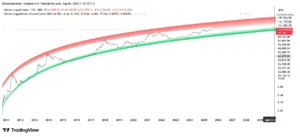
BTC/USDT Weekly Chart | Credit: Valdrin Tahiri/TradingView

He explains that since Bitcoin’s inception, its price has largely respected the parameters of a logarithmic growth curve, which has served as a reliable guide to its cyclical highs and lows.

“In every cycle, the price has reached the upper boundary of the curve, though it has yet to do that in the current cycle,” he said.

“Since the cycle might not be over, Bitcoin could reach it later in the year or in 2026.”

If historical trends continue, Tahiri notes, the curve offers a “structured envelope” of likely outcomes, where $1.3 million represents the extreme high end, and $250,000 remains a more statistically probable middle ground.

Bitcoin’s Future Role in Society

While debates over Bitcoin’s price dominate headlines, AI believes its long-term societal role may be less about speculation and more about invisible infrastructure.

ChatGPT’s Prediction

According to ChatGPT, the future of Bitcoin might not resemble the volatile and headline-grabbing asset it is today.

Instead, the AI said it could evolve into something far more subdued and essential.

“In the future, Bitcoin may not feel like a cryptocurrency at all — it’ll feel like a monetary constant, quietly underpinning financial systems the way GPS underpins logistics,” the AI model explained.

“You won’t notice it, but it’ll be there — clearing transactions, anchoring value, and offering sovereignty in a world that increasingly automates trust.”

Rather than replacing fiat currencies or dismantling the traditional banking system, ChatGPT suggests Bitcoin will find its place alongside them.

“It won’t replace fiat. It won’t destroy banks. But it will coexist — as a parallel financial rail for anyone who values neutrality over permission,” the model stated.

“Whether it’s held by nations, treasuries, or individuals, Bitcoin’s role will be less revolutionary, more infrastructural.”

In this vision of the future, Bitcoin becomes more of a default mechanism in the background of modern finance, ChatGPT said.

“And like the internet, it may fade into the background — not because it failed, but because it won,” ChatGPT added.

Grok’s Prediction

Grok painted a more colorful but conflicted picture of Bitcoin’s future.

“Picture this: Bitcoin could totally become the cool, rebellious hero of finance — a decentralized dream where people stash their wealth to dodge inflation’s sticky fingers.”

The xAI model likened Bitcoin’s potential to a new form of digital gold — one that appeals to both skeptics of central banks and high-risk investors hedging against fiat instability.

“With more folks waking up to fiat’s wobbles, BTC might just shine as a legit store of value, like digital gold with a swagger,” Grok explained.

But the optimism was tempered with a hefty dose of skepticism.

Despite its appeal, Grok doesn’t see Bitcoin replacing traditional money or payment systems anytime soon.

“It’s got a shot at being a niche player, but don’t hold your breath for it to replace your debit card,” it warned.

“A global currency? Pfft. Transaction fees are still a headache, and it’s slower than your grandma’s dial-up,” Grok quipped.

“Lightning Network’s got potential, but good luck getting mass adoption when most people can’t even spell ‘blockchain.’”

CCN’s Reality Check

Both ChatGPT and Grok offered visions for Bitcoin’s long-term role in the global financial system.

ChatGPT envisioned it as an invisible layer of monetary infrastructure, while Grok painted a more electric picture of Bitcoin as a defiant hedge against fiat instability.

Yet despite these imaginative outlooks, Bitcoin’s future as either a neutral financial backbone or a widely used currency faces substantial real-world obstacles.

At present, Bitcoin remains largely impractical for day-to-day commerce.

While its base layer was never optimized for high-frequency transactions, efforts to overcome this through second-layer solutions like the Lightning Network have so far struggled to achieve widespread adoption.

Also, the complexity of setting up wallets and other channels continues to limit the assets reach to the general non-tech savvy public.

The regulatory landscape is another source of uncertainty for Bitcoin.

While some jurisdictions have moved to integrate Bitcoin into formal financial frameworks, others have proposed outright bans.

Environmental concerns around Bitcoin’s energy consumption also need to be addressed.

As Bitcoin becomes more mainstream, more push back from climate activists and green-conscious governments are likely.

The History of Bitcoin $1 Million Predictions

The idea of Bitcoin reaching $1 million has been a long-discussed speculation by the community.

Many have dismissed it as a pure fantasy, but the value goal has also been embraced by many high-profile business leaders for years.

Wences Casares, CEO of bitcoin service provider Xapo, said on a panel at TechCrunch Disrupt 2015 that he believes $1 million is possible.

“I think that there is a higher than 50 percent chance that a bitcoin is worth more than a million dollars,” he said.

One of the most vocal proponents of a seven-figure Bitcoin is unsurprisingly Michael Saylor, co-founder and executive chairman of MicroStrategy.

Since converting his company’s treasury into a massive Bitcoin reserve starting in 2020, Saylor has repeatedly asserted that Bitcoin will reach and surpass the $1 million mark.

In June, Saylor pushed off threats of a looming bear market and instead made the bold bet of Bitcoin reaching seven figures.

“Winter is not coming back,” Saylor told Bloomberg . “We’re past that phase, if Bitcoin’s not going to zero, it’s going to $1 million.”

Cathie Wood, CEO of ARK Invest, has also backed the $1 million thesis.

In ARK’s annual Big Ideas reports, her team has projected that Bitcoin could surpass $1.5 million per coin by the end of the decade, assuming a bullish scenario of institutional adoption and global demand.

In February, Wood posted a video stating: “Many people know us for our [Bitcoin] bull case, $1.5 million.

“We actually think the odds have gone up that our bull case will be the right number, because of what is becoming the institutionalization of this new asset class.”


Was this Article helpful? Yes No

Trending Cryptos

Related Reads

The Most Secretive Winners of the AI Boom

"The Most Hidden AI Winners" An unlikely group of companies are emerging as major beneficiaries of the AI boom, not from designing chips, but from supplying critical materials and components essential for advanced semiconductor manufacturing. These 'hidden winners' are traditional manufacturers whose deep expertise in materials science has become indispensable. Japanese companies are leading this trend. Toto, globally known for bathroom fixtures, has seen its stock surge 145% over the past year, driven by its 40-year-old semiconductor ceramics business, which now contributes over half of its operating profit. Its electrostatic chucks are vital for advanced chip production and require years of expertise to manufacture. Similarly, Nittobo, a 128-year-old textile firm, controls 90% of the market for T-glass, a low-expansion glass fiber essential for AI chip substrates. Ajinomoto, the world's largest MSG producer, dominates the market (80-95% share) for ABF insulating film used in chip packaging. The core insight is that chasing "advanced" chips paradoxically increases reliance on traditional, high-precision material science where supply cannot be quickly replicated. These materials are now critical bottlenecks in the AI supply chain. This trend is mirrored in China's A股 market, framed by the theme of 'import substitution'. Companies like Zhongci Dianzi (electrostatic chucks) and Honghe Technology (ultra-thin electronic cloth) are making progress, but face the test of scaling production and matching Japanese rivals' quality. The key tension lies in the slow change of market perception. While profit structures rapidly shift towards high-margin tech components, these firms retain their traditional industry classifications, creating a valuation gap that is gradually closing as their roles in the AI ecosystem become undeniable.

链捕手1m ago

The Most Secretive Winners of the AI Boom

链捕手1m ago

DeFi Enters a Moment of Value Reassessment: Risks and Opportunities Behind the $70 Billion TVL

DeFi Enters a Moment of Value Reassessment: Peril and Opportunity Behind $70 Billion TVL On July 1st, the total value locked (TVL) across all DeFi protocols fell below $70 billion to approximately $69.358 billion, hitting its lowest point since February 2024. This decline signals a significant contraction in DeFi liquidity and marks a new adjustment phase for the industry, far from its 2021 peak of over $180 billion. The primary drivers of this TVL drop are a general decrease in crypto market risk appetite, which leads capital to exit volatile sectors like DeFi first, and the fading effectiveness of the high-yield liquidity incentive models that fueled the initial DeFi boom. Many protocols' high TVL figures were built on temporary subsidy-driven capital rather than genuine demand. Furthermore, capital is migrating to newer narratives like AI, RWA, and modular infrastructure. This cooldown exposes DeFi's growth bottlenecks: innovation has slowed with rampant protocol copycats, real yields have normalized to single digits, and poor user experience continues to hinder mass adoption beyond crypto-natives. However, the TVL decline does not spell the end for DeFi. The metric itself is limited, as it fluctuates with underlying asset prices. The industry is shifting from capital accumulation to efficiency competition, leveraging Layer 2 solutions and modular architecture to do more with less locked value. Crucially, DeFi is expanding into real-world financial use cases like the tokenization of real-world assets (RWA) and the growth of the stablecoin ecosystem, moving its value proposition from speculative token subsidies to real cash flows. In conclusion, while short-term pressures from liquidity contraction and user growth stagnation persist, the sector is undergoing a necessary value reassessment. DeFi is transitioning from a subsidy-driven, hype-based era toward a more mature, rational, and efficiency-focused phase, with long-term growth hinging on meeting real-world financial needs through RWA, stablecoins, and robust infrastructure.

marsbit21m ago

DeFi Enters a Moment of Value Reassessment: Risks and Opportunities Behind the $70 Billion TVL

marsbit21m ago

Trading

Spot

Hot Articles

What is $BITCOIN

DIGITAL GOLD ($BITCOIN): A Comprehensive Analysis Introduction to DIGITAL GOLD ($BITCOIN) DIGITAL GOLD ($BITCOIN) is a blockchain-based project operating on the Solana network, which aims to combine the characteristics of traditional precious metals with the innovation of decentralized technologies. While it shares a name with Bitcoin, often referred to as “digital gold” due to its perception as a store of value, DIGITAL GOLD is a separate token designed to create a unique ecosystem within the Web3 landscape. Its goal is to position itself as a viable alternative digital asset, although specifics regarding its applications and functionalities are still developing. What is DIGITAL GOLD ($BITCOIN)? DIGITAL GOLD ($BITCOIN) is a cryptocurrency token explicitly designed for use on the Solana blockchain. In contrast to Bitcoin, which provides a widely recognized value storage role, this token appears to focus on broader applications and characteristics. Notable aspects include: Blockchain Infrastructure: The token is built on the Solana blockchain, known for its capacity to handle high-speed and low-cost transactions. Supply Dynamics: DIGITAL GOLD has a maximum supply capped at 100 quadrillion tokens (100P $BITCOIN), although details regarding its circulating supply are currently undisclosed. Utility: While precise functionalities are not explicitly outlined, there are indications that the token could be utilized for various applications, potentially involving decentralized applications (dApps) or asset tokenization strategies. Who is the Creator of DIGITAL GOLD ($BITCOIN)? At present, the identity of the creators and development team behind DIGITAL GOLD ($BITCOIN) remains unknown. This situation is typical among many innovative projects within the blockchain space, particularly those aligning with decentralized finance and meme coin phenomena. While such anonymity may foster a community-driven culture, it intensifies concerns about governance and accountability. Who are the Investors of DIGITAL GOLD ($BITCOIN)? The available information indicates that DIGITAL GOLD ($BITCOIN) does not have any known institutional backers or prominent venture capital investments. The project seems to operate on a peer-to-peer model focused on community support and adoption rather than traditional funding routes. Its activity and liquidity are primarily situated on decentralized exchanges (DEXs), such as PumpSwap, rather than established centralized trading platforms, further highlighting its grassroots approach. How DIGITAL GOLD ($BITCOIN) Works The operational mechanics of DIGITAL GOLD ($BITCOIN) can be elaborated on based on its blockchain design and network attributes: Consensus Mechanism: By leveraging Solana’s unique proof-of-history (PoH) combined with a proof-of-stake (PoS) model, the project ensures efficient transaction validation contributing to the network's high performance. Tokenomics: While specific deflationary mechanisms have not been extensively detailed, the vast maximum token supply implies that it may cater to microtransactions or niche use cases that are still to be defined. Interoperability: There exists the potential for integration with Solana’s broader ecosystem, including various decentralized finance (DeFi) platforms. However, the details regarding specific integrations remain unspecified. Timeline of Key Events Here is a timeline that highlights significant milestones concerning DIGITAL GOLD ($BITCOIN): 2023: The initial deployment of the token occurs on the Solana blockchain, marked by its contract address. 2024: DIGITAL GOLD gains visibility as it becomes available for trading on decentralized exchanges like PumpSwap, allowing users to trade it against SOL. 2025: The project witnesses sporadic trading activity and potential interest in community-led engagements, although no noteworthy partnerships or technical advancements have been documented as of yet. Critical Analysis Strengths Scalability: The underlying Solana infrastructure supports high transaction volumes, which could enhance the utility of $BITCOIN in various transaction scenarios. Accessibility: The potential low trading price per token could attract retail investors, facilitating wider participation due to fractional ownership opportunities. Risks Lack of Transparency: The absence of publicly known backers, developers, or an audit process may yield skepticism regarding the project's sustainability and trustworthiness. Market Volatility: The trading activity is heavily reliant on speculative behavior, which can result in significant price volatility and uncertainty for investors. Conclusion DIGITAL GOLD ($BITCOIN) emerges as an intriguing yet ambiguous project within the rapidly evolving Solana ecosystem. While it attempts to leverage the “digital gold” narrative, its departure from Bitcoin's established role as a store of value underscores the need for a clearer differentiation of its intended utility and governance structure. Future acceptance and adoption will likely depend on addressing the current opacity and defining its operational and economic strategies more explicitly. Note: This report encompasses synthesised information available as of October 2023, and developments may have transpired beyond the research period.

552 Total ViewsPublished 2025.05.13Updated 2025.05.13

What is $BITCOIN

Discussions

Welcome to the HTX Community. Here, you can stay informed about the latest platform developments and gain access to professional market insights. Users' opinions on the price of BTC (BTC) are presented below.

活动图片