Author: Flora, CryptoPulse Labs
On July 1, according to DeFiLlama data, the total value locked (TVL) in DeFi across all networks has fallen below $70 billion. Currently at approximately $69.358 billion, it has hit a new low since February 2024, a figure that quickly drew market attention.
As a crucial indicator measuring the activity level of the decentralized finance ecosystem, changes in TVL not only reflect on-chain capital flow but also, to some extent, mirror market sentiment and industry cycles.
Compared to its peak size of over $180 billion during 2021, the current DeFi market is clearly entering a new adjustment phase. Does TVL breaking through this key level signify that DeFi is entering a downturn cycle, or is the industry undergoing a new round of reshuffling and restructuring?
I. TVL Falls Below $70 Billion: Why is DeFi Liquidity Continuously Shrinking?
TVL, or Total Value Locked, has long been regarded as a core metric for gauging the health of the DeFi ecosystem. It represents the total value of assets users have locked in protocols such as lending, DEXs, derivatives, and yield aggregators.
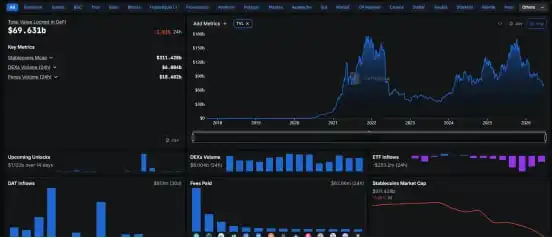
Therefore, an increase in TVL typically signals capital inflow and market activity, while a decrease indicates capital withdrawal and liquidity contraction. The recent drop of the entire network's TVL below $70 billion essentially reflects the continuous shrinkage of overall DeFi liquidity.
The primary reason for this phenomenon is the decline in overall risk appetite across the crypto market. When core assets like Bitcoin and Ethereum enter phases of consolidation or even correction, risk capital in the market often withdraws first from highly volatile sectors.
DeFi, being a field highly dependent on market sentiment, naturally bears the brunt. Users become less frequent in conducting leveraged trading, lending, and liquidity mining operations, leading to a subsequent decrease in on-chain capital activity.
Simultaneously, the liquidity incentive model that DeFi heavily relied on in recent years is losing its effectiveness. During the DeFi Summer period from 2020 to 2021, numerous protocols attracted massive capital inflows through high token subsidies, with APYs often reaching tens or even hundreds of percent, leading to rapid capital accumulation.
However, this growth model was essentially subsidy-driven rather than real demand-driven. Once incentives weakened, capital quickly exited. The market is now becoming increasingly aware that the high TVL of many protocols does not represent real value but is more a result of short-term arbitrage capital accumulation.
Additionally, the migration of capital towards other popular narratives is also a significant factor. Over the past two years, market focus has gradually shifted from DeFi to new sectors such as AI, RWA, stablecoin payments, and modular infrastructure.
Capital naturally chases higher growth expectations. When new narratives continuously attract attention, the appeal for capital in the traditional DeFi sector weakens. In other words, the decline in TVL does not merely signify capital leaving the chain; it also indicates that the market is reallocating capital.
II. Behind the DeFi Cooling: The Industry is Facing Growth Bottlenecks
Looking back at the development history of DeFi, it was once one of the most revolutionary innovative directions in the entire crypto industry. Protocols represented by Uniswap, Aave, and MakerDAO successfully reconstructed mechanisms for trading, lending, and stablecoin issuance found in traditional finance, allowing users to perform complex financial operations without banks or brokers.

This concept of permissionless finance was once considered one of the core application scenarios of blockchain.
However, after several market cycles (bull and bear), the growth bottlenecks of DeFi have become increasingly apparent. First, the pace of innovation has significantly slowed down. In the early DeFi ecosystem, there was clear differentiation between protocols—some focused on trading, some on lending, and some explored synthetic assets. But now, many new projects are merely copies or slight tweaks of old models.
New AMMs, new lending protocols, and new yield farms emerge endlessly but rarely bring about real structural innovation. Intensified homogeneous competition leads to reduced willingness among users to migrate.
Secondly, the substantial decline in yields has weakened the appeal of DeFi. Many of the high yields common in 2021 came from token inflation and market bubbles. As the market matures, real yields are gradually returning to rationality.
Currently, returns for stablecoin lending, market making, and basic yield products have generally dropped to single-digit percentages. For average users, when DeFi yields gradually approach those of traditional financial products, its complex operations and smart contract risks become disadvantages.
A deeper issue lies in the stagnation of user growth. Despite years of development, DeFi still struggles to break out of the crypto-native user circle. For the average user, concepts like wallet management, gas fees, cross-chain bridges, private key security, and liquidation risks remain significant barriers.
Compared to using traditional payment systems like PayPal or Visa, the user experience in DeFi is still relatively complex. Technological advancement does not equate to product ease of use. This user experience bottleneck prevents DeFi from achieving truly large-scale adoption.
III. TVL Decline Does Not Mean the End: DeFi May Be Moving Towards a New Stage
Although TVL has dropped to a phase low, this does not signify the end of DeFi. In fact, viewing TVL as the sole metric itself has limitations.
Since TVL is usually denominated in USD, price fluctuations of crypto assets directly affect its numerical value. Even if the amount of user lock-up remains unchanged, TVL can shrink significantly simply because the price of assets like Ethereum falls. Therefore, a decline in TVL does not entirely equate to real capital outflow.
More importantly, the industry is shifting from capital accumulation to efficiency competition. With the continuous maturation of Layer 2, modular architecture, intent-driven trading, and cross-chain liquidity solutions, future DeFi protocols may no longer need massive TVL to support their business scale.
Improvements in capital efficiency mean that less locked capital can create higher trading volumes and better user experiences. This will change the market's past singular reliance on TVL.
Simultaneously, DeFi is also extending into more real-world financial scenarios. One of the most watched directions is RWA, or Real World Asset tokenization. Through tokenization, traditional assets like US Treasury bonds, funds, real estate, and private credit are gradually entering the on-chain financial system.
This means the source of DeFi's yield is beginning to shift from "token subsidies" to real cash flows, providing a more solid value foundation.
On the other hand, the rapid expansion of the stablecoin ecosystem is also propelling DeFi into a new stage. USD Coin issued by Circle and Tether issued by Tether have gradually become the core liquidity foundation of on-chain finance.
From a longer-cycle perspective, the core future competition in DeFi might no longer be "whose APY is higher," but rather "who can provide more stable, secure, and efficient financial services." Protocols that can truly weather cycles often possess four characteristics: real revenue, strong user stickiness, high capital efficiency, and robust security.
A TVL of $70 billion might seem like a low point, but it more closely resembles a watershed moment after the industry bubble has cleared. DeFi is bidding farewell to the old era reliant on subsidies and speculation and moving towards a new, more rational and mature stage. The next industry explosion might no longer be about financial speculation, but rather about who gets closer to real-world financial needs.
Conclusion
The decline of DeFi's total value locked below $70 billion, on the surface, signals a cooling market, but behind it reflects that the industry is undergoing a profound value reassessment. From the wild growth driven by liquidity mining to today's return of capital to rationality and accelerated market clearing, DeFi is leaving behind the old narrative built on high-yield myths.
In the short term, liquidity contraction, slowing user growth, and intensified sector competition will continue to put considerable pressure on the industry. However, from a long-term perspective, the continuous evolution of RWA, stablecoin payments, and on-chain financial infrastructure also opens up new growth space for DeFi.