33 Major Banks Invest $100M+ in Blockchain Deals & Uplift Bitcoin Hyper

bitcoinistPublished on 2025-08-04Last updated on 2025-08-04

Abstract

A new report by Ripple, CB Insights, and the UK Centre of Blockchain Technologies reveals that the blockchain is no...

Trusted Editorial content, reviewed by leading industry experts and seasoned editors. Ad Disclosure

A new report by Ripple, CB Insights, and the UK Centre of Blockchain Technologies reveals that the blockchain is no longer just for the crypto bros – global banking giants are among its most active investors.

Titled ‘Banking on Digital Assets: How Traditional Finance is Investing in Blockchain’, the report found that between 2020 and 2024, over $100B was invested in blockchain firms across over 10K deals.

Of those, 345 investments included major banks, with 33 of those contributions topping $100M. Citigroup, JP Morgan Chase, Goldman Sachs, and Japan’s SBI Group were among the biggest spenders.

Interestingly, tokenization emerged as a core focus of their strategies.

This underscores how committed TradFi giants are to expanding investor access through Web3 tech, plus how vital the Bitcoin Hyper ($HYPER) Layer 2 solution could become in supporting that infrastructure.

90% of Banking Giants Have High Hopes for Blockchain Tech

According to the report, ‘90% of global finance leaders believe blockchain and digital assets will have a significant or massive impact on finance.’

The reason is that blockchain technology can streamline transactions, slash costs, and enable global access around the clock.

Among the 33 banks investing over $100M, the research found that the highest investments came from institutions based in the US and Japan, followed by Singapore, France, and the UK.

Of the ‘mega-round’ deals, the Web3 use cases that stood out among TradFi firms included institutional infrastructure for trading, staking, and tokenization. Together, they accounted for 27% of deals.

The Boston Consulting Group, in partnership with Ripple, now estimates tokenized assets will surpass $18T by 2033.

This growing appeal comes from the fact that tokenization enables investors to purchase small portions of traditionally high-cost assets, like real estate or bonds. This helps open up investment opportunities to more participants.

So, it’s no surprise that major banks are already investing heavily in this space. For instance, JPMorgan’s Kinexys platform enables tokenized US Treasury transactions.

Meanwhile HSBC has launched a tokenized gold product for both institutional and retail investors.

Also signaling a rosy future for the industry is that the SEC Chairman, Paul Atkins, plans to boost tokenization in the US through ‘Project Crypto,’ his latest crypto initiative.

He recently announced that Commission staff will take active steps to remove regulatory roadblocks and work with firms looking to tokenize stocks, bonds, and other securities.

Project Crypto on tokenized assets.
Source: Project Crypto (American Leadership in the Digital Finance Revolution)

Of course, it’s also great news for Bitcoin Hyper ($HYPER), an upcoming Layer-2 with a bridge to Bitcoin.

Bitcoin Hyper Has the Tools to Power Tokenized Economies

Bitcoin Hyper ($HYPER) is designed for super-fast, secure, and scalable $BTC transactions.

It also includes the foundational tools needed to power future tokenized economies, like smart contracts, DeFi, and the ability to mint wrapped crypto assets cross-chain.

To achieve this, the project leverages the Solana Virtual Machine (SVM), which helps bring Solana-style smart contract capabilities to the Bitcoin ecosystem.
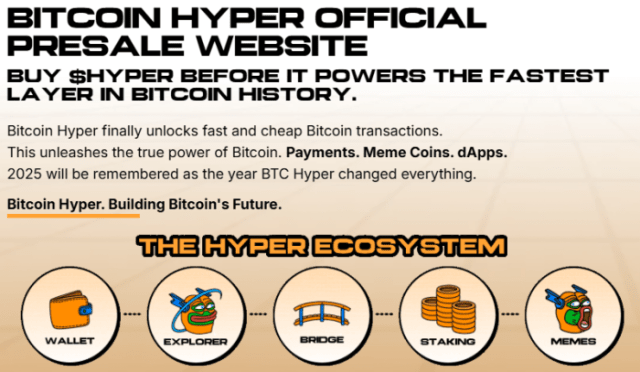
Bitcoin Hyper ecosystem benefits.
Source: Bitcoin Hyper

Here’s how it works:

  • Bitcoin Hyper uses a Canonical Bridge to monitor $BTC deposits.
  • Once a transaction is verified through an SVM smart contract, it mints an equivalent wrapped $BTC on the Layer 2.
  • That $BTC can then be used across DeFi protocols, like dApps that power tokenized asset transactions.
  • When you want to withdraw your Bitcoin, the bridge validates the Layer 2 activity and frees your $BTC from the deposit address on the Bitcoin Layer 1.

To preserve Bitcoin’s base layer security while scaling activity off-chain, transactions are batched and verified using Zero-Knowledge (ZK) Proofs. This ensures fast, trustless execution with minimal on-chain footprint.

If you hold $HYPER, the project’s native token, you can also enjoy lower gas fees, governance rights, and staking rewards at a 156% APY.

$HYPER has already raised $6.8M+, backed by individual whale investments like $54.1K and $53.9K back in June. And these were the investors that got in early, before the presale price hit $0.012525.

Given that its mainnet launch could propel the $HYPER token to $0.32, now’s a great time to join for gains possibly exceeding 2,455%.

As interest in Bitcoin Hyper’s Layer 2 solution continues to grow, so too does the presale.

It’s attracting early supporters eager to capitalize and utilize its high-speed infrastructure, real-world utility, and tokenized future.

Join $HYPER Presale to Unlock the Project’s Full Potential

As traditional banks invest more into the blockchain and the SEC makes moves to make its crypto policy less stringent, a new era of tokenized finance is quickly falling into place.

It appears that Bitcoin Hyper is launching at a peak time. With its SVM-powered execution layer, trustless bridging, and real-world utility across DeFi, it has the potential to support future tokenized assets in a permissionless, public ecoystem.

You can unlock the L2’s full potential by purchasing $HYPER on presale today.

This isn’t investment advice. DYOR and put in more than you’re willing to lose.

Editorial Process for bitcoinist is centered on delivering thoroughly researched, accurate, and unbiased content. We uphold strict sourcing standards, and each page undergoes diligent review by our team of top technology experts and seasoned editors. This process ensures the integrity, relevance, and value of our content for our readers.

Leah is a British journalist with a BA in Journalism, Media, and Communications and nearly a decade of content writing experience. Over the last four years, her focus has primarily been on Web3 technologies, driven by her genuine enthusiasm for decentralization and the latest technological advancements. She has contributed to leading crypto and NFT publications – Cointelegraph, Coinbound, Crypto News, NFT Plazas, Bitcolumnist, Techreport, and NFT Lately – which has elevated her to a senior role in crypto journalism. Whether crafting breaking news or in-depth reviews, she strives to engage her readers with the latest insights and information. Her articles often span the hottest cryptos, exchanges, and evolving regulations. As part of her ploy to attract crypto newbies into Web3, she explains even the most complex topics in an easily understandable and engaging way. Further underscoring her dynamic journalism background, she has written for various sectors, including software testing (TEST Magazine), travel (Travel Off Path), and music (Mixmag). When she's not deep into a crypto rabbit hole, she's probably island-hopping (with the Galapagos and Hainan being her go-to's). Or perhaps sketching chalk pencil drawings while listening to the Pixies, her all-time favorite band.

Trending Cryptos

Related Reads

When US Giants Collectively "Defect" to Chinese AI Models

When Silicon Valley Giants Turn to Chinese AI Models to Cut Costs A surprising trend is emerging: major U.S. tech companies are significantly reducing AI costs by switching to Chinese models. Coinbase, the largest U.S. cryptocurrency exchange, reportedly halved its AI spending after migrating to China's GLM-5.2 and Kimi 2.7 models, despite increasing usage. They achieved this through a sophisticated three-part strategy: implementing an automatic routing system to select the most cost-effective model per task, boosting cache hit rates from 5% to 60% to reuse computations, and employing "context engineering" to provide AI with more precise, less cluttered information. They are not alone. AI startup Lindy switched from Claude to DeepSeek, saving millions, while Snowflake's tests found GLM-5.2 solved 66% of coding tasks compared to Claude Opus's 67%—but at a fraction of the cost (output pricing is 5-7 times lower). While the top Western models may offer slightly better stability, the massive price differential is leading many businesses to reconsider their value proposition. This shift signals a deeper change in the AI industry, moving beyond pure performance benchmarks to a fierce cost competition. As pressure mounts, even OpenAI and Anthropic have begun slashing prices. For users, this means more choices, lower costs, and a crucial lesson: using multiple models based on task complexity, optimizing with caching, and keeping contexts lean are now key to leveraging AI efficiently and affordably.

marsbit7m ago

When US Giants Collectively "Defect" to Chinese AI Models

marsbit7m ago

BIS Report Compliance Watch: The Real Risks of Stablecoins Are Not Just 'De-pegging'

BIS Report Compliance Observations: The real risks of stablecoins go beyond "depegging" The BIS report "Anchoring trust in money: innovation beyond stablecoins" argues that while stablecoins and tokenization offer efficiency gains, their primary risk lies in fitting into an identifiable, monitorable, accountable, and regulatable financial system. Money's trust stems not just from technology but from institutional arrangements: a common unit of account, guaranteed redemption at par, liquidity support, regulatory frameworks, and financial integrity requirements. Stablecoins, operating on permissionless blockchains with pseudo-anonymity and non-custodial wallets, create systemic compliance gaps: unclear customer identity, incomplete fund origins, unexplained transaction purposes, fragmented cross-chain paths, and ambiguous liability. On-chain transparency does not equal compliance transparency. Public addresses don't reveal identity or intent. While blockchain analytics aid law enforcement, they cannot replace routine, large-scale AML/CFT controls. Effective compliance requires a closed-loop process encompassing customer onboarding, transaction monitoring, investigation, reporting, and audit. Stablecoin risks are not confined to the blockchain; they re-enter the traditional financial system via on/off-ramps, exchanges, and payment institutions. This forces banks to monitor client accounts for activity linked to virtual assets. The future direction is not to prohibit innovation but to embed rules into the technology. Tokenized finance should integrate with the existing two-tier monetary system, embedding compliance—like customer identification, pre-transaction screening, and auditable data trails—directly into the transaction flow. For compliance professionals, the key takeaway is that any new financial instrument must answer core questions: Who identifies the customer? Who monitors transactions? Who handles exceptions? Who is liable? Compliance is not the antithesis of innovation but the essential infrastructure for its sustainable growth.

链捕手8m ago

BIS Report Compliance Watch: The Real Risks of Stablecoins Are Not Just 'De-pegging'

链捕手8m ago

When American Giants 'Defect' to Chinese AI Models

Summary: The trend of major U.S. technology firms adopting more cost-effective Chinese AI models is gaining momentum. A prime example is Coinbase, the largest U.S. cryptocurrency exchange, which reportedly halved its AI expenditure by switching to Chinese models GLM-5.2 and Kimi 2.7, while its usage volume increased. This was achieved through a sophisticated cost-saving system featuring intelligent model routing (selecting the most suitable model per task), dramatically improving cache hit rates from 5% to 60%, and implementing "Context Engineering" to streamline prompts. This shift is not isolated. Other companies like the AI startup Lindy and data cloud firm Snowflake are making similar moves, drawn by the significant price disparity. For instance, GLM-5.2 costs $1.40/$4.40 per million tokens (input/output), compared to $5/$25 for Claude Opus 4.7. While top Western models may offer slightly higher stability or speed in complex tasks, the performance gap is narrowing, making the price difference harder to justify for many enterprise use cases. The implications are significant for both businesses and individual users. It highlights the importance of a multi-model strategy based on task requirements, the value of caching and reusing outputs, and the effectiveness of providing concise context. Ultimately, this migration signals a potential reshaping of the AI industry's pricing model, moving competition from pure performance benchmarks to practical cost-effectiveness, with increased choice and downward price pressure benefiting end-users.

链捕手14m ago

When American Giants 'Defect' to Chinese AI Models

链捕手14m ago

Trading

Spot

Hot Articles

What is $BITCOIN

DIGITAL GOLD ($BITCOIN): A Comprehensive Analysis Introduction to DIGITAL GOLD ($BITCOIN) DIGITAL GOLD ($BITCOIN) is a blockchain-based project operating on the Solana network, which aims to combine the characteristics of traditional precious metals with the innovation of decentralized technologies. While it shares a name with Bitcoin, often referred to as “digital gold” due to its perception as a store of value, DIGITAL GOLD is a separate token designed to create a unique ecosystem within the Web3 landscape. Its goal is to position itself as a viable alternative digital asset, although specifics regarding its applications and functionalities are still developing. What is DIGITAL GOLD ($BITCOIN)? DIGITAL GOLD ($BITCOIN) is a cryptocurrency token explicitly designed for use on the Solana blockchain. In contrast to Bitcoin, which provides a widely recognized value storage role, this token appears to focus on broader applications and characteristics. Notable aspects include: Blockchain Infrastructure: The token is built on the Solana blockchain, known for its capacity to handle high-speed and low-cost transactions. Supply Dynamics: DIGITAL GOLD has a maximum supply capped at 100 quadrillion tokens (100P $BITCOIN), although details regarding its circulating supply are currently undisclosed. Utility: While precise functionalities are not explicitly outlined, there are indications that the token could be utilized for various applications, potentially involving decentralized applications (dApps) or asset tokenization strategies. Who is the Creator of DIGITAL GOLD ($BITCOIN)? At present, the identity of the creators and development team behind DIGITAL GOLD ($BITCOIN) remains unknown. This situation is typical among many innovative projects within the blockchain space, particularly those aligning with decentralized finance and meme coin phenomena. While such anonymity may foster a community-driven culture, it intensifies concerns about governance and accountability. Who are the Investors of DIGITAL GOLD ($BITCOIN)? The available information indicates that DIGITAL GOLD ($BITCOIN) does not have any known institutional backers or prominent venture capital investments. The project seems to operate on a peer-to-peer model focused on community support and adoption rather than traditional funding routes. Its activity and liquidity are primarily situated on decentralized exchanges (DEXs), such as PumpSwap, rather than established centralized trading platforms, further highlighting its grassroots approach. How DIGITAL GOLD ($BITCOIN) Works The operational mechanics of DIGITAL GOLD ($BITCOIN) can be elaborated on based on its blockchain design and network attributes: Consensus Mechanism: By leveraging Solana’s unique proof-of-history (PoH) combined with a proof-of-stake (PoS) model, the project ensures efficient transaction validation contributing to the network's high performance. Tokenomics: While specific deflationary mechanisms have not been extensively detailed, the vast maximum token supply implies that it may cater to microtransactions or niche use cases that are still to be defined. Interoperability: There exists the potential for integration with Solana’s broader ecosystem, including various decentralized finance (DeFi) platforms. However, the details regarding specific integrations remain unspecified. Timeline of Key Events Here is a timeline that highlights significant milestones concerning DIGITAL GOLD ($BITCOIN): 2023: The initial deployment of the token occurs on the Solana blockchain, marked by its contract address. 2024: DIGITAL GOLD gains visibility as it becomes available for trading on decentralized exchanges like PumpSwap, allowing users to trade it against SOL. 2025: The project witnesses sporadic trading activity and potential interest in community-led engagements, although no noteworthy partnerships or technical advancements have been documented as of yet. Critical Analysis Strengths Scalability: The underlying Solana infrastructure supports high transaction volumes, which could enhance the utility of $BITCOIN in various transaction scenarios. Accessibility: The potential low trading price per token could attract retail investors, facilitating wider participation due to fractional ownership opportunities. Risks Lack of Transparency: The absence of publicly known backers, developers, or an audit process may yield skepticism regarding the project's sustainability and trustworthiness. Market Volatility: The trading activity is heavily reliant on speculative behavior, which can result in significant price volatility and uncertainty for investors. Conclusion DIGITAL GOLD ($BITCOIN) emerges as an intriguing yet ambiguous project within the rapidly evolving Solana ecosystem. While it attempts to leverage the “digital gold” narrative, its departure from Bitcoin's established role as a store of value underscores the need for a clearer differentiation of its intended utility and governance structure. Future acceptance and adoption will likely depend on addressing the current opacity and defining its operational and economic strategies more explicitly. Note: This report encompasses synthesised information available as of October 2023, and developments may have transpired beyond the research period.

575 Total ViewsPublished 2025.05.13Updated 2025.05.13

What is $BITCOIN

Discussions

Welcome to the HTX Community. Here, you can stay informed about the latest platform developments and gain access to professional market insights. Users' opinions on the price of BTC (BTC) are presented below.

活动图片