Прогноз цены биткоина (BTC) на 30 июля

cryptonews.ruPublished on 2025-07-14Last updated on 2025-07-29

После уверенного восстановления в июле, сегодня цена биткоина консолидируется ниже критической отметки в $120 000, торгуясь вблизи $118 800 на момент публикации. Эта ценовая область стала ключевой зоной перегиба, при этом сжатие волатильности усиливается на младших таймфреймах. Сейчас рынок ожидает подтверждения прорыва на фоне слабого импульса и сужающихся полос Боллинджера.

Что происходит с ценой биткоина?
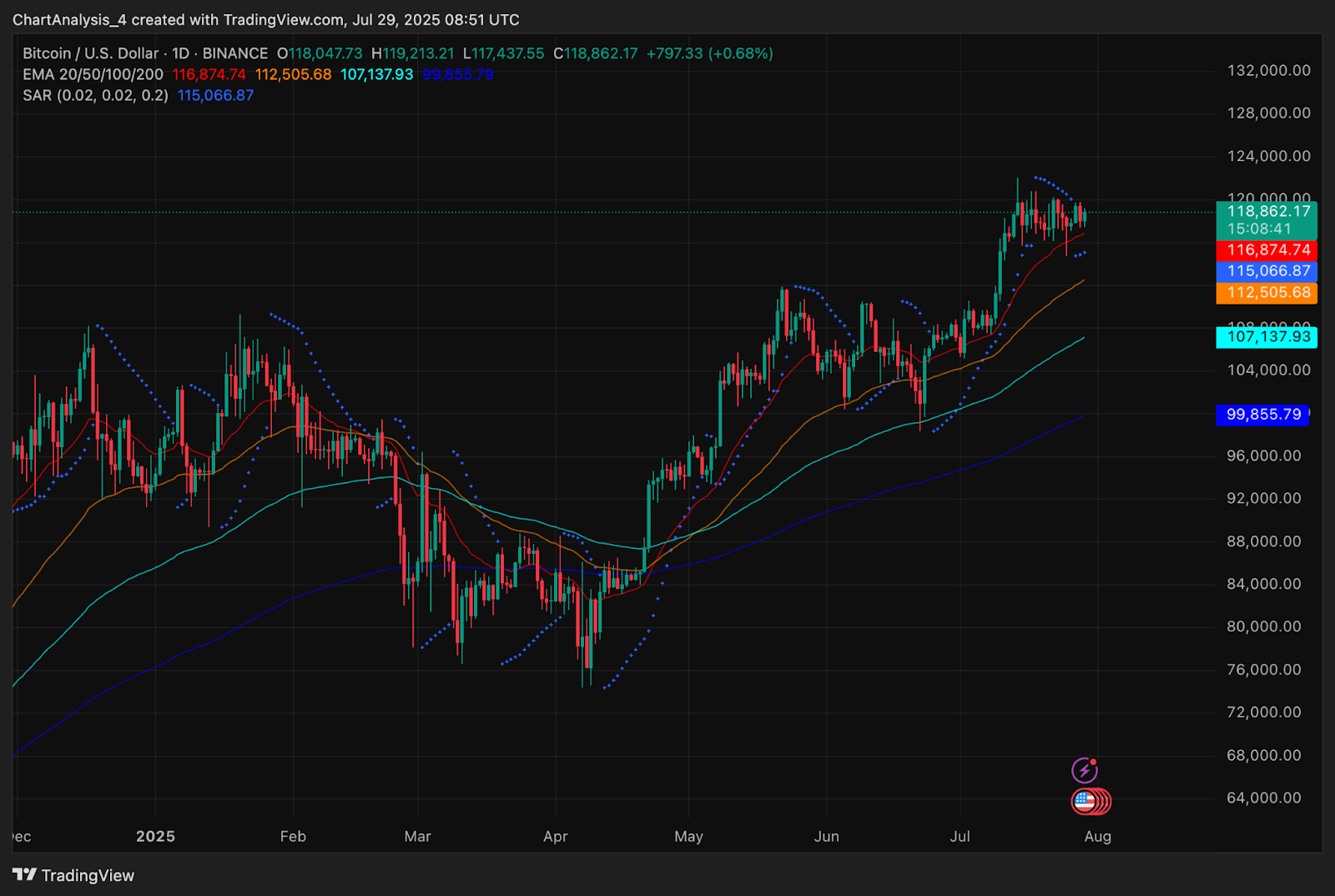
Динамика цены BTC (Источник: TradingView)

Биткоин по-прежнему находится в тесной консолидации чуть ниже зоны предложения $120 000. На дневном графике точки Parabolic SAR остаются выше цены, что указывает на застопорившиеся попытки роста с 26 июля. Цена продолжает удерживаться выше 20-дневной экспоненциальной скользящей средней (EMA) на уровне $116 874 и 50-дневной экспоненциальной скользящей средней (EMA) на уровне $112 505, что указывает на то, что общая структура по-прежнему благоприятствует быкам.
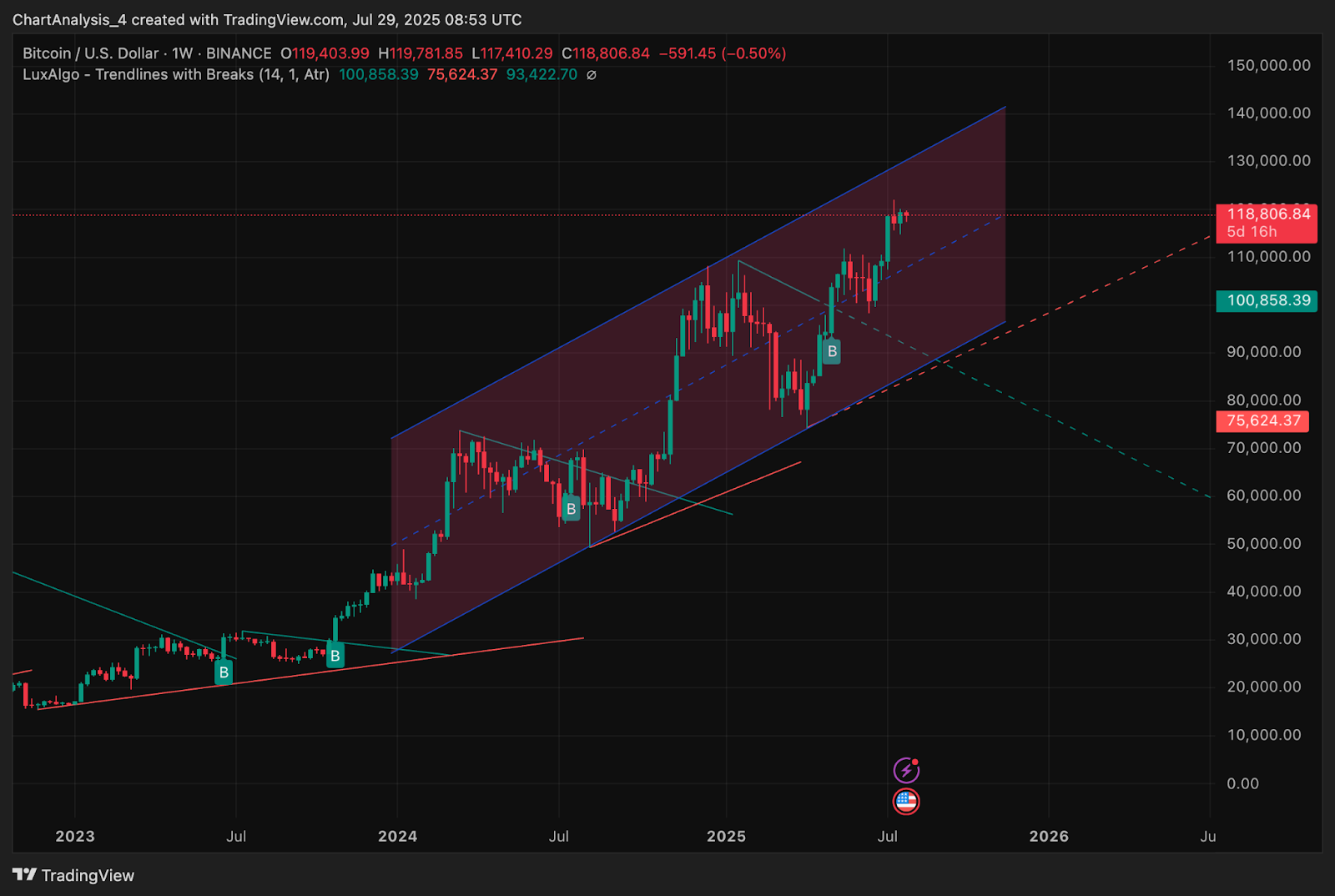
Динамика цены BTC (Источник: TradingView)

На недельном графике BTC уверенно находится в восходящем параллельном канале, начинающемся с середины 2023 года. В настоящее время цена тестирует верхнюю границу этого канала в районе $119 000, уровня, который неоднократно ограничивал предыдущие ралли. Устойчивый отскок от этого уровня может спровоцировать коррекцию, а подтверждённый прорыв, вероятно, нацелит курс на диапазон $125 000–$130 000 в ближайшие сессии.

Почему цена биткоина сегодня падает?
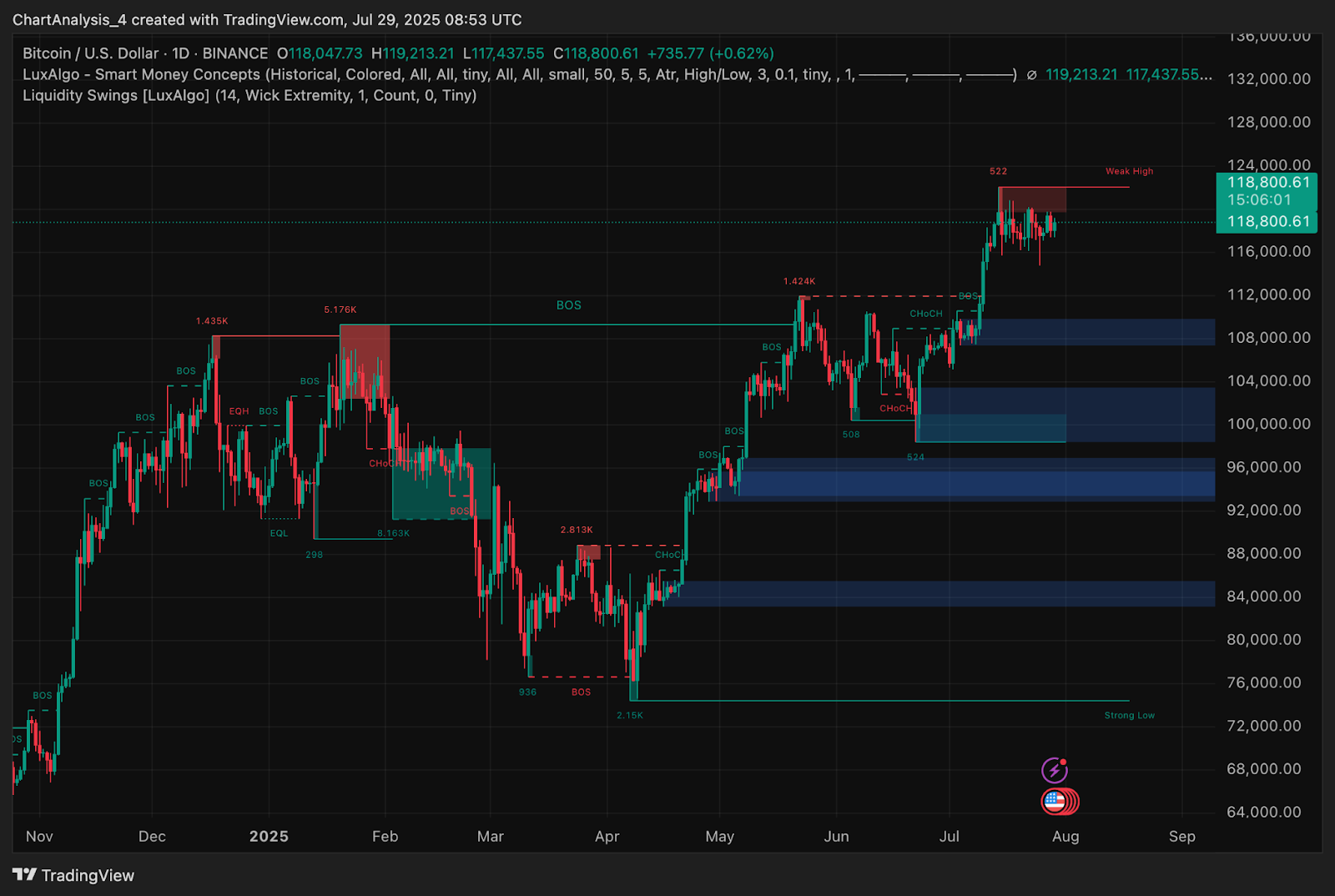
Динамика цены BTC (Источник: TradingView)

Причина падения цены биткоина сегодня связана с отторжением от зоны ликвидности «слабого максимума» Smart Money. На дневном графике BTC не смог закрыться выше $119 200 в течение пяти сессий подряд, формируя последовательные более низкие максимумы, находясь внутри видимого блока предложения. Это совпадает с красным уровнем супертренда на $119 792, который продолжает выступать в качестве динамического внутридневного сопротивления.
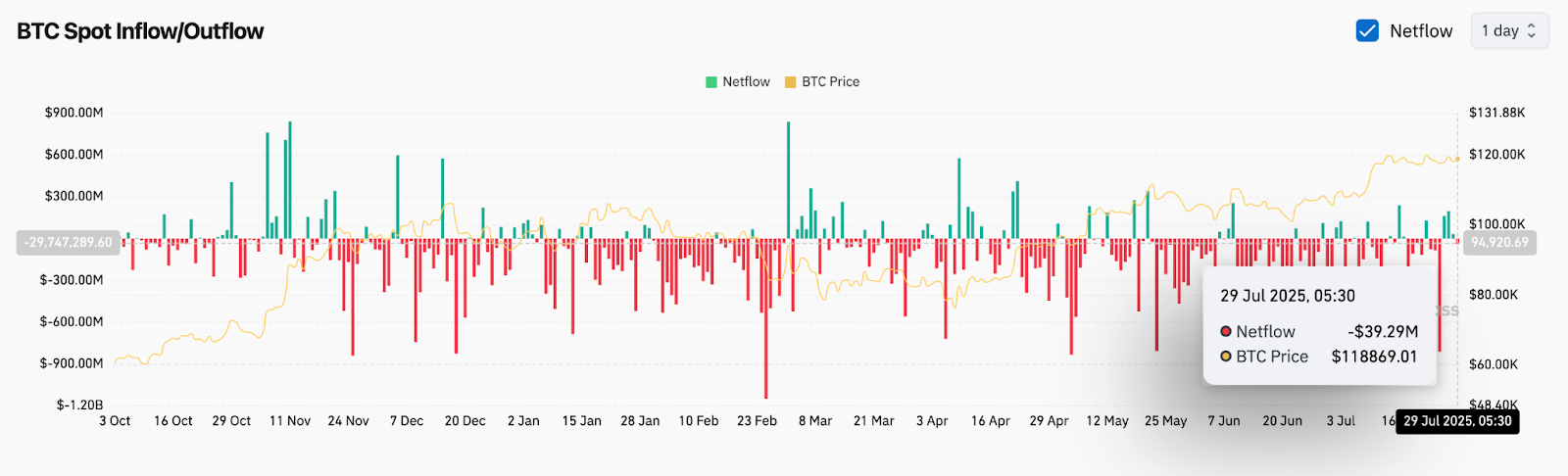
Данные о чистом потоке BTC (Источник: Coinglass)

Кроме того, чистый отток средств спот-биржами демонстрирует стабильный отток средств между биржами: по состоянию на 29 июля чистые потери BTC с торговых площадок составили $39,29 млн. Это сигнализирует об осторожном накоплении или выводе средств, снижая краткосрочное давление продаж, но также указывает на отсутствие агрессивного спроса на приток средств на текущих максимумах.

Индекс относительной силы (RSI) опустился до 64,08 по сравнению с предыдущими значениями перекупленности, что свидетельствует о консолидации, а не о полном развороте. MACD по-прежнему положительный, но столбцы гистограммы сужаются на 4-часовом графике, указывая на истощение импульса.

Индикаторы BTC сигнализируют о боковом тренде перед прорывом


Динамика цены BTC (Источник: TradingView)

Полосы Боллинджера на дневном таймфрейме начали сжиматься, и теперь диапазон сужается между $115 800 и $120 300. Исторически такие фазы сжатия предшествуют значительным направленным движениям. Поскольку цена колеблется вблизи верхней полосы, но не может закрыться выше неё, трейдеры ожидают скорого роста волатильности.


Динамика цены BTC (Источник: TradingView)

Индекс направленного движения (DMI) демонстрирует потерю явной силы тренда. +DI и -DI сужаются, а ADX ниже 20, что указывает на нерешительность контроля над направлением движения. Тем временем, супертренд на 4-часовом графике остаётся медвежьим, если цена не закроется уверенно выше $119 792.

На графике Smart Money Concepts отмечена формация CHoCH в районе $118 200 и недавний прорыв структуры (BOS) на уровне $117 000. Пока BTC удерживается выше зоны $116 000–$117 000, бычья структура сохраняется, но отсутствие возможности отыграть $120 000 сведет на нет надежды на прорыв.

Прогноз цены BTC: краткосрочный прогноз (24H)

Краткосрочная структура цены биткоина остаётся нейтральной или бычьей: для подтверждения прорыва быкам необходимо дневное закрытие выше $120 000. В случае успеха следующее сопротивление находится на $122 500 и $125 000. Однако повторный отскок от диапазона $119 200–$120 000 может открыть путь к снижению до $116 800 (EMA20) и, возможно, до $115 000 (Parabolic SAR и средняя линия BB).

Ключом к подтверждению станет внутридневной объем и то, сможет ли BTC пробить клин сжатия, сформировавшийся с 24 июля. Прорыв вниз отметки $116 000 сменит краткосрочный медвежий настрой и может обнажить кластер поддержки $112 500–$113 000, совмещенный с 50-дневной EMA.

Таблица прогноза цены биткоина: 30 июля 2025 г.

Индикатор/Зона Уровень/Сигнал
Цена биткойна сегодня $118,800
Сопротивление 1 119 792 долларов США (Supertrend)
Сопротивление 2 $122,500
Поддержка 1 $116,874 (EMA20)
Поддержка 2 115 066 долларов США (параболический саудовский реал)
Ширина полос Боллинджера (дневная) Плотный (приближается прорыв волатильности)
RSI (ежедневный) 64.08 (нейтрально-бычий)
Гистограмма MACD (4H) Угасающий бычий настрой
Чистый поток -39,29 млн долларов США (отток)
Умные деньги CHoCH 118 200 долларов США (уровень возврата)
DMI (14) Слабый тренд, ADX ~16,9
Верхняя граница недельного канала 119 500 долларов США (триггер прорыва)

Trending Cryptos

Related Reads

The Philadelphia Semiconductor Index Tumbles Nearly 5% in a Single Night, Optical and Memory Sectors 'Collapse' Together: Surging U.S. Bond Yields Shake AI Belief

On the evening of August 18th, the US stock market saw a sharp sell-off concentrated in the AI hardware sector, with the Philadelphia Semiconductor Index plummeting nearly 5%. Leading AI infrastructure and components companies in fields like optical communication and memory chips experienced some of the steepest declines, such as Fabrinet (-19.38%) and Kioxia ADR (-13%). The sell-off was not broad-based but rather targeted the long-duration, high-momentum stocks previously driven by AI narrative optimism. This market shift is primarily attributed to a significant surge in long-term US Treasury yields, with the 30-year yield hitting its highest level since 2007. Rising yields increase discount rates, disproportionately impacting the valuations of growth stocks whose profits are projected far into the future—a category that includes most AI hardware plays. Additional pressure came from climbing oil prices due to Middle East tensions, which fueled inflation concerns. The article identifies three structural reasons for the severity of the drop in these specific subsectors: excessive prior gains and crowded positioning, high sensitivity to the sustainability of AI capital expenditure narratives, and inherent high volatility within the supply chain. Importantly, the sell-off appears to be a valuation and positioning reset rather than a fundamental repudiation of AI, evidenced by the relatively modest decline in a bellwether like Nvidia (-2.34%). Looking ahead, the direction hinges on three key indicators: whether the 30-year Treasury yield stabilizes, the trajectory of oil prices and geopolitical risks, and the market's pricing of new AI-related corporate debt. For related Asian and A-share markets, short-term negative sentiment spillover is expected, but medium-term drivers like domestic cloud capex may provide divergence. The episode signifies a market transition from pricing AI's "story" to rigorously evaluating its returns against a backdrop of higher financing costs.

marsbit3m ago

The Philadelphia Semiconductor Index Tumbles Nearly 5% in a Single Night, Optical and Memory Sectors 'Collapse' Together: Surging U.S. Bond Yields Shake AI Belief

marsbit3m ago

Ten Years, Wang Xingxing's Comeback: Unitree Valued at 400 Billion

Over a decade ago, Wang Xingxing, a 29-year-old with a passion for robotics but little funding, demonstrated his struggling robot dog to investors in Hangzhou. In 2019, with his company Unitree nearly out of cash, he captured the attention of Sequoia Capital China's managing director Li Yannan. Despite initial skepticism about the niche market for robot dogs, Wang's vision and deep technical conviction led Sequoia to make an initial seed investment. This marked a turning point. Following Sequoia's lead, a wave of prominent investors including Meituan, Tencent, Alibaba, and various venture capital and state-backed funds joined subsequent funding rounds. Wang's relentless focus and Unitree's technological advancements propelled the company to become a global leader in humanoid robotics. On August 19th, 2027, Unitree Robotics debuted on Shanghai's STAR Market as the first listed humanoid robotics company in China. Its shares skyrocketed over 500% at opening, reaching a market valuation of approximately 400 billion yuan. Wang Xingxing became one of the wealthiest individuals of his generation on the exchange, while Sequoia China, having invested across multiple rounds, remained a major shareholder. The story is celebrated as a classic outlier's triumph—a founder without elite credentials achieving success through pure belief and perseverance. Unitree's IPO is seen as a major milestone for China's embodied AI industry, providing a valuation benchmark and accelerating the sector's maturation. As Wang once stated, he aims to be "a small boat riding the mighty torrent of technology." His journey symbolizes the beginning of a new narrative for Chinese robotics on the global stage.

marsbit4m ago

Ten Years, Wang Xingxing's Comeback: Unitree Valued at 400 Billion

marsbit4m ago

Manufacturing's Share Drops Below 25%: Is Hangzhou Unconcerned?

Hangzhou is entering a critical phase of industrial restructuring. While its manufacturing-to-GDP ratio has fallen below 25%, the city is not alarmed. Instead, it is strategically navigating a dual focus: advancing advanced manufacturing and expanding its service sector, particularly producer services. Recently, the city celebrated the IPO of a humanoid robotics company, seen as a milestone in moving beyond its e-commerce era. Simultaneously, it set an ambitious target for its service sector: to exceed 2 trillion yuan in value by 2030, with producer services making up over 60%. Data shows a clear trend: the service sector's share of GDP has risen to 75.3%, while manufacturing's share has declined to around 20.1%. This shift revives the debate on whether a strong service sector weakens a city's manufacturing "foundation." Hangzhou's approach challenges the notion of a fixed manufacturing "red line" near 25%. The city argues that the quality and integration of industries matter more than simple ratios. Its strategy is "using software to drive hardware," leveraging its core strengths in digital economy and producer services—like R&D, software, and supply chain management—to empower and add value to manufacturing. This is embodied by its emerging "AI era" companies, whose innovation in Hangzhou feeds into national industrial chains. The city believes that for a hub like Hangzhou, the key is not merely boosting visible manufacturing output, but strengthening the "invisible" competitive edge provided by high-end producer services, which ultimately determine manufacturing profitability. National policy is also shifting from insisting on a "stable" manufacturing share to acknowledging a "reasonable" range, allowing for quality-focused development. Hangzhou's future industrial blueprint aims for a manufacturing share above 22% of GDP by 2027, coupled with a dominant, high-value service sector. The goal is not to choose between manufacturing and services, but to deeply integrate them, using advanced services as the accelerator for next-generation manufacturing.

marsbit28m ago

Manufacturing's Share Drops Below 25%: Is Hangzhou Unconcerned?

marsbit28m ago

SEC Suddenly Proposes "Regulation Crypto": U.S. Token Fundraising May Become Legal Again

On August 18, the U.S. Securities and Exchange Commission (SEC) proposed a landmark set of permanent rules, "Regulation Crypto Assets," specifically designed for crypto asset investment contracts. The 402-page proposal introduces two registration exemption paths and a groundbreaking safe harbor mechanism, representing the SEC's first dedicated crypto-specific regulatory framework. Two exemption tiers are proposed: a "Startup Exemption" allowing a one-time raise of up to $5 million within four years with basic disclosure requirements, and a "Financing Exemption" permitting raises of up to $75 million every 12 months with stricter obligations, including financial statements and ongoing reporting. Both paths require "principles-based narrative disclosure," a flexible approach distinct from traditional IPO forms. The most transformative element is the investment contract safe harbor. It provides a legal path for tokens to "graduate" from being classified as securities. If an issuer completes or permanently ceases its "essential managerial efforts" as promised in the investment contract and meets specific conditions, it can file with the SEC to have the token exit the securities framework. This creates a novel legal lifecycle where a token can begin as a regulated security for fundraising and later become a non-security asset as the network decentralizes. This move is seen as the SEC pragmatically filling a legislative vacuum, as the stalled CLARITY Act in Congress faces significant delays. The proposal aims to offer a compliant pathway for token offerings within the U.S., countering the trend of projects moving overseas. While currently a proposal open for a 60-day public comment period, it signals a major potential shift from an enforcement-heavy approach toward establishing clearer rules for the crypto industry.

marsbit32m ago

SEC Suddenly Proposes "Regulation Crypto": U.S. Token Fundraising May Become Legal Again

marsbit32m ago

Late Qing County Magistrates' 'Official Debt' and the Crypto World's 'Exchange Listings': The Cross-Temporal Truth of Financializing Power

This article draws parallels between financialization of power in late Qing Dynasty China and the modern cryptocurrency industry. It opens with a staggering contemporary corruption case involving billions, illustrating how official positions control massive cash flows, akin to toll booths. The core analysis focuses on Du Fengzhi, a late Qing county magistrate. His 22-year journey from passing the provincial exam to finally obtaining a post highlights how bureaucratic "qualification" (like a VC investment) doesn't guarantee immediate benefit. Crucially, upon receiving his appointment, Du had to borrow heavily—"official debt"—to cover travel and networking costs to actually assume his position. Lenders, seeing his future post as a revenue-generating asset, offered loans with exorbitant effective interest rates (e.g., borrowing 4000 taels but receiving only 2000), effectively discounting and financializing his future power. Once in office, Du faced immense pressure from both public tax quotas and his crippling private debt. His diaries reveal aggressive, sometimes extreme, tax collection methods (sealing ancestral temples, pressuring local gentry) to meet these demands. The article argues this created a system where public duty and private financial survival became indistinguishable, with corruption evolving from operational necessity to normalized practice. The piece consistently analogizes this to crypto: VC funding as mere "qualification," the costly "listing" process on exchanges, the role of market makers and KOLs as intermediaries akin to local gentry, and the relentless pressure on funded projects to deliver returns—often leading to perpetual pivots, artificial metrics, and ultimately, the extraction of value from retail liquidity. Both systems, it concludes, are driven by the financialization of future potential, trapping individuals in cycles of debt and obligation with limited alternatives for upward mobility.

marsbit40m ago

Late Qing County Magistrates' 'Official Debt' and the Crypto World's 'Exchange Listings': The Cross-Temporal Truth of Financializing Power

marsbit40m ago

Trading

Spot

Hot Articles

What is $BITCOIN

DIGITAL GOLD ($BITCOIN): A Comprehensive Analysis Introduction to DIGITAL GOLD ($BITCOIN) DIGITAL GOLD ($BITCOIN) is a blockchain-based project operating on the Solana network, which aims to combine the characteristics of traditional precious metals with the innovation of decentralized technologies. While it shares a name with Bitcoin, often referred to as “digital gold” due to its perception as a store of value, DIGITAL GOLD is a separate token designed to create a unique ecosystem within the Web3 landscape. Its goal is to position itself as a viable alternative digital asset, although specifics regarding its applications and functionalities are still developing. What is DIGITAL GOLD ($BITCOIN)? DIGITAL GOLD ($BITCOIN) is a cryptocurrency token explicitly designed for use on the Solana blockchain. In contrast to Bitcoin, which provides a widely recognized value storage role, this token appears to focus on broader applications and characteristics. Notable aspects include: Blockchain Infrastructure: The token is built on the Solana blockchain, known for its capacity to handle high-speed and low-cost transactions. Supply Dynamics: DIGITAL GOLD has a maximum supply capped at 100 quadrillion tokens (100P $BITCOIN), although details regarding its circulating supply are currently undisclosed. Utility: While precise functionalities are not explicitly outlined, there are indications that the token could be utilized for various applications, potentially involving decentralized applications (dApps) or asset tokenization strategies. Who is the Creator of DIGITAL GOLD ($BITCOIN)? At present, the identity of the creators and development team behind DIGITAL GOLD ($BITCOIN) remains unknown. This situation is typical among many innovative projects within the blockchain space, particularly those aligning with decentralized finance and meme coin phenomena. While such anonymity may foster a community-driven culture, it intensifies concerns about governance and accountability. Who are the Investors of DIGITAL GOLD ($BITCOIN)? The available information indicates that DIGITAL GOLD ($BITCOIN) does not have any known institutional backers or prominent venture capital investments. The project seems to operate on a peer-to-peer model focused on community support and adoption rather than traditional funding routes. Its activity and liquidity are primarily situated on decentralized exchanges (DEXs), such as PumpSwap, rather than established centralized trading platforms, further highlighting its grassroots approach. How DIGITAL GOLD ($BITCOIN) Works The operational mechanics of DIGITAL GOLD ($BITCOIN) can be elaborated on based on its blockchain design and network attributes: Consensus Mechanism: By leveraging Solana’s unique proof-of-history (PoH) combined with a proof-of-stake (PoS) model, the project ensures efficient transaction validation contributing to the network's high performance. Tokenomics: While specific deflationary mechanisms have not been extensively detailed, the vast maximum token supply implies that it may cater to microtransactions or niche use cases that are still to be defined. Interoperability: There exists the potential for integration with Solana’s broader ecosystem, including various decentralized finance (DeFi) platforms. However, the details regarding specific integrations remain unspecified. Timeline of Key Events Here is a timeline that highlights significant milestones concerning DIGITAL GOLD ($BITCOIN): 2023: The initial deployment of the token occurs on the Solana blockchain, marked by its contract address. 2024: DIGITAL GOLD gains visibility as it becomes available for trading on decentralized exchanges like PumpSwap, allowing users to trade it against SOL. 2025: The project witnesses sporadic trading activity and potential interest in community-led engagements, although no noteworthy partnerships or technical advancements have been documented as of yet. Critical Analysis Strengths Scalability: The underlying Solana infrastructure supports high transaction volumes, which could enhance the utility of $BITCOIN in various transaction scenarios. Accessibility: The potential low trading price per token could attract retail investors, facilitating wider participation due to fractional ownership opportunities. Risks Lack of Transparency: The absence of publicly known backers, developers, or an audit process may yield skepticism regarding the project's sustainability and trustworthiness. Market Volatility: The trading activity is heavily reliant on speculative behavior, which can result in significant price volatility and uncertainty for investors. Conclusion DIGITAL GOLD ($BITCOIN) emerges as an intriguing yet ambiguous project within the rapidly evolving Solana ecosystem. While it attempts to leverage the “digital gold” narrative, its departure from Bitcoin's established role as a store of value underscores the need for a clearer differentiation of its intended utility and governance structure. Future acceptance and adoption will likely depend on addressing the current opacity and defining its operational and economic strategies more explicitly. Note: This report encompasses synthesised information available as of October 2023, and developments may have transpired beyond the research period.

1.9k Total ViewsPublished 2025.05.13Updated 2025.05.13

What is $BITCOIN

Discussions

Welcome to the HTX Community. Here, you can stay informed about the latest platform developments and gain access to professional market insights. Users' opinions on the price of BTC (BTC) are presented below.

活动图片