BTC高压警报:三重临界指标共振,变盘一触即发

Odaily星球日报Published on 2025-07-28Last updated on 2025-07-28

Abstract

空头压顶,多头扛盘,11.5万美元成多空对决生死线。

原创 | Odaily 星球日报(@OdailyChina)

作者 | Ethan(@ethanzhang_web3)

近期,比特币价格持续高位横盘,在关键技术支撑位上 11.5 万美元反复震荡,似乎陷入“进退两难”的僵局。

平静表象下暗流汹涌:市场成交量不断萎缩,投资者情绪趋于谨慎,并且三项核心链上指标——期货空头杠杆强度、链上已实现利润释放程度及巨鲸资金动向——正同步逼近历史极值。这种罕见的三指标同步临界状态叠加,令当前市场结构异常脆弱,高压态势显著。任一关键指标的异动,都可能成为触发市场剧烈波动的导火索。

信号一:空头持续施压,OI 净持仓跌破 1 亿美元警戒线​

据 CryptoQuant 数据,7 月 25 日,BTC 期货市场净未平仓头寸(OI)再度跌破 1 亿美元大关,创 7 月初以来新低,进入“最大空头压制”区间。这意味着空头合约在资金结构中占据绝对主导,严重压缩了多头的杠杆空间。

历史规律揭示预警意义:​​ 每当 OI 净持仓进入该区域(如 2023 年 10 月、2024 年 3 月、2025 年 7 月初),市场往往在短期内出现剧烈波动。极端空头压制通常催生局部底部或引发短线爆发性反弹。
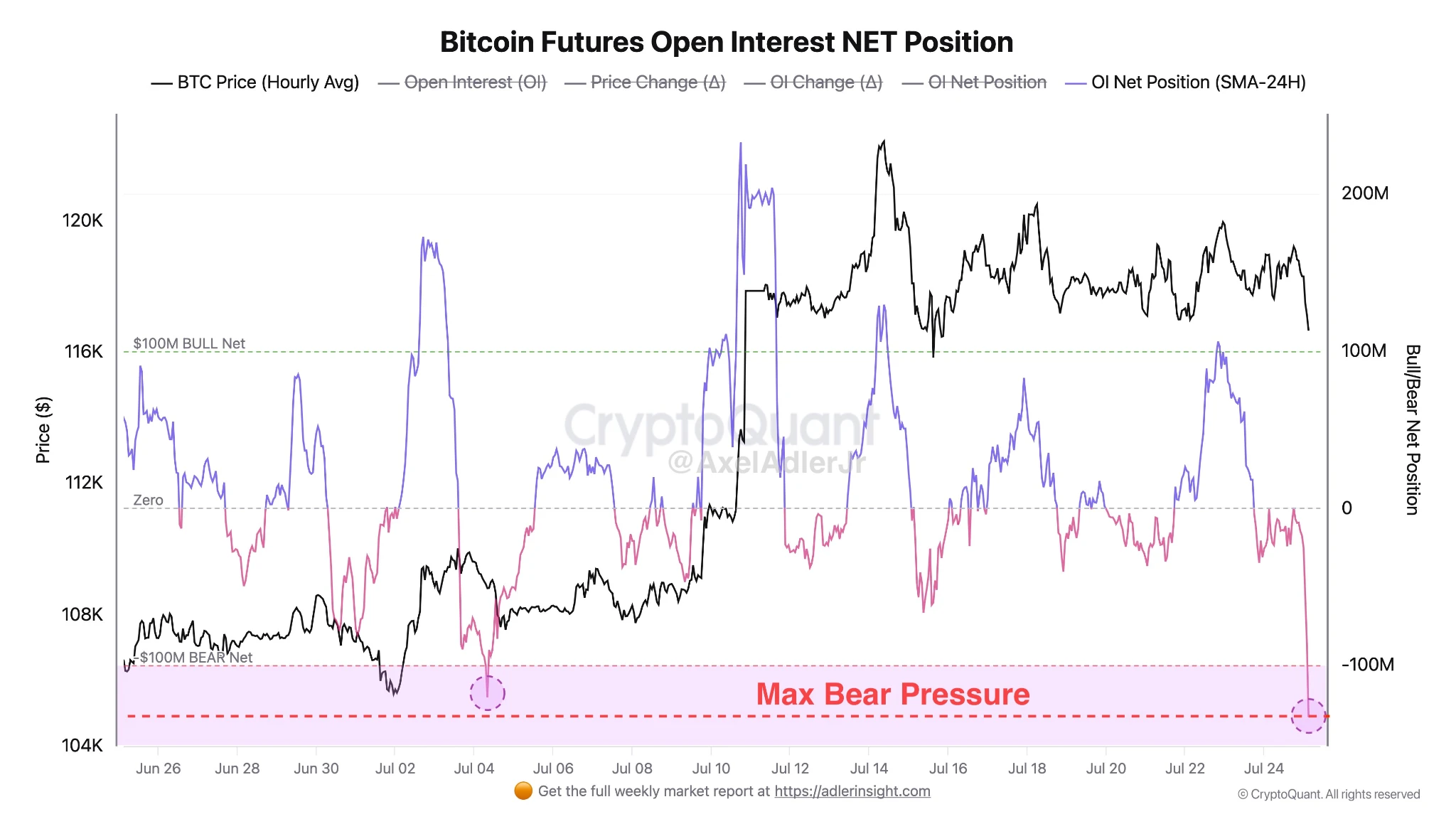
潜在引爆点解析:​​ 空头持续加码,期待价格最终破位下行。​然而从市场行为学角度看,极度拥挤的空头结构本身即是典型的反向信号——一旦价格启动反弹,空头的大规模止损平仓将形成“轧空”效应,推动价格呈爆炸式上涨。当前行情的核心观测点在于:比特币能否有效突破 116,000-118,000 美元阻力区间,点燃这枚“空头火药桶”。​​

信号二:巨鲸抛压悬顶,Galaxy Digital 再转 3700 枚 BTC​

在期货结构高度紧绷的同时,链上的“实盘”变量——即持币巨鲸的行为,也未向多头提供喘息空间。

链上数据显示,自 7 月 15 日以来,一个持有超过 80,000 枚 BTC 的老钱包地址开始持续向交易所和新地址转移资产。该地址随后被识别为托管于 Galaxy Digital,后者正通过分批方式协助出售这批早期挖矿所得资产。

最新动向与持仓透视:​​

截至 7 月 24 日,已确认转出量超过 68,000 枚 BTC,流入币安、Bitstamp、OKX、Bybit 等交易所及疑似 OTC 买家的新地址。

​仅 24 小时内,该地址再向 12 个新地址分发 3,715 枚 BTC(约合 4.28 亿美元)。​​

​当前该钱包仍持有 18,504 枚 BTC,价值逾 21 亿美元。​

市场解读与策略影响:​​ 对市场而言,Galaxy 尚未清仓的头寸仍是高悬的“达摩克利斯之剑”。尽管当前价格并未显著走低,但链上真实抛压远未结束,这为空头维持仓位提供了底气。值得注意的是,其转出节奏(小批量、多批次)显示其采用“温和但持久”的分销策略,意在避免集中抛售冲击市场。这种策略虽缓解短期踩踏风险,却可能延长压制期,延缓市场彻底转强的时间窗口。​​​

信号三:获利盘扎堆兑现,7 日 PNL 触年内次高​

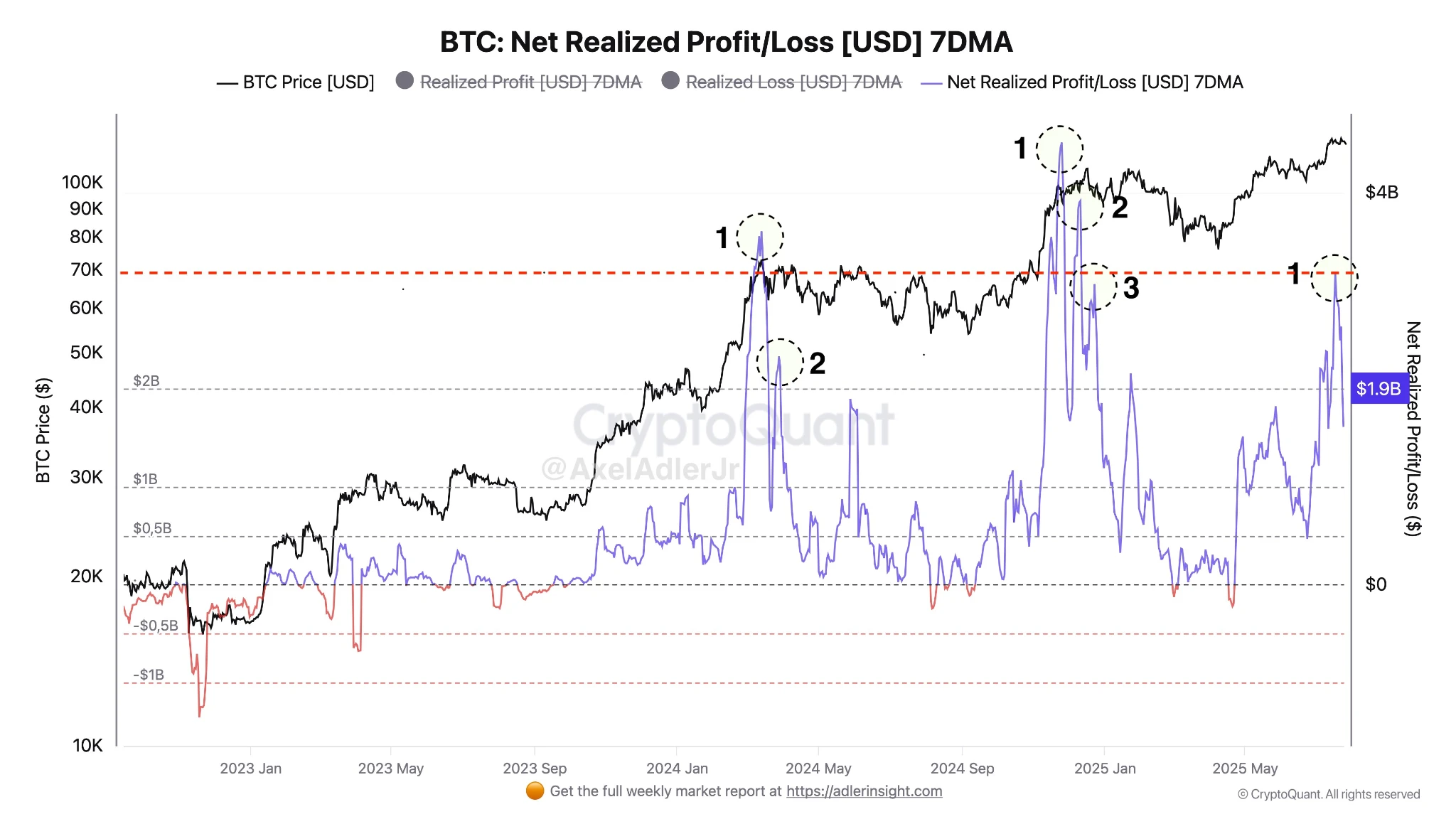
链上第三大预警信号浮现:比特币7 日平均净已实现利润(PNL)​于 7 月 24 日飙升至19 亿美元,创 2025 年以来第二高点,仅次于 3 月峰值。

​历史回测关联风险:​​ 过去三次类似的利润兑现高峰(2023 年 11 月、2024 年 3 月、2025 年 1 月)均不同程度地预示阶段性顶部形成。其内在逻辑在于——价格高位促使持币者集中兑现利润,若后续买盘接力不足,抛售压力将自我强化,形成“获利了结式筑顶”。
当前评估与预警:​​

尽管 BTC 价格未创新高,但 PNL 指标快速攀升,显示大量资金已选择提前落袋为安。

部分抛盘或来源于“持币超 1 年”的长期持有者(LTH),其流出往往暗示中线交易者信心松动。

​关键分歧点:19 亿美元的兑现规模虽未达历史峰值,属“健康调整”范畴,但若后续数日该指标持续走高而价格停滞不前,则可能确认多空力量逆转的风险。​​

高压市场:临界点上的多空博弈​

当前市场呈现出典型的“三重临界”高压结构:​期货空头杠杆登峰造极、链上获利盘加速兑现、巨鲸实盘抛压悬而未决。​​ 任何单一变量的突变,都足以打破当前脆弱的平衡,引爆新一轮行情。

​多空对峙核心逻辑:​​

​空方观点:​​ BTC价格受制于 11.8 万美元阻力位、Galaxy 余量未清、PNL 高企三大因素压制,下行风险犹存。

​多方倚仗:​​ 押注空头杠杆过度(轧空潜能)、抛压边际递减及结构性反弹势能蓄积。

​历史经验与路径推演:​​ 此类高压状态难以持久维系。关键分水岭在于:

​若有效下破 112,000 美元支撑位,则确认短期下行趋势。​​

​若强势突破 118,000 美元阻力区,则可能触发大规模空头止损平仓,推动价格快速拉升。​​

​投资者策略建议:​​

面对高度不确定性,中短线投资者当前不宜重仓押注单一方向。相比“追涨杀跌”,​降低杠杆、密切追踪资金动向与技术结构变化,静待方向性信号明确后再行决策,是更为审慎的策略选择。​​

结语:避免单边押注,保持策略灵活​

比特币市场正处于多空结构极端对峙的临界时刻。这并非单边牛市加速期,亦非熊市确认期,而是典型的“震荡收敛”窗口。

一面是链上基础指标(如活跃地址、交易频次)尚未显著衰减,显示市场活力尚存;另一面是持仓结构、价格动能与情绪指标同步濒临极限。​任何主导力量(多/空)的率先破局,都可能引发连锁反应式的技术破位与资金踩踏。​​

市场不缺方向选择的动能,只缺临门一脚的契机。而这一契机,或许源自一则突发宏观利好、一次巨鲸清仓完毕,或是一轮集中爆仓清算。​​

​在趋势尘埃落定前,保持策略的灵活性,远胜于盲目的方向押注。​

Trending Cryptos

Related Reads

AI Agents Also Need 'Credit Checks': ERC-8126 is Filling the Gap in On-chain Trust

The article discusses ERC-8126, a proposed standard designed to address the lack of trust and verification for AI Agents operating on-chain. While ERC-8004 provides AI Agents with a basic on-chain identity (answering "Who are you?"), it does not guarantee trustworthiness. ERC-8126 aims to fill this gap by establishing a verification layer (answering "Are you reliable?"). It standardizes how independent verification providers can assess an agent's associated risks across five key areas: Token/Contract Verification (ETV), Media Content Verification (MCV), Solidity Code Verification (SCV), Web Application Verification (WAV), and Wallet Verification (WV). These providers generate a standardized risk score (0-100) and proofs based on their checks, without acting as a single authoritative certifier. This allows wallets, marketplaces, dApps, and other agents to consume these risk signals—for example, to display warnings, filter listings, or make interaction decisions. The standard also incorporates concepts like Private Data Verification (PDV) and Zero-Knowledge Proofs (ZKP) to allow verification without exposing sensitive underlying data. Positioned alongside ERC-8004 (Identity) and ERC-8183 (Commerce for agents), ERC-8126 represents a step toward building a verifiable and accountable infrastructure for the emerging on-chain AI Agent economy, shifting trust assessment from purely user-based judgment to standardized, consumable signals.

marsbit20m ago

AI Agents Also Need 'Credit Checks': ERC-8126 is Filling the Gap in On-chain Trust

marsbit20m ago

Rented Conviction: How Much Real Money Is Behind the Bitcoin ETF Flows

Borrowed Belief: How much of Bitcoin ETF flows are real money? Weekly Bitcoin ETF flows, often interpreted as a measure of institutional conviction, are heavily influenced by a hidden arbitrage trade rather than genuine directional buying. A cash-and-carry arbitrage, where traders buy the ETF while simultaneously shorting Bitcoin futures on the CME to lock in a basis spread (the price difference between futures and spot), drives roughly half of the week-to-week flow volatility. This delta-neutral activity appears as ETF inflows but is unrelated to price views. Data shows a strong correlation (0.70) between weekly ETF inflows and increases in hedge fund short positions on CME futures, while Bitcoin’s weekly price returns have almost no explanatory power. However, this arbitrage activity dominates short-term *fluctuations*, not the cumulative *stock* of investments. Of the total ~$55 billion in net ETF inflows since launch, only about $1 billion currently represents net arbitrage exposure. The vast majority consists of steady, directional buying averaging around $400 million per week. The arbitrage trade has been unwinding for two years, with hedge fund short positions peaking near $14 billion in late 2024 and declining to ~$4.5 billion. Recent ETF outflows partly reflect this ongoing unwind as the basis compresses, not a loss of faith in Bitcoin. Thus, ETF flows overstate the *volatility* of belief, not its *level*. The headline number is more a gauge of arbitrage desk activity than conviction. For accurate interpretation, monitor the CME basis relative to Treasury yields and hedge fund net shorts—these reveal how much of the reported “demand” is truly directional.

marsbit22m ago

Rented Conviction: How Much Real Money Is Behind the Bitcoin ETF Flows

marsbit22m ago

Borrowed Faith: How Much of the Bitcoin ETF Flows Are Real Money

"Rented Faith: How Much of Bitcoin ETF Flows Are Real Money?" Bitcoin ETF inflows are often seen as a barometer of institutional conviction. However, week-to-week analysis reveals they are primarily driven by a hidden arbitrage trade rather than directional bullishness. This is the cash-and-carry trade: buying the ETF while simultaneously shorting Bitcoin futures on the CME to lock in the price difference (basis). This delta-neutral activity registers as ETF inflows but reflects a rate-seeking, not price-betting, strategy. Data shows weekly ETF flow volatility is closely tied to hedge fund ("leveraged funds") short positions on CME futures, with a correlation of 0.70. About half of weekly flow variation can be explained by this single factor. In contrast, Bitcoin's weekly price changes have no statistically significant power to predict flows. Crucially, while this arbitrage trade dominates weekly *fluctuations*, it is not the main component of the cumulative *stock*. Of the ~$55 billion total net inflow, the estimated net arbitrage position is only about $1 billion. The vast majority is steady, directional buying averaging ~$400 million per week. Thus, ETF flows overstate the *volatility* of belief, not its *level*. The "rented" arbitrage capital churns, while "owned" directional capital forms the bedrock. This arbitrage trade has been unwinding for two years, with hedge fund shorts peaking at ~$14 billion in late 2024 and falling to ~$4.5 billion. Recent outflows align with basis compression, signaling the trade's exit, not a loss of faith. For Ethereum ETFs, the same dynamic is weaker due to negative carry from forgone staking yield. The key takeaway: To interpret ETF flows, watch the basis vs. Treasury yields and CME hedge fund net shorts. They reveal how much of the weekly "demand" headline is driven by rented, rate-seeking capital versus real conviction.

链捕手36m ago

Borrowed Faith: How Much of the Bitcoin ETF Flows Are Real Money

链捕手36m ago

Trading

Spot
Futures

Hot Articles

What is $BITCOIN

DIGITAL GOLD ($BITCOIN): A Comprehensive Analysis Introduction to DIGITAL GOLD ($BITCOIN) DIGITAL GOLD ($BITCOIN) is a blockchain-based project operating on the Solana network, which aims to combine the characteristics of traditional precious metals with the innovation of decentralized technologies. While it shares a name with Bitcoin, often referred to as “digital gold” due to its perception as a store of value, DIGITAL GOLD is a separate token designed to create a unique ecosystem within the Web3 landscape. Its goal is to position itself as a viable alternative digital asset, although specifics regarding its applications and functionalities are still developing. What is DIGITAL GOLD ($BITCOIN)? DIGITAL GOLD ($BITCOIN) is a cryptocurrency token explicitly designed for use on the Solana blockchain. In contrast to Bitcoin, which provides a widely recognized value storage role, this token appears to focus on broader applications and characteristics. Notable aspects include: Blockchain Infrastructure: The token is built on the Solana blockchain, known for its capacity to handle high-speed and low-cost transactions. Supply Dynamics: DIGITAL GOLD has a maximum supply capped at 100 quadrillion tokens (100P $BITCOIN), although details regarding its circulating supply are currently undisclosed. Utility: While precise functionalities are not explicitly outlined, there are indications that the token could be utilized for various applications, potentially involving decentralized applications (dApps) or asset tokenization strategies. Who is the Creator of DIGITAL GOLD ($BITCOIN)? At present, the identity of the creators and development team behind DIGITAL GOLD ($BITCOIN) remains unknown. This situation is typical among many innovative projects within the blockchain space, particularly those aligning with decentralized finance and meme coin phenomena. While such anonymity may foster a community-driven culture, it intensifies concerns about governance and accountability. Who are the Investors of DIGITAL GOLD ($BITCOIN)? The available information indicates that DIGITAL GOLD ($BITCOIN) does not have any known institutional backers or prominent venture capital investments. The project seems to operate on a peer-to-peer model focused on community support and adoption rather than traditional funding routes. Its activity and liquidity are primarily situated on decentralized exchanges (DEXs), such as PumpSwap, rather than established centralized trading platforms, further highlighting its grassroots approach. How DIGITAL GOLD ($BITCOIN) Works The operational mechanics of DIGITAL GOLD ($BITCOIN) can be elaborated on based on its blockchain design and network attributes: Consensus Mechanism: By leveraging Solana’s unique proof-of-history (PoH) combined with a proof-of-stake (PoS) model, the project ensures efficient transaction validation contributing to the network's high performance. Tokenomics: While specific deflationary mechanisms have not been extensively detailed, the vast maximum token supply implies that it may cater to microtransactions or niche use cases that are still to be defined. Interoperability: There exists the potential for integration with Solana’s broader ecosystem, including various decentralized finance (DeFi) platforms. However, the details regarding specific integrations remain unspecified. Timeline of Key Events Here is a timeline that highlights significant milestones concerning DIGITAL GOLD ($BITCOIN): 2023: The initial deployment of the token occurs on the Solana blockchain, marked by its contract address. 2024: DIGITAL GOLD gains visibility as it becomes available for trading on decentralized exchanges like PumpSwap, allowing users to trade it against SOL. 2025: The project witnesses sporadic trading activity and potential interest in community-led engagements, although no noteworthy partnerships or technical advancements have been documented as of yet. Critical Analysis Strengths Scalability: The underlying Solana infrastructure supports high transaction volumes, which could enhance the utility of $BITCOIN in various transaction scenarios. Accessibility: The potential low trading price per token could attract retail investors, facilitating wider participation due to fractional ownership opportunities. Risks Lack of Transparency: The absence of publicly known backers, developers, or an audit process may yield skepticism regarding the project's sustainability and trustworthiness. Market Volatility: The trading activity is heavily reliant on speculative behavior, which can result in significant price volatility and uncertainty for investors. Conclusion DIGITAL GOLD ($BITCOIN) emerges as an intriguing yet ambiguous project within the rapidly evolving Solana ecosystem. While it attempts to leverage the “digital gold” narrative, its departure from Bitcoin's established role as a store of value underscores the need for a clearer differentiation of its intended utility and governance structure. Future acceptance and adoption will likely depend on addressing the current opacity and defining its operational and economic strategies more explicitly. Note: This report encompasses synthesised information available as of October 2023, and developments may have transpired beyond the research period.

421 Total ViewsPublished 2025.05.13Updated 2025.05.13

What is $BITCOIN

Discussions

Welcome to the HTX Community. Here, you can stay informed about the latest platform developments and gain access to professional market insights. Users' opinions on the price of BTC (BTC) are presented below.

活动图片