Ethereum Validator Exit Queue Explodes To 521,000 ETH ATH, What This Means

bitcoinistPublished on 2025-07-26Last updated on 2025-07-26

Abstract

Ethereum staking validator Everstake has announced that the validator exit queue has reached its highest point in one year. The...

Trusted Editorial content, reviewed by leading industry experts and seasoned editors. Ad Disclosure

Ethereum staking validator Everstake has announced that the validator exit queue has reached its highest point in one year. The expert further explained why this development might be a positive for the ETH ecosystem

Ethereum Validator Exit Queue Reaches New High

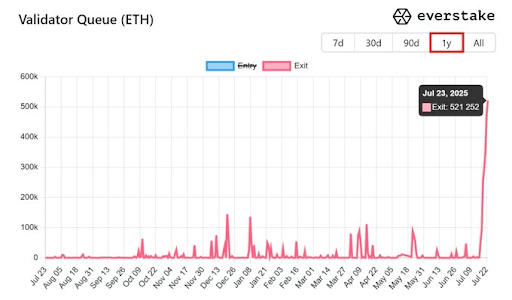
In an X post, Everstake stated that the Ethereum validator exit queue has reached its highest level in over a year, representing approximately 520,000 ETH, which is equivalent to $1.9 billion at current prices. The validator noted that this queue will take around 19 days to fully clear. He further explained that this exit queue tracks how many validators are leaving Ethereum’s staking system

This typically raises concerns about a huge sell-off being imminent from these validators. However, Everstake assured that the surge in the validator queue is not a sign of fear or collapse. Instead, the expert claimed that it is a shift, whereby these validators are more likely to exit and restake, optimize, or rotate operators than leave the ETH ecosystem. 

Meanwhile, Everstake admitted that there is still the possibility that these validators may want to lock in profits, especially seeing as the Ethereum price just recently surged to a six-month high. He noted that it is natural to assume that some stakers are preparing to sell, which could create short-term sell pressure and potentially cause ETH to correct.  
Ethereum
Source: Everstake on X

However, on the other hand, the validator remarked that Ethereum is seeing record ETF demand, with billions of dollars in net flows since the beginning of this month. As such, BlackRock, Fidelity, and other ETH ETF issuers could match this potential sell pressure with similar buying pressure. 

Everstake also declared that this development with the validator exit queue is a “sign of health” and the freedom to move. He claimed that activity like this shows how mature ETH staking has become, with the protocol doing what it was designed to do. He added that this is what decentralization looks like. 

ETH ETFs Record Inflows For 15 Consecutive Days

SoSo Value data shows that the Ethereum ETFs have now recorded 15 consecutive days of net inflows. This follows the net inflow of $231.23 million that they recorded on July 24. These funds currently hold $20.70 billion in net assets, representing 4.59% of Ethereum’s market capitalization

The significant inflows into these funds support Bitwise CIO Matt Hougan’s theory that ETH will soon witness a demand shock. He stated that this demand will come from the ETFs and corporate treasuries, predicting that they could purchase up to $20 billion of ETH in the next year.

At the time of writing, the Ethereum price is trading at around $3,630, up over 1% in the last 24 hours, according to data from CoinMarketCap.

Ethereum
ETH trading at $3,738 on the 1D chart | Source: ETHUSDT on Tradingview.com
Featured image from Getty Images, chart from Tradingview.com
Editorial Process for bitcoinist is centered on delivering thoroughly researched, accurate, and unbiased content. We uphold strict sourcing standards, and each page undergoes diligent review by our team of top technology experts and seasoned editors. This process ensures the integrity, relevance, and value of our content for our readers.

Scott Matherson is a leading crypto writer at Bitcoinist, who possesses a sharp analytical mind and a deep understanding of the digital currency landscape. Scott has earned a reputation for delivering thought-provoking and well-researched articles that resonate with both newcomers and seasoned crypto enthusiasts. Outside of his writing, Scott is passionate about promoting crypto literacy and often works to educate the public on the potential of blockchain.

Trending Cryptos

Related Reads

Doubao and Qwen Will Discontinue Agent Functionality on July 15

On July 4th, Doubao and Tongyi Qianwen announced the impending shutdown of their user-created "AI Agent" features. Doubao confirmed its agent feature will be taken offline on July 15, directing users to ByteDance's CatBox app for similar needs. On the same day, Tongyi Qianwen notified users, specifying that personalized interactive agents and user-built agent functions will cease on July 10, with all agent features and services completely deactivated by July 15. After this date, access to agent configurations and historical chat records will be lost. This adjustment impacts core user scenarios like role-playing, personal assistants, and vertical tool agents. The shutdown date coincides with the official implementation of China's "Interim Measures for the Administration of Artificial Intelligence Human-like Interactive Services" on July 15. The new regulations impose strict rules on "human-like emotional interaction services," requiring platforms to implement measures like anti-addiction systems, minor verification, and content moderation. This move is widely seen as a proactive step by the platforms to align with regulatory timelines and mitigate compliance risks. Additionally, commercial challenges are a key driver. Analysis suggests that casual, human-like chat agents generate high-frequency, low-value interactions, leading to high computational costs with poor monetization. As the AI application market shifts from user growth to proving value, sustaining such "high-cost, low-efficiency" user-generated content becomes difficult. Both platforms have outlined transition plans. Doubao will allow data viewing and self-backup for a period after shutdown, with data scheduled for permanent deletion by October 15. Tongyi Qianwen similarly advised users to save important content via copying or screenshots before the deadline. This strategic retreat from C-end agent features signals a broader market shift. Compliance capability and sustainable business models are replacing user scale and feature richness as the new core competitive dimensions. Tongyi Qianwen's recent move to fully open its Agent and Skill platforms to third-party enterprises and developers further underscores a strategic pivot from low-value C-end services to high-value B-end enterprise scenarios.

marsbit46m ago

Doubao and Qwen Will Discontinue Agent Functionality on July 15

marsbit46m ago

Why Did Codex and ChatGPT Merge? What's Next for Codex? OpenAI Core Leader Answers Everything

In 2026, OpenAI's Codex saw explosive growth, with weekly active users surging over 5x to 5 million since January, driven largely by the February launch of its desktop app. Codex desktop lead Andrew Ambrosino explains key shifts behind its evolution. A core change is the inversion of development costs: implementation is now cheap, while curation and taste—judging which of many AI-generated prototypes is valuable—have become the new scarcities. Ambrosino defines taste as a blend of aesthetics, systems thinking, direction, and semantic coherence in interaction. He notes AI still struggles with design because evaluating it requires human cultural context and abstract reasoning about how components relate—capabilities beyond current models. Timing is critical: the same Codex app would have failed months earlier; success hinges on the model's capabilities at launch. Roles are blurring within his team, with engineers, designers, and PMs overlapping significantly. However, Ambrosino cautions against eliminating specialized roles entirely, as each field retains deep expertise. On AI-assisted development, the focus has shifted from measuring code written by AI to distinguishing between supervised and unsupervised generation. A current challenge is teaching models to simplify code, not just add complexity. The merger of Codex and ChatGPT stems from observed user behavior: non-developers adopted Codex for general knowledge work despite its developer-centric interface. This revealed a collapsing boundary between specialized tools and universal assistants. The vision is a "home base" that orchestrates tasks across external professional tools (like Excel or Premiere Pro) via connectors, rather than rebuilding everything internally. An internal example showed Codex helping edit video by interacting with Premiere Pro's files and even writing a plugin for it. The future direction is a unified, extensible platform that serves as a central hub for automating and managing work across any specialized tool the user employs.

marsbit56m ago

Why Did Codex and ChatGPT Merge? What's Next for Codex? OpenAI Core Leader Answers Everything

marsbit56m ago

Trading

Spot

Hot Articles

Discussions

Welcome to the HTX Community. Here, you can stay informed about the latest platform developments and gain access to professional market insights. Users' opinions on the price of ETH (ETH) are presented below.

活动图片