Ethereum-Hungry Firms See Double-Digit Gains as ETH Becomes the New Corporate Play

ccn.comPublished on 2025-07-23Last updated on 2025-07-23

Key Takeaways

  • Public companies holding large ETH treasuries are seeing explosive stock growth.
  • Firms like Sharplink and Bitmine have committed over 50% of their valuations to Ethereum.
  • ETH is quickly emerging as the next big corporate treasury asset, following Bitcoin’s path.

Bitcoin (BTC) may still be the go-to treasury asset for over 100 public companies, but Ethereum (ETH) is closing the gap—and fast.

A growing number of publicly traded firms are adding ETH to their balance sheets in bulk, echoing MicroStrategy’s (now Strategy) famous Bitcoin strategy.

And it’s paying off: these Ethereum-hungry companies are not only amassing ETH in hoards but also enjoying massive jumps in their stock prices.

Sharplink and Bitmine Lead the ETH Charge

Amid a sea of firms adopting Ethereum treasury strategies, Sharplink Gaming and Bitmine have emerged as two of the most aggressive players.

Sharplink Gaming currently holds the largest ETH treasury among public companies, with 360,807 ETH valued at approximately $1.33 billion. Bitmine follows closely, holding 300,700 ETH.

Both companies have made significant commitments to Ethereum.

Sharplink has allocated 52% of its total valuation of $2.53 billion to ETH, while Bitmine has dedicated 54% of its current valuation to the asset.

Meanwhile, BTCS, a smaller-cap firm with a market valuation of just $144 million, has taken an even bolder approach—allocating 144% of its valuation to Ethereum.

The company now holds 55,000 ETH worth around $206 million.
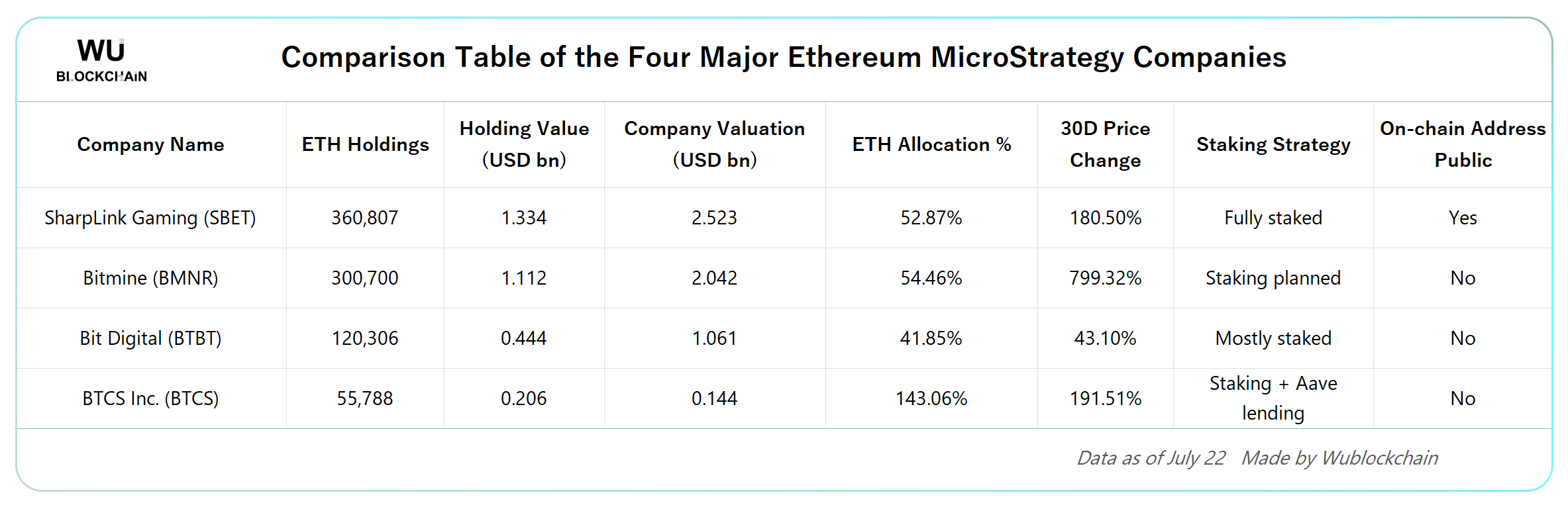
ETH treasury.
Top ETH holding firms. Source: Wu Blockchain.

ETH Treasury Firms See Stock Prices Soar

Much like MicroStrategy’s early Bitcoin strategy, the Ethereum-focused treasury moves have sent the stock prices of these companies soaring.

Sharplink Gaming (SBET) shares surged over 200% in the past month, jumping from $9 to a monthly high of $27.
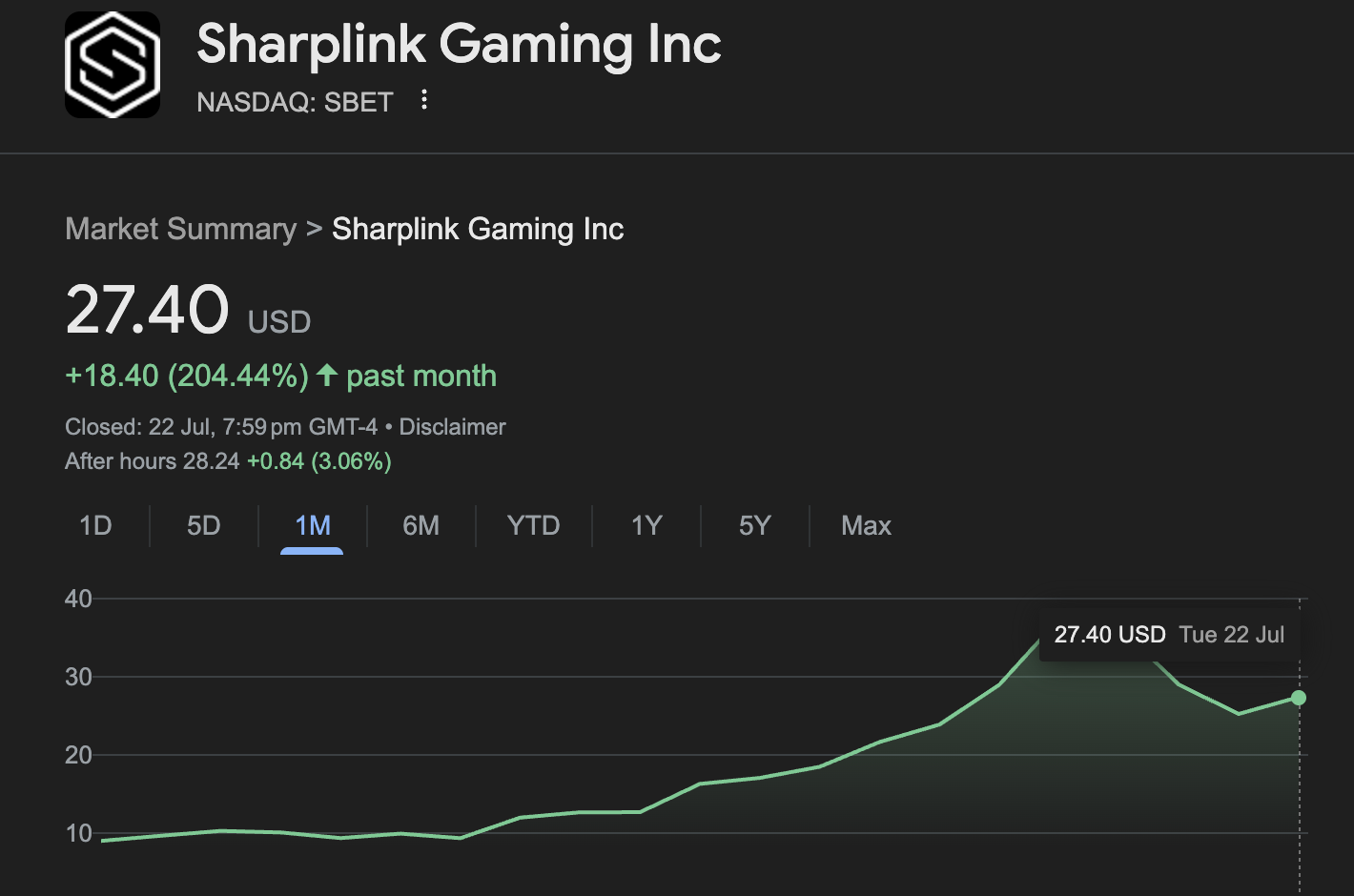
Sharplink Gaming Stock.
Sharplink Gaming stock performance. Source: Google.

Bitmine (BMNR) posted even more dramatic gains. Its stock price rose more than 800% in the same period, climbing from $4.26 to above $40.
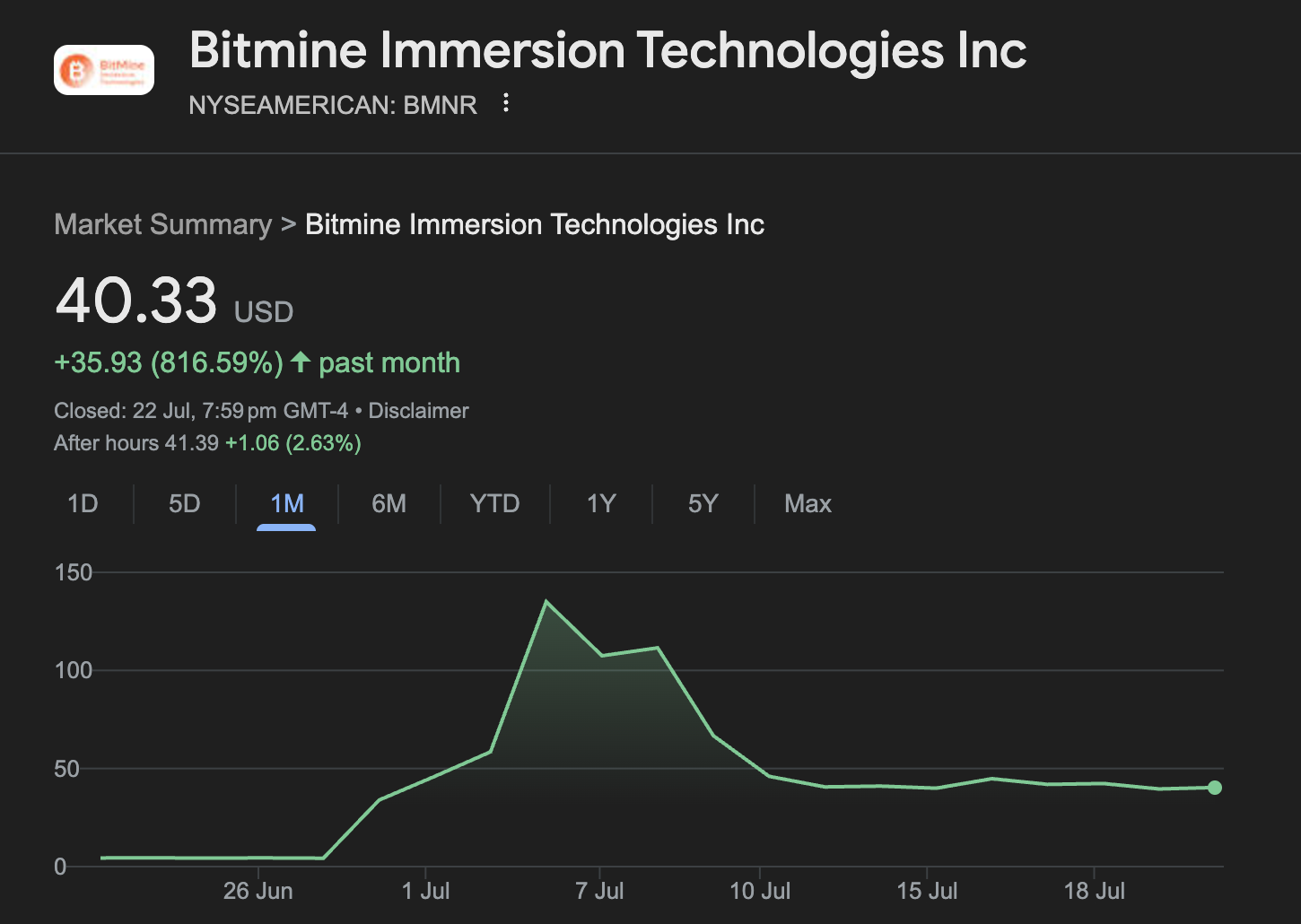
Bitmine stock.
Bitmine stock price surges 800%. Source: Google.

BTCS has also benefited handsomely from its ETH-heavy approach, with its share price rising from $2 to more than $6—an increase of roughly 195%.

BTCS stock.
BTCS stock gained over 190%. Source: Google.

ETH Is the New BTC?

Bitcoin has long been considered the premier treasury asset among crypto-focused public firms, but Ethereum appears to be closing the gap.

After spending much of the bull market in Bitcoin’s shadow, ETH is now seeing renewed interest as both a strategic and institutional asset.

Favorable regulatory shifts and rising institutional adoption have helped turn sentiment in Ethereum’s favor.

Over the past month alone, ETH has jumped from under $2,800 to a multi-month high of $3,800.

Despite still trading below its all-time high of $4,800 set in 2021, the outlook remains bullish.

Analysts increasingly point to Ethereum’s expanding use cases and corporate adoption as catalysts that could push its price past the $10,000 mark during this cycle.


Was this Article helpful? Yes No

Trending Cryptos

Related Reads

Li Fei-Fei's Latest Long-Form Article: When Video Generation, Robotics, and NVIDIA All Call Themselves World Models, We Need a Taxonomy

In a new article, Dr. Fei-Fei Li addresses the widespread and often inconsistent use of the term "world model" in AI. She proposes a clear, functional taxonomy rooted in the classic Partially Observable Markov Decision Process (POMDP) loop (agent → action → state → observation → agent). According to this framework, current systems called "world models" are different projections of this loop, categorized by their primary output: 1. **Renderers**: Output observations (pixels). Their goal is visual fidelity for human consumption (e.g., video generation models like Sora). They are the most commercially mature but are limited by a focus on appearance over physical accuracy. 2. **Simulators**: Output states (geometric, physical, dynamic representations). They provide a structurally accurate world for both human professionals (e.g., architects) and computational agents (e.g., robots for training). Li argues simulators are the crucial, underappreciated bridge, as they can underpin both rendering and planning. 3. **Planners**: Output actions. Given an observation and a goal, they decide what an agent should do next (e.g., robotic action models). This area is highly promising but remains the least mature for real-world deployment. Li highlights a key trend: the boundaries between these three categories are beginning to blur, as they all rely on a shared underlying understanding of geometry, physics, and dynamics. The logical endpoint is a unified world foundation model capable of switching between rendering, simulation, and planning based on downstream needs. This convergence, she concludes, is central to advancing spatial intelligence—enabling machines not just to talk about the world, but to truly understand, imagine, and interact with it.

marsbit1h ago

Li Fei-Fei's Latest Long-Form Article: When Video Generation, Robotics, and NVIDIA All Call Themselves World Models, We Need a Taxonomy

marsbit1h ago

Forbes Feature: Stablecoin Cross-Border Payments Are Faster, But Not Yet Cheaper

A Forbes feature delves into the state of stablecoin-based cross-border payments, noting rapid growth but a key shortfall: while faster and more accessible, they are not yet cheaper. At a recent industry conference in Mexico City, optimism about technology, regulation, and volume was tempered by discussions with practitioners. The core issue is liquidity. Traditional FX brokers charge 60-70 basis points, and stablecoins promise to slash this to 2-5 basis points. However, this theoretical cost advantage cannot be realized until deep liquidity pools are established at scale, requiring significant institutional capital inflow. A major adoption barrier is trust. Businesses often rely on long-standing relationships with traditional brokers, valuing reliability over marginal cost savings. This shift will be gradual. Furthermore, successful companies in the space are not positioning themselves as replacements for legacy systems like SWIFT, but as complements. They leverage stablecoins for speed while using traditional rails for their standardization and reliability in ensuring accurate payment details—a critical factor for supplier payments to avoid customs issues. Companies like Caliza, experiencing high monthly growth, exemplify this hybrid approach. The industry anticipates consolidation, as long-term viability will depend on securing the essential trifecta: proper licensing, robust fiat on/off-ramps, and deep liquidity. Without these, firms risk being mere intermediaries rather than building sustainable businesses.

marsbit1h ago

Forbes Feature: Stablecoin Cross-Border Payments Are Faster, But Not Yet Cheaper

marsbit1h ago

Li Feifei's Latest Article: When Video Generation, Robotics, and NVIDIA All Claim to Have 'World Models,' We Need a Taxonomy

"World Model" has become a widely used yet ambiguous term in AI. Drawing from the classic POMDP framework (agent → action → state → observation), this article proposes a functional taxonomy to clarify the concept. It identifies three distinct types, categorized by their output in the perception-action loop: 1. **Renderers**: Output visual observations (pixels). These models, like advanced video generators, prioritize visual fidelity but often lack underlying physical accuracy. 2. **Simulators**: Output the state of the world (geometry, physics, dynamics). They provide a structurally accurate representation for professionals (e.g., architects) and serve as training environments for robots and AI agents. 3. **Planners**: Output actions. Given an observation and a goal, they determine what an agent should do next, closing the perception-action loop (e.g., vision-language-action models). While renderers are currently the most commercially mature and planners are the most aspirational, the article argues that **simulators are the crucial, underappreciated hub**. By working at the level of geometry and physics, a simulator can project upwards to create visuals for humans and downwards to predict action consequences for agents. The future lies in the convergence of these three functions. Emerging research and products, like World Labs' Marble model which outputs both visual splats and physical collision meshes, are beginning to blur these boundaries. The logical endpoint is a unified world foundation model capable of rendering, simulating, and planning based on a shared understanding of spatial and temporal structures—ultimately enabling machines to understand, imagine, and interact with the physical world.

链捕手2h ago

Li Feifei's Latest Article: When Video Generation, Robotics, and NVIDIA All Claim to Have 'World Models,' We Need a Taxonomy

链捕手2h ago

Trading

Spot

Hot Articles

Discussions

Welcome to the HTX Community. Here, you can stay informed about the latest platform developments and gain access to professional market insights. Users' opinions on the price of ETH (ETH) are presented below.

活动图片