以太坊 19 亿解质押潮:获利了结还是生态新起点?

深潮Published on 2025-07-22Last updated on 2025-07-23

解除质押并不意味着一定会出售。

撰文:深潮 TechFlow

每当行情好,FUD少不了。

今天,一条消息让大家再次对 ETH 的价格感到担忧:

以太坊网络的验证者们,正在排队解除质押ETH。

作为PoS共识机制的代表,质押 ETH 在技术上用以维护整个以太坊网络的安全,在经济上也能获取质押所产生的额外收益,将 ETH 的流动性锁定在质押池中。

但根据 Validator Queue 的数据显示,截止7月23日,以太坊验证者的退出队列中积累了约521,252 ETH 正在解除质押,时价换算价值约19.3亿美元,排队解质押的等待时间超过9天1小时。
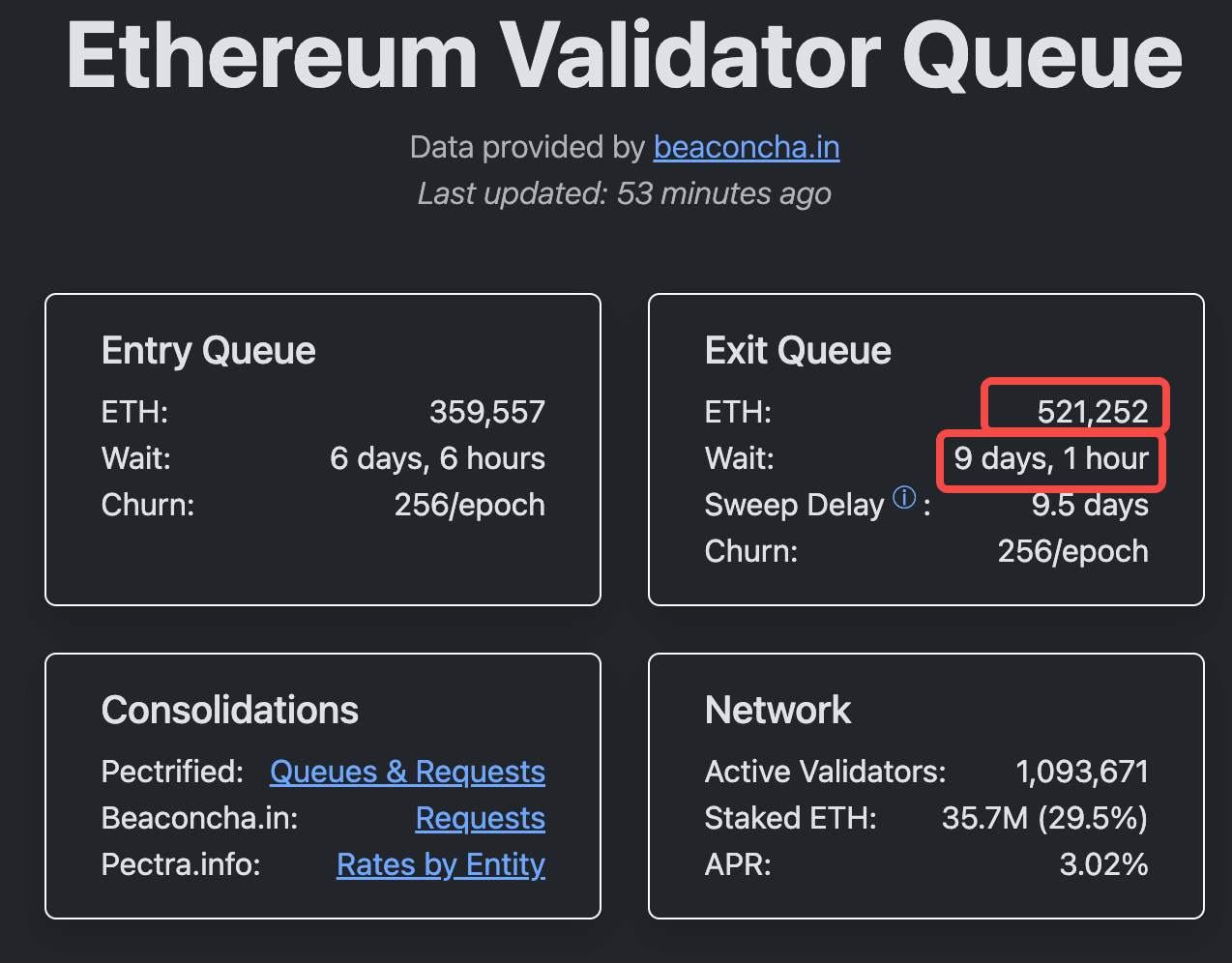
这也是过去一年的时间中,验证者们选择退出时,排过的最长的队。

由于每个验证者通常质押32 ETH,理论上这相当于超过16,000个验证者正在寻求退出质押。而大规模的排队选择解除质押,则让人嗅到一些危险的气息。

获利了结?

是不是巨鲸和机构们要卖 ETH 获利了结了?

以太坊的解除质押激增,或许部分与最近的价格上涨相关。

从2025年4月初的低点(约1,500-2,000美元区间)开始,ETH 经历了强劲反弹,截止目前累计涨幅达160%。具体来看,7月21日 ETH 触及3,812美元的高点,这是过去七个月的峰值。

这种快速上涨往往会促使部分投资者选择获利了结,尤其是那些早期质押的持有人,他们可能在看到收益后决定锁定利润,而不是继续持有。
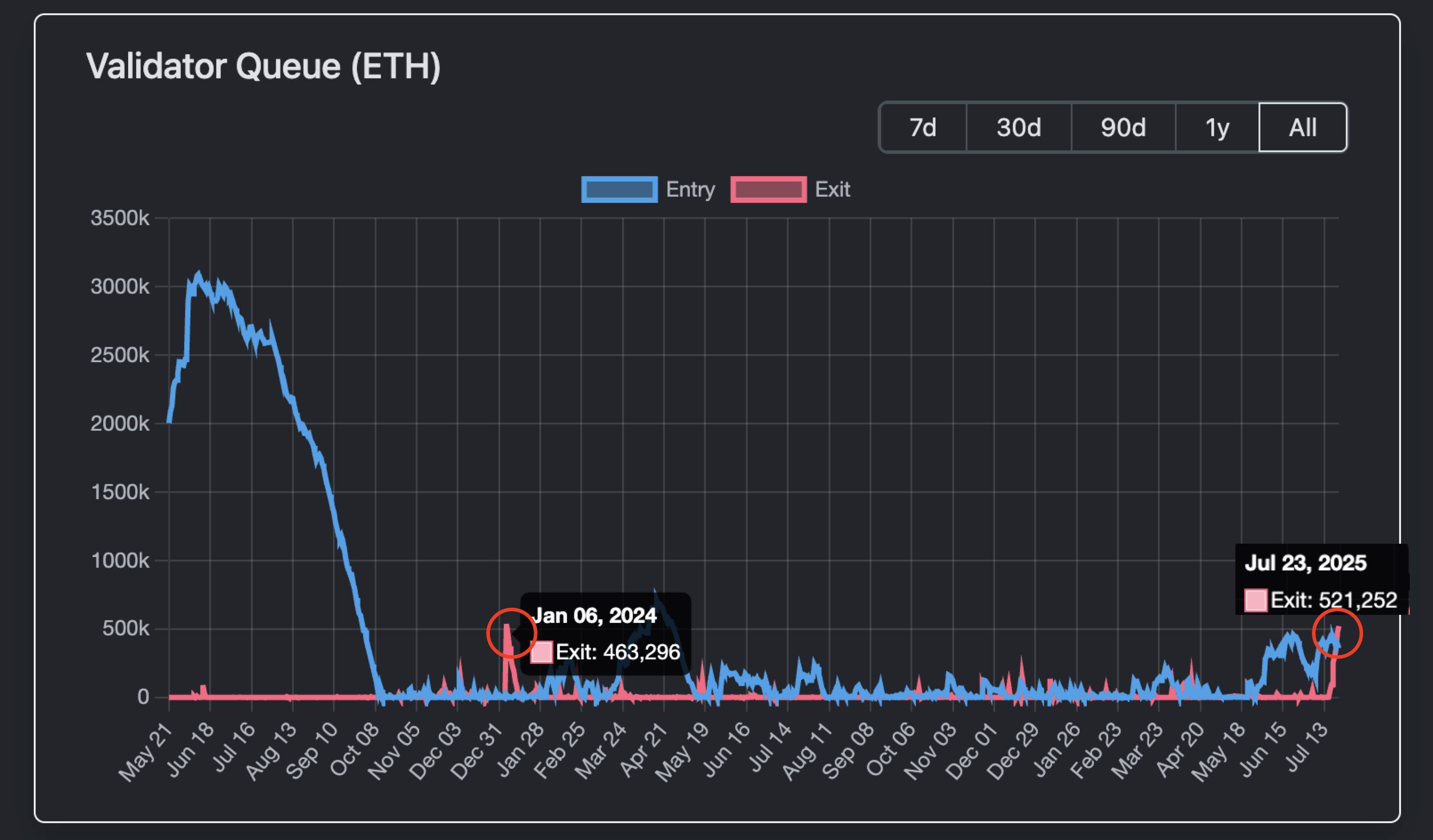
从历史角度看,这种模式并不新鲜。

2024年1月到2月,当ETH/BTC比率一周内上涨25%后,类似规模的解除质押潮出现,导致价格短期下跌10%-15%。不过也差不多是在同一时期,恰逢 Celsius 破产清算,46万枚 ETH 在短时间内被集中解除质押,导致整个 ETH 网络验证者退出队列也产生过一周左右的排队拥堵。

并非卖压

与之前不同,虽然这次 ETH 的解除质押队列排队长,解质押的金额大,但并不意味着直接的卖压。

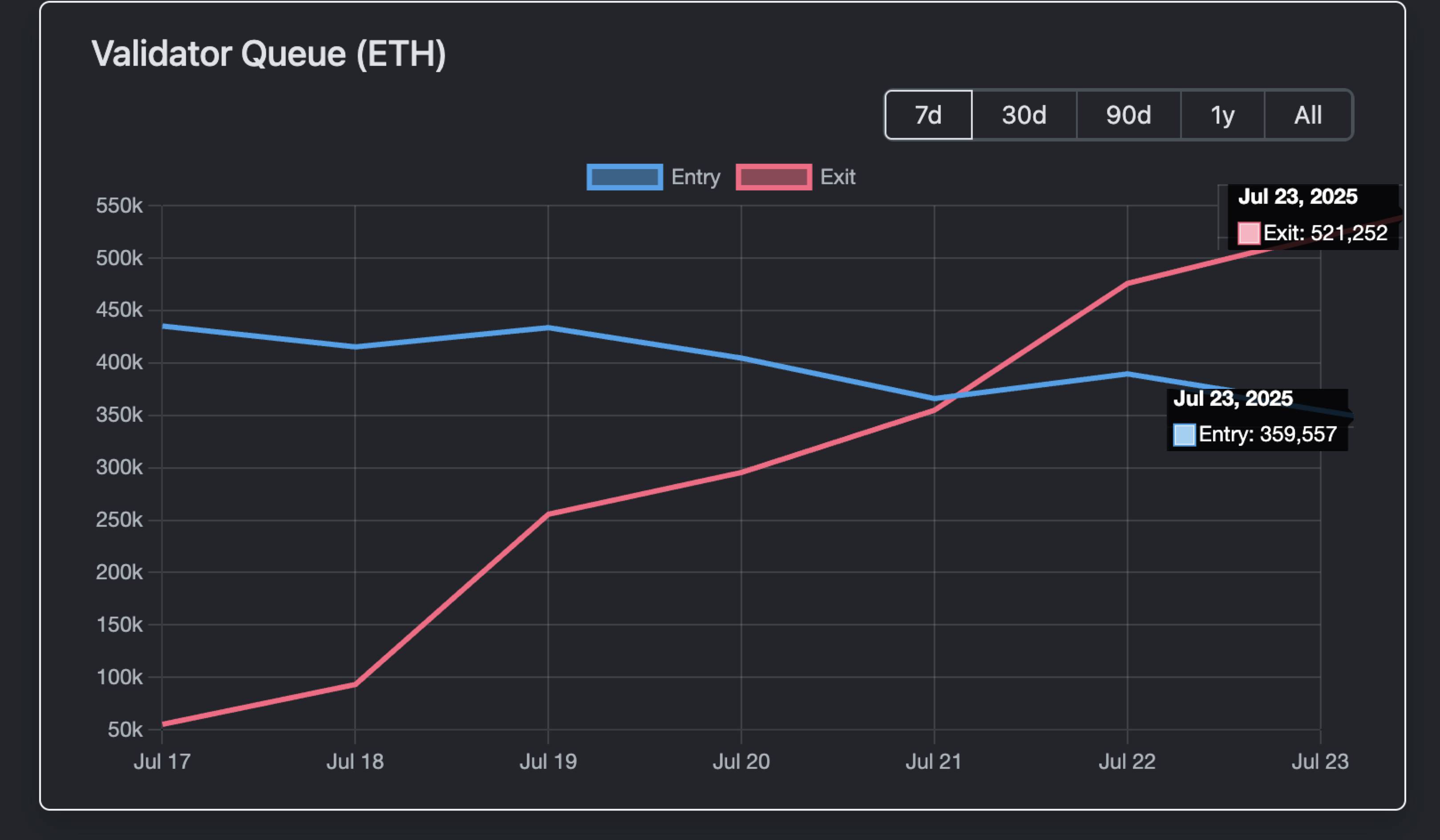
首先还是从 Validator Queue 的数据看,7月23日当天有52万个ETH排队解质押,但同时也有36万个ETH 进入质押队列。

两相抵消,从以太坊网络中净退出的ETH就会大幅减少。
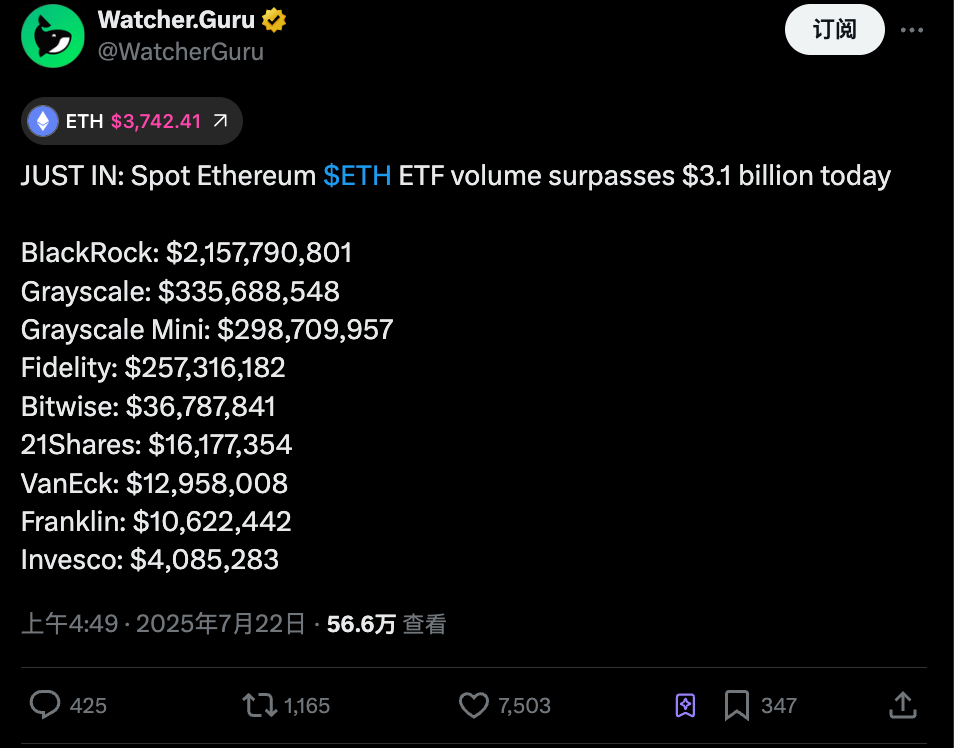
其次,机构行为也起到一定的缓冲作用。

7月22日数据显示,公开市场上各家机构的 ETH现货 ETF 加起来总流入达到31亿美金,在金额的绝对值上显著大于当天排队解质押的 52万个 ETH (19亿美金)。

而且这还是一天的 ETF 净流入量,更不用说验证者退出队列还有9天的排队周期。
同时,解除质押并不意味着一定会出售。

在本轮 ETH 上涨的大环境下,集中的解除质押,也很有可能是因为机构调整托管服务或转向加密财库策略,说的更明白一点就是换人保管 ETH 寻求更多的收益,而不是把 ETH 拿出来卖掉。

而在链上,部分解除质押的 ETH 更可能被用于DeFi 和 NFT 相关活动。比如作为抵押品提供流动性,或是昨天有巨鲸在扫 Crypto Punks 的地板;

此外链上的 LST 代币经常有脱锚现象,这也给 ETH 提供了套利机会 --- 比如近期 stETH对 ETH 的比率跌至0.996(折扣约0.04%),weETH也出现类似波动。套利者通过买入折扣LST并等待恢复1:1锚定获利,这一过程增加了ETH需求。

总的来看,解除质押更像是以太坊生态内部调整,而非直接的抛售信号。

不过社媒上也有多种猜测,集中的解除质押虽然并不意味着卖压,但很有可能指向一种现象,即“换庄”

有观点认为,致力于推动加密资产进入主流金融圈的贝莱德(BlackRock) 已经成为 ETH 事实上的大庄, 截止到7月的数据,贝莱德已累计持有超过200万ETH(价值约69-89亿美元),占ETH总供应量(约1.2亿ETH)的1.5%-2%左右。

这不是秘密,而是公开的ETF资产管理行为,所以这更像是机构级“明庄”——通过ETF公开持有和积累,推动ETH机构化采用,而非操纵市场。

而换庄的逻辑是,当以太坊从圈内价值共识转变为更广泛意义上的金融工具共识,华尔街接手准备弄出大动静已经是非常明显的趋势。

这种推测不无道理,质押和解除质押,或许也是筹码结构的转换。

但无论如何,以太坊的成长性将继续支撑其在加密领域的领导地位,这场解质押潮或许只是新周期的起点。

Trending Cryptos

Related Reads

Goldman Sachs' Summary After Silicon Valley Investigation: Agents Enter the Execution Era, AI Competition Shifts to Workflows, World Models Rise

Based on a recent field research in Silicon Valley, Goldman Sachs highlights a key shift in the AI industry: moving from systems that "answer questions" to autonomous AI agents that "execute tasks." Commercial models are transitioning from per-seat subscriptions to usage- and outcome-based pricing. The competition is shifting from raw model capability to mastery over specific business workflows, with value accruing to proprietary data, domain context, and operational expertise. A major hurdle for enterprise Agent deployment is not technical ability but "controllability"—issues of accountability, auditability, and error correction, especially in regulated fields. Workflows with clear rules, verifiable outcomes, and reversible actions (e.g., invoice processing) are being automated first. The model landscape is evolving toward a division of labor. Frontier models (like GPT-4) are expected to handle high-value, high-reliability core tasks, while improving open-source models will likely capture the majority (~90%) of inference tokens for standardized, high-volume tasks due to cost advantages. Finally, attention is moving from Large Language Models (LLMs) to "World Models," which understand physical environments, causality, and dynamic interactions. This shift elevates the importance of proprietary, real-world data (from industrial, scientific, and robotic systems) and could drive a second wave of compute demand. Goldman Sachs projects compute needs could grow ~24x over five years, benefiting cloud and infrastructure providers.

marsbit40m ago

Goldman Sachs' Summary After Silicon Valley Investigation: Agents Enter the Execution Era, AI Competition Shifts to Workflows, World Models Rise

marsbit40m ago

Fidelity Warns: The Boom in AI Agents May Not Be a Feast for Public Blockchains

Fidelity Digital Assets cautions that the anticipated boom in AI agents does not automatically guarantee a corresponding surge in public blockchain adoption or token value. While AI agents that can autonomously perform tasks like payments and data calls could theoretically utilize blockchain for settlement, a significant gap exists between "can use" and "must use." The analysis highlights six key risks. First, many AI agents, especially in corporate settings, may prefer closed, permissioned systems over public blockchains due to needs for speed, cost, compliance, and control. Second, increased on-chain transactions from AI-driven micropayments may not benefit native tokens if fees remain low or if value is captured by stablecoins and payment service providers instead. Third, while AI lowers development costs and increases the number of projects, more code does not equal more economic value and can lead to market oversaturation. Fourth, AI commoditizes coding, making pure technological advantage less of a sustainable moat; competition may shift to brand, liquidity, and user networks. Fifth, AI can also lower the cost of attacks by making vulnerability discovery easier, potentially outpacing security auditing and increasing ecosystem risk. Sixth, institutions may require "controlled blockchain" systems with robust identity, permissioning, and audit trails, conflicting with the permissionless nature of public chains. Ultimately, Fidelity argues against simply equating AI growth with blockchain prosperity. The narrative requires moving from speculation to a concrete analysis of which infrastructures can convert real AI agent needs into sustainable economic value, critically examining each step of the assumed value chain.

marsbit41m ago

Fidelity Warns: The Boom in AI Agents May Not Be a Feast for Public Blockchains

marsbit41m ago

Telegram Introduces WEB-Proxy Technology: Masks Traffic as Regular Website Visits

Telegram has introduced a new experimental WEB-Proxy technology designed to circumvent blocking by disguising messenger traffic as regular, secure website visits. Announced on August 21, 2026, the technology routes MTProxy data through an in-app WebView using HTTPS or WebSocket transport, making the data stream indistinguishable from legitimate web surfing. The core innovation is a multiplexed stream sent through a single WebView session. It uses special frame formats to pack multiple logical Telegram connections into one encrypted channel that externally resembles loading a web page. A server-side relay receives this stream, separates it into individual connections for the standard MTProxy, without decrypting content or knowing final destinations, thus preserving privacy. The WEB-Proxy operates on a standard HTTPS domain that also hosts a public website. The proxy bridge page is only activated by a specific URL parameter derived via HMAC-SHA256 from the proxy configuration; all other requests receive the normal site homepage. This provides reliable cover against automated detection systems. Currently a proof-of-concept, the system includes a desktop implementation, an experimental Android client, and plans for iOS support. The technology represents a shift towards more sophisticated integration with legitimate web infrastructure, complicating filtering systems that must choose between blocking HTTPS traffic entirely or allowing service access. Its long-term value will depend on resilience to adaptive traffic analysis and scalability without performance loss.

cryptonews.ru56m ago

Telegram Introduces WEB-Proxy Technology: Masks Traffic as Regular Website Visits

cryptonews.ru56m ago

MiCA is coming for DeFi vaults, but regulation will be difficult

The European Commission is exploring whether to extend the Markets in Crypto-Assets (MiCA) regulation to cover decentralized finance (DeFi) lending and borrowing, including lending vaults. These vaults, which channel billions into on-chain credit markets, present significant regulatory challenges because their decentralized structure doesn't map neatly onto existing financial frameworks. Their legal status is currently based on non-binding interpretations that they fall outside MiCA and EU fund rules. The article uses Morpho's decentralized lending protocol as an example, illustrating how responsibilities are divided among various participants (owner, curator, allocator, sentinel), making it difficult to identify a single "provider" to regulate. Experts warn that broadly categorizing "DeFi lending" could inadvertently capture vastly different structures. They argue that any regulatory approach should focus on the specific structure and control mechanisms of a vault, rather than using decentralization as a simple dividing line, and that DeFi lending may require a dedicated, carefully crafted framework distinct from traditional finance. The Commission's consultation closes on September 30, 2026. The core challenge for regulators is not just whether to regulate DeFi lending, but how to design rules that distinguish between different forms of on-chain lending and the entities that control them.

cointelegraph2h ago

MiCA is coming for DeFi vaults, but regulation will be difficult

cointelegraph2h ago

Trading

Spot

Hot Articles

Discussions

Welcome to the HTX Community. Here, you can stay informed about the latest platform developments and gain access to professional market insights. Users' opinions on the price of ETH (ETH) are presented below.

活动图片