Solana 速度困境:为何验证者靠‘拖延区块’牟利?

比推Published on 2025-07-21Last updated on 2025-07-21

原文作者:Jack Kubinec,Blockworks

原文编译:深潮 TechFlow

原标题:区块越慢钱越多?Solana遭遇验证者收益套利难题


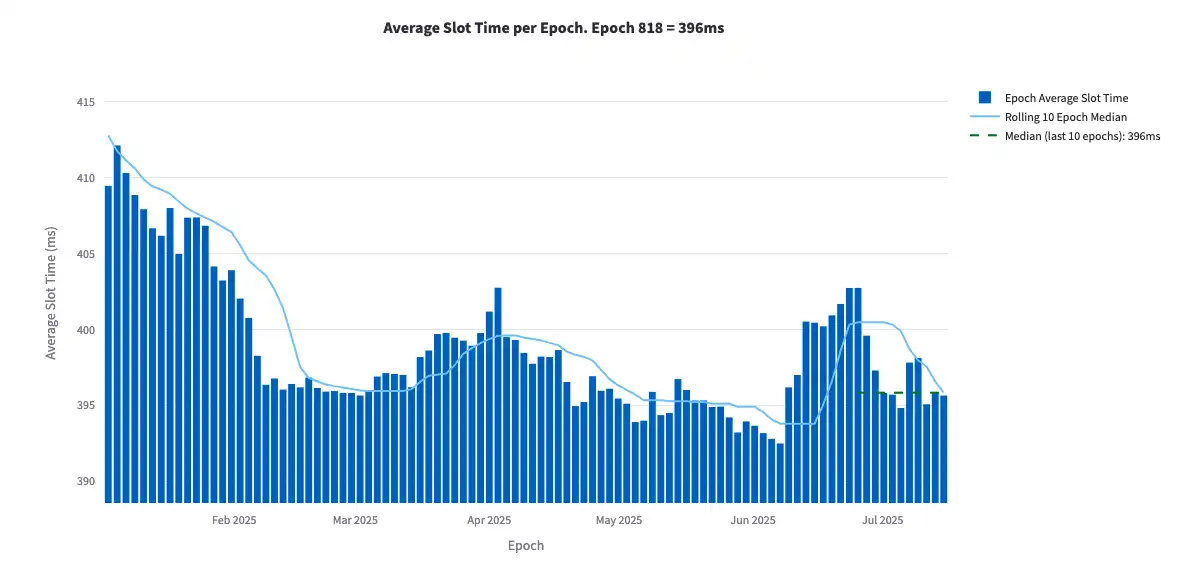
随着 Solana 的代码问题在过去几年中逐步得到解决,区块时间(即网络生成新交易区块所需的时间)显著减少,甚至低于其标称的 400 毫秒。

然而,在过去一个月中,出现了一个有趣的趋势:中位区块时间(区块链网络中一个关键的性能指标,反映区块链网络处理交易和生成区块的速度)激增,Solana 添加新交易到区块链的速度变慢。原因在于一种新的验证者策略,这表明缓慢生成区块可能更具收益性。据 Blockworks 报道,Anza、Jito 和 Marinade 正在考虑解决这一问题。
每个 Solana 区块都有一个验证者担任领导者角色——负责收集交易、创建区块并将其广播到网络。领导者通过创建区块收取交易费用。更多的订单流意味着更多的费用机会,因此验证者可能会选择处理 500 毫秒的交易,而不是 300 毫秒,以增加收益。

从基本层面来看,一些 Solana 验证者似乎在尽可能长时间地等待,以便将更多交易打包进区块,从而最大化收益。这种行为导致了 Solana 的周期长度增加。

对于一个致力于像纳斯达克一样快速的网络来说,这显然不是理想的情况。此外,周期减少意味着质押奖励的复利机会减少,这一点由 Sol Strategies 的首席技术官 Max Kaplan 提出。

Solana 提供了一种称为「宽限滴答」(grace ticks)的机制,这是一个允许领导者仍然能够成功提交区块的延迟期。这一机制旨在防止远程位置的验证者受到不公平的惩罚,但也为验证者故意延迟提交区块打开了大门。

此外,Solana 的替代客户端 Frankendancer 最近发布了一个收入最大化的调度器。

据 Kaplan 透露,运行该客户端的验证者似乎正在以稍慢于正常的速度打包区块。不过,Kaplan 补充道,与更严重的延迟者相比,Frankendancer 的延迟可以忽略不计,他并不认为这是一件「坏事」。此外,在权益证明区块链上,区块延迟并不是一个新概念。然而,Firedancer 的升级可能让这一策略在 Solana 上变得更加显眼。Jump 尚未对此发表评论。

有趣的是,Firedancer 软件工程师 Michael McGee 在本周的 Lightspeed 播客中描述了这一现象。他提到:「我们在当前的验证者中看到的一件事是…[验证者] 往往通过延迟交易执行来创建更有利可图的区块。」

Blockworks Research 分析师 Victor Pham 指出,那些更明显延迟区块的 Solana 验证者通常运行的是 Agave-Jito 客户端的修改版本。

例如,在 6 月中旬的第 802 周期中,Galaxy 和 Kiln 的中位区块时间均超过了 570 毫秒。根据 Solana Compass 数据,一些未标记的验证者运行速度也较慢,而 Temporal 的验证者中位区块时间为 475 毫秒。

Kiln 联合创始人 Ernest Oppetit 承认,其验证者——Solana 网络中第六大质押验证者——曾在一段时间内延迟区块插槽,但表示目前已停止这种行为。

「在 Kiln,我们以提供市场上最高的质押年收益率(APY)为荣,同时不牺牲安全性。我们一直在对技术栈的不同部分进行研发,包括时间策略,并与客户、客户端团队以及基金会保持持续讨论。目前,我们遵循规范,不再延迟区块,但许多其他验证者仍在这样做。我们认为最终需要在协议层面解决激励问题(快速生成区块导致奖励减少),」Oppetit 说道。

Temporal 工程总监 Ben Coverston 在被问及其验证者显然参与缓慢区块趋势时表示:「我可以说,我们并不是让人们了解这一现象的原因。」

Galaxy 的一位发言人则表示:「作为服务提供商,我们支持能够优先最大化客户质押奖励的验证者配置。在 Solana 上,这可能意味着提议稍慢的区块以确保更高的奖励获取。Galaxy 也一直响应社区反馈,并已将区块时间调整至可接受的范围内。」

然而,Solana 验证者社区普遍认为减慢网络速度并不合适,缓慢的验证者目前正面临公众的强烈反对。

他们可能很快会面临更实质性的惩罚。据 Blockworks 报道,Jito 计划将缓慢验证者从其质押池中列入黑名单,而该质押池是 Solana 网络中规模最大的。

Jito 基金会主席 Brian Smith 表示,该组织正在「起草一项治理提案,赋予一个委员会权力,从 JitoSOL 委托集合中移除落后者。这项提案应该会在几天内向社区开放讨论。」

Marinade 的联合创始人 Michael Repetny 表示,该质押池提供商正在「考虑将此问题提交治理提案,以讨论将 [缓慢验证者] 作为硬性规则/委托策略违规行为的利弊考量。」

协议层面的解决方案也正在推进中。Anza 的 GitHub 仓库显示了一项新提案,建议将 Solana 的宽限滴答期缩短一半。此外,Solana 提出的共识机制改革也有望解决这一问题。

「Alpenglow 将通过启用跳过投票功能来解决这个问题,」Anza 核心工程副总裁 Brennan Watt 表示。

Watt 在最近一期的 Lightspeed 播客中透露,Anza 希望在今年 12 月的 Solana Breakpoint 大会之前让 Alpenglow 上线主网。

说明: 比推所有文章只代表作者观点,不构成投资建议

Trending Cryptos

Related Reads

GensynAI's Jeff Amico States That Real-World Asset (RWA) Investors May Lose Creditor Rights

Jeff Amico of GensynAI warns that investors in Real-World Asset (RWA) tokenized lending pools may lack creditor rights in case of borrower default. He notes a common structure where users receive a yield-bearing stablecoin from a platform, but the underlying loan and collateral are held by separate legal entities. This setup means investors have no enforceable claims against the borrower, the special purpose vehicles (SPVs), or the collateral itself, relying instead on the platform's promise to return funds. Amico emphasizes that investors must first identify who legally owes them money and what credit enhancement mechanisms exist, rather than focusing solely on nominal yield. Protections like collateral or first-loss capital are meaningless unless the lien is properly perfected and an agent is designated to enforce it on the investor's behalf. Investors without a formal credit agreement are particularly vulnerable. He cites Pareto/FalconX as a better model where depositors are direct contractual creditors, though this comes with higher minimum investments and KYC requirements. This highlights a trade-off: the crypto industry's permissionless ideals often conflict with the legal protections required for secure lending. Amico argues that weak legal structures could limit the RWA sector's growth. Traditional finance offers a clear template with defined creditor rights and perfected liens. Tokenized lending needs infrastructure, like oracles, to verify off-chain loan agreement status and collateral perfection, as smart contracts cannot do this autonomously. Ultimately, transparency is key. Some investors may accept weaker protections for open access, while others may prefer stronger legal rights. The legal structure of a lending pool will be as critical as its advertised yield, especially during a default, determining whether a token holder has enforceable rights or merely a platform promise.

cryptonews.ru5m ago

GensynAI's Jeff Amico States That Real-World Asset (RWA) Investors May Lose Creditor Rights

cryptonews.ru5m ago

Beyond the 'Kimchi Premium': Institutional Transformation in Korea

South Korea's crypto landscape is moving beyond the volatile "Kimchi Premium" era driven by retail speculation, according to Andrew Park, CEO of Factblock. Park, who organizes Korea Blockchain Week, notes a significant shift in the nature of international inquiries. Global institutions are now focusing on market access, asset custody, tokenization, stablecoins, and regulatory compliance, rather than just token listings and prices. This institutionalization is being built through foundational, "unsexy" back-office work: developing corporate crypto accounts, legal finality for settlements, accounting standards, and custody solutions. Key regulatory steps include the Financial Services Commission's framework for corporate virtual asset accounts and National Assembly amendments to laws governing tokenized securities and real-world assets. Park, with a traditional finance background, bridges the perspectives of Wall Street and Web3. He explains that traditional banks prioritize managing edge-case failures and regulatory reporting, which crypto-native firms sometimes misunderstand. Conversely, traditional financiers often overlook blockchain's systemic utility for 24/7 global settlement and programmable money. Looking ahead, Park sees South Korea's next frontier at the intersection of AI and programmable blockchain infrastructure. He is particularly interested in the infrastructure needed for a "machine-to-machine" economy, where AI agents could autonomously conduct micropayments and transactions using on-chain settlement mechanisms—a concept already being explored in pilot projects by the Bank of Korea. With its advanced digital infrastructure and investments in both Web3 and AI, South Korea is uniquely positioned to develop this future.

cryptonews.ru8m ago

Beyond the 'Kimchi Premium': Institutional Transformation in Korea

cryptonews.ru8m ago

Trading

Spot

Hot Articles

Discussions

Welcome to the HTX Community. Here, you can stay informed about the latest platform developments and gain access to professional market insights. Users' opinions on the price of SOL (SOL) are presented below.

活动图片