Hoskinson Says Cardano Bitcoin DeFi Vision Is No Longer Just Theory

bitcoinistPublished on 2025-07-14Last updated on 2025-07-14

Abstract

In an interview, Input Output CEO Charles Hoskinson declared that Cardano’s long-running efforts to bring DeFi functionality to Bitcoin are...

Trusted Editorial content, reviewed by leading industry experts and seasoned editors. Ad Disclosure

In an interview, Input Output CEO Charles Hoskinson declared that Cardano’s long-running efforts to bring DeFi functionality to Bitcoin are no longer theoretical. Speaking with Crypto Megan, Hoskinson laid out the architecture, live integrations, and strategic rationale for what he described as a “multi-trillion dollar opportunity” to merge Bitcoin’s liquidity with Cardano’s programmability.

“This is not the beginning,” Hoskinson said, “but it’s the midpoint of a very long conversation about how does Bitcoin achieve programmability.” What began years ago with experiments like Colored Coins and Mastercoin has now matured, he argued, into real interoperability between Bitcoin and other smart contract systems—driven by breakthroughs like Taproot, BitVMX, and an expanding partner ecosystem.

Cardano Tech Goes Live on Bitcoin Mainnet

One of the most striking announcements came when Hoskinson confirmed that live transactions are already flowing between Bitcoin mainnet and Cardano mainnet. “We had demonstrated transaction between Bitcoin mainnet and Cardano mainnet where an ordinal was able to move back and forth,” he said. “It really proves not only the concept but it proves it at scale.”

Cardano’s role in this emerging stack, according to Hoskinson, is to serve as the computational layer to Bitcoin’s value and security layer. “Bitcoin is a very secure audit layer… Cardano is an amazing computation layer. And when you pull these two pieces together and have a little toggle to go back and forth, we can allow a seamless experience,” he said.

This toggle—a major part of the user experience innovation—is designed to abstract away complexity for end users. “You have a switch, and you push the switch and it says DeFi mode,” Hoskinson explained. “No mention of another network, no mention of other things… All your transactions you pay fees in Bitcoin and all your returns you get back in Bitcoin.”

From a design philosophy standpoint, Hoskinson emphasized the importance of staying true to Bitcoin’s cultural and ideological core. He identified three rules that define legitimate Bitcoin DeFi: it must use Bitcoin for security, Bitcoin for fees, and return yield in Bitcoin. “Unless and until you’re able to present that experience, you’re kind of dead in the water philosophically, culturally, and technologically,” he said. For years, this was an unsolved problem. Now, according to Hoskinson, it isn’t.

The infrastructure stack, he said, is maturing rapidly thanks to contributions from Cardano-aligned partners like Fairgate, Sundial, and the Lace Wallet team. The toggle switch was first showcased during this year’s Bitcoin conference, and is already live in the Lace desktop wallet.

Hoskinson also revealed that Cardano’s development environment is being reused on Bitcoin via BitVMX. “We showcased… is there a path where Cardano programming language can be used to write Bitcoin script?” he asked rhetorically, before answering with live demos that included tools across both chains.

He emphasized that the model builds on Cardano’s foundational similarities with Bitcoin, from its UTXO model to its native assets system. “It just has all the things you always wished Bitcoin had,” he said, “but if you’re a Bitcoin developer, you’ll instantly get how Cardano manages.”

That compatibility extends to Cardano’s Babel fees mechanism, which enables users to pay transaction costs in currencies other than ADA—including Bitcoin. “So just like when a tourist goes to France and they pay with dollars and don’t even realize they’re spending euros… under the hood, there’s ADA being transacted, but the user doesn’t see it.”

Hoskinson also revealed ambitions for a Bitcoin-backed algorithmic stablecoin, building on Cardano’s experience with Jed and his early work with BitShares. “I’d love to do a Bitcoin-backed algorithmic stablecoin. That would be incredible. It’s almost like the Bretton Woods agreement—you have gold-backed money, now you have Bitcoin-backed money.”

On the adoption curve, he believes the combination of user experience improvements, reduced fees, and clear trade-off control is critical. “You don’t pick the security model for the user—you let them decide,” he said, describing a UX layer where Bitcoin maximalists can toggle to a purist configuration, while others may prefer lower fees and faster throughput.

Hoskinson framed the entire initiative as part of a broader shift toward pragmatic cross-chain cooperation in crypto. “Bitcoin and Cardano kind of make each other better,” he said. “This is the changing of the ways in crypto. We’ve kind of buried the hatchet.”

And the scale is massive. “It’s four times larger than the market cap of Solana and Ethereum combined,” Hoskinson claimed. “Bitcoin at this juncture, especially with the bull market coming, has almost unlimited liquidity. So it’s the ecosystem that really needs this.”

While Cardano has long pushed for this integration, Hoskinson made clear that the leap from vision to mainnet deployment changes everything. Cardano’s Bitcoin DeFi roadmap is no longer just theoretical—it’s alive, on-chain, and ready to scale.

At press time, Cardano traded at $0.7598.
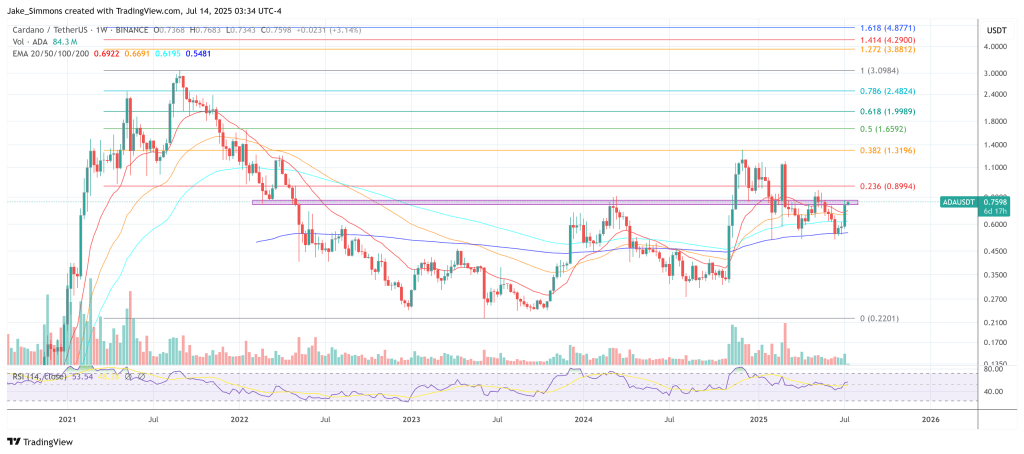
Cardano price
ADA price penetrates into key resistance zone, 1-week chart | Source: ADAUSDT on TradingView.com
Featured image from YouTube, chart from TradingView.com
Editorial Process for bitcoinist is centered on delivering thoroughly researched, accurate, and unbiased content. We uphold strict sourcing standards, and each page undergoes diligent review by our team of top technology experts and seasoned editors. This process ensures the integrity, relevance, and value of our content for our readers.

Jake Simmons has been a Bitcoin enthusiast since 2016. Ever since he heard about Bitcoin, he has been studying the topic every day and trying to share his knowledge with others. His goal is to contribute to Bitcoin's financial revolution, which will replace the fiat money system. Besides BTC and crypto, Jake studied Business Informatics at a university. After graduation in 2017, he has been working in the blockchain and crypto sector. You can follow Jake on Twitter at @realJakeSimmons.

Trending Cryptos

Related Reads

A Decade of Change: The Demise of Crypto Startups

"The Decade-Long Transformation: The Demise of Crypto Startups" The article traces the dramatic evolution of the cryptocurrency industry from its anarchic beginnings to its current highly regulated and institutionalized state. In the early days (circa 2017), launching a crypto startup was remarkably simple: a whitepaper, a GitHub repository, and a Telegram group could attract thousands of retail investors via an Initial Coin Offering (ICO). Founders operated anonymously with near-zero regulatory and financial barriers, enabling rapid, global innovation but also widespread fraud. By 2026, the landscape is fundamentally different. To operate in major markets like the US, EU, and Asia, crypto businesses must now navigate a complex web of regulations akin to traditional finance. Compliance costs are prohibitive: estimates for a US multi-state operation range from $750,000 to $1.2 million in the first three years, with annual costs exceeding $2 million thereafter. Regulations like MiCA in the EU and New York's BitLicense have created high capital and operational hurdles that act as barriers to entry. Simultaneously, venture capital investment has shifted dramatically. Following the collapses of Terra and FTX, funding has concentrated in later-stage, established companies, creating a "barbell market." Early-stage and seed funding has shrunk significantly, while mega-funds like Andreessen Horowitz's $15 billion pool dominate. Most capital now flows to trading platforms, lending infrastructure, and B2B services. This environment favors mergers and acquisitions as the primary path for growth. Companies like Coinbase and Ripple are acquiring firms like Deribit and Hidden Road not for their technology, but for their licenses, banking relationships, and institutional trust—assets far more valuable than code. Distribution channels, compliance, and brand reputation have become the new moats, overshadowing pure technical innovation. The industry's maturation brings benefits: reduced scams, increased institutional participation, and clearer regulatory frameworks. However, it comes at a cost. The low-barrier, experimental ethos that defined crypto's first decade is fading. Entrepreneurs without substantial capital, pre-existing licenses, or institutional connections face immense challenges. Funding for exploratory fields like decentralized social media or novel governance models is drying up. Ultimately, the crypto industry is replicating the consolidation pattern seen in banking and tech after the 2008 financial crisis. While this brings stability and legitimacy, it raises a critical question: in this new, resource-intensive reality, is there still room for the disruptive, from-scratch innovation that gave birth to the sector?

Foresight News21m ago

A Decade of Change: The Demise of Crypto Startups

Foresight News21m ago

Trading

Spot

Hot Articles

What is $BITCOIN

DIGITAL GOLD ($BITCOIN): A Comprehensive Analysis Introduction to DIGITAL GOLD ($BITCOIN) DIGITAL GOLD ($BITCOIN) is a blockchain-based project operating on the Solana network, which aims to combine the characteristics of traditional precious metals with the innovation of decentralized technologies. While it shares a name with Bitcoin, often referred to as “digital gold” due to its perception as a store of value, DIGITAL GOLD is a separate token designed to create a unique ecosystem within the Web3 landscape. Its goal is to position itself as a viable alternative digital asset, although specifics regarding its applications and functionalities are still developing. What is DIGITAL GOLD ($BITCOIN)? DIGITAL GOLD ($BITCOIN) is a cryptocurrency token explicitly designed for use on the Solana blockchain. In contrast to Bitcoin, which provides a widely recognized value storage role, this token appears to focus on broader applications and characteristics. Notable aspects include: Blockchain Infrastructure: The token is built on the Solana blockchain, known for its capacity to handle high-speed and low-cost transactions. Supply Dynamics: DIGITAL GOLD has a maximum supply capped at 100 quadrillion tokens (100P $BITCOIN), although details regarding its circulating supply are currently undisclosed. Utility: While precise functionalities are not explicitly outlined, there are indications that the token could be utilized for various applications, potentially involving decentralized applications (dApps) or asset tokenization strategies. Who is the Creator of DIGITAL GOLD ($BITCOIN)? At present, the identity of the creators and development team behind DIGITAL GOLD ($BITCOIN) remains unknown. This situation is typical among many innovative projects within the blockchain space, particularly those aligning with decentralized finance and meme coin phenomena. While such anonymity may foster a community-driven culture, it intensifies concerns about governance and accountability. Who are the Investors of DIGITAL GOLD ($BITCOIN)? The available information indicates that DIGITAL GOLD ($BITCOIN) does not have any known institutional backers or prominent venture capital investments. The project seems to operate on a peer-to-peer model focused on community support and adoption rather than traditional funding routes. Its activity and liquidity are primarily situated on decentralized exchanges (DEXs), such as PumpSwap, rather than established centralized trading platforms, further highlighting its grassroots approach. How DIGITAL GOLD ($BITCOIN) Works The operational mechanics of DIGITAL GOLD ($BITCOIN) can be elaborated on based on its blockchain design and network attributes: Consensus Mechanism: By leveraging Solana’s unique proof-of-history (PoH) combined with a proof-of-stake (PoS) model, the project ensures efficient transaction validation contributing to the network's high performance. Tokenomics: While specific deflationary mechanisms have not been extensively detailed, the vast maximum token supply implies that it may cater to microtransactions or niche use cases that are still to be defined. Interoperability: There exists the potential for integration with Solana’s broader ecosystem, including various decentralized finance (DeFi) platforms. However, the details regarding specific integrations remain unspecified. Timeline of Key Events Here is a timeline that highlights significant milestones concerning DIGITAL GOLD ($BITCOIN): 2023: The initial deployment of the token occurs on the Solana blockchain, marked by its contract address. 2024: DIGITAL GOLD gains visibility as it becomes available for trading on decentralized exchanges like PumpSwap, allowing users to trade it against SOL. 2025: The project witnesses sporadic trading activity and potential interest in community-led engagements, although no noteworthy partnerships or technical advancements have been documented as of yet. Critical Analysis Strengths Scalability: The underlying Solana infrastructure supports high transaction volumes, which could enhance the utility of $BITCOIN in various transaction scenarios. Accessibility: The potential low trading price per token could attract retail investors, facilitating wider participation due to fractional ownership opportunities. Risks Lack of Transparency: The absence of publicly known backers, developers, or an audit process may yield skepticism regarding the project's sustainability and trustworthiness. Market Volatility: The trading activity is heavily reliant on speculative behavior, which can result in significant price volatility and uncertainty for investors. Conclusion DIGITAL GOLD ($BITCOIN) emerges as an intriguing yet ambiguous project within the rapidly evolving Solana ecosystem. While it attempts to leverage the “digital gold” narrative, its departure from Bitcoin's established role as a store of value underscores the need for a clearer differentiation of its intended utility and governance structure. Future acceptance and adoption will likely depend on addressing the current opacity and defining its operational and economic strategies more explicitly. Note: This report encompasses synthesised information available as of October 2023, and developments may have transpired beyond the research period.

627 Total ViewsPublished 2025.05.13Updated 2025.05.13

What is $BITCOIN

Discussions

Welcome to the HTX Community. Here, you can stay informed about the latest platform developments and gain access to professional market insights. Users' opinions on the price of BTC (BTC) are presented below.

活动图片