PumpFun борется за сохранение лидерства на фоне обострения конкуренции на стартовой площадке Solana

cryptonews.ruPublished on 2024-03-12Last updated on 2025-07-12

  • LetsBonk сокращает разрыв в доходах с PumpFun на фоне обострения войны за стартовую площадку Solana
  • Токены на базе Bonk доминируют среди новых проектов, занимая более 60% доли рынка.
  • Совокупный доход от запуска стабилизируется, что свидетельствует о насыщении или миграции пользователей

Экосистема стартовой площадки мемкоинов Соланы переживает резкие перемены: стартовая площадка LetsBonk, поддерживаемая Bonk, становится серьёзным конкурентом как по активности, так и по выручке. В секторе стартовых площадок, где ранее доминировал Pump.Fun, сейчас разворачивается ожесточённая борьба за долю рынка, что стало очевидно с конца июня: LetsBonk демонстрирует заметный рост выручки и объёма выпуска токенов.

До долгожданной распродажи токенов остался всего один день, и рыночные аналитики внимательно следят за дальнейшими действиями Pump.Fun. Тем временем экосистема мемкоина Solana демонстрирует признаки растущей конкуренции и изменения предпочтений пользователей, что, возможно, подготавливает почву для более масштабных преобразований, вызванных изменением предпочтений пользователей и потоков капитала.

Гонка за доходами обостряется

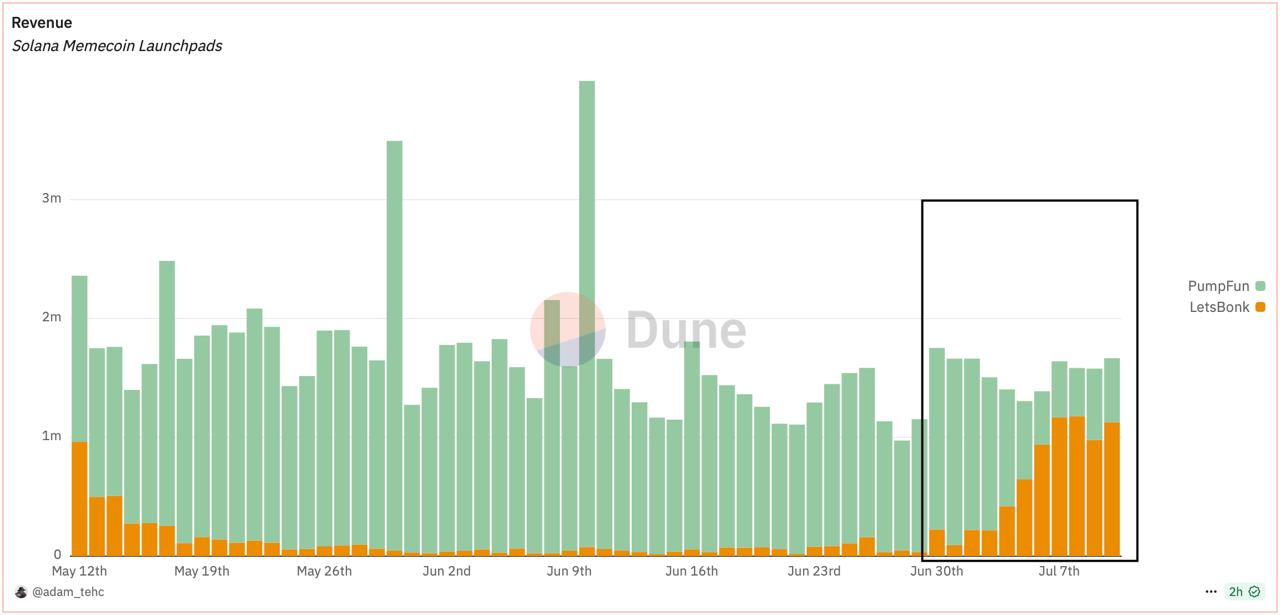
На протяжении всего второго квартала Pump.Fun сохранял уверенное лидерство, стабильно получая более 1,5 млн долларов ежедневной выручки и достигнув пика около 3,5 млн долларов в начале июня. Однако в последнее время это доминирование оказалось под угрозой.

С конца июня LetsBonk стремительно набирает популярность: к началу июля ежедневный доход превысил 1 миллион долларов. Этот внезапный скачок сократил разрыв между двумя платформами, сигнализируя о возможном поворотном моменте в борьбе за внимание пользователей.
Источник: Newsmaker

В настоящее время совокупный доход обеих платформ стабилизировался на уровне от 2 до 2,5 миллионов долларов в день, что указывает на растущую насыщенность или изменение распределения капитала среди пользователей launchpad.

Таким образом, способность PumpFun быстро завершить предстоящую продажу может повлиять на общие настроения рынка. Успешный запуск может вселить новый оптимизм в платформу, в то время как любая задержка или неудовлетворительные результаты могут ускорить миграцию пользователей на LetsBonk.

По теме: Обновление PumpFun: вызовет ли запуск $PUMP скачок цен?

Развертывания токенов выявляют новые тенденции

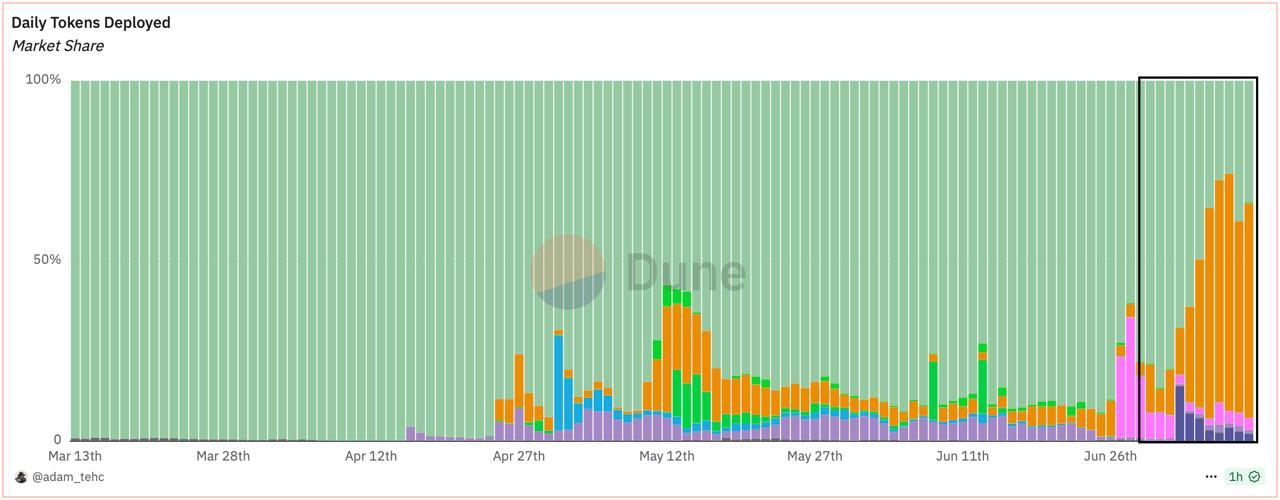
Помимо выручки, изменение ландшафта отражается в доле рынка, которую ежедневно выпускают токены. Примечательно, что ранее Pump.Fun практически полностью доминировал на рынке, особенно с марта по середину мая. Однако волна новых участников в конце июня ослабила этот контроль, и токены, выпущенные через платформы на базе Bonk, привлекли внимание.
Источник: Newsmaker

Ближе к последней неделе июня, ровно после 26 июня, сдвиг стал заметен после того, как доля LetsBonk в новых запусках резко возросла. К 11 июля токены на базе Bonk заняли более 60% рынка, что свидетельствует о явном изменении предпочтений пользователей. Этот импульс свидетельствует не только о любопытстве, но и, возможно, о устойчивом интересе к проектам на базе Bonk. Более того, это давление усилило потребность в инновациях, улучшении пользовательского опыта и усилении взаимодействия с сообществом. По мере того, как обе платформы стремятся улучшить свои сервисы, более обширное пространство для запуска мем-коинов на Solana становится более динамичным и сегментированным.

По теме: Неопределенность омрачает планы по выпуску токенов Pumpfun, несмотря на официальный отказ


Trending Cryptos

Related Reads

When US Giants Collectively "Defect" to Chinese AI Models

When Silicon Valley Giants Turn to Chinese AI Models to Cut Costs A surprising trend is emerging: major U.S. tech companies are significantly reducing AI costs by switching to Chinese models. Coinbase, the largest U.S. cryptocurrency exchange, reportedly halved its AI spending after migrating to China's GLM-5.2 and Kimi 2.7 models, despite increasing usage. They achieved this through a sophisticated three-part strategy: implementing an automatic routing system to select the most cost-effective model per task, boosting cache hit rates from 5% to 60% to reuse computations, and employing "context engineering" to provide AI with more precise, less cluttered information. They are not alone. AI startup Lindy switched from Claude to DeepSeek, saving millions, while Snowflake's tests found GLM-5.2 solved 66% of coding tasks compared to Claude Opus's 67%—but at a fraction of the cost (output pricing is 5-7 times lower). While the top Western models may offer slightly better stability, the massive price differential is leading many businesses to reconsider their value proposition. This shift signals a deeper change in the AI industry, moving beyond pure performance benchmarks to a fierce cost competition. As pressure mounts, even OpenAI and Anthropic have begun slashing prices. For users, this means more choices, lower costs, and a crucial lesson: using multiple models based on task complexity, optimizing with caching, and keeping contexts lean are now key to leveraging AI efficiently and affordably.

marsbit7m ago

When US Giants Collectively "Defect" to Chinese AI Models

marsbit7m ago

BIS Report Compliance Watch: The Real Risks of Stablecoins Are Not Just 'De-pegging'

BIS Report Compliance Observations: The real risks of stablecoins go beyond "depegging" The BIS report "Anchoring trust in money: innovation beyond stablecoins" argues that while stablecoins and tokenization offer efficiency gains, their primary risk lies in fitting into an identifiable, monitorable, accountable, and regulatable financial system. Money's trust stems not just from technology but from institutional arrangements: a common unit of account, guaranteed redemption at par, liquidity support, regulatory frameworks, and financial integrity requirements. Stablecoins, operating on permissionless blockchains with pseudo-anonymity and non-custodial wallets, create systemic compliance gaps: unclear customer identity, incomplete fund origins, unexplained transaction purposes, fragmented cross-chain paths, and ambiguous liability. On-chain transparency does not equal compliance transparency. Public addresses don't reveal identity or intent. While blockchain analytics aid law enforcement, they cannot replace routine, large-scale AML/CFT controls. Effective compliance requires a closed-loop process encompassing customer onboarding, transaction monitoring, investigation, reporting, and audit. Stablecoin risks are not confined to the blockchain; they re-enter the traditional financial system via on/off-ramps, exchanges, and payment institutions. This forces banks to monitor client accounts for activity linked to virtual assets. The future direction is not to prohibit innovation but to embed rules into the technology. Tokenized finance should integrate with the existing two-tier monetary system, embedding compliance—like customer identification, pre-transaction screening, and auditable data trails—directly into the transaction flow. For compliance professionals, the key takeaway is that any new financial instrument must answer core questions: Who identifies the customer? Who monitors transactions? Who handles exceptions? Who is liable? Compliance is not the antithesis of innovation but the essential infrastructure for its sustainable growth.

链捕手8m ago

BIS Report Compliance Watch: The Real Risks of Stablecoins Are Not Just 'De-pegging'

链捕手8m ago

When American Giants 'Defect' to Chinese AI Models

Summary: The trend of major U.S. technology firms adopting more cost-effective Chinese AI models is gaining momentum. A prime example is Coinbase, the largest U.S. cryptocurrency exchange, which reportedly halved its AI expenditure by switching to Chinese models GLM-5.2 and Kimi 2.7, while its usage volume increased. This was achieved through a sophisticated cost-saving system featuring intelligent model routing (selecting the most suitable model per task), dramatically improving cache hit rates from 5% to 60%, and implementing "Context Engineering" to streamline prompts. This shift is not isolated. Other companies like the AI startup Lindy and data cloud firm Snowflake are making similar moves, drawn by the significant price disparity. For instance, GLM-5.2 costs $1.40/$4.40 per million tokens (input/output), compared to $5/$25 for Claude Opus 4.7. While top Western models may offer slightly higher stability or speed in complex tasks, the performance gap is narrowing, making the price difference harder to justify for many enterprise use cases. The implications are significant for both businesses and individual users. It highlights the importance of a multi-model strategy based on task requirements, the value of caching and reusing outputs, and the effectiveness of providing concise context. Ultimately, this migration signals a potential reshaping of the AI industry's pricing model, moving competition from pure performance benchmarks to practical cost-effectiveness, with increased choice and downward price pressure benefiting end-users.

链捕手14m ago

When American Giants 'Defect' to Chinese AI Models

链捕手14m ago

Trading

Spot

Hot Articles

Discussions

Welcome to the HTX Community. Here, you can stay informed about the latest platform developments and gain access to professional market insights. Users' opinions on the price of SOL (SOL) are presented below.

活动图片