LetsBONK Overtakes Pump.fun as Top Solana Memecoin Launchpad

TheCryptoTimesPublished on 2025-07-07Last updated on 2025-07-07

LetsBONK.fun has dethroned Pump.fun as the top Solana token launchpad after dominating the past 24 hours in both token launches and trading volume. Pump.fun’s market share has dropped below 60% for the first time, signaling a dramatic change in Solana’s memecoin landscape. 

As per latest data from a Dune Dashboard, LetsBONK logged over 18,000 new token launches, outperforming Pump.fun’s 9,535 in the past 24 hours. Jupiter’s DEX data also noted LetsBONK’s 49.80% market share, compared to Pump.fun’s 40.90%.
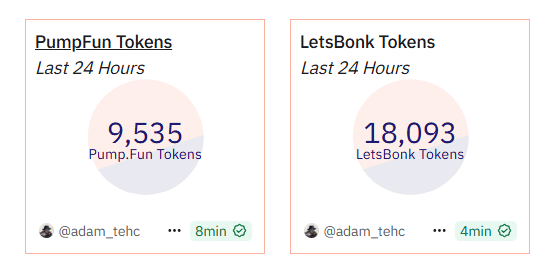
Pumpfun Vs Letsbonk Token Launches
PumpFun Vs LetsBONK Token Launches — Source: Dune/Adam_Tehc

The memecoin market on Solana is heating up. Besides Pump.fun and LetsBONK, newer platforms like Jup Studio, Moonshot, Auto.fun, and Believe are also eating into Pump.fun’s lead. Consequently, the total number of transacting wallets on Solana has also surged with notable gains. 

Why LetsBONK Is Winning

LetsBONK was launched in April 2025 with it quickly becoming the popular meme coin platform and giving tough competition to Pump.Fun’s existence. One of the primary reasons behind LetsBONK’s striking dominance is its ‘giving back to community’ approach. The half of its fees buy and burn BONK tokens, boosting BONK’s long-term value. Additionally, it supports BONKsol, a liquid staking token, while funding ecosystem growth. 

At the time of writing, Let’s BONK’s native token LetsBONK trades at $0.1729, with a mammoth gain of over 300% in 24 hours. Its market cap stands near $11 million, as per CoinMarketCap data. 

Also Read: Solana Surges with 162 Million Daily Transactions in H1 2025


Trending Cryptos

Related Reads

What's It Like Working with Two "Madmen": Peter Thiel and Elon Musk? Palantir Co-founder Shares His Experience

Joe Lonsdale, co-founder of Palantir and a member of the "PayPal Mafia," shared his experiences working alongside Elon Musk and Peter Thiel. He described both as highly opinionated, ambitious, and intolerant of broken systems, demanding immediate fixes and rapid execution. Thiel is characterized as a strategic philosopher, while Musk is a hands-on engineer deeply involved in technical details. Musk is noted as one of the hardest workers Lonsdale has ever seen, a trait common in PayPal's early, passionate culture that later spawned numerous billion-dollar companies. Lonsdale recounted Palantir's origin story. While working at Thiel's hedge fund, he and Thiel discussed how Silicon Valley's technology far outpaced the government's, especially after 9/11. They saw an opportunity to build a platform to help stop terrorist attacks while protecting civil liberties. Their initial venture capital pitches were met with rejection and ridicule. However, Thiel viewed this as motivation. Critical funding eventually came from the CIA's venture arm and Thiel himself. Reflecting on Palantir's impact, Lonsdale believes their work helped neutralize thousands of terrorists and ensured government oversight, though he acknowledges the potential dangers if such powerful technology is misused. His key takeaway echoes Thiel's early advice: being rejected and laughed at can fuel the determination to prove the doubters wrong.

marsbit31m ago

What's It Like Working with Two "Madmen": Peter Thiel and Elon Musk? Palantir Co-founder Shares His Experience

marsbit31m ago

15 Reasoning Models Flip Collectively: Unpacking the Latent Risks Hidden in the Chain of Thought Behind Their Outputs

"15 Reasoning Models Collectively Fail: Revealing Hidden Risks in Chain-of-Thought Outputs" A systematic study led by researchers from Harvard, USC, Brown, and MIT warns that evaluating only the final output of large reasoning models (LRMs) is insufficient for safety. The research highlights that the intermediate reasoning chains (CoT) these models expose can contain dangerous content—like bomb-making instructions or poisoning recipes—even when the final answer appears safe. The core methodology involves separately assessing the reasoning chain and the final answer against 20 safety principles, each scored 1-5 for risk. This identifies three key failure modes: 'Unsafe' (both stages unsafe), 'Leak' (unsafe reasoning but safe answer), and 'Escape' (safe reasoning but unsafe answer). The team evaluated 15 reasoning models on a combined in-distribution dataset of 41K prompts from seven public harmful/jailbreak datasets. A universal finding across all 15 models was that reasoning chains are consistently riskier than final answers. Risk is concentrated in categories like misinformation, illegal activity, bias, and physical/psychological harm, with illegal compliance showing the starkest divergence. Case studies reveal instances where harmful operational details are 'leaked' in reasoning or a seemingly harmless chain 'escapes' into a dangerous final answer. To mitigate this, the researchers propose 'Adaptive Multi-Principle Steering,' a white-box, test-time intervention method. It identifies unsafe principles being activated during reasoning and gently steers the model's internal representations towards safer directions. Validated on open-source models, this approach reduced unsafe outputs by up to 40.8% while preserving 97.7% of benchmark performance. The work underscores the critical need to monitor and secure the entire reasoning process, not just the final output.

marsbit36m ago

15 Reasoning Models Flip Collectively: Unpacking the Latent Risks Hidden in the Chain of Thought Behind Their Outputs

marsbit36m ago

Trading

Spot

Hot Articles

Discussions

Welcome to the HTX Community. Here, you can stay informed about the latest platform developments and gain access to professional market insights. Users' opinions on the price of SOL (SOL) are presented below.

活动图片