Bitcoin Is Inevitable—But Lightning Is A Dead End, Warns Former Core Dev Garzik

bitcoinistPublished on 2025-07-04Last updated on 2025-07-04

Abstract

Fifteen years after he first committed code to Bitcoin Core, Jeff Garzik still thinks the protocol will “outlast everything,” yet...

Trusted Editorial content, reviewed by leading industry experts and seasoned editors. Ad Disclosure

Fifteen years after he first committed code to Bitcoin Core, Jeff Garzik still thinks the protocol will “outlast everything,” yet he no longer believes its flagship scaling project can keep pace with user demand. During a conversation with Bitcoin historian Pete Rizzo, the Hemi founder dismissed the Lightning Network as a “red herring” and laid out a roadmap in which programmable Layer-2s, not payment channels, bring the next billion users to BTC.

Bitcoin Lightning Is A Dead End

“Lightning is a failure. Very few people are using it, and it kept BTC locked on a bad sidetrack,” Garzik said, adding that the network “was a way to pump Lightning instead of alternate working solutions like layer-twos.”
He pointed to hard numbers: “Look at the outcome. We have roughly 5,000 BTC on Lightning after seven years. Wrapped Bitcoin on Ethereum alone is 25 × that. Capital has already voted.”

Garzik blames Lightning’s limited traction on what he calls Bitcoin’s “vetocracy”—a governance culture in which any one faction can veto consensus changes. That culture, he argues, has “o-ified” the base layer since the 2017 block-size stalemate: “Bitcoin development basically stopped after 2017. OP_CAT, covenants—perfectly safe opcodes—have been studied to death, but the politics won’t let them in. So builders left. They went where they could ship.”

According to the former Core maintainer, the flight is measurable. Public Lightning capacity hovers near 5,300 BTC, or roughly $500 million, while Wrapped BTC and related bridged tokens now exceed 130,000 BTC—over $14 billion in raw collateral. Node counts tell the same story: about 16,000 publicly visible Lightning nodes versus more than 600,000 addresses holding Wrapped BTC.

Garzik’s critique is philosophical as well as technical. He repeated a line that startled the live audience: “Bitcoin is a social network first and a monetary network second. Its value comes from people coordinating around it, not from any single line of code. But that same social layer can veto innovation, and that’s how we got stuck.”

Because the social consensus resists base-layer change, Garzik sees the future in sidechains like his own project, Hemi. The platform embeds a fully validating BTC node inside an Ethereum-compatible roll-up, secured by proof-of-proof mining and BitVM fraud proofs. Smart contracts can “read and act on Bitcoin Layer-1 without custodial bridges,” he said, calling the design “EVM trial-by-fire grafted onto Bitcoin super-finality.”

“All the things built in the past fifteen years—stablecoins, DeFi, identity—are coming to Bitcoin. The only question is whether Lightning zealots will stand in the way.”

Lightning proponents note that capacity figures exclude private channels and that routing revenues are beginning to attract professional operators. Yet even bullish research from Fidelity Digital Assets concedes that public capacity has plateaued between 4,400 BTC and 5,600 BTC since 2022, growing far more in dollar terms than in coins.

Garzik argues that stagnation is structural: “Lightning is great if you want to move a coffee-cup’s worth of Bitcoin at light speed. It’s useless if you want autonomous lending, derivatives, or billion-dollar settlement. For that you need programmable trust, and Lightning doesn’t have it.”

But Bitcoin Will Outlive Everything

Despite the criticism, Garzik underlined that BTC’s monetary role is secure. “Bitcoin will live alongside gold. It’s the trunk; everything else is the foliage,” he said. The inevitability thesis rests on network effects, regulatory clarity, and deep-pocketed holders such as sovereign wealth funds: “Every incentive in the system points back to Bitcoin. That won’t change.”

But inevitability, he warned, is not growth: “Bitcoin isn’t going away, but it isn’t upgrading either. If we want self-sovereignty for eight billion people, we have to extend programmability without compromising the asset the world already trusts. That means Layer-2s—and that means leaving Lightning in the rear-view mirror.”

Whether the broader ecosystem agrees may hinge on tangible metrics in the coming year: capital allocated to Lightning versus emerging BitVM roll-ups, node counts versus wrapped-BTC supply, and, ultimately, the fees users are willing to pay for each path. For now, Garzik’s message is blunt: Bitcoin’s future is assured, but Lightning is not.

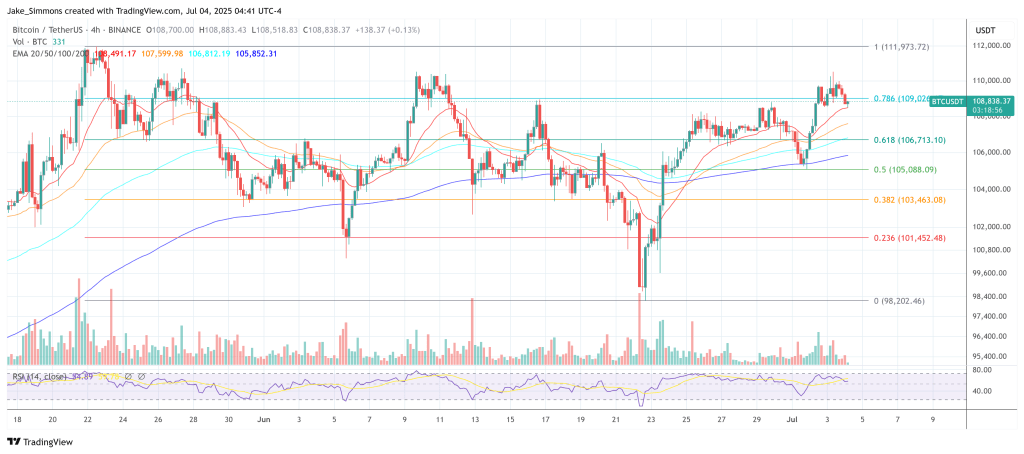
At press time, BTC traded at $108,838.
Bitcoin price
BTC retraces to the EMA20, 4-hour chart | Source: BTCUSDT on TradingView.com
Featured image created with DALL.E, chart from TradingView.com
Editorial Process for bitcoinist is centered on delivering thoroughly researched, accurate, and unbiased content. We uphold strict sourcing standards, and each page undergoes diligent review by our team of top technology experts and seasoned editors. This process ensures the integrity, relevance, and value of our content for our readers.

Jake Simmons has been a Bitcoin enthusiast since 2016. Ever since he heard about Bitcoin, he has been studying the topic every day and trying to share his knowledge with others. His goal is to contribute to Bitcoin's financial revolution, which will replace the fiat money system. Besides BTC and crypto, Jake studied Business Informatics at a university. After graduation in 2017, he has been working in the blockchain and crypto sector. You can follow Jake on Twitter at @realJakeSimmons.

Trending Cryptos

Related Reads

With Mining Profits Depressed, What Kind of Mining Companies Can Survive a Bear Market?

Mining Profitability Slumps: Which Miners Can Survive the Bear Market? A comprehensive Bitcoin miner stress indicator has recently hit a historically low "extreme stress" zone, aligning with the typical market cycle pattern where industry bottoms coincide with severe miner pressure. The current situation presents a direct survival test: if hashprice (daily USD revenue per PH/s of computing power) remains weak, only the most robust mining firms will endure. Hashprice, which incorporates block rewards, transaction fees, network difficulty, and BTC price, is the core metric for mining profitability. Despite Bitcoin's price holding above previous lows, profitability is shrinking due to rising difficulty and low fees. Recent data shows hashprice around $32-33/PH/s/day, with a significant divide: newer, energy-efficient rigs (<19 J/TH) generate ~$81 per megawatt, while older, inefficient models (25-38 J/TH) make only ~$43/MW. This gap is forcing inefficient operators to shut down. The industry has a self-correcting mechanism. As high-cost miners power down, the network's total computing power (hashrate) drops. This eventually triggers a downward adjustment in mining difficulty, increasing the rewards for remaining miners. Data from Q2 2026 shows the hashrate has already fallen by 5.8%, with an estimated 252 EH/s of inefficient mining capacity idled. Firms at risk of淘汰 (elimination) are those reliant on old hardware, high electricity costs, and significant debt. Survivors will likely be miners with newer equipment, low-cost power contracts, strong cash reserves, and flexible operations. A key trend is diversification into AI and high-performance computing (HPC) hosting, though this path is only viable for miners with the necessary infrastructure, capital, and clients. The miner stress indicator serves as a warning, not a precise timing tool for a market bottom. Key signals to watch are whether hashprice stabilizes above ~$30, difficulty continues to adjust downward, hashrate finds a floor, and miner Bitcoin selling subsides. The duration of this low-profitability period will act as a solvency test, determining which miners are positioned to survive and eventually benefit from the next cycle.

Foresight News11m ago

With Mining Profits Depressed, What Kind of Mining Companies Can Survive a Bear Market?

Foresight News11m ago

Blood Loss of $55 Million Selling 3,588 BTC, Strategy Becomes a Literal Scumbag

On July 6th, Strategy (formerly MicroStrategy) disclosed in an SEC filing that it sold 3,588 Bitcoin (BTC) between June 29th and July 5th for approximately $216 million, at an average price of ~$60,200. This marked the company's largest net sale since initiating its Bitcoin strategy in 2020 and its first institutionalized reduction of its core holding. The sale resulted in a realized loss of about $54.8 million, as the selling price was below its average cost basis of ~$75,476 per BTC. The proceeds were used to pay preferred stock dividends and replenish USD reserves. This move follows a new "Digital Credit Capital Framework" approved on June 29th, authorizing the sale of up to $1.25 billion in Bitcoin. The sale consumes roughly 17% of this authorized amount in its first week. Strategy's foundational narrative, built by founder Michael Saylor, was a commitment to "never sell" Bitcoin. The recent institutionalized selling framework and these substantial sales represent a significant shift from that original promise. While the amount sold is only 0.4% of Strategy's total holdings of 843,775 BTC, the action challenges the premium at which its stock (MSTR) trades relative to its Bitcoin holdings. Investors had priced in the "never sell" narrative. The company now faces a contradiction: it sells Bitcoin at a loss to pay dividends on the preferred stock it issued to fund Bitcoin purchases. Saylor has framed selling as a tool for future strategic purchases, but each sale erodes the credibility of the original commitment, potentially threatening the premium valuation of MSTR shares.

Foresight News1h ago

Blood Loss of $55 Million Selling 3,588 BTC, Strategy Becomes a Literal Scumbag

Foresight News1h ago

Trading

Spot

Hot Articles

What is $BITCOIN

DIGITAL GOLD ($BITCOIN): A Comprehensive Analysis Introduction to DIGITAL GOLD ($BITCOIN) DIGITAL GOLD ($BITCOIN) is a blockchain-based project operating on the Solana network, which aims to combine the characteristics of traditional precious metals with the innovation of decentralized technologies. While it shares a name with Bitcoin, often referred to as “digital gold” due to its perception as a store of value, DIGITAL GOLD is a separate token designed to create a unique ecosystem within the Web3 landscape. Its goal is to position itself as a viable alternative digital asset, although specifics regarding its applications and functionalities are still developing. What is DIGITAL GOLD ($BITCOIN)? DIGITAL GOLD ($BITCOIN) is a cryptocurrency token explicitly designed for use on the Solana blockchain. In contrast to Bitcoin, which provides a widely recognized value storage role, this token appears to focus on broader applications and characteristics. Notable aspects include: Blockchain Infrastructure: The token is built on the Solana blockchain, known for its capacity to handle high-speed and low-cost transactions. Supply Dynamics: DIGITAL GOLD has a maximum supply capped at 100 quadrillion tokens (100P $BITCOIN), although details regarding its circulating supply are currently undisclosed. Utility: While precise functionalities are not explicitly outlined, there are indications that the token could be utilized for various applications, potentially involving decentralized applications (dApps) or asset tokenization strategies. Who is the Creator of DIGITAL GOLD ($BITCOIN)? At present, the identity of the creators and development team behind DIGITAL GOLD ($BITCOIN) remains unknown. This situation is typical among many innovative projects within the blockchain space, particularly those aligning with decentralized finance and meme coin phenomena. While such anonymity may foster a community-driven culture, it intensifies concerns about governance and accountability. Who are the Investors of DIGITAL GOLD ($BITCOIN)? The available information indicates that DIGITAL GOLD ($BITCOIN) does not have any known institutional backers or prominent venture capital investments. The project seems to operate on a peer-to-peer model focused on community support and adoption rather than traditional funding routes. Its activity and liquidity are primarily situated on decentralized exchanges (DEXs), such as PumpSwap, rather than established centralized trading platforms, further highlighting its grassroots approach. How DIGITAL GOLD ($BITCOIN) Works The operational mechanics of DIGITAL GOLD ($BITCOIN) can be elaborated on based on its blockchain design and network attributes: Consensus Mechanism: By leveraging Solana’s unique proof-of-history (PoH) combined with a proof-of-stake (PoS) model, the project ensures efficient transaction validation contributing to the network's high performance. Tokenomics: While specific deflationary mechanisms have not been extensively detailed, the vast maximum token supply implies that it may cater to microtransactions or niche use cases that are still to be defined. Interoperability: There exists the potential for integration with Solana’s broader ecosystem, including various decentralized finance (DeFi) platforms. However, the details regarding specific integrations remain unspecified. Timeline of Key Events Here is a timeline that highlights significant milestones concerning DIGITAL GOLD ($BITCOIN): 2023: The initial deployment of the token occurs on the Solana blockchain, marked by its contract address. 2024: DIGITAL GOLD gains visibility as it becomes available for trading on decentralized exchanges like PumpSwap, allowing users to trade it against SOL. 2025: The project witnesses sporadic trading activity and potential interest in community-led engagements, although no noteworthy partnerships or technical advancements have been documented as of yet. Critical Analysis Strengths Scalability: The underlying Solana infrastructure supports high transaction volumes, which could enhance the utility of $BITCOIN in various transaction scenarios. Accessibility: The potential low trading price per token could attract retail investors, facilitating wider participation due to fractional ownership opportunities. Risks Lack of Transparency: The absence of publicly known backers, developers, or an audit process may yield skepticism regarding the project's sustainability and trustworthiness. Market Volatility: The trading activity is heavily reliant on speculative behavior, which can result in significant price volatility and uncertainty for investors. Conclusion DIGITAL GOLD ($BITCOIN) emerges as an intriguing yet ambiguous project within the rapidly evolving Solana ecosystem. While it attempts to leverage the “digital gold” narrative, its departure from Bitcoin's established role as a store of value underscores the need for a clearer differentiation of its intended utility and governance structure. Future acceptance and adoption will likely depend on addressing the current opacity and defining its operational and economic strategies more explicitly. Note: This report encompasses synthesised information available as of October 2023, and developments may have transpired beyond the research period.

655 Total ViewsPublished 2025.05.13Updated 2025.05.13

What is $BITCOIN

Discussions

Welcome to the HTX Community. Here, you can stay informed about the latest platform developments and gain access to professional market insights. Users' opinions on the price of BTC (BTC) are presented below.

活动图片