New Research Predicts Ethereum At $706,000—ETH’s Wildest Target Yet

bitcoinistPublished on 2025-07-04Last updated on 2025-07-04

Abstract

A newly published, 38-page research titled The Bull Case for ETH contends that Ethereum (ETH) could ultimately command a fully...

Trusted Editorial content, reviewed by leading industry experts and seasoned editors. Ad Disclosure

A newly published, 38-page research titled The Bull Case for ETH contends that Ethereum (ETH) could ultimately command a fully diluted market capitalization of roughly $85 trillion, implying a long-run price near $706,000 per coin. The work—dated June 2025 and signed by twenty-one contributors including core researcher Danny Ryan, Bankless co-founder Ryan Sean Adams, and investor Vivek Raman—seeks to re-frame ETH as “digital oil”: a yield-bearing, deflationary reserve asset that simultaneously powers and secures the emerging on-chain economy.

The authors open with the claim that the global financial system “is on the cusp of a generational transformation, as assets worldwide become digitized and transition on-chain.” In this transition, they argue, Ethereum has “emerged as [the] foundation” because it combines the deepest developer community with “unparalleled reliability and zero downtime.”

Yet, they add, ETH the asset “remains among the most significantly mispriced opportunities in global markets today,” still trading well below its 2021 peak despite a series of technical upgrades and solidifying dominance in tokenized assets and stable-coin settlement.

“ETH is the next generational asymmetric investment opportunity, positioned to emerge as a core holding for institutional digital-asset portfolios,” the report states. “It is digital oil—the fuel, collateral, and reserve asset powering the internet’s new financial system.”

Framing Ethereum Against Traditional Stores Of Value

To reach the headline valuation, the study compares Ethereum’s native asset with four established reservoirs of value: proven crude-oil reserves (~ $85 trillion), gold (~ $22 trillion), the global bond market (~ $141 trillion) and worldwide broad money supply, M2 (~ $93 trillion). averaging those four benchmarks yields an indicative “long-term potential” of $85 trillion for ETH’s aggregate valuation, or roughly $706,000 per coin.

The authors emphasise that this figure is not a price target on a timetable but rather an end-state equilibrium if Ethereum succeeds in acting simultaneously as energy commodity, monetary metal, sovereign-grade collateral and base-layer money for a digital economy.

Crucial to their thesis is Ethereum’s monetary design. Gross issuance tops out at 1.51 percent of supply per year, while roughly 80 percent of transaction fees are destroyed, driving net issuance toward deflation as on-chain activity rises.

Since the September 2022 merge to proof-of-stake, the study notes, effective supply growth has hovered near 0.09 percent—lower than both fiat money and Bitcoin. The report frames this programme as “predictable scarcity” that contrasts with Bitcoin’s hard-cap model, which the authors argue may eventually under-incentivise miners and weaken Bitcoin’s security budget.

Another pillar is staking yield: validators earn base issuance plus a share of fees for securing the chain, making staked ETH “a productive, yield-bearing digital commodity.” The paper likens that yield to gold-lending revenue or oil-reserve leasing, but emphasises that, unlike those physical commodities, ETH’s yield is natively programmable and automatically compounding.

Roughly 32.6 percent of the current ETH supply already serves as collateral in DeFi or enterprise infrastructure, while an additional 3.5 percent has migrated to other blockchains. As tokenized real-world assets proliferate, the authors foresee rising demand for a “globally neutral, censorship-resistant reserve asset” within settlement protocols—an economic role they argue only ETH can fill without external counterparty risk.

Near-Term And Medium-Term Milestones For ETH

While the ultimate scenario envisions a six-figure ETH, the study outlines interim milestones: a “short-term” price of $8,000 (~US $1 trillion market cap) and a “medium-term” level of $80,000 (~US $10 trillion). Four catalysts are identified: First, the rapid tokenization of real-world assets and institutional on-chain infrastructure. Second is the institutional appetite for native staking yield, especially once staked-ETH exchange-traded funds come to market.

The third argument is the “race to stockpile ETH,” evidenced by an embryonic strategic-reserve pool that already counts nearly US $2 billion in publicly disclosed holdings. Moreover, the authors predict growing use of ETH in treasury management, where its neutrality, programmability and yield allow automated collateral, escrows and payments.

“ETH stands alone as the neutral reserve asset uniquely positioned to secure and power the global tokenized financial system,” the authors write, characterising the current market price as “a temporary mispricing, not a structural weakness.”

However, the report’s authors also concede that Ethereum’s complexity makes valuation “more challenging” than Bitcoin’s simpler digital-gold narrative. They also warn that ETH cannot be modelled like a technology equity: discounted-cash-flow methods capture neither ETH’s commodity burn nor its role as base-layer collateral.

Nevertheless, they argue that multipronged utility—fuel, store of value, collateral and yield—creates an upside “which could even surpass Bitcoin’s.” In their words, ETH is “an entirely new category of asset,” requiring comparables drawn from energy, monetary metals, sovereign bonds and global money supplies rather than from fee-generating software platforms.

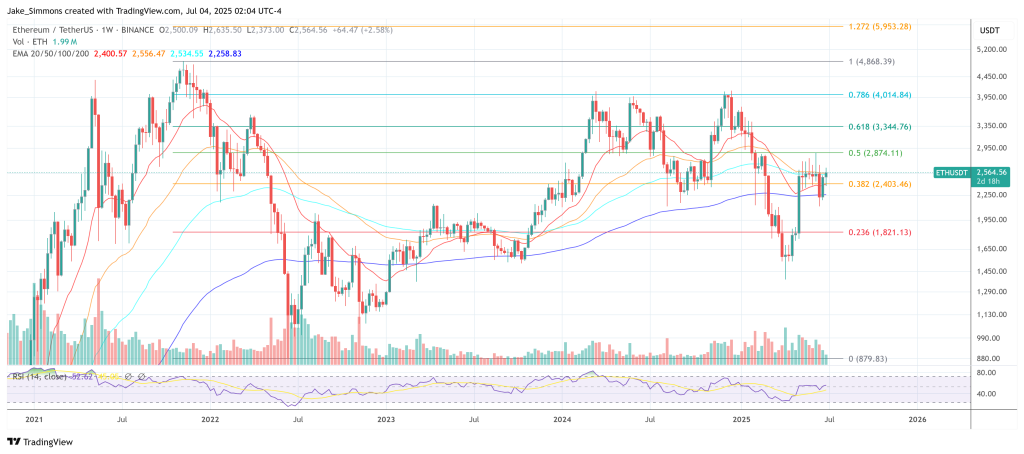
At press time, ETH traded at $2,564.
Ethereum price
ETH price, 1-week chart | Source: ETHUSDT on TradingView.com
Featured image created with DALL.E, chart from TradingView.com
Editorial Process for bitcoinist is centered on delivering thoroughly researched, accurate, and unbiased content. We uphold strict sourcing standards, and each page undergoes diligent review by our team of top technology experts and seasoned editors. This process ensures the integrity, relevance, and value of our content for our readers.

Jake Simmons has been a Bitcoin enthusiast since 2016. Ever since he heard about Bitcoin, he has been studying the topic every day and trying to share his knowledge with others. His goal is to contribute to Bitcoin's financial revolution, which will replace the fiat money system. Besides BTC and crypto, Jake studied Business Informatics at a university. After graduation in 2017, he has been working in the blockchain and crypto sector. You can follow Jake on Twitter at @realJakeSimmons.

Trending Cryptos

Related Reads

With Mining Profits Depressed, What Kind of Mining Companies Can Survive a Bear Market?

Mining Profitability Slumps: Which Miners Can Survive the Bear Market? A comprehensive Bitcoin miner stress indicator has recently hit a historically low "extreme stress" zone, aligning with the typical market cycle pattern where industry bottoms coincide with severe miner pressure. The current situation presents a direct survival test: if hashprice (daily USD revenue per PH/s of computing power) remains weak, only the most robust mining firms will endure. Hashprice, which incorporates block rewards, transaction fees, network difficulty, and BTC price, is the core metric for mining profitability. Despite Bitcoin's price holding above previous lows, profitability is shrinking due to rising difficulty and low fees. Recent data shows hashprice around $32-33/PH/s/day, with a significant divide: newer, energy-efficient rigs (<19 J/TH) generate ~$81 per megawatt, while older, inefficient models (25-38 J/TH) make only ~$43/MW. This gap is forcing inefficient operators to shut down. The industry has a self-correcting mechanism. As high-cost miners power down, the network's total computing power (hashrate) drops. This eventually triggers a downward adjustment in mining difficulty, increasing the rewards for remaining miners. Data from Q2 2026 shows the hashrate has already fallen by 5.8%, with an estimated 252 EH/s of inefficient mining capacity idled. Firms at risk of淘汰 (elimination) are those reliant on old hardware, high electricity costs, and significant debt. Survivors will likely be miners with newer equipment, low-cost power contracts, strong cash reserves, and flexible operations. A key trend is diversification into AI and high-performance computing (HPC) hosting, though this path is only viable for miners with the necessary infrastructure, capital, and clients. The miner stress indicator serves as a warning, not a precise timing tool for a market bottom. Key signals to watch are whether hashprice stabilizes above ~$30, difficulty continues to adjust downward, hashrate finds a floor, and miner Bitcoin selling subsides. The duration of this low-profitability period will act as a solvency test, determining which miners are positioned to survive and eventually benefit from the next cycle.

Foresight News11m ago

With Mining Profits Depressed, What Kind of Mining Companies Can Survive a Bear Market?

Foresight News11m ago

Blood Loss of $55 Million Selling 3,588 BTC, Strategy Becomes a Literal Scumbag

On July 6th, Strategy (formerly MicroStrategy) disclosed in an SEC filing that it sold 3,588 Bitcoin (BTC) between June 29th and July 5th for approximately $216 million, at an average price of ~$60,200. This marked the company's largest net sale since initiating its Bitcoin strategy in 2020 and its first institutionalized reduction of its core holding. The sale resulted in a realized loss of about $54.8 million, as the selling price was below its average cost basis of ~$75,476 per BTC. The proceeds were used to pay preferred stock dividends and replenish USD reserves. This move follows a new "Digital Credit Capital Framework" approved on June 29th, authorizing the sale of up to $1.25 billion in Bitcoin. The sale consumes roughly 17% of this authorized amount in its first week. Strategy's foundational narrative, built by founder Michael Saylor, was a commitment to "never sell" Bitcoin. The recent institutionalized selling framework and these substantial sales represent a significant shift from that original promise. While the amount sold is only 0.4% of Strategy's total holdings of 843,775 BTC, the action challenges the premium at which its stock (MSTR) trades relative to its Bitcoin holdings. Investors had priced in the "never sell" narrative. The company now faces a contradiction: it sells Bitcoin at a loss to pay dividends on the preferred stock it issued to fund Bitcoin purchases. Saylor has framed selling as a tool for future strategic purchases, but each sale erodes the credibility of the original commitment, potentially threatening the premium valuation of MSTR shares.

Foresight News1h ago

Blood Loss of $55 Million Selling 3,588 BTC, Strategy Becomes a Literal Scumbag

Foresight News1h ago

Trading

Spot

Hot Articles

Discussions

Welcome to the HTX Community. Here, you can stay informed about the latest platform developments and gain access to professional market insights. Users' opinions on the price of ETH (ETH) are presented below.

活动图片