Жертва криптомошенничества подала в суд на банки East West Bank и Cathay Bank

cryptonews.ruPublished on 2025-07-04Last updated on 2025-07-04

Житель США Майкл Зайделл (Michael Zidell), пострадавший от «романтического криптоскама», подал в суд на банки East West Bank и Cathay Bank, обвинив их в халатности и пособничестве в криптовалютном мошенничестве.

Согласно жалобе истца, поданной в федеральный суд Калифорнии, Зайделл совершил 18 переводов на общую сумму около $7 млн на счет предполагаемых мошенников через East West Bank и 13 переводов на сумму более $9,7 млн через Cathay Bank. Мужчина упрекнул банки в том, что они не заблокировали эти транзакции для предотвращения мошенничества, не исполнив установленные законом обязанности. Недавно Зайделл подал в суд на Citibank, предъявив ему аналогичные обвинения. Мужчина утверждает, что через этот банк он перевел мошенникам $4 млн за 12 транзакций.

В исках против банков указано, что в начале 2023 года с пострадавшим связалась через Facebook некая Кэролин Паркер, предполагаемая владелица бизнеса, и у них завязались романтические отношения. Через месяц общения Паркер рассказала Зайделлу, что ей удалось заработать миллионы на инвестициях в невзаимозаменяемые токены (NFT). Женщина предложила ему попробовать то же самое, пригласив на торговую платформу. Зайделл согласился, и за несколько месяцев он совершил 43 перевода на сумму $20 млн. Средства перечислялись на различные банковские счета — как было заявлено на платформе, ей приходилось обрабатывать деньги в нескольких банках из-за большого объема клиентских депозитов. Однако в апреле 2023 года криптоплатформа внезапно «испарилась», вместе с вложенными миллионами инвестора.

«Банки-ответчики оказали материальную помощь Паркер и ее сообщникам, открыв им счета, куда поступали банковские переводы. Эти счета использовались для совершения мошенничества с NFT. Банки должны были провести мониторинг подозрительных транзакций, но их не насторожил перевод крупных сумм», — указано в иске.

Зайделл также намерен привлечь East West Bank и Cathay Bank к ответственности за пособничество в жестоком обращении с пожилыми людьми. Истец не упомянул свой возраст, однако по законам Калифорнии, человек считается пожилым в возрасте старше 65 лет. Мужчина потребовал от банков возместить его финансовые потери и судебные издержки.

Ранее житель Калифорнии Кен Лием (Ken Liem) обвинил азиатские банки Fubon Bank, Chong Hing Bank и DBS Bank в отсутствии проверок, которые могли бы заблокировать его переводы на $1 млн криптомошенникам.

Trending Cryptos

Related Reads

13F Reveals New Signal: AI Has Not Faded, Wall Street Is Just Getting 'Pickier'

Title: 13F New Signal: AI Is Not Receding, Wall Street Just Became "Selective" Analysis of 13F filings from the second quarter of 2026, which disclose institutional holdings, reveals a key trend: the AI investment theme persists, but Wall Street is now scrutinizing opportunities more selectively rather than chasing the sector broadly. While nearly 44% of the 6,371 institutions analyzed reduced holdings in the "Magnificent Seven" tech giants, semiconductors saw net buying from 48% of institutions. This indicates the core AI infrastructure thesis remains intact. However, significant internal shifts are occurring as major funds prioritize "risk-reward" or "betting odds" over simple sector exposure. Four prominent investors exemplify this new selectivity: 1. **Berkshire Hathaway** made a major new bet on Alphabet, valuing its strong cash flow and core businesses despite AI-related uncertainties. 2. **Tiger Global** reduced crowded mega-cap tech positions (e.g., Alphabet, NVIDIA) but increased exposure to other AI-related names like AMD and semiconductor manufacturing, rebalancing within the theme. 3. **Third Point** fully exited several first-wave AI winners (NVIDIA, Broadcom) to lock in gains, reallocating to names like Alphabet and Taiwan Semiconductor, and diversifying into media and industrials. 4. **Duquesne Family Office** (Stanley Druckenmiller) also sold some semiconductor holdings while buying others (e.g., Taiwan Semiconductor), focusing on individual companies' valuation and expectation gaps rather than the sector beta. Key conclusions from the filings: * **Alphabet is becoming a "divisive asset"** with significant institutional disagreement, representing a potential source of alpha. * The **"buy any chip stock" phase is over**. Semiconductor investing is now an alpha game, requiring stock-specific analysis over blanket sector bets. * **Non-AI assets are reappearing** in portfolios (e.g., airlines, homebuilders, media) as diversification and correlation-management tools. In summary, the AI investment cycle has not ended, but the phase of easy, broad-based gains is concluding. The next phase will be defined by selective stock-picking and precise calculation of risk versus reward within the AI ecosystem.

marsbit17m ago

13F Reveals New Signal: AI Has Not Faded, Wall Street Is Just Getting 'Pickier'

marsbit17m ago

Bitcoin 'Whale Investors' Increase Their Holdings by 43,000 BTC, Ending a Months-Long Selling Wave

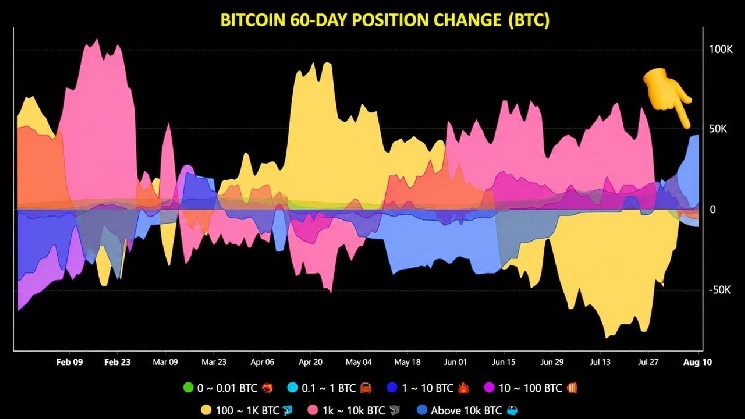
Large Bitcoin holders, defined as non-exchange and non-mining pool wallets, have accumulated approximately 43,000 BTC (worth around $2.9 billion) over the past 60 days. This marks a significant reversal from a several-month period where this same group were net sellers, contributing to downward pressure on Bitcoin's price following its October 2025 all-time high. The accumulation began when Bitcoin fell to around $60,000, a level that seemingly attracted large holders who had stayed on the sidelines during the sharper phase of the decline. Bitcoin has since recovered to trade in a narrower range between $62,000 and $65,000. This renewed demand is not limited to the largest "whale" wallets. Balances of so-called "dolphin" holders also increased in the same period, indicating a broader accumulation trend beyond just a handful of mega-wallets. This activity occurs against a backdrop of declining overall market activity, with August spot trading volumes hitting their lowest monthly level since August 2021, meaning the whale purchases represent a disproportionately large share of total market activity. This buying shift contrasts with the dominant selling trend seen for much of 2026 from other major entities. Looking ahead, a key factor to watch is whether this large-investor activity persists as Bitcoin approaches the upper bound of its recent $62k-$65k trading range.

cryptonews.ru22m ago

Bitcoin 'Whale Investors' Increase Their Holdings by 43,000 BTC, Ending a Months-Long Selling Wave

cryptonews.ru22m ago

Bitcoin (BTC) Enters a Bear Market, BlackRock Remains Optimistic! Here's Why and the Latest Statements

Bitcoin (BTC) has entered a bear market since October 2025, dropping over 50% from its all-time high of $126,000 to test support at $57,000. It is currently trading sideways around $63,000. In its latest analysis, asset management giant BlackRock stated that this severe correction does not invalidate the long-term investment case for the leading cryptocurrency. BlackRock attributes the decline primarily to market deleveraging, position shifts, capital rotation from Bitcoin into AI investments, weakening capital inflows, and a slowdown in digital asset purchases. It highlighted that open cryptocurrency futures positions exceeding $90 billion, with about 80% being perpetual futures outside the CME, were a significant contributor to the downturn. Additional selling pressure came from digital asset management firms and large Bitcoin holders, alongside net outflows from spot Bitcoin ETFs. Despite these challenges, BlackRock maintains its long-term bullish stance on Bitcoin. The firm reiterates that Bitcoin's limited supply and its potential to behave differently from traditional financial assets make it a viable tool for portfolio diversification and a potential hedge against fiat currency depreciation. BlackRock concludes that the sharp correction signals a market rebalancing of leverage and capital flows rather than a breakdown of Bitcoin's fundamental investment thesis.

cryptonews.ru33m ago

Bitcoin (BTC) Enters a Bear Market, BlackRock Remains Optimistic! Here's Why and the Latest Statements

cryptonews.ru33m ago

Trading

Spot

Hot Articles

What is $BANK

Bank AI: A Revolutionary Step in the Future of Banking Introduction In an era marked by rapid advancements in technology, Bank AI stands at the intersection of artificial intelligence (AI) and banking services. This innovative project seeks to redefine the financial landscape, enhancing operational efficiency, security measures, and customer experiences through the power of AI. As we embark on this exploration of Bank AI, we will delve into what the project entails, its operational dynamics, its historical context, and significant milestones. What is Bank AI? At its core, Bank AI represents a transformative initiative aimed at integrating artificial intelligence into various banking operations. This project harnesses the capabilities of AI to automate processes, improve risk management protocols, and enhance customer interaction through personalised services. The primary objectives of Bank AI include: Automation of Banking Functions: By leveraging AI technologies, Bank AI aims to automate routine tasks, reducing the burden on human resources and enhancing efficiency. Enhanced Risk Management: The project utilises AI algorithms to predict and identify risks, thereby fortifying security measures against fraud and other threats. Personalisation of Banking Services: Bank AI focuses on offering tailored financial products and services by analysing customer data and behaviours. Improving Customer Experience: The implementation of AI-driven solutions, such as chatbots and virtual assistants, aims to provide users with more human-like interactions, revolutionising the way customers engage with banks. With these goals, Bank AI positions itself as a crucial player in rendering banking more efficient, secure, and user-centric. Who is the Creator of Bank AI? Details regarding the creator of Bank AI remain unknown. As such, no specific individual or organisation has been identified in the available information. The anonymity surrounding the project's inception raises questions but does not detract from its ambitious vision and objectives. Who are the Investors of Bank AI? Similar to the project's creator, specific information regarding the investors or supporting organisations of Bank AI has not been disclosed. Without this information, it is challenging to outline the financial backing and institutional support that might be propelling the project forward. Nevertheless, the importance of having a robust investment foundation is pivotal for sustaining development in such an innovative field. How Does Bank AI Work? Bank AI operates on several innovative fronts, focusing on unique factors that differentiate it from traditional banking frameworks. Below are key operational features: Automation: By applying machine learning algorithms, Bank AI automates various manual processes within banks. This results in reduced operational costs and allows human workers to redirect their efforts towards more strategic activities. Advanced Risk Management: The integration of AI into risk management practices equips banks with tools to accurately predict potential threats such as fraud, ensuring that customer information and assets remain secure. Tailored Financial Recommendations: Through continuous learning from customer interactions, the AI systems develop a nuanced understanding of user needs, enabling them to offer tailored advice on financial decisions. Enhanced Customer Interactions: Utilizing chatbots and virtual assistants powered by AI, Bank AI enables a more engaging customer experience, allowing users to have their queries resolved quickly, thus reducing wait times and improving satisfaction levels. Together, these operational features position Bank AI as a pioneer in the banking sector, establishing new benchmarks for service delivery and operational excellence. Timeline of Bank AI Understanding the trajectory of Bank AI requires a look at its historical context. Below is a timeline highlighting important milestones and developments: Early 2010s: The conceptualisation of AI integration into banking services began to gain attention as banking institutions recognised the potential benefits. 2018: A marked increase in the implementation of AI technologies occurred when banks started using AI tools like chatbots for basic customer service and risk management systems for improved security handling. 2023: The sophistication of AI continued to advance, with generative AI being introduced for more complex tasks such as document processing and real-time investment analysis. This year marked a significant leap in the capabilities afforded to banks by AI technology. 2024-Current Status: As of this year, Bank AI is on an upward trajectory, with ongoing research and developments poised to further enhance capabilities in banking operations. Continued exploration of AI applications hints at exciting developments yet to come. Key Points About Bank AI Integration of AI in Banking: Bank AI focuses on adopting artificial intelligence to streamline banking processes and improve user experiences. Automation and Risk Management Focus: The project strongly emphasises these areas, aiming to shift the burden of routine tasks while enhancing security frameworks through predictive analytics. Personalised Banking Solutions: By harnessing customer data, Bank AI enables tailored banking services that cater to individual user needs. Commitment to Development: Bank AI remains committed to ongoing research and development efforts, ensuring its adaptability and ongoing relevance as technology continues to evolve. Conclusion In summary, Bank AI exemplifies a crucial step forward in the banking industry, leveraging artificial intelligence to reshape operational paradigms, enhance security, and promote customer satisfaction. Despite gaps in information surrounding the creator and investors, the clear objectives and functional mechanisms of Bank AI provide a strong foundation for its ongoing evolution. As AI technology continues to advance and merge with the banking sector, Bank AI is well-positioned to significantly impact the future of financial services, enhancing the way we understand and interact with banking.

404 Total ViewsPublished 2024.04.06Updated 2024.12.03

What is $BANK

Discussions

Welcome to the HTX Community. Here, you can stay informed about the latest platform developments and gain access to professional market insights. Users' opinions on the price of BANK (BANK) are presented below.

活动图片