Sui выигрывает у конкурента Solana, поскольку объем торговли резко вырос на 101%

cryptonews.ruPublished on 2025-04-04Last updated on 2025-07-04

  • Объем 24-часовой торговли Sui резко вырос более чем на 101%, достигнув 1,48 млрд долларов на фоне возобновившегося интереса
  • Блокчейн Layer-1 недавно превзошел своего основного конкурента Solana по краткосрочным ценовым показателям
  • Техническая диаграмма показывает, что Суй может готовиться к прорыву после длительной консолидации

Блокчейн уровня 1 Sui (SUI) привлекает повышенное внимание рынка, его цена демонстрирует новую силу, а объем торгов за один день вырос более чем на 100%. Недавние результаты показали, что Sui обогнал своего ключевого конкурента Solana, в то время как ключевая диаграмма предполагает, что токен может готовиться к крупному прорыву.

По состоянию на пятницу Sui торговался около $3.00, увеличившись на 4% за последние 24 часа. Этот шаг был подкреплен огромным всплеском объема торговли, который вырос на 101.31% до $1.48 млрд, что свидетельствует о всплеске нового интереса со стороны трейдеров.

Аналитики прогнозируют прорыв после длительной консолидации

Подкрепляя оптимистичные настроения, криптоаналитик НАЙТ обратил внимание на диаграммную модель, предполагающую, что Суй может готовиться к прорыву.

График показал, что токен потратил несколько месяцев на создание прочной базы в зоне консолидации между $2,00 и $2,40. Этот тип расширенной консолидации часто рассматривается техническими аналитиками как фаза «спиральной пружины», когда ценовое давление нарастает перед прорывом.

Экспертное мнение аналитика по этому аспекту цены теперь оправдалось, поскольку SUI сейчас торгуется в диапазоне 3 долларов.

$SUI TO DOUBLE DIGITS IF MARKET ALLOWS https://t.co/fIsrADa9F0 pic.twitter.com/r1NlEzazd4

— KNIGHT (@cryptoknight890) July 3, 2025

Sui демонстрирует силу, превосходя Solana по ключевым показателям

В прямом сравнении, недавние рыночные показатели Sui были сильнее, чем у ее главного конкурента, Solana (SOL). За 24-часовой период, закончившийся 3 июля, цена Sui подскочила на 2,89%, в то время как Solana показала более скромный рост на 0,81%.
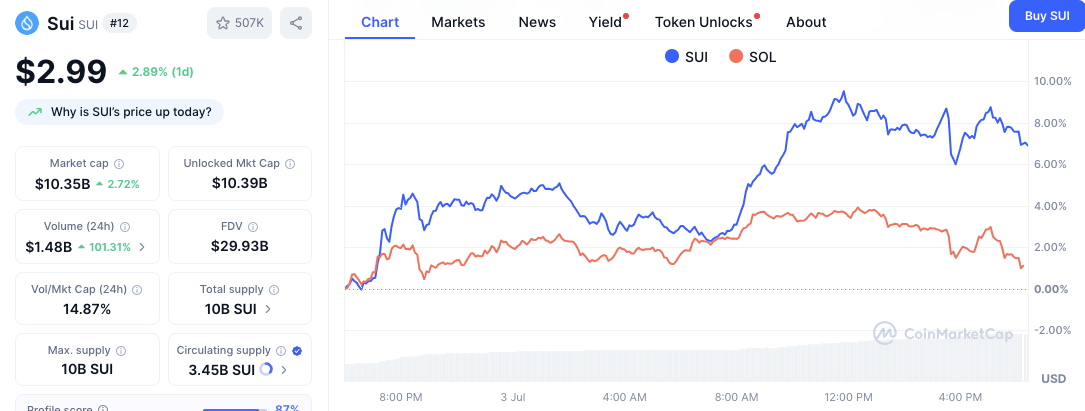
Источник: CoinMarketCap

Это расхождение в результатах показывает, что Sui захватывает большую долю интереса трейдеров в краткосрочной перспективе. В настоящее время Sui имеет рыночную капитализацию в размере $10,3 млрд, что ставит его на 12-е место на CoinMarketCap, сразу за Solana с $10,93 млрд.

По теме:Почему Sui (SUI) может возглавить следующий крупный цикл роста криптовалюты

Рост числа разработчиков обеспечивает прочную основу

Рыночная динамика Sui поддерживается сильными фундаментальными факторами. Годовой рост застройщиков Sui в настоящее время составляет 16,1%, что ставит ее в прямую конкуренцию Solana, темпы роста которой составили 17,7%.

В то время как во многих цепочках Layer-1 на базе виртуальной машины Ethereum (EVM) наблюдается спад активности разработчиков, Sui удалось привлечь и сохранить надежную базу разработчиков.

По теме:Суй строит небоскреб на шатком ценовом фундаменте

Сэм Блэкшир, соучредитель и технический директор компании-разработчика Sui Mysten Labs, ранее подчеркивал это достижение как свидетельство силы технологии Sui и ее способности привлекать и удерживать застройщиков даже в сложных рыночных условиях.


Trending Cryptos

Related Reads

Deciphering the Ethereum Foundation's New Structure: Reaffirming Self-Sovereignty Amid Institutionalization Trends

Summary: The Ethereum Foundation (EF) has announced a major restructuring, laying off 20% of its staff and introducing a new five-layer operational framework. This move aims to clarify the EF's mission and reaffirm Ethereum's core principle of self-sovereignty amidst growing institutionalization in the crypto space. The five layers are: 1. **Protocol Layer**: Focuses on maintaining Ethereum's foundational "CROPS" values—Censorship-resistant, Robust, Open, Private, and Secure. This involves core technical work like secure hard forks and mitigating toxic MEV. 2. **Access Layer**: Ensures users can practically exercise self-sovereignty through actions like reading the chain and making transactions. A key principle is the "zero option," meaning a trusted, non-intermediated path must always exist as an alternative to any centralized service. 3. **User Layer**: Bridges the protocol and access layers by grounding EF's work in the real needs of users and organizations. This is seen as crucial for moving beyond a purely research-driven approach and ensuring development effectively serves the ecosystem. 4. **Community Layer**: Responsible for building and maintaining consensus around Ethereum's core values both internally and externally. This involves guarding against centralization, upholding technological neutrality, and preventing short-term commercial interests from undermining CROPS principles. 5. **Institutional Layer**: Manages EF's engagement with institutions, but with the precondition of self-sovereignty. The goal is not to make it easier for institutions to control users, but to demonstrate how Ethereum's technology can enable better integrations. The article argues that while institutional adoption brings legitimacy, it also risks diluting crypto's foundational ethos of decentralization. The new structure represents EF's effort to navigate this tension, upholding its core mission while actively engaging with a broader, more complex ecosystem.

marsbit12m ago

Deciphering the Ethereum Foundation's New Structure: Reaffirming Self-Sovereignty Amid Institutionalization Trends

marsbit12m ago

OpenRouter: How Did This 'AI Model Relay Station' Achieve a $10 Billion Valuation?

OpenRouter: The Model Router Building a $10B+ Company This article explores OpenRouter, a platform that aggregates access to over 400 AI models from 70+ providers (like OpenAI, Claude, Gemini) through a single API. It has grown into a unicorn with a $1.3B valuation by 2026, processing massive scale—reaching 100 trillion tokens monthly. Its core value isn't just being a "model supermarket." For developers building real-world AI applications, managing multiple models for different tasks (e.g., cheap models for titles, powerful ones for long articles) is complex. OpenRouter acts as a critical "model scheduling layer," handling routing, failover between providers, cost optimization, and enterprise features like zero-data-retention policies and budget controls. OpenRouter's business model is a "toll fee": it charges a small platform fee (5.5%) on purchased credits while passing model costs directly to users. Its revenue scales with the tokens flowing through its system, which saw explosive growth as AI apps evolved. Key growth drivers include: 1) The explosion of specialized models, increasing choice complexity; 2) AI apps shifting focus from performance to cost optimization; 3) The rise of AI agents that require more reliable, multi-step model calls. However, risks remain. Large enterprises or cloud providers (AWS, Google Cloud) could build similar internal gateways. Its position between model suppliers and developers could also create future tension over pricing and data control. To stay ahead, OpenRouter must deepen its enterprise features and prove it's more than just a request forwarder.

marsbit32m ago

OpenRouter: How Did This 'AI Model Relay Station' Achieve a $10 Billion Valuation?

marsbit32m ago

Bitcoin Falls Below $60,000 Again; After 20 Months, We've Reached a New Low

Bitcoin Drops Below $60,000, Hitting a 20-Month Low Bitcoin fell below the key $60,000 psychological level again, reaching a low of $59,023—its lowest point in approximately 20 months, dating back to October 2024. While it later recovered slightly to around $60,600, this marks its third significant breach of $60,000 this year. The downturn is attributed to two primary factors. First, U.S. spot Bitcoin ETFs are experiencing their longest streak of net outflows since launch, with nearly $5.94 billion withdrawn over 30 days. This creates sustained selling pressure as Authorized Participants sell Bitcoin to meet redemptions. Second, shifting macroeconomic expectations are adding pressure. Strong U.S. job data and hawkish remarks from Fed officials have increased market pricing for potential rate hikes, reversing the earlier liquidity-driven bullish sentiment and prompting a shift away from risk assets like Bitcoin. Analyst views are mixed. 21Shares maintains a bullish long-term outlook, expecting prices to recover towards $100,000, citing historical post-halving cycles and substantial ETF holdings as a base. In contrast, Arthur Hayes predicts a potential bottom around $40,000 within six months due to persistent Fed hawkishness. CryptoQuant suggests, based on on-chain data, that the market may not find a bottom until prices fall below the average investor cost basis around $53,000, potentially extending the bearish phase into late 2026 or early 2027. The immediate focus is on upcoming U.S. inflation data and Fed signals. Lower-than-expected CPI could offer relief, but confirmation of sticky inflation or continued ETF outflows may lead to further downside pressure. Bitcoin's ability to hold above $60,000 remains a critical test for the near-term market direction.

Odaily星球日报1h ago

Bitcoin Falls Below $60,000 Again; After 20 Months, We've Reached a New Low

Odaily星球日报1h ago

Trading

Spot
Futures

Hot Articles

Discussions

Welcome to the HTX Community. Here, you can stay informed about the latest platform developments and gain access to professional market insights. Users' opinions on the price of SOL (SOL) are presented below.

活动图片