XRP, Solana, Litecoin ETF Approval Odds Raised To 95% By Bloomberg

bitcoinistPublished on 2025-07-01Last updated on 2025-07-01

Abstract

Bloomberg Intelligence’s James Seyffart and Eric Balchunas have upgraded their outlook for a swathe of single-asset spot-crypto exchange-traded funds, taking...

Trusted Editorial content, reviewed by leading industry experts and seasoned editors. Ad Disclosure

Bloomberg Intelligence’s James Seyffart and Eric Balchunas have upgraded their outlook for a swathe of single-asset spot-crypto exchange-traded funds, taking the headline odds for XRP, Solana (SOL) and Litecoin (LTC) to 95 percent for approval by the end of 2025. Posting the revised forecast on X late on 30 June, Seyffart wrote: “Here are mine and Eric Balchunas’ most recent odds on spot crypto ETF approvals by the end of 2025. We expect a wave of new ETFs in this second half of 2025.”

Bloomberg Raises XRP, Solana, Litecoin ETF Odds To 95%

The analysts’ latest matrix assigns identical 95 percent odds to four categories: XRP, SOL, LTC and a separate “basket/index” product that would convert Grayscale, Bitwise, Hashdex and Franklin vehicles holding multiple tokens into spot ETFs. Each of those filings has already had its initial Rule 19b-4 submission acknowledged by the Securities and Exchange Commission, and each faces a final SEC decision in early July (for the basket product) or in mid-October 2025 (for the three single-asset funds).
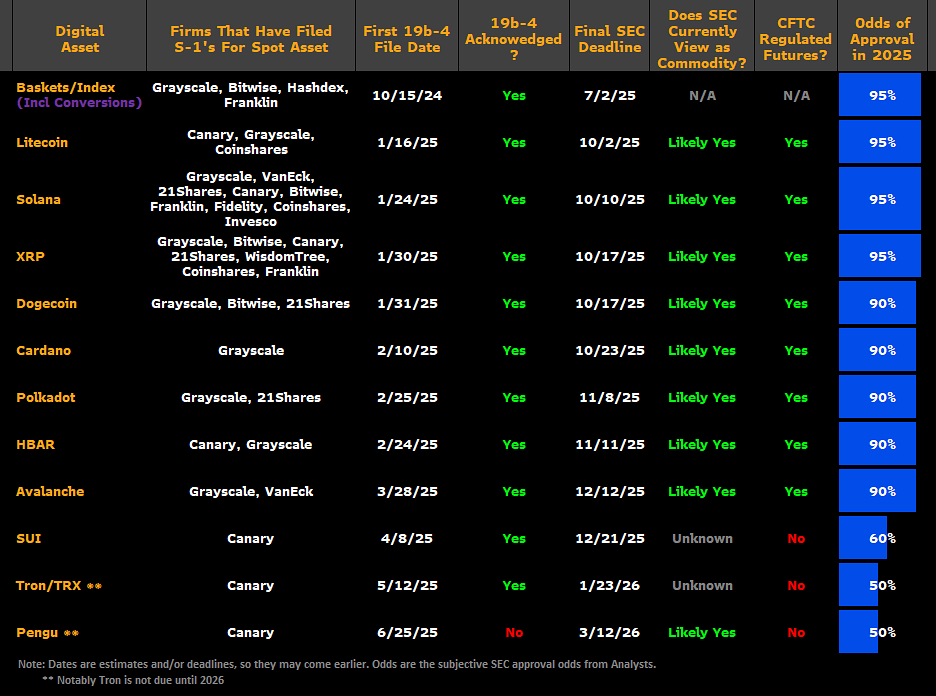
Updated altcoin ETF odds by Bloomberg
Updated altcoin ETF odds by Bloomberg | Source: X @JSeyff

Directly behind the front-runners sit Dogecoin, Cardano, Polkadot, Hedera (HBAR) and Avalanche, all marked at 90 percent. Canary-filed Sui is judged a coin-flip at 60 percent, while Tron and the micro-cap token Pengu each remain at 50 percent, reflecting open questions around commodity status and the absence of CFTC-regulated futures.

The new 95 percent figure is the third upward revision in as many months. On 20 June Balchunas and Seyffart lifted most altcoin ETFs to “90% or higher”, citing “remarkably positive” engagement from SEC staff. Back in late April, the same analysts still pegged SOL at 70 percent and XRP at just 65 percent, a level they themselves called “an improved outlook” compared with February’s sub-60 percent assessments. In percentage-point terms, XRP and LTC have therefore gained roughly thirty points since the start of the year, while SOL is up 25.

Three dynamics underpin the latest bump: First, there’s the impending decision on Grayscale’s Digital Large Cap Fund (GDLC). The SEC must decide by 2 July whether to allow NYSE Arca to list shares of GDLC, a $730 million vehicle that holds Bitcoin, Ether and a combined 8 percent slice of XRP, SOL and Cardano.

Seyffart told Blockworks that the agency could “let the product through” precisely because the non-BTC/ETH allocation is modest; “if they’re not approved on this first date, it’ll only be because the SEC isn’t ready with a full framework,” he said blockworks.co. ETF Store president Nate Geraci went further, writing via X that approval is “highly likely” and would create a “low-risk sandbox” for the SEC to gather surveillance data before green-lighting standalone altcoin funds.

In every case where Seyffart assigns 90 percent or more, the underlying token already trades on a Commodity Futures Trading Commission-regulated venue and has been implicitly treated as a commodity in recent SEC correspondence. The agency’s acknowledgement of the relevant 19b-4 filings, Seyffart argues, “suggests that the underlying altcoins are likely viewed as commodities”

The third positive sign is the active, iterative dialogue with issuers. Multiple sponsors — including Canary, VanEck, 21Shares and Fidelity — have filed amended S-1s at the SEC’s request over the past month. Seyffart and Balchunas see that level of back-and-forth as the same pattern that preceded spot-Bitcoin approval in January 2024 and spot-Ether approval seven months later.

If GDLC wins the nod this week, attention will swing quickly to the single-asset queue. The SEC’s final deadline for Solana is 10 October 2025; XRP and Dogecoin come up on 17 October; Litecoin on 2 October; Cardano on 23 October; Polkadot on 8 November; Hedera on 11 November; and Avalanche on 12 December. Sui’s file runs to 21 December, while the first substantive decision on Tron is not due until 23 January 2026, and Pengu stretches to 12 March 2026.

At press time, XRP traded at $2.21.
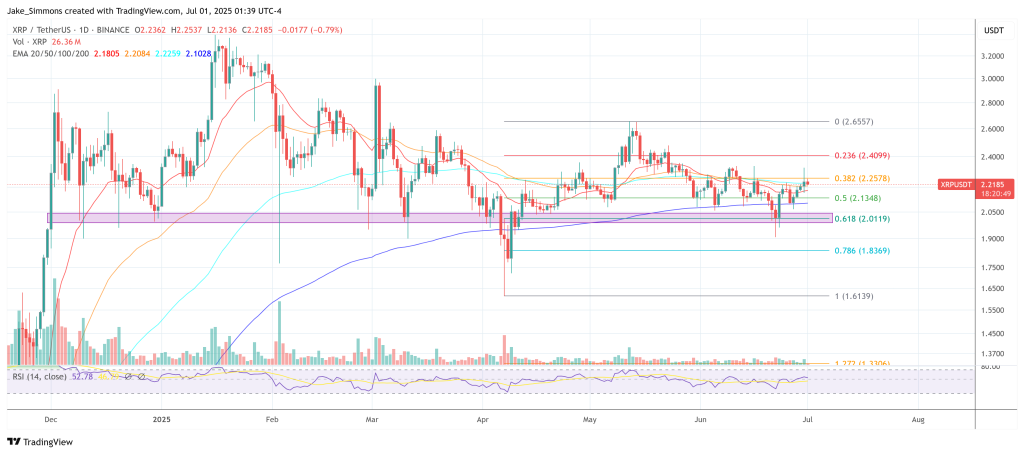
XRP price
XRP price, 1-day chart | Source: XRPUSDT on TradingView.com
Featured image created with DALL.E, chart from TradingView.com
Editorial Process for bitcoinist is centered on delivering thoroughly researched, accurate, and unbiased content. We uphold strict sourcing standards, and each page undergoes diligent review by our team of top technology experts and seasoned editors. This process ensures the integrity, relevance, and value of our content for our readers.

Jake Simmons has been a Bitcoin enthusiast since 2016. Ever since he heard about Bitcoin, he has been studying the topic every day and trying to share his knowledge with others. His goal is to contribute to Bitcoin's financial revolution, which will replace the fiat money system. Besides BTC and crypto, Jake studied Business Informatics at a university. After graduation in 2017, he has been working in the blockchain and crypto sector. You can follow Jake on Twitter at @realJakeSimmons.

Trending Cryptos

Related Reads

Founder of Baixing.com: The Notion That Large Language Models Will Devour Everything, I Believe Half of It

Founder of Baixing.com: I Only Half-Believe the Saying “Large Language Models Will Devour Everything” Author: Wang Jianshuo, Founder of Baixing.com Many proclaim that large models are everything, but the author is skeptical. He argues that such sweeping claims often stem from a limited understanding of the future. Drawing parallels to past technologies like electricity and the internet—which were predicted to “devour everything” but didn’t—he suggests that large language models (LLMs) are better seen as a foundational base. Like electricity, this base is essential for modern development, but its real value emerges only when applied to specific scenarios through various “machines” or “tools” (e.g., Claude Code for programming, Claude Design for design). The author acknowledges that LLMs may indeed replace many existing software systems built on rigid rules, workflows, and forms (e.g., CRMs, SaaS tools), as these are precisely what LLMs excel at processing. However, he emphasizes that beyond software, elements like customer data, execution capabilities (e.g., booking a flight), trust, and physical-world interactions will not be “devoured.” Instead, he foresees that after streamlining existing software, LLMs will open up a larger space for innovative, next-generation applications. These new tools will likely feature fluid interfaces and rely less on fixed rules, unleashing greater creativity. The author cautions against short-sightedness, recalling how in 2004 many believed internet giants like Sina, Sohu, and NetEase would monopolize the market—only to be proven wrong by subsequent disruptions. In conclusion, while LLMs are a crucial foundation and a current focal point, the true mainstream of this wave lies in the diverse applications built atop them to solve concrete problems. The phrase “devour everything” is imprecise; the real opportunity lies in identifying and leveraging the areas where LLMs do bring transformative change.

marsbit2h ago

Founder of Baixing.com: The Notion That Large Language Models Will Devour Everything, I Believe Half of It

marsbit2h ago

Founder of Baixing.com: I Only Half Believe in the Notion that Large Language Models Devour Everything

The founder of Baixing Wang states that while large language models (LLMs) are an extremely important foundational technology—akin to electricity or the internet—he only "half believes" the notion that they will "consume everything." He argues that LLMs provide a base layer of intelligence, but real-world value and transformation come from integrating this intelligence into specific applications and devices designed for particular scenarios—like how electricity powers various appliances from washing machines to TVs. He agrees LLMs will likely consume or replace a significant portion of existing rule-based, workflow-driven software (e.g., many SaaS systems, CRMs), as these are precisely what LLMs excel at handling. However, numerous other elements—such as customer data, execution capabilities (e.g., booking a flight), trust, and physical-world interactions—will not be consumed. Wang emphasizes that after LLMs absorb certain software layers, they will open up a much larger space for innovation: new types of "streaming" software with less rigid interfaces, where fixed rules are managed by AI. This next wave of applications built on top of the stable LLM foundation is where the true mainstream opportunity lies. He cautions against the short-sightedness of declaring any technology as all-consuming, drawing parallels to past premature predictions about internet giants monopolizing the web. The key is to find opportunities within the areas LLMs do transform.

链捕手2h ago

Founder of Baixing.com: I Only Half Believe in the Notion that Large Language Models Devour Everything

链捕手2h ago

Trading

Spot

Hot Articles

What is XRP 2.0

XRP 2.0: A New Frontier in the Cryptocurrency Landscape Introduction to XRP 2.0 In the ever-evolving realm of cryptocurrency, new projects continuously emerge, vying for attention and adoption. One such promising initiative is XRP 2.0, a novel cryptocurrency project designed to leverage advanced blockchain technology and robust encryption methodologies. While the name draws parallels with Ripple’s XRP, it’s crucial to note that XRP 2.0 operates independently, focusing on enhancing transaction security, privacy, and scalability. As the digital financial landscape increasingly embraces decentralized solutions, XRP 2.0 aims to contribute meaningfully to web3 and the overall expansion of crypto projects. What is XRP 2.0? At its core, XRP 2.0 is a cryptocurrency project that aims to create a secure and decentralized digital currency ecosystem. Its foundational technology integrates sophisticated blockchain principles with cutting-edge encryption techniques. The overarching goal of XRP 2.0 is to establish itself as a reliable and efficient platform enabling swift transaction execution while prioritizing enhanced privacy protections for its users. The project is promoted as a solution to many limitations faced by existing cryptocurrencies, proposing a system that can handle a higher volume of transactions with improved speed and privacy. This versatility positions XRP 2.0 as a significant contender in a marketplace riddled with various digital currencies. Who is the Creator of XRP 2.0? The identity of the creator behind XRP 2.0 has been flagged as ‘Wilbur.’ However, comprehensive details regarding Wilbur or their associated entity remain elusive. The anonymity of many cryptocurrency creators is not an uncommon phenomenon in the industry, often designed to maintain a degree of privacy and security. Who are the Investors of XRP 2.0? As of now, specific information related to the investment foundations or organizations supporting XRP 2.0 is not publicly available. In the cryptocurrency sector, the backing by reputed investors can significantly influence a project's credibility and success, yet the transparency regarding the financial supporters of XRP 2.0 has not been established. How Does XRP 2.0 Work? XRP 2.0 stands out by employing a combination of blockchain technology and advanced encryption algorithms that ensures secure and decentralized transactions. Its innovative structure includes unique features designed to foster user engagement and broaden functionalities beyond conventional cryptocurrency transactions. Among these features, XRP 2.0 incorporates AI-powered capabilities, such as text-to-image and text-to-speech functionalities. These additions are designed to enhance the interactive experience for users, promoting broader applicability across various sectors. By bridging technological advancements with user-centered design, XRP 2.0 aims to capture the attention of a diverse range of individuals and enterprises looking to integrate cryptocurrency solutions into their operational frameworks. Timeline of XRP 2.0 Understanding XRP 2.0 requires examining the milestones that have defined its journey thus far: July 23, 2023: XRP 2.0 is introduced as a novel cryptocurrency project, aiming to revolutionize secure and decentralized transaction capabilities in the blockchain domain. September 8, 2023: The launching of another project, XRP20, occurs, marking the emergence of an ERC-20 token on the Ethereum blockchain that remains unrelated to XRP 2.0. November 13, 2023: The XRP Ledger undergoes a significant update with the release of rippled server software version 2.0.0. It is essential to note that this development is disconnected from the XRP 2.0 cryptocurrency project. Key Points About XRP 2.0 To distill the essence of XRP 2.0, several critical factors emerge: Unique Features: The inclusion of features like AI-powered text-to-image and text-to-speech further diversifies the potential applications of XRP 2.0. Blockchain Technology: The framework utilizes advanced blockchain mechanisms and encryption protocols, ensuring a secure and decentralized environment for transactions. Scalability and Privacy: XRP 2.0 prioritizes enhanced privacy protections in transaction processes and the scalability necessary to accommodate a growing user base. No Affiliation with Ripple: Importantly, despite its name, XRP 2.0 does not have any allegiance or collaboration with Ripple’s XRP, distinguishing its operational framework and objectives within the cryptocurrency ecosystem. Conclusion XRP 2.0 represents an ambitious venture into the cryptocurrency sphere, aiming to offer a combination of security, privacy, and efficiency in digital transactions. By integrating sophisticated technologies and user-friendly features, the project sets out to broaden the horizons of what cryptocurrency can achieve in today's digital economy. While the anonymity of its creator and lack of disclosed investors might raise questions for some, XRP 2.0's focus on advanced functionalities and decentralisation enhances its appeal amidst an increasingly crowded crypto market. As the cryptocurrency landscape continues to evolve, XRP 2.0 may yet emerge as a pivotal player in the expansion of secure and scalable blockchain solutions.

1.1k Total ViewsPublished 2024.04.01Updated 2024.12.03

What is XRP 2.0

Discussions

Welcome to the HTX Community. Here, you can stay informed about the latest platform developments and gain access to professional market insights. Users' opinions on the price of XRP (XRP) are presented below.

活动图片