Bank Of Korea Halts CBDC Project As Lawmakers Focus On Stablecoin Regulation

bitcoinistPublished on 2025-07-01Last updated on 2025-07-01

Abstract

The Bank of Korea (BOK) has reportedly halted its Central Bank Digital Currency (CBDC) project following the South Korean government’s...

Trusted Editorial content, reviewed by leading industry experts and seasoned editors. Ad Disclosure

The Bank of Korea (BOK) has reportedly halted its Central Bank Digital Currency (CBDC) project following the South Korean government’s focus on stablecoins. The shift has left project participants with “no long-term roadmap” and banks pivoting to this sector.

BOK Suspends Second Phase Of CBDC Testing

On Sunday, local news outlet Yonhap News Agency reported that the Bank of Korea had notified banks participating in the Han River Project that the second phase of CBDC testing would be suspended.

The BOK and seven banks began the first phase of testing in April, targeting 100,000 financial consumers and planning to complete it by June 30. Originally, the project was scheduled to start its second phase at the end of the year, testing peer-to-peer transfers, expanding payment merchant locations, and simplifying authentication methods.

However, banks reportedly raised concerns about the “excessive cost burden without concrete plans for commercialization,” leading to the project’s pause. Notably, the banking sector is bearing the cost of the project and recently demanded that the Bank of Korea provide a clear long-term roadmap with plans for commercialization.

Banks requested the BOK to “establish a ‘CBDC General User Real-Transaction Test Task Force’ involving all relevant departments of the Bank of Korea and banks to develop a long-term roadmap including post-test commercialization plans, and then realistically adjust the project schedule based on this roadmap.”

As a result, the BOK has concluded that it must clarify its internal stance and schedule regarding digital assets, as stablecoin momentum grows and discussions in the National Assembly and the private sector intensify.

According to a senior official at a commercial bank, the Bank of Korea explained that it would “wait and see how the situation develops, given that the legalization of stablecoins is currently underway, while it is unclear how CBDC, stablecoins, and deposit tokens differ and can coexist.”

Similarly, another senior official affirmed that the atmosphere is shifting toward stablecoins, detailing that “Until the dinner meeting between Bank of Korea Governor Lee Chang-yong and bank presidents on the 23rd, the atmosphere was not like this, but the situation has changed significantly since then.”

Nonetheless, the Han River Project could be reconsidered in 2026, according to another bank official, who claimed that the Bank of Korea mentioned the possibility of revisiting CBDC testing and “pushing forward with it around the first half of next year.”

Banks Prepare For Stablecoin Legislation

Following this development, banks participating in the CBDC project are expected to shift to stablecoin issuance as related legislation gains support, preparing for issuance with other banks or non-bank entities.

 At the start of the month, a member of South Korea’s ruling party, Min Byeong-deok, introduced a comprehensive bill to establish a more structured regulatory framework for crypto assets in the country.

As reported by Bitcoinist, the Democratic Party of Korea (DPK) lawmaker proposed the Digital Assets Basic Act to complement the Virtual Asset Investor Protection Act and offer a broader legal foundation for the industry.  Additionally, it focuses on implementing a licensing system for stablecoin issuers and clear rules.

The banking sector is considering a business model in which banks establish a joint venture to collectively issue stablecoins, while contacting various non-bank companies to prepare for the legalization and issuance of stablecoins.

A bank official affirmed that “It is unclear whether banks or big tech (large IT companies) and fintech (financial technology companies) will be the issuers of stablecoins,” adding that they “have no choice but to prepare for both scenarios before legalization.”

Another bank official stated that it is necessary to collaborate with fintech companies for scalability, explaining that banks are “not only discussing stablecoins with the Bank of Korea and other banks, but also meeting regularly with ‘payment’ companies, cryptocurrency exchanges, and blockchain companies to prepare for the issuance of stablecoins.”
stablecoin, Bitcoin, btc, btcusdt

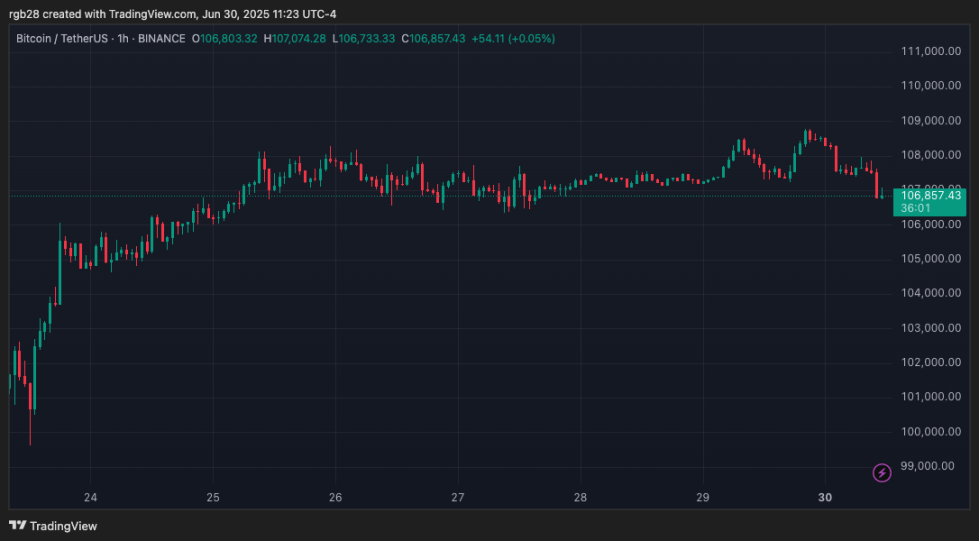
Bitcoin (BTC) trades at $106,857 in the one-week chart. Source: BTCUSDT on TradingView
Featured Image from Unsplash.com, Chart from TradingView.com
Editorial Process for bitcoinist is centered on delivering thoroughly researched, accurate, and unbiased content. We uphold strict sourcing standards, and each page undergoes diligent review by our team of top technology experts and seasoned editors. This process ensures the integrity, relevance, and value of our content for our readers.

Rubmar is a crypto enthusiast who likes learning and improving constantly. She enjoys reporting on the latest news and developments in the crypto industry. Rubmar also enjoys scrapbooking, crafting, simulation games, and watching football.

Trending Cryptos

Related Reads

Founder of Baixing.com: The Notion That Large Language Models Will Devour Everything, I Believe Half of It

Founder of Baixing.com: I Only Half-Believe the Saying “Large Language Models Will Devour Everything” Author: Wang Jianshuo, Founder of Baixing.com Many proclaim that large models are everything, but the author is skeptical. He argues that such sweeping claims often stem from a limited understanding of the future. Drawing parallels to past technologies like electricity and the internet—which were predicted to “devour everything” but didn’t—he suggests that large language models (LLMs) are better seen as a foundational base. Like electricity, this base is essential for modern development, but its real value emerges only when applied to specific scenarios through various “machines” or “tools” (e.g., Claude Code for programming, Claude Design for design). The author acknowledges that LLMs may indeed replace many existing software systems built on rigid rules, workflows, and forms (e.g., CRMs, SaaS tools), as these are precisely what LLMs excel at processing. However, he emphasizes that beyond software, elements like customer data, execution capabilities (e.g., booking a flight), trust, and physical-world interactions will not be “devoured.” Instead, he foresees that after streamlining existing software, LLMs will open up a larger space for innovative, next-generation applications. These new tools will likely feature fluid interfaces and rely less on fixed rules, unleashing greater creativity. The author cautions against short-sightedness, recalling how in 2004 many believed internet giants like Sina, Sohu, and NetEase would monopolize the market—only to be proven wrong by subsequent disruptions. In conclusion, while LLMs are a crucial foundation and a current focal point, the true mainstream of this wave lies in the diverse applications built atop them to solve concrete problems. The phrase “devour everything” is imprecise; the real opportunity lies in identifying and leveraging the areas where LLMs do bring transformative change.

marsbit2h ago

Founder of Baixing.com: The Notion That Large Language Models Will Devour Everything, I Believe Half of It

marsbit2h ago

Founder of Baixing.com: I Only Half Believe in the Notion that Large Language Models Devour Everything

The founder of Baixing Wang states that while large language models (LLMs) are an extremely important foundational technology—akin to electricity or the internet—he only "half believes" the notion that they will "consume everything." He argues that LLMs provide a base layer of intelligence, but real-world value and transformation come from integrating this intelligence into specific applications and devices designed for particular scenarios—like how electricity powers various appliances from washing machines to TVs. He agrees LLMs will likely consume or replace a significant portion of existing rule-based, workflow-driven software (e.g., many SaaS systems, CRMs), as these are precisely what LLMs excel at handling. However, numerous other elements—such as customer data, execution capabilities (e.g., booking a flight), trust, and physical-world interactions—will not be consumed. Wang emphasizes that after LLMs absorb certain software layers, they will open up a much larger space for innovation: new types of "streaming" software with less rigid interfaces, where fixed rules are managed by AI. This next wave of applications built on top of the stable LLM foundation is where the true mainstream opportunity lies. He cautions against the short-sightedness of declaring any technology as all-consuming, drawing parallels to past premature predictions about internet giants monopolizing the web. The key is to find opportunities within the areas LLMs do transform.

链捕手2h ago

Founder of Baixing.com: I Only Half Believe in the Notion that Large Language Models Devour Everything

链捕手2h ago

Trading

Spot

Hot Articles

What is $BANK

Bank AI: A Revolutionary Step in the Future of Banking Introduction In an era marked by rapid advancements in technology, Bank AI stands at the intersection of artificial intelligence (AI) and banking services. This innovative project seeks to redefine the financial landscape, enhancing operational efficiency, security measures, and customer experiences through the power of AI. As we embark on this exploration of Bank AI, we will delve into what the project entails, its operational dynamics, its historical context, and significant milestones. What is Bank AI? At its core, Bank AI represents a transformative initiative aimed at integrating artificial intelligence into various banking operations. This project harnesses the capabilities of AI to automate processes, improve risk management protocols, and enhance customer interaction through personalised services. The primary objectives of Bank AI include: Automation of Banking Functions: By leveraging AI technologies, Bank AI aims to automate routine tasks, reducing the burden on human resources and enhancing efficiency. Enhanced Risk Management: The project utilises AI algorithms to predict and identify risks, thereby fortifying security measures against fraud and other threats. Personalisation of Banking Services: Bank AI focuses on offering tailored financial products and services by analysing customer data and behaviours. Improving Customer Experience: The implementation of AI-driven solutions, such as chatbots and virtual assistants, aims to provide users with more human-like interactions, revolutionising the way customers engage with banks. With these goals, Bank AI positions itself as a crucial player in rendering banking more efficient, secure, and user-centric. Who is the Creator of Bank AI? Details regarding the creator of Bank AI remain unknown. As such, no specific individual or organisation has been identified in the available information. The anonymity surrounding the project's inception raises questions but does not detract from its ambitious vision and objectives. Who are the Investors of Bank AI? Similar to the project's creator, specific information regarding the investors or supporting organisations of Bank AI has not been disclosed. Without this information, it is challenging to outline the financial backing and institutional support that might be propelling the project forward. Nevertheless, the importance of having a robust investment foundation is pivotal for sustaining development in such an innovative field. How Does Bank AI Work? Bank AI operates on several innovative fronts, focusing on unique factors that differentiate it from traditional banking frameworks. Below are key operational features: Automation: By applying machine learning algorithms, Bank AI automates various manual processes within banks. This results in reduced operational costs and allows human workers to redirect their efforts towards more strategic activities. Advanced Risk Management: The integration of AI into risk management practices equips banks with tools to accurately predict potential threats such as fraud, ensuring that customer information and assets remain secure. Tailored Financial Recommendations: Through continuous learning from customer interactions, the AI systems develop a nuanced understanding of user needs, enabling them to offer tailored advice on financial decisions. Enhanced Customer Interactions: Utilizing chatbots and virtual assistants powered by AI, Bank AI enables a more engaging customer experience, allowing users to have their queries resolved quickly, thus reducing wait times and improving satisfaction levels. Together, these operational features position Bank AI as a pioneer in the banking sector, establishing new benchmarks for service delivery and operational excellence. Timeline of Bank AI Understanding the trajectory of Bank AI requires a look at its historical context. Below is a timeline highlighting important milestones and developments: Early 2010s: The conceptualisation of AI integration into banking services began to gain attention as banking institutions recognised the potential benefits. 2018: A marked increase in the implementation of AI technologies occurred when banks started using AI tools like chatbots for basic customer service and risk management systems for improved security handling. 2023: The sophistication of AI continued to advance, with generative AI being introduced for more complex tasks such as document processing and real-time investment analysis. This year marked a significant leap in the capabilities afforded to banks by AI technology. 2024-Current Status: As of this year, Bank AI is on an upward trajectory, with ongoing research and developments poised to further enhance capabilities in banking operations. Continued exploration of AI applications hints at exciting developments yet to come. Key Points About Bank AI Integration of AI in Banking: Bank AI focuses on adopting artificial intelligence to streamline banking processes and improve user experiences. Automation and Risk Management Focus: The project strongly emphasises these areas, aiming to shift the burden of routine tasks while enhancing security frameworks through predictive analytics. Personalised Banking Solutions: By harnessing customer data, Bank AI enables tailored banking services that cater to individual user needs. Commitment to Development: Bank AI remains committed to ongoing research and development efforts, ensuring its adaptability and ongoing relevance as technology continues to evolve. Conclusion In summary, Bank AI exemplifies a crucial step forward in the banking industry, leveraging artificial intelligence to reshape operational paradigms, enhance security, and promote customer satisfaction. Despite gaps in information surrounding the creator and investors, the clear objectives and functional mechanisms of Bank AI provide a strong foundation for its ongoing evolution. As AI technology continues to advance and merge with the banking sector, Bank AI is well-positioned to significantly impact the future of financial services, enhancing the way we understand and interact with banking.

186 Total ViewsPublished 2024.04.06Updated 2024.12.03

What is $BANK

Discussions

Welcome to the HTX Community. Here, you can stay informed about the latest platform developments and gain access to professional market insights. Users' opinions on the price of BANK (BANK) are presented below.

活动图片