Crypto Reserve In The Works, Says Kazakhstan’s Central Bank Chief

bitcoinistPublished on 2025-06-30Last updated on 2025-07-01

Abstract

Kazakhstan’s National Bank (NBK) has begun designing what could become the country’s first sovereign crypto-asset reserve, signalling a shift from...

Trusted Editorial content, reviewed by leading industry experts and seasoned editors. Ad Disclosure

Kazakhstan’s National Bank (NBK) has begun designing what could become the country’s first sovereign crypto-asset reserve, signalling a shift from piecemeal digital-asset oversight toward full-fledged strategic portfolio management. In a written response to a parliamentary inquiry, NBK Chairman Timur Suleimenov confirmed that “work is underway on the development of its formation and management concept,” adding that one option under review is to lodge the reserve inside an NBK-controlled subsidiary that already handles alternative investments.

Kazakhstan To Build Crypto Reserve

Suleimenov’s letter frames the reserve as a financial-stability instrument rather than a speculative bet. “International practice shows that the sources for such a reserve may include confiscated crypto-assets, as well as cryptocurrencies mined by a crypto miner partially owned by the government,” he wrote, stressing that feasibility studies are benchmarking global models of sovereign crypto reserves.

While Suleimenov’s language was cautious, the central bank’s house view is hard-edged. A separate note released through state news agency Kazinform says the NBK “stands for an institutionally sound approach,” grounded in the transparency norms used by traditional sovereign wealth funds. The same communication highlights the need for centralised custody inside a secure state structure “to ensure the sustainability (safety) of the state crypto-reserve.”

Turning concept into law will require parliamentary action. According to the NBK chief, amendments are needed to define the reserve’s legal status and set procedures for deposit and withdrawal. Draft language is already circulating, and the NBK says it “is ready to discuss relevant amendments with MPs.”

Kazakhstan’s Ambivalence Towards Crypto

The legislative push is unfolding against an aggressive clean-upof Kazakhstan’s grey crypto market. Since a 2024 ban on bank-mediated payments to unlicensed platforms, regulators have blocked 15,800 suspect transactions worth about $3.07 million in the first quarter of 2025 alone. Suleimenov has also flagged an upcoming bill that would attach administrative and criminal liability to off-exchange dealings and curb digital-asset advertising.

Even as the NBK sketches out a reserve, its public messaging to retail investors remains sceptical. Earlier this month Suleimenov warned that cryptocurrencies are “complex assets from a financial perspective… not like a deposit, where you go to a bank, put your money in for a year and earn interest.” He argued that “people get the impression that it’s some kind of magic wand,” a perception exploited by “scammers and Ponzi schemes.”

Today’s central-bank initiative builds on groundwork laid by the Ministry of Digital Development, which in May floated a crypto reserve capable of “respond[ing] more quickly to changes in the global financial system.” The ministry drew an explicit parallel to the National Fund — the country’s commodity-backed stabilisation vehicle — calling the prospective crypto reserve “a similar function, but in a digital dimension.”

Policy momentum also reflects pressure from legislators. Mazhilis member Olzhas Kuspekov recently proposed a fund inside the NBK that would warehouse crypto assets seized in criminal cases, though Deputy Governor Berik Sholpankulov countered that existing asset-forfeiture rules already channel such property to the budget.

For now, Kazakhstan’s central bank is working with law-enforcement and other state bodies on what Suleimenov calls the “specific mechanisms” of reserve construction — from custody architecture to valuation and risk-management protocols. No timeline has been published, and officials have yet to disclose which digital assets might qualify. What is clear is that the NBK wants its reserve — if created — to look less like a speculative vault and more like an institutional buffer that sits comfortably beside the country’s gold-and-FX war chest.

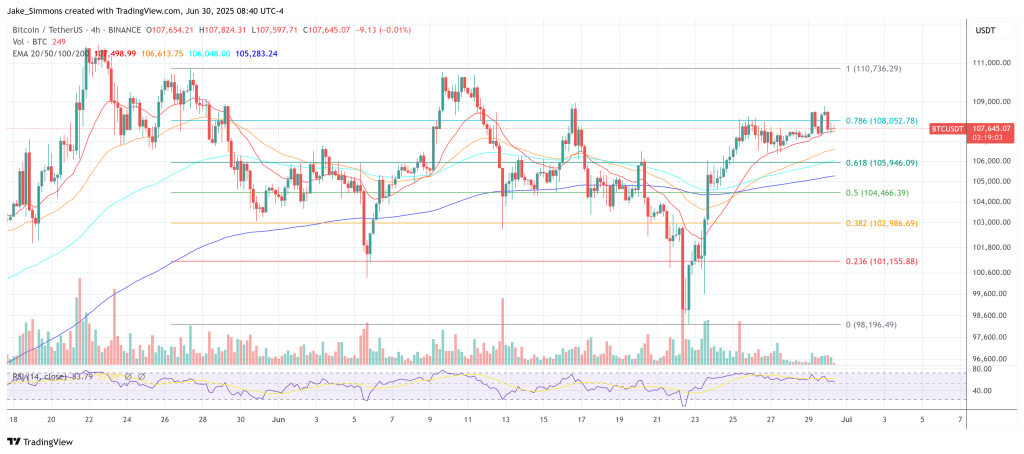
At press time, Bitcoin traded at $107,645.
Bitcoin price
BTC price, 4-hour chart | Source: BTCUSDT on TradingView.com
Featured image created with DALL.E, chart from TradingView.com
Editorial Process for bitcoinist is centered on delivering thoroughly researched, accurate, and unbiased content. We uphold strict sourcing standards, and each page undergoes diligent review by our team of top technology experts and seasoned editors. This process ensures the integrity, relevance, and value of our content for our readers.

Jake Simmons has been a Bitcoin enthusiast since 2016. Ever since he heard about Bitcoin, he has been studying the topic every day and trying to share his knowledge with others. His goal is to contribute to Bitcoin's financial revolution, which will replace the fiat money system. Besides BTC and crypto, Jake studied Business Informatics at a university. After graduation in 2017, he has been working in the blockchain and crypto sector. You can follow Jake on Twitter at @realJakeSimmons.

Trending Cryptos

Related Reads

Trading

Spot

Hot Articles

What is $BANK

Bank AI: A Revolutionary Step in the Future of Banking Introduction In an era marked by rapid advancements in technology, Bank AI stands at the intersection of artificial intelligence (AI) and banking services. This innovative project seeks to redefine the financial landscape, enhancing operational efficiency, security measures, and customer experiences through the power of AI. As we embark on this exploration of Bank AI, we will delve into what the project entails, its operational dynamics, its historical context, and significant milestones. What is Bank AI? At its core, Bank AI represents a transformative initiative aimed at integrating artificial intelligence into various banking operations. This project harnesses the capabilities of AI to automate processes, improve risk management protocols, and enhance customer interaction through personalised services. The primary objectives of Bank AI include: Automation of Banking Functions: By leveraging AI technologies, Bank AI aims to automate routine tasks, reducing the burden on human resources and enhancing efficiency. Enhanced Risk Management: The project utilises AI algorithms to predict and identify risks, thereby fortifying security measures against fraud and other threats. Personalisation of Banking Services: Bank AI focuses on offering tailored financial products and services by analysing customer data and behaviours. Improving Customer Experience: The implementation of AI-driven solutions, such as chatbots and virtual assistants, aims to provide users with more human-like interactions, revolutionising the way customers engage with banks. With these goals, Bank AI positions itself as a crucial player in rendering banking more efficient, secure, and user-centric. Who is the Creator of Bank AI? Details regarding the creator of Bank AI remain unknown. As such, no specific individual or organisation has been identified in the available information. The anonymity surrounding the project's inception raises questions but does not detract from its ambitious vision and objectives. Who are the Investors of Bank AI? Similar to the project's creator, specific information regarding the investors or supporting organisations of Bank AI has not been disclosed. Without this information, it is challenging to outline the financial backing and institutional support that might be propelling the project forward. Nevertheless, the importance of having a robust investment foundation is pivotal for sustaining development in such an innovative field. How Does Bank AI Work? Bank AI operates on several innovative fronts, focusing on unique factors that differentiate it from traditional banking frameworks. Below are key operational features: Automation: By applying machine learning algorithms, Bank AI automates various manual processes within banks. This results in reduced operational costs and allows human workers to redirect their efforts towards more strategic activities. Advanced Risk Management: The integration of AI into risk management practices equips banks with tools to accurately predict potential threats such as fraud, ensuring that customer information and assets remain secure. Tailored Financial Recommendations: Through continuous learning from customer interactions, the AI systems develop a nuanced understanding of user needs, enabling them to offer tailored advice on financial decisions. Enhanced Customer Interactions: Utilizing chatbots and virtual assistants powered by AI, Bank AI enables a more engaging customer experience, allowing users to have their queries resolved quickly, thus reducing wait times and improving satisfaction levels. Together, these operational features position Bank AI as a pioneer in the banking sector, establishing new benchmarks for service delivery and operational excellence. Timeline of Bank AI Understanding the trajectory of Bank AI requires a look at its historical context. Below is a timeline highlighting important milestones and developments: Early 2010s: The conceptualisation of AI integration into banking services began to gain attention as banking institutions recognised the potential benefits. 2018: A marked increase in the implementation of AI technologies occurred when banks started using AI tools like chatbots for basic customer service and risk management systems for improved security handling. 2023: The sophistication of AI continued to advance, with generative AI being introduced for more complex tasks such as document processing and real-time investment analysis. This year marked a significant leap in the capabilities afforded to banks by AI technology. 2024-Current Status: As of this year, Bank AI is on an upward trajectory, with ongoing research and developments poised to further enhance capabilities in banking operations. Continued exploration of AI applications hints at exciting developments yet to come. Key Points About Bank AI Integration of AI in Banking: Bank AI focuses on adopting artificial intelligence to streamline banking processes and improve user experiences. Automation and Risk Management Focus: The project strongly emphasises these areas, aiming to shift the burden of routine tasks while enhancing security frameworks through predictive analytics. Personalised Banking Solutions: By harnessing customer data, Bank AI enables tailored banking services that cater to individual user needs. Commitment to Development: Bank AI remains committed to ongoing research and development efforts, ensuring its adaptability and ongoing relevance as technology continues to evolve. Conclusion In summary, Bank AI exemplifies a crucial step forward in the banking industry, leveraging artificial intelligence to reshape operational paradigms, enhance security, and promote customer satisfaction. Despite gaps in information surrounding the creator and investors, the clear objectives and functional mechanisms of Bank AI provide a strong foundation for its ongoing evolution. As AI technology continues to advance and merge with the banking sector, Bank AI is well-positioned to significantly impact the future of financial services, enhancing the way we understand and interact with banking.

186 Total ViewsPublished 2024.04.06Updated 2024.12.03

What is $BANK

Discussions

Welcome to the HTX Community. Here, you can stay informed about the latest platform developments and gain access to professional market insights. Users' opinions on the price of BANK (BANK) are presented below.

活动图片