European Central Bank Trials XRP Ledger For Bonds—But There’s A Catch

bitcoinistPublished on 2025-06-25Last updated on 2025-06-25

Abstract

The European Central Bank (ECB) has quietly given the XRP Ledger a place in its wholesale-DLT sandbox—yet only behind the...

Trusted Editorial content, reviewed by leading industry experts and seasoned editors. Ad Disclosure

The European Central Bank (ECB) has quietly given the XRP Ledger a place in its wholesale-DLT sandbox—yet only behind the walls of a closed network. Annex II of the ECB’s June 2025 report describes 48 trials and experiments, but a single project run by Lithuanian fintech Axiology is the only one grounded in its technology.

XRP Ledger Powers ECB Trial

Axiology’s DLT Trading and Settlement System (TSS) is, in the ECB’s own words, a “private, permissioned infrastructure built using the open-source code of the XRP Ledger.” The central bank immediately qualifies that pedigree: “While Axiology benefits from XRP Ledger technology, it operates as an independent system, designed to streamline trading, settlement, and custody of tokenized assets.” In short, the code is XRPL-inspired, but the sandbox itself is hermetically sealed.

The trial rehearsed three events—primary issuance, coupon payments, and maturity redemption—while the Banque de France’s Trigger Solution handled central-bank money. In the issuance phase the ledger recorded that “Node sends asset amount from issuer’s operational wallet to created escrow wallet, which uses XRP Payment transaction,” after which “Operator transfers amount of asset from escrow wallet to final investor’s wallet, using XRP Payment transaction and thus finalizing DVP.”

Later, during redemption, the report shows the flow reversing: “Node sends amount of asset from end-investor wallet to created escrow wallet, which uses XRP Payment transaction,” and finally “Operator transfers amount of asset from escrow wallet to Issuer Agent Operational Wallet using XRP Payment transaction, thereby finalising DVP and initiating burning process.”

Those six sentences—the two structural descriptions plus four transaction steps—are the document’s entire reference set to “XRP.” Nowhere does the annex suggest that the token, open-network validators, or public liquidity pools were involved; every transfer ran strictly inside a permissioned ledger, and the cash side remained pure central-bank money.

Axiology says its goal was to test the “performance and reliability” of synchronizing delivery-versus-payment in central-bank euros with a tokenized bond ledger. For the ECB, the exercise is one of many in a comparative sweep that already includes Canton, Corda, and Ethereum variants. The findings will inform whatever wholesale CBDC architecture the Eurosystem may one day pursue.

The upshot is stark: the ECB did trial Ripple’s technology, but only in a sealed environment, detached from the public ecosystem. For proponents it is a technical validation; for skeptics it shows regulators are still wary of open networks. Either way, the catch remains: the technology was allowed inside the room, yet the door to public adoption stays seemingly firmly shut.

At press time, XRP traded at $2.18, up 13% since the Sunday low at $1.90.
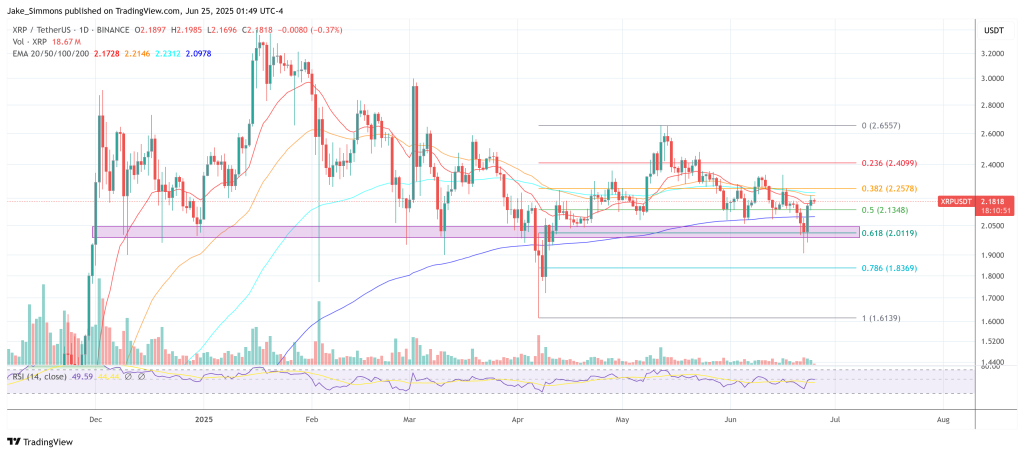
XRP price
Key resistance looms ahead, 1-day chart | Source: XRPUSDT on TradingView.com
Featured image created with DALL.E, chart from TradingView.com
Editorial Process for bitcoinist is centered on delivering thoroughly researched, accurate, and unbiased content. We uphold strict sourcing standards, and each page undergoes diligent review by our team of top technology experts and seasoned editors. This process ensures the integrity, relevance, and value of our content for our readers.

Jake Simmons has been a Bitcoin enthusiast since 2016. Ever since he heard about Bitcoin, he has been studying the topic every day and trying to share his knowledge with others. His goal is to contribute to Bitcoin's financial revolution, which will replace the fiat money system. Besides BTC and crypto, Jake studied Business Informatics at a university. After graduation in 2017, he has been working in the blockchain and crypto sector. You can follow Jake on Twitter at @realJakeSimmons.

Trending Cryptos

Related Reads

Not Betting on Goals but on 'Tears': Polymarket Users Argue Over Ronaldo's Final World Cup Match

Title: Beyond Goals, Betting on Tears: Polymarket Users Clash Over Ronaldo's Emotional World Cup Exit On July 6, Portugal's 0-1 loss to Spain in the World Cup round of 16 marked the final tournament for Cristiano Ronaldo. The 41-year-old star's emotional reaction—red eyes, wiping his face, fighting back tears—was captured globally. Concurrently, a fierce debate erupted on the crypto prediction platform Polymarket over a specific market: "Will Ronaldo cry during the 2026 FIFA World Cup?" The market, with over $23 million in volume, saw its "YES" probability surge to 99% after the match, but the result was disputed and entered a final review phase. The core conflict centered on the market's precise rules: it required "clearly visible tears streaming down [Ronaldo's] face" in photos/videos taken on the field or bench area during Portugal's matches. While major media outlets described Ronaldo as "in tears" and footage showed him emotional, "NO" bettors argued visible tear tracks were not conclusively evident, only red eyes and dampness. Polymarket's official clarification on July 8 stated that eligible evidence existed showing Ronaldo crying with visible tears on his face post-match. The dispute now goes to a UMA oracle community vote for resolution. This incident highlights a recurring challenge for prediction markets: they excel with quantifiable events but can spark major controversies over subjective, visual, or emotional interpretations. It also serves as a reminder for participants to scrutinize rule wording meticulously, not rely on general perception. Ultimately, such high-profile disputes drive significant trading volume and attention for the platform.

Foresight News36m ago

Not Betting on Goals but on 'Tears': Polymarket Users Argue Over Ronaldo's Final World Cup Match

Foresight News36m ago

DeepSeek Secretly Builds AI Chip, Specializing in Inference, Project Started a Year Ago with No Public Recruitments

DeepSeek, the Chinese AI company known for its algorithmic models, is secretly developing its own AI chip to reduce dependence on Nvidia, according to a Reuters report. The chip is designed specifically for AI inference, not training, and the project began approximately a year ago. Currently in early stages, DeepSeek is reportedly in discussions with chip design firms, foundries, and memory suppliers. The company, historically focused on algorithmic efficiency, has been discreetly hiring chip design engineers without public job postings. This move aligns with a global trend where major AI model companies like OpenAI and Anthropic are also pursuing custom chip development. DeepSeek founder Liang Wenfeng previously highlighted chip shortages as a challenge. While the company initially trained models on Nvidia H800s and later adapted to Huawei's Ascend chips, it now seeks greater control over its hardware foundation. Designing a competitive AI chip is a significant challenge, requiring years and substantial investment with no guarantee of success. However, DeepSeek's efforts are backed by a recent major funding round of approximately 51 billion RMB (about $7.4 billion) raised in June 2026. The funds are designated for expanding data centers based on domestic chips, developing proprietary AI chips, and recruiting top global talent. Infrastructure plans are also advancing, with job postings for data center design engineers, including projects in locations like Ulanqab, Inner Mongolia. The company remains characteristically low-key, with sources speaking anonymously and no official comment from DeepSeek itself. Nevertheless, this initiative marks a strategic expansion from software algorithms into the hardware layer that powers its AI systems.

marsbit43m ago

DeepSeek Secretly Builds AI Chip, Specializing in Inference, Project Started a Year Ago with No Public Recruitments

marsbit43m ago

Trading

Spot

Hot Articles

What is $BANK

Bank AI: A Revolutionary Step in the Future of Banking Introduction In an era marked by rapid advancements in technology, Bank AI stands at the intersection of artificial intelligence (AI) and banking services. This innovative project seeks to redefine the financial landscape, enhancing operational efficiency, security measures, and customer experiences through the power of AI. As we embark on this exploration of Bank AI, we will delve into what the project entails, its operational dynamics, its historical context, and significant milestones. What is Bank AI? At its core, Bank AI represents a transformative initiative aimed at integrating artificial intelligence into various banking operations. This project harnesses the capabilities of AI to automate processes, improve risk management protocols, and enhance customer interaction through personalised services. The primary objectives of Bank AI include: Automation of Banking Functions: By leveraging AI technologies, Bank AI aims to automate routine tasks, reducing the burden on human resources and enhancing efficiency. Enhanced Risk Management: The project utilises AI algorithms to predict and identify risks, thereby fortifying security measures against fraud and other threats. Personalisation of Banking Services: Bank AI focuses on offering tailored financial products and services by analysing customer data and behaviours. Improving Customer Experience: The implementation of AI-driven solutions, such as chatbots and virtual assistants, aims to provide users with more human-like interactions, revolutionising the way customers engage with banks. With these goals, Bank AI positions itself as a crucial player in rendering banking more efficient, secure, and user-centric. Who is the Creator of Bank AI? Details regarding the creator of Bank AI remain unknown. As such, no specific individual or organisation has been identified in the available information. The anonymity surrounding the project's inception raises questions but does not detract from its ambitious vision and objectives. Who are the Investors of Bank AI? Similar to the project's creator, specific information regarding the investors or supporting organisations of Bank AI has not been disclosed. Without this information, it is challenging to outline the financial backing and institutional support that might be propelling the project forward. Nevertheless, the importance of having a robust investment foundation is pivotal for sustaining development in such an innovative field. How Does Bank AI Work? Bank AI operates on several innovative fronts, focusing on unique factors that differentiate it from traditional banking frameworks. Below are key operational features: Automation: By applying machine learning algorithms, Bank AI automates various manual processes within banks. This results in reduced operational costs and allows human workers to redirect their efforts towards more strategic activities. Advanced Risk Management: The integration of AI into risk management practices equips banks with tools to accurately predict potential threats such as fraud, ensuring that customer information and assets remain secure. Tailored Financial Recommendations: Through continuous learning from customer interactions, the AI systems develop a nuanced understanding of user needs, enabling them to offer tailored advice on financial decisions. Enhanced Customer Interactions: Utilizing chatbots and virtual assistants powered by AI, Bank AI enables a more engaging customer experience, allowing users to have their queries resolved quickly, thus reducing wait times and improving satisfaction levels. Together, these operational features position Bank AI as a pioneer in the banking sector, establishing new benchmarks for service delivery and operational excellence. Timeline of Bank AI Understanding the trajectory of Bank AI requires a look at its historical context. Below is a timeline highlighting important milestones and developments: Early 2010s: The conceptualisation of AI integration into banking services began to gain attention as banking institutions recognised the potential benefits. 2018: A marked increase in the implementation of AI technologies occurred when banks started using AI tools like chatbots for basic customer service and risk management systems for improved security handling. 2023: The sophistication of AI continued to advance, with generative AI being introduced for more complex tasks such as document processing and real-time investment analysis. This year marked a significant leap in the capabilities afforded to banks by AI technology. 2024-Current Status: As of this year, Bank AI is on an upward trajectory, with ongoing research and developments poised to further enhance capabilities in banking operations. Continued exploration of AI applications hints at exciting developments yet to come. Key Points About Bank AI Integration of AI in Banking: Bank AI focuses on adopting artificial intelligence to streamline banking processes and improve user experiences. Automation and Risk Management Focus: The project strongly emphasises these areas, aiming to shift the burden of routine tasks while enhancing security frameworks through predictive analytics. Personalised Banking Solutions: By harnessing customer data, Bank AI enables tailored banking services that cater to individual user needs. Commitment to Development: Bank AI remains committed to ongoing research and development efforts, ensuring its adaptability and ongoing relevance as technology continues to evolve. Conclusion In summary, Bank AI exemplifies a crucial step forward in the banking industry, leveraging artificial intelligence to reshape operational paradigms, enhance security, and promote customer satisfaction. Despite gaps in information surrounding the creator and investors, the clear objectives and functional mechanisms of Bank AI provide a strong foundation for its ongoing evolution. As AI technology continues to advance and merge with the banking sector, Bank AI is well-positioned to significantly impact the future of financial services, enhancing the way we understand and interact with banking.

187 Total ViewsPublished 2024.04.06Updated 2024.12.03

What is $BANK

Discussions

Welcome to the HTX Community. Here, you can stay informed about the latest platform developments and gain access to professional market insights. Users' opinions on the price of BANK (BANK) are presented below.

活动图片