牛市诱空还是崩盘前奏 BTC日线守住10万 XRP酝酿反弹 CORE楔形蓄势 ZEC仍在探底

金色财经Published on 2025-06-23Last updated on 2025-06-23

最近的宏观局势,看似战火纷飞,实则更像是在“空袭”我们的账户。**昨晚,比特币出现大幅下挫,不仅跌破了一个半月构筑的震荡区间,还短暂失守关键心理关口——10万美元,市场一度陷入“牛市终结”的恐慌情绪。

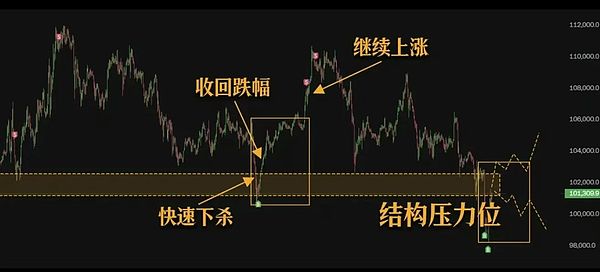
不过,从时间结构、价格空间、成交量、下跌速度以及K线形态等多个维度综合分析,目前尚无法确认此次下破是否为有效破位,或仅是主力诱空的“假摔”。
0?wx_fmt=jpeg&from=appmsg

值得注意的是,虽然盘中曾跌破10万关口,但日线收盘价格重新回到关键支撑上方,后续能否稳定在10万上方,将成为判断趋势转折或延续的关键信号。

主力手法升级,技术不精=被反复收割

这一轮牛市,比以往更加复杂,主力操盘手法更具迷惑性。**技术不扎实的投资者,极容易在“假跌破”中被扫出场,然后错失真正的反弹。**尤其是将止损设置在震荡边缘区域的交易者,更容易被“假突破”戏耍。

我们6月初便多次提醒:当前阶段最重要的不是追高,而是严格做好风控,保持仓位灵活,切勿情绪化操作。

 山寨币观察:谁在泥沙俱下中酝酿机会?

XRP:等待关键阻力突破

XRP近期走势与比特币、以太坊类似。在跌破关键支撑2.120美元后,进一步跌破2.050和2.020美元,目前最低探至1.910美元后出现小幅企稳。

0?wx_fmt=jpeg&from=appmsg

目前,XRP价格运行在2.020下方,并受制于100小时简单移动平均线。技术面上,一条短期下行趋势线构成压制。若突破2.020美元,下一阻力在2.050美元(对应本轮下跌的50%斐波那契回撤位),上方目标依次为2.080、2.120、2.150,强势情况下或将测试2.200-2.250区域。

短期来看,XRP处于方向选择的临界点,能否收复关键压制位将决定下一步走势空间。

 CORE:下降楔形形态酝酿反转?

CORE 近期在4小时图中呈现典型的下降楔形形态,目前价格已触及下边缘支撑,并出现初步反弹。该形态常被视为潜在的反转信号。

0?wx_fmt=jpeg&from=appmsg

然而,在真正突破楔形上轨并放量之前,仍不建议贸然入场。**只有有效放量突破楔形上沿,并获得市场资金认同,才能构成合理的做多信号。**建议将 CORE 纳入关注列表,静待机会。

ZEC:尚未止跌,耐心等待更佳入场点

ZEC 从此前构筑的对称三角形形态中下破,并跌穿关键支撑位,空头力量占据上风。当前正在快速向下寻求支撑,尚未出现明确的企稳信号。

0?wx_fmt=jpeg&from=appmsg

操作上应保持克制,等待价格触及更明确的支撑区域后,再观察是否形成反弹信号。如果形成止跌形态,可考虑跟进多单;若继续下探,则耐心观望为宜。

尾声总结:当前市场波动剧烈,主流币种集体承压,山寨币跟随下跌。比特币的“假跌破”仍有待后市验证,短线操作需严格控制风险。

XRP、CORE 和 ZEC 等币种均处于关键技术形态中,不妨保持耐心,等趋势明朗后再出手。记住:复杂行情中,控制节奏比激进交易更重要!

Trending Cryptos

Related Reads

19 New Decacorns in Half a Year: Why is the Primary Market Chasing 'Certainty'?

In the first half of 2026, China’s primary market saw a notable increase in unicorns, adding 19 new companies each valued over 100 billion RMB, particularly in sectors like embodied AI and large language models (LLMs). Firms such as Galaxy General, Zibian, and ZhiPingFang even surpassed 200 billion RMB valuations within months. Moonshot AI's valuation surged from around $10 billion to $35 billion by July 2026, with a pre-IPO target of $50 billion. This concentration of capital into a few "certain" sectors highlights a market shift. The driving force is not a general abundance of capital but a chase for "certainty"—primarily clearer exit pathways like imminent IPOs. Companies with defined public listing timelines attract intense investment despite higher valuations, as they reduce exit uncertainty for investors. Secondary market valuations of listed peers also serve as new anchors, boosting the perceived value of private companies in similar fields, though this creates dependency on public market sentiment. Another form of certainty comes from the expectation of rising valuations in subsequent funding rounds. The investment logic has shifted in some cases from assessing long-term fundamental value to betting on the next round attracting higher prices. This dynamic is also seen in deep-tech areas like nuclear fusion, where firms like NeoFusion secured a 10.6 billion RMB valuation despite early commercial stages, driven by scarcity and strategic bets. However, this trend signals a risk transfer: technical uncertainties remain but are temporarily masked by valuation inflation. As valuations climb—50 billion to 200 billion or 500 billion RMB—companies face increasing pressure to demonstrate real revenue, profit, and sustainable business models. The danger lies not in the rise of unicorns itself, but if valuations become detached from value creation and rely merely on the expectation of future funding or exits. Ultimately, the surge reflects investors seeking perceived safety in shorter-term exit certainty and transactional momentum, rather than a renewed appetite for risk. The true test will come when the market inevitably refocuses on fundamentals, questioning how many of today’s high valuations are backed by genuine economic value.

marsbit3m ago

19 New Decacorns in Half a Year: Why is the Primary Market Chasing 'Certainty'?

marsbit3m ago

Just Now, Sam Altman Blasts Dario Amodei as 'Anti-Human', Secret Model Exposed the Same Day

Just now, Sam Altman strongly criticized Dario (Amodei, co-founder of Anthropic), denouncing his "doomsday marketing" as "anti-human dictator rhetoric." This came alongside the accidental exposure of OpenAI's next-generation model, codenamed "gpt-nathree," hinting at the imminent release of GPT-6 Astra. The leak occurred when an OpenAI employee's public GitHub commit mentioned the codename. Combined with previous leaks of "gpt-mewfour," it suggests these are iterative checkpoints for OpenAI's upcoming agent model, Astra. Astra is known for multi-agent collaboration and long-duration task handling, having reportedly solved previously unsolved mathematical problems. Meanwhile, two new Anthropic model codenames, "claude-marshmallow-eap" and "claude-melon-eap," were also exposed but are believed to be iterations of the Claude 5 series, not a new flagship. In a wide-ranging podcast interview, Altman admitted he was wrong about the speed of AI-driven disruption, acknowledging societal inertia slows adoption. He fiercely criticized rivals' marketing that simultaneously promises immense benefits (like curing cancer) and warns of existential risk, calling it a dangerous "benevolent dictator" narrative that seeks to concentrate power. He emphasized that people are the ultimate purpose of AI. Altman also revealed OpenAI's unconventional, consensus-defying path: spending four and a half years in the "dark" without a public product before ChatGPT's breakthrough, driven by scaling laws rather than early customer feedback. He concluded that even with superintelligent AI, genuine human connection will remain irreplaceably valuable.

marsbit43m ago

Just Now, Sam Altman Blasts Dario Amodei as 'Anti-Human', Secret Model Exposed the Same Day

marsbit43m ago

The 'Saving U.S. Treasuries' Baton Pass: Bessent Fumbled Last Week, This Week It's Wash's Turn

"Rescuing US Treasuries" Relay: After Bessent's Miss, All Eyes Are on Walsh Last week, US Treasury Secretary Bessent's announcement to at least double long-term Treasury buybacks failed to sustainably lower yields, which quickly rebounded. The market response saw a drop in the dollar alongside surges in gold and Bitcoin, interpreted as a "pressure release valve" for anxiety. The focus now shifts to Fed Chairman Walsh's upcoming Jackson Hole speech. Markets are highly sensitive to his message, seeking clarity on the Fed's policy response to stubborn inflation and worsening fiscal conditions. Analysts warn that a lack of new guidance could disappoint markets and worsen the sell-off in long-dated bonds. Analysts question the scale of Bessent's operations, noting they are too small relative to the overall debt market and do not constitute quantitative easing. A key issue is the Fed's massive holdings of long-term bonds, which distorts the market. With the Fed holding low-yielding short-term bonds that are losing money relative to its policy rate, discussion is growing around a potential Fed-led "Operation Twist." This would involve selling short-term bonds to buy long-term ones, aiming to lower long-end yields without expanding the balance sheet. The upcoming PCE inflation data will set the stage for Walsh's speech. However, the window for action is narrowing amid political pressures. A critical threshold is the 30-year yield at 5%; holding above it could increase stress on the dollar and leveraged sectors. Overall, the article suggests that without coordinated Fed action to anchor inflation expectations, Treasury interventions may ultimately fail, with investors increasingly looking to assets like gold as hedges.

marsbit1h ago

The 'Saving U.S. Treasuries' Baton Pass: Bessent Fumbled Last Week, This Week It's Wash's Turn

marsbit1h ago

Hyperliquid's Compliance Journey: From Permissionless to Permissioned via HIP-3

Hyperliquid’s Compliance Path: From Permissionless to Permissioned HIP-3 Hyperliquid currently blocks U.S. access because its permissionless, on-chain infrastructure conflicts with U.S. market structure laws, which restrict futures trading to registered exchanges, clearinghouses, and brokers. Through its Hyperliquid Policy Center (HPC), the project is advocating for regulatory modernization, proposing that regulated entities be allowed to build products on HyperCore (its exchange and clearing layer) while fulfilling their compliance obligations. The platform’s modular stack separates roles like a traditional exchange (DCM), clearinghouse (DCO), and broker (FCM), but reconstructs them on-chain with code. This enables permissionless access, self-custody, and 24/7 global trading, but clashes with U.S. rules requiring KYC, specific margin models, and custodial arrangements. To resolve this, HPC is engaging with U.S. regulators (CFTC, SEC) to seek clarity that deploying on-chain software does not itself trigger licensing, and to establish exemptions allowing non-custodial wallets to route users to regulated derivatives. Recent political signals suggest openness to this approach. On the technical side, Hyperliquid Labs has introduced permissioned HIP-3 deployers on testnet. These allow regulated entities to launch markets, perform KYC, and whitelist compliant users. While these create separate order books, whitelisted market makers can bridge liquidity between them, ensuring deep, shared liquidity across the same L1. Features like payload-based “PA” permissions enable DEX-level account controls (e.g., reduce-only orders), mirroring traditional broker authorities. The strategy is not to open the native, permissionless front-end to U.S. users, but to position Hyperliquid as neutral infrastructure that U.S. regulated firms can use while meeting their legal duties. This paves a compliant path for U.S. investor access while preserving the protocol’s core, permissionless nature.

marsbit1h ago

Hyperliquid's Compliance Journey: From Permissionless to Permissioned via HIP-3

marsbit1h ago

Trading

Spot

Hot Articles

How to Buy ZEC

Welcome to HTX.com! We've made purchasing Zcash (ZEC) simple and convenient. Follow our step-by-step guide to embark on your crypto journey.Step 1: Create Your HTX AccountUse your email or phone number to sign up for a free account on HTX. Experience a hassle-free registration journey and unlock all features.Get My AccountStep 2: Go to Buy Crypto and Choose Your Payment MethodCredit/Debit Card: Use your Visa or Mastercard to buy Zcash (ZEC) instantly.Balance: Use funds from your HTX account balance to trade seamlessly.Third Parties: We've added popular payment methods such as Google Pay and Apple Pay to enhance convenience.P2P: Trade directly with other users on HTX.Over-the-Counter (OTC): We offer tailor-made services and competitive exchange rates for traders.Step 3: Store Your Zcash (ZEC)After purchasing your Zcash (ZEC), store it in your HTX account. Alternatively, you can send it elsewhere via blockchain transfer or use it to trade other cryptocurrencies.Step 4: Trade Zcash (ZEC)Easily trade Zcash (ZEC) on HTX's spot market. Simply access your account, select your trading pair, execute your trades, and monitor in real-time. We offer a user-friendly experience for both beginners and seasoned traders.

4.3k Total ViewsPublished 2024.03.29Updated 2026.06.02

How to Buy ZEC

Discussions

Welcome to the HTX Community. Here, you can stay informed about the latest platform developments and gain access to professional market insights. Users' opinions on the price of ZEC (ZEC) are presented below.

活动图片